
Two Artists: One Forgotten Battle
Originally published May-June 2026 · pp. 28–34
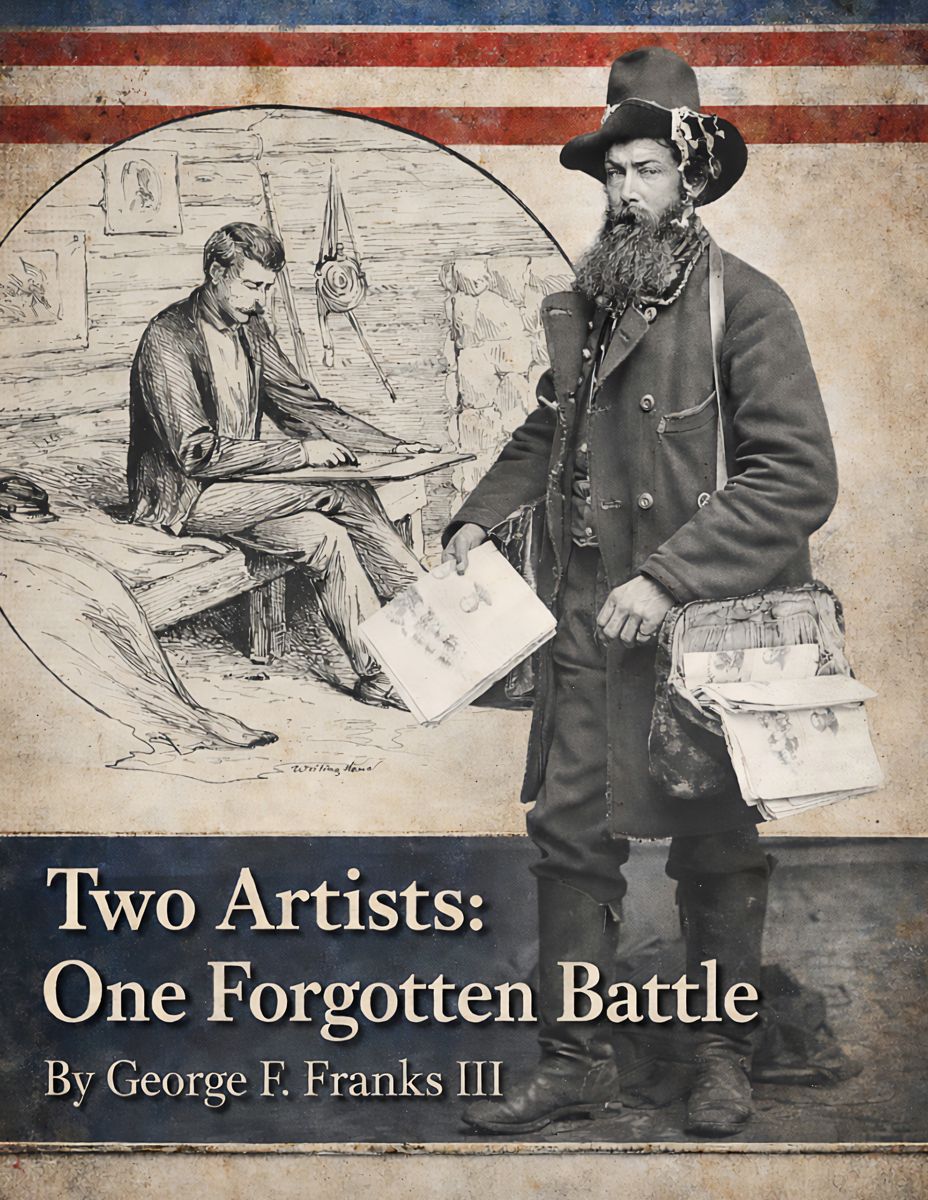
Introduction and the Battle
General Robert E. Lee, commander of the Army of Northern Virginia, ordered his commanders to move from their earthworks and to cross the Potomac River from Maryland to (West) Virginia the night of July 13, 1863. Lieut. Gen. Richard Ewell’s corps was ordered to ford the river at Williamsport in Maryland. Lieutenant Generals James Longstreet and Ambrose P. Hill were ordered to cross over the newly rebuilt pontoon bridge at the Falling Waters crossing, approximately five miles downstream. Lieut. Gen. J.E.B. Stuart was ordered to remain in the earthworks with his cavalry troopers until all artillery and infantry had crossed the river, but to use his discretion. After marching from earthworks to a rise and an open field straddling the road to the Falling Waters crossing, Maj. Gen. Henry Heth followed his orders to position his rear guard to protect Hill’s movement across the river until relieved by Stuart, at which time his division could cross. The rear guard position was approximately two miles from the pontoon bridge and provided excellent fields of fire and visibility of the road. On the rise, six artillery positions had been constructed, but all the guns were already across the river—a priority for Lee. Meanwhile, Gen. George G. Meade, the new commander of the Army of the Potomac and victor at Gettysburg, received word from scouts that Lee’s army was out of the earthworks and crossing the Potomac River. Meade ordered Brig. Gen. Judson Kilpatrick, who was near Hagerstown, to immediately have his cavalry division mount up and gallop toward Williamsport. Word was also sent to cavalry commander Brig. Gen. John Buford, at the crossroads of Downsville, to have his mounted division prepare to block Lee’s movement across the Potomac. After finding that Ewell’s corps had successfully forded the Potomac River at Williamsport, a local civilian informed 321.)
Kilpatrick that the bulk of Lee’s army was in the process of crossing at Falling Waters. Orders were issued, and newly promoted Brig. Gen. George Armstrong Custer and his Michigan “Wolverines” mounted up and galloped toward Falling Waters crossing. Arriving less than one-half mile from the rear guard position, Custer halted his Michigan troopers and awaited Kilpatrick’s arrival. In the meantime, he ordered his troopers to dismount and to prepare to advance toward the rebels who were visible on a rise to their front. It was not clear to Custer whether they were infantry or cavalry. Their numbers were unknown. Advancing dismounted as skirmishers seemed the prudent tactic. Once Kilpatrick arrived at Custer’s staging area, he countermanded Custer’s orders. Kilpatrick wanted an immediate attack on the rebels to their front. He ordered Companies B and F of Custer’s Sixth Michigan Cavalry to attack the troops behind entrenchments on the ridge. Maj. Peter Weber was to command the nearly 100 mounted troopers. Companies B and F trotted in formation down the road toward Falling Waters crossing (the pontoon bridge) and across a field in the direction of the ridge occupied by men in gray and butternut. Once they reached a bend in the road, he ordered his troopers to go from column to line of battle, draw sabers, and charge at the gallop. The bugler blew the signal for “charge,” and the guidon was held high. On the ridge, Heth and Brig. Gen. James Johnston Pettigrew and their staffs chatted at the northeast (rear) corner of the 1823 Daniel Donnelly House, which had served as a Confederate field hospital since Lee’s army arrived back in Maryland. Hearing horsemen on the road, the officers raised their field glasses. They had been anticipating the arrival of Stuart’s cavalry and orders to withdraw to the pontoon bridge and cross the river. They saw a formation of less than 100 mounted men carrying a Union cavalry guidon. No doubt it was a trophy from a recent skirmish, they surmised. Companies B and F galloped up the wet and muddy ridge and into the center of Heth’s rear guard position. Lee’s veterans from Brig. Gen. Archer’s battered brigade of Alabama and Tennessee infantry repelled the Wolverines with any weapon at hand. These included axes, stones, fence rails, musket butts, and bayonets because many of Heth’s soldiers were carrying paper cartridges wet from the previous night’s march in the heavy rain. The Wolverines suffered heavy casualties among both mounts and troopers. Those who pierced the Confederate rear guard line rode through rank after rank of surprised men in wet butternut and gray. They galloped to their right toward the position of Pettigrew’s North Carolina “Tar Heel” regiments, then back down the ridge and toward the point where they had staged for the attack. Some were mounted, but many were on foot. And horses returned without their riders. Newspaper artists Alfred Waud and Edwin Forbes attached themselves to Meade’s Army of the Potomac before, during, and after the Battle of Gettysburg. They sketched the men, the horses, the structures, the landscape (including earthworks), and the fighting throughout June and July 1863, not just July 1-3 at Gettysburg, Penn.
Artist Alfred Waud Pronounced “Wode,” Alfred Waud was born in London, England, on Oct. 2, 1863. He studied at the School of Design, Somerset House, London. Waud relocated to New York in 1850. As there was no work for him in New York, he moved to Boston, where he learned to draw on wood blocks for engravers. This was the most common method for mass circulation reproductions. In Boston, illustrations were
Alfred R. Waud, artist of Harper’s Weekly, sketching on the Gettysburg battlefield, at Devils Den. (Library of Congress)
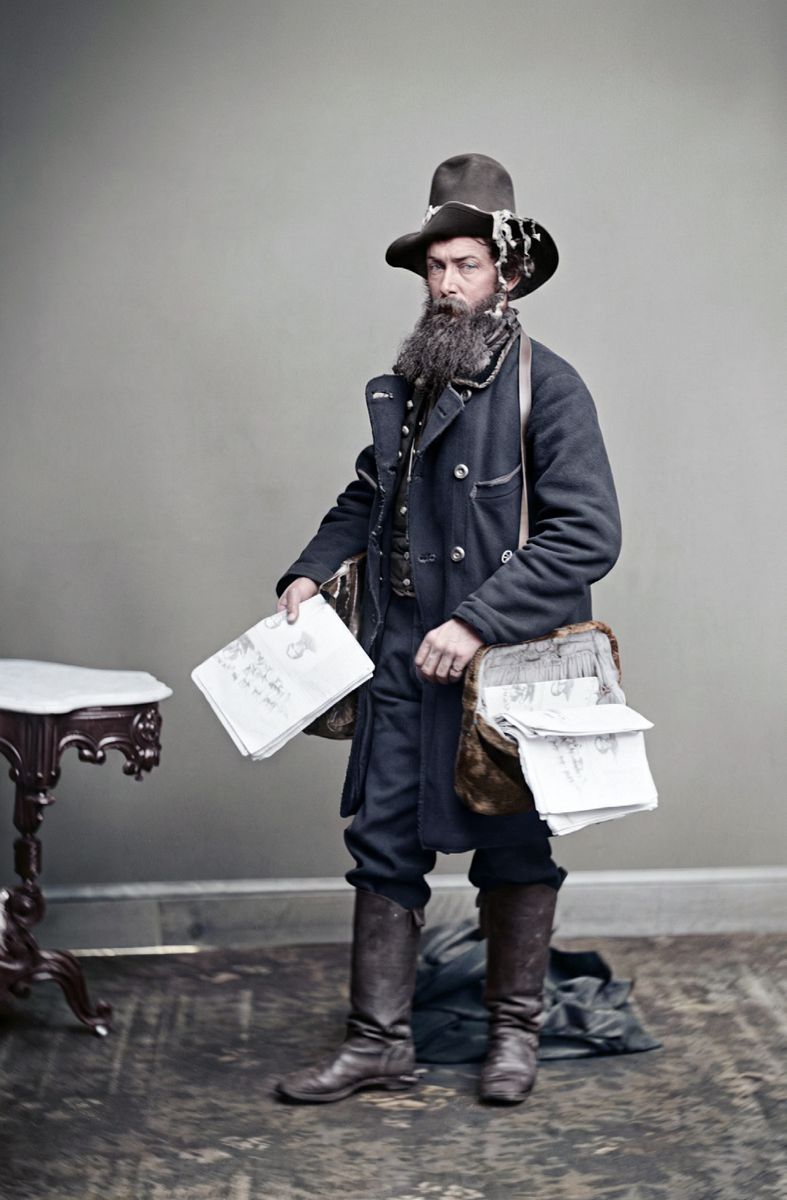
Alfred Waud with his sketches. (Library of Congress)
produced for a number of publications. From 1853 through 1855, Waud was back in New York. During this time, he illustrated books and worked on seascapes. Waud accepted a position as an illustrator at the New York Illustrated News. By 1861, the three leading illustrated news weeklies were: Harper’s Weekly, Frank Leslie’s Illustrated Newspaper, and the New York Illustrated News. Each had “Special Artists” and “Special Correspondents” to cover the war. Waud eventually left The News for the staff of Harper’s Weekly. He worked there until 1870. After Gettysburg, Waud followed Meade’s pursuit of Lee’s army to the Potomac River. Based on his onsite sketches, he produced a double-page entitled “The Maryland Campaign.” It was engraved and appeared in Harper’s Weekly, August 15, 1863, issue. The montage included: views of Williamsport, the site of Lee’s crossing, rebel prisoners, and “a charge of Custer’s 6th Michigan Cavalry near Falling Waters.” Waud produced art for publications until near his death in Georgia on April 6, 1891. At that time, he was on a tour sketching Southern battlefields. Waud was buried in Georgia, even though his home was in South Orange, New Jersey.
Artist Edwin Forbes Waud’s counterpart on Frank Leslie’s Illustrated Newspaper staff was artist Edwin Forbes, who was considered a better figure and animal artist than Waud with a finished drawing, although Forbes’ quick sketches of battle action were never equaled. Artist Edwin Austin Forbes was born in New York in 1839. He studied art under Arthur Fitzwilliam Tait. Forbes began his professional career as a painter of landscapes and animals. During the American Civil War, he was a “special artist” with Frank Leslie’s Illustrated Newspaper. Forbes’ drawings of battles and the daily life of common soldiers were popular during the war and remained so long after the Civil War as well. His sketches were made into etchings for publication. Following the conflict, Forbes painted cattle scenes and landscapes. He was made an honorary member of the London Etching Club in 1877. Forbes died in Brooklyn, New York, in 1895. He is buried in GreenWood Cemetery.
The Sketches: Waud On or after July 14, 1863, artist Alfred Waud sketched the initial charge of Companies B and F of the 6th Michigan Cavalry. While we know that Waud was often close to the action, he was not in actual combat. As such, he must have visited the site of the battle soon after the engagement. He must also have spoken with the participants in the fight. His sketch captures several key details of the battle. Maj. Peter A. Weber was ordered by Brig. Gen. Judson Kilpatrick to attack the Confederates on a ridge to the right of the road to the Falling Waters crossing. The sketch shows the backs of Michigan Wolverine horsemen riding up the ridge and into the Confederate rear-guard defensive position. Three of the mounts are down in the sketch. Two troopers are dismounted, one is on the ground, dead or wounded, and another reels back from being shot or stabbed. The troopers have their sabers drawn. They are wearing Federal mounted services jackets, not four-button blouses (and, despite earlier rain, not foul-weather ponchos). To the left, a trooper holds a Federal National Colors guideon. Faintly, we see the Donnelly House structure or the Donnelly House barn to the far left in the background. The Confederates, who we know to be Alabamians and Tennesseans from Archer’s Brigade, fight from behind earthworks, actually artillery lunettes. The steepness of the ridge is also evident from the sketch. Waud submitted the sketch to his newspaper for reproduction as a lithograph. This process often required many weeks and was broken into grids, which were produced individually and then combined to create a cohesive picture. This scene was published as part of a larger work in August 1863. The drawing was entitled “Charge of the 6th Michigan cavalry over the rebel earthwork nr. Falling Waters.” It was sketched on tan paper in pencil and “Chinese white” and is 14.2 by 29.7 centimeters. At present, the drawing is in the Library of Congress Prints and Photographs Division, Washington, D.C.
Charge of the 6th Michigan cavalry over the rebel earthworks nr. Falling Waters by Alfred Waud. (Library of Congress)
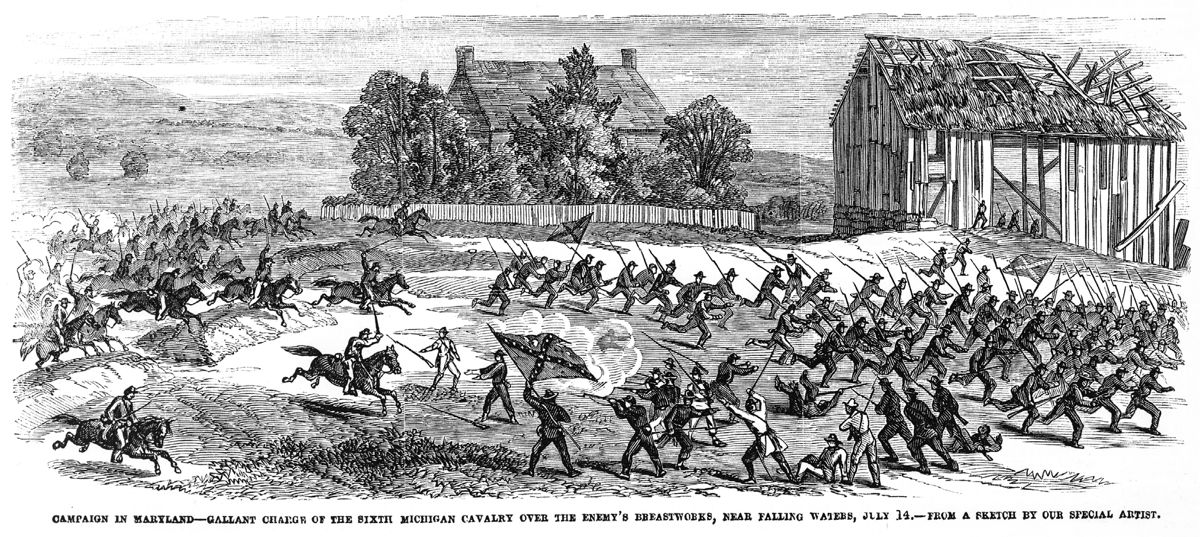
The Sketches: Edwin Forbes Similar to his fellow journalist-artist in the field, Alfred Waud, Edwin Forbes attached himself to the Army of the Potomac troops during the Gettysburg Campaign, including the July 4-14 retreat phase. By July 14, Forbes followed Meade’s cavalry. The morning of that day, the troopers were the first to respond to Lee’s crossing of the Potomac River into Virginia. In his drawing of the Battle of Falling Waters, Forbes chose a different perspective from Waud, but also of the initial charge by Custer’s 6th Michigan Cavalry. From above eye level, as if observed from a balloon, Forbes sketched the horsemen under the command of Maj. Peter F. Weber as Companies B and F breached the center of Heth’s rear guard line atop the crest of the ridge behind the Donnelly House. From left to right, Forbes’ drawing illustrates the Michigan “Wolverines” galloping into and over the artillery earthworks or lunettes and toward the remnants of Archer’s Brigade. Unlike Waud, he only shows one Federal mount as it goes down. Some of Archer’s men in the rear guard are standing and fighting. Most appear to be in the process
Cavalry in pursuit of infantry across farm with damaged barn in background. (Edwin Forbes, artist. Library of Congress)
of withdrawing. In the background, detailed depictions of both the Donnelly House (still standing) and the Donnelly barn (gone since soon after the conflict) can be seen. It appears some of the rebels are running toward the barn. The withdrawing Confederates are moving to the west in the direction of the river crossing (which was actually two miles away). The barn appears to be in disrepair—more likely from years of neglect rather than being stripped for firewood or to help replace the pontoon bridge (the first one had been destroyed by a Federal patrol on July 4). As with Waud, Forbes sent the sketch to his newspaper for conversion into an engraving to be published. The published version appeared in August 1863. The sketch is entitled “Gallant charge by two companies of the 6th Michigan on Tuesday morning on the rebel rearguard, near Falling Waters, where part of the rebel army crossed the Potomac.” Forbes’ caption notes: “This charge was really a very brilliant and dashing affair. The cavalry numbering not more than fifty or sixty men, charged up a steep hill in the face of a terrific fire, went over the breast works and captured nearly the intire [sic] force of the enemy with two or three regimental battle flags. Our boys were at least two thirds of the men engaged killed and wounded, quite a number of the dead were lying inside the works. This charge deserves an illustration, as it is without execption [sic] the most brilliant charge that has been made.” There is no published record of the medium other than “pencil” or size of the work. The sketch is in the collection of the Library of Congress Prints and Photographs Division, Washington, D.C.
Post Script Both Waud’s and Forbes’ drawings of the July 14, 1863, Battle of Falling Waters in Maryland were converted into lithographs and published in the respective newspapers in August 1863, along with related articles about the retreat and pursuit from Gettysburg. They made no mention of President Abraham Lincoln’s disappointment that his hero of Gettysburg, Gen. George G. Meade, had allowed Lee and his Army of Northern Virginia to escape back into Virginia. The war would continue until April 1865. After the battle, the land reverted to farming as was the case with the surrounding area of Washington County, Maryland, after the 1862 Campaign (Antietam) as well. In 2002, Melissa Cooperson and the author were looking for a historical house and surrounding property and came across the Daniel Donnelly House and the surrounding 16 acres. From 2003 through 2011, we restored the house and tamed the property, moving to the site in September 2011. The Battle of Falling Waters 1863 Foundation, Inc. was established in 2014. The organization saved the adjoining 3 ½ acres of battlefield land with support from the American Battlefield Trust and the American Battlefield Protection Program. More information on the battlefield preservation organization for Falling Waters 1863 in Maryland can be viewed at: http://battleoffallingwaters1863foundation.wordpress.com.
Bibliography Forbes, Edwin, Thirty Years After, An Artist’s Memoir of the Civil War, 1993, Louisiana State University Press Franks, George F., III, Battle of Falling Waters 1863, Custer, Pettigrew and the End of the Gettysburg Campaign, 2013, SelfPublished Katz, Harry L. and Viga, Vincent, Civil War Sketchbook, Drawings from the Battlefront, 2012, W. W. Norton & Company, Inc. Ray, Frederick E., Our Special Artist, Alfred Waud’s Civil War, 1994, Stackpole Books Library of Congress Prints and Photographs Division, Washington, D.C. 20540
George F. Franks III is a former technology executive with extensive international experience. He is the founder
President of the Battle of Falling Waters 1863 Foundation Inc., and President of Hagerstown Civil War Round Table. George served as an officer and governor of the Company of Military Historians and as President of the organization’s Chesapeake Chapter. George is the author of Battle of Falling Waters 1863: Custer, Pettigrew and the End of the Gettysburg Campaign and lives in the 1823 Daniel Donnelly House on the battlefield. He studied history at the U.S. Naval Academy and the University of Pittsburgh. and
Since 1978, we have collected or handled over 80 of the “Big Six” Confederate Notes to include nearly 10% of all known surviving Montgomery Notes.