
This & That The Accomplishment of This One Object
By Gould Hagler · Originally published May-June 2026 · pp. 44–47
& I
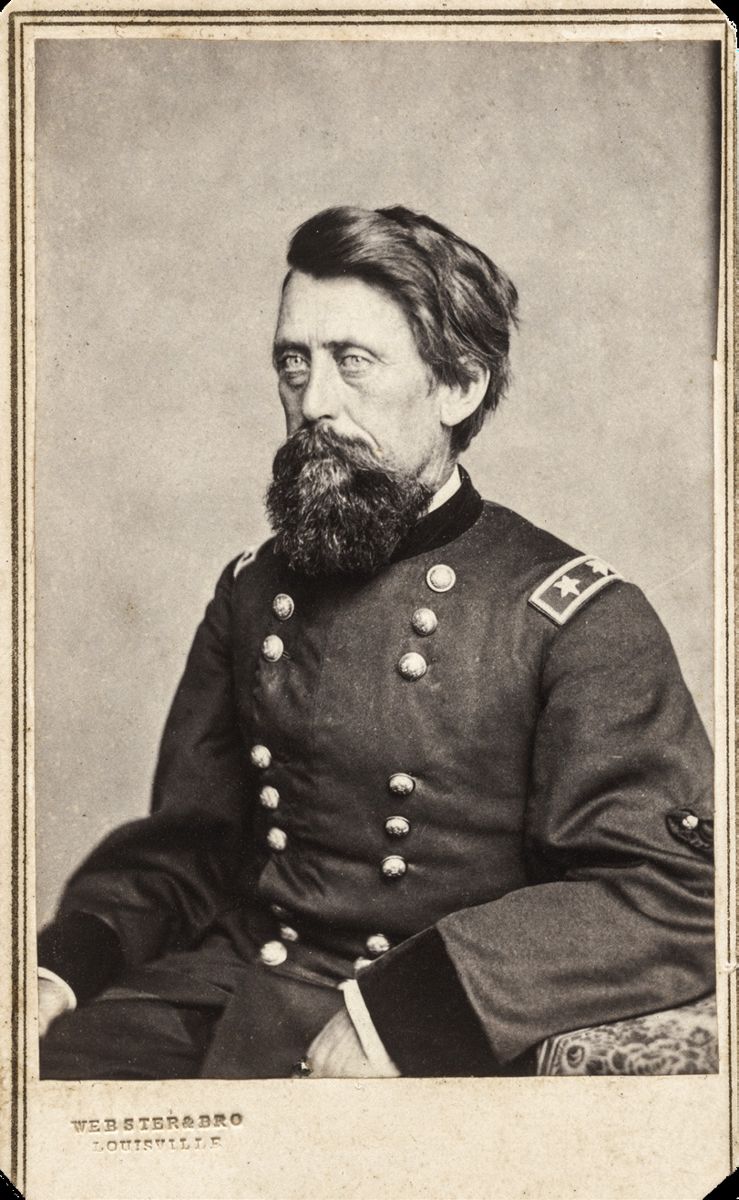
A Closer Look at the Cast – Part 2 This & That n the last issue, I wrote about Robert Anderson, the commander at Fort Sumter, and Samuel Cooper, the U.S. Army’s adjutant general when the crisis at Sumter began and the adjutant general of the Confederate Army when the crisis ended. This month, I will discuss the career of another officer who played a role in the first scene of the first act of the drama—the other Jefferson Davis. Lieutenant Jefferson Columbus Davis was one of seven officers serving under Maj. Robert Anderson at Fort Sumter. Like many other junior officers in the small, pre-war army, Davis rapidly rose to high rank during the Civil War. By war’s end, he commanded a corps and held the rank of brevet major general.
Maj. Gen. Jefferson “Jef” Columbus Davis. (National Portrait Gallery, Smithsonian Institution)
Davis is not among the best-known Federal commanders, but his name is certainly familiar to most students of the war. He is best known for two stains on his reputation. In 1862, he shot and killed another Union general in a Louisville hotel. In 1864, he further marred his record during Sherman’s Savannah Campaign when he caused the death and capture of many of the escaped slaves who were following his corps. I will first summarize these two episodes, then review other aspects of Davis’s interesting career. First, the homicide. Davis, then a brigadier general of volunteers, was on sick leave in September 1862 when the Confederates marched through Tennessee into Kentucky. Davis rushed
Maj. Gen. William “Bull” Nelson. (Library of Congress)
to Louisville and offered his services to Maj. Gen. William some danger to the marching Federals. The fleeing slaves “Bull” Nelson, the Federal commander in the state and encumbered the Federal forces and put some strain on their a man known to be an arrogant, abusive martinet with a limited supplies. volatile temper. Nelson gave Davis the job of organizing The 14th Corps came to Ebenezer Creek in early local volunteers to resist the oncoming invaders. On the December. The narrow road ran along a causeway built 22nd, Nelson asked Davis for a progress report. Davis, very across the swampy terrain. Hostile cavalry hung on the oddly, answered “I don’t know” to three direct questions Federals’ rear. Confederate gunboats from the nearby posed by Nelson. Expressing his disappointment, the Savannah River directed sporadic fire toward the Federals. irritated major general said he had obviously been mistaken The column halted. Work began on the pontoon bridge on in thinking that Davis was up to the job. Davis took offense. the evening of December 7 and was finished by noon on the Tempers flared. Nelson dismissed Davis and ordered him 8th. The refugees were held back while troops marched and to leave the city. Threatened with arrest, Davis departed. More Federal troops arrived in Kentucky under Maj. Gen. Don Carlos Buell, who superseded Nelson in command. The emergency ended, and Davis returned to Louisville to take command of his division, which by then had arrived in Kentucky. Davis encountered Nelson at the Galt House on Sept. 29. Their argument resumed and grew even more heated than before. Davis demanded satisfaction. Nelson said with contempt, “go away, you damned puppy.” Davis tossed a crumpled paper into Nelson’s face. Nelson slapped Davis. Davis stormed off, saying, “I will see you again.”1 Davis obtained a pistol from a friend. He sought out Nelson and, after more angry words, shot him in the chest. Nelson was taken to a nearby room. Knowing the wound was mortal, he asked for a minister. He was baptized and within the hour was dead. A court-martial would seem imperative, but Buell determined that no senior officers were available to form a court, as all were needed in battle. Davis was indicted in a local court, but nothing came of it. He was released from house arrest on October 13 and restored to duty on the 21st. Two years later, Davis commanded the 14th Corps as Sherman led his force from Atlanta to Savannah. Along the way, many slaves began to follow the Federal forces, making their destructive way across Georgia’s Piedmont Region and Coastal Plain. As the four Federal corps neared the coast, Davis’s was positioned on the left Ebenezer Creek at flood stage, as the creek would have appeared in flank. Confederate opposition was December 1864. (Photos courtesy of Georgia Civil War Heritage Trails, Inc.) not significant, but cavalry did pose wagons rolled along the causeway and bridge. By daylight on the 9th, they were across. Immediately after, as ordered by Davis, the pontoons were taken up and moved forward toward the next stream. Seeing what was happening, the stranded unfortunates panicked. Some crossed the creek on makeshift rafts. Some swam across; some drowned trying. Some were captured by Confederate cavalry. A military necessity, said Davis. An act of barbarity, said others. Soldiers told the story in letters to newspapers and members of Congress. In January, with the Savannah Campaign complete and plans underway for the march through the Carolinas, Secretary of War Edwin Stanton sailed to Savannah to confer with Sherman. The general who had presented Savannah to Lincoln as a Christmas present backed Davis. Stanton let the matter drop. Jefferson C. Davis had dodged another bullet. After killing Bull Nelson and after precipitating a national outrage at Ebenezer Creek, Davis continued to hold important commands in the Civil War and for the rest of his life. There is far more to Davis’s military career than these two scandals. Like many other Civil War generals, he fought in the earlier conflict with Mexico. He was different from
The Cargo of the Slave Ship Echo In reading up on Jef Davis, I learned something of interest about his service in Charleston before the crisis at Fort Sumter. In an earlier column on Lt. John Newland Maffit, CSN, I mentioned his role in capturing a slaver in 1858. Commanding the USS Dolphin, Maffit took the ship Echo and its human cargo to Charleston, where the captain of the Echo and crew were put on trial. For their safety, the Africans were delivered to Fort Moultrie, where Davis was in temporary command during the absence of the commander and the senior lieutenant. The captain and crew were acquitted by a sympathetic jury. Davis removed the Africans to Sumter, where they were guarded by a detail of troops. Some Charlestonians claimed to be the owners of the Africans and demanded that they be turned over. A local court ordered Davis to deliver his charges to the sheriff. Davis refused. The court order was repeated, and Davis still said no. There were threats of violence, and Davis stood fast. He continued to watch over his charges until they were picked up by a U.S. ship for passage to Liberia. Jef Davis was not known for being sympathetic to blacks or unsympathetic to slavery, but the law is the law, and duty is duty.
the others, however, as he started off as an enlisted man, not as a recent West Point graduate. Warfare and military life suited Davis. He performed well and, after the Battle of Buena Vista in 1847, he was promoted to sergeant, one day shy of his 19th birthday. Every officer in his Indiana regiment signed a letter to Pres. Polk recommending the soldier for an appointment to West Point. Davis did not receive the appointment, but as a consolation prize, he was commissioned as a second lieutenant in the First Artillery Regiment. For the next decade, service for Davis was mostly routine, at various posts from Maryland to the Rio Grande. The routine was interrupted when his company was sent to New Orleans and Texas to rein in filibusters2 and again when he was sent to Florida to fight the Seminoles. In 1858, Davis, by then a first lieutenant, was assigned to Fort Moultrie in Charleston Harbor. Army life would soon be very unroutine. After the evacuation to Sumter on Dec. 26, 1860, Davis and the other officers and men occupied the fort until the April bombardment, the surrender, and evacuation. In this climate of ever-mounting tension, Davis corresponded with his sister Annie from time to time. The mail to and from Annie did not have to travel far: she was a student at a school in Charleston. After the surrender, Annie was taken to the fort to be evacuated with her brother and his comrades. Annie probably enrolled in another school. Jef (that is how he spelled his name) went to war. Back home in Indiana and now famous, Davis was put to work recruiting, mustering in, and training volunteers. He soon took charge of a regiment, and in the rapidly expanding army quickly moved up to brigade and then division command. He performed well at Wilson’s Creek, a serious Federal loss, and at Pea Ridge and Corinth, both major victories. Then came the fateful events at the Galt House. With Nelson baptized and buried, and Davis under house arrest, Buell’s army departed to pursue the retreating Confederates. The invaders were soon out of Kentucky and back in Tennessee. Once released and returned to duty, Davis rejoined his division in the Army of the Cumberland, now commanded by Maj. Gen. William S. Rosecrans. Davis was aggressive and not hesitant to take a risk. He was demanding and set a high bar. His men had to march fast and fight hard, but Davis took care of them and was well-liked by the troops. The next test for these marchers and fighters came on the first day of the Battle of Stones River on December 31. Davis’s division was on the Union right, where the Confederates struck suddenly and with great force. Davis’s men fought as best they could when they were flanked, but their efforts failed. Their fighting retreat turned into a rout. This was a hard day for the division and the army, but the Federals held on and forced the Confederates to retreat after more fighting on January 2. The following September, in the northwest corner of Georgia, the same two armies faced off again, in an even more sanguinary battle. At Chickamauga, Davis’s division was once more caught in a maelstrom, when a gap in the Federal line opened the way for a Confederate corps just as its attack began. Davis’s division and the entire army were routed and forced back to Chattanooga. It was a disaster, but no blame was attached to Davis. He told the truth frankly when he wrote in his report that “Nothing but precipitous flight could save my command from annihilation or capture.”3 Chickamauga delayed the campaign into Georgia until the following spring. Davis continued to command a division in the Atlanta Campaign, but one comprising different brigades than his previous command. This division notched a notable win when, detached from the main force, it took Rome, an important manufacturing center. This movement also placed a sizable force south of the Etowah River, which could have been a significant obstacle had the Confederates chosen to make a stand there. This episode illustrates Davis’s aggressive and risk-taking style. When a cavalry force, not under Davis’s command, went east to rejoin the main Federal force, Davis pushed west to Rome, with only infantry and some artillery. He examined the situation. He considered the odds and the value of the prize. He threw the dice and won. Closer to Atlanta, the Confederates dug in at Kennesaw Mountain. Sherman chose to attack. Davis’s division faced a strong position on the Confederate left. Had the choice been Davis’s, would the risk-taking general have attacked? Possibly, but the choice was not his. The division attacked in force and, after a vicious fight, failed to drive the Confederates from the high ground known to history as Cheatham Hill. Davis took command of the 14th Corps on August 9, six weeks after Kennesaw. The corps played a major role in the Battle of Jonesboro, which cinched the noose on Atlanta and forced the Confederates to evacuate to the south. The Atlanta Campaign was over; the Savannah Campaign was to follow, and the affair at Ebenezer Creek. Sherman kicked off the new year by crossing the Savannah River and embarking on the devastating Carolinas Campaign. His armies wrecked their way through January, February, and half of March against token opposition. However, the Confederates’ makeshift Army of the South prepared to meet Sherman in eastern North Carolina. At Bentonville, on March 19, Gen. Joseph E. Johnston, commander of these 21,000 men and boys, chose his moment. The Confederates attacked Sherman’s left wing while the right wing was a dozen miles to the east. Jef Davis’s corps was once again in the thick of the battle. The Confederate attack achieved some success against the surprised (and initially outnumbered) 14th Corps. The aggressive and impatient corps commander ordered a counterattack to sweep away what he and other officers mistook as a light line of cavalry. The attack was “a stunning and costly failure.”4 The early Confederate success could not be sustained. The right wing joined the fight, and Johnston was forced to withdraw. The battle ended in defeat for the Confederates, and soon the war would end the same way. After the parade in Washington and other celebratory events, Jef Davis remained in the regular army, his home since 1846. Sent to the new territory of Alaska, he commanded the two companies that constituted the entire
U.S. military force in that vast northern expanse. He later commanded U.S. troops in the Modoc War, which he saw through to a successful conclusion in 1873. Davis’s duties in the following years were limited because of his chronic and worsening health problems. He died in 1879 at the age of 51, still in uniform. Source: Nathaniel Cheairs Hughes, Jr., and Gordon D. Whitney, Jefferson Davis in Blue: The Life of Sherman’s Relentless Warrior. Endnotes 1. 2.
This account, with the quotes, is taken from Hughes and Whitney, pp. 107-113. The term “filibuster” had a different meaning then than it does today. Filibusters were groups of armed adventurers who attempted, in violation to American law, to foment rebellion in the Caribbean and Latin America with the goal of annexing territory to the U.S. Hughes and Whitney, p. 183; OR, Ser. 1, Vol. 30, Pt. 1, p. 500 Hughes and Whitney, p. 336
Gould Hagler is a retired lobbyist living in Dunwoody, Ga. He has been a regular contributor to CWN since 2016. He can be reached at gould.hagler@gmail.com.