
The Unfinished Fight Photo Analysis
By Craig L. Barry · Originally published May-June 2026 · pp. 22–25
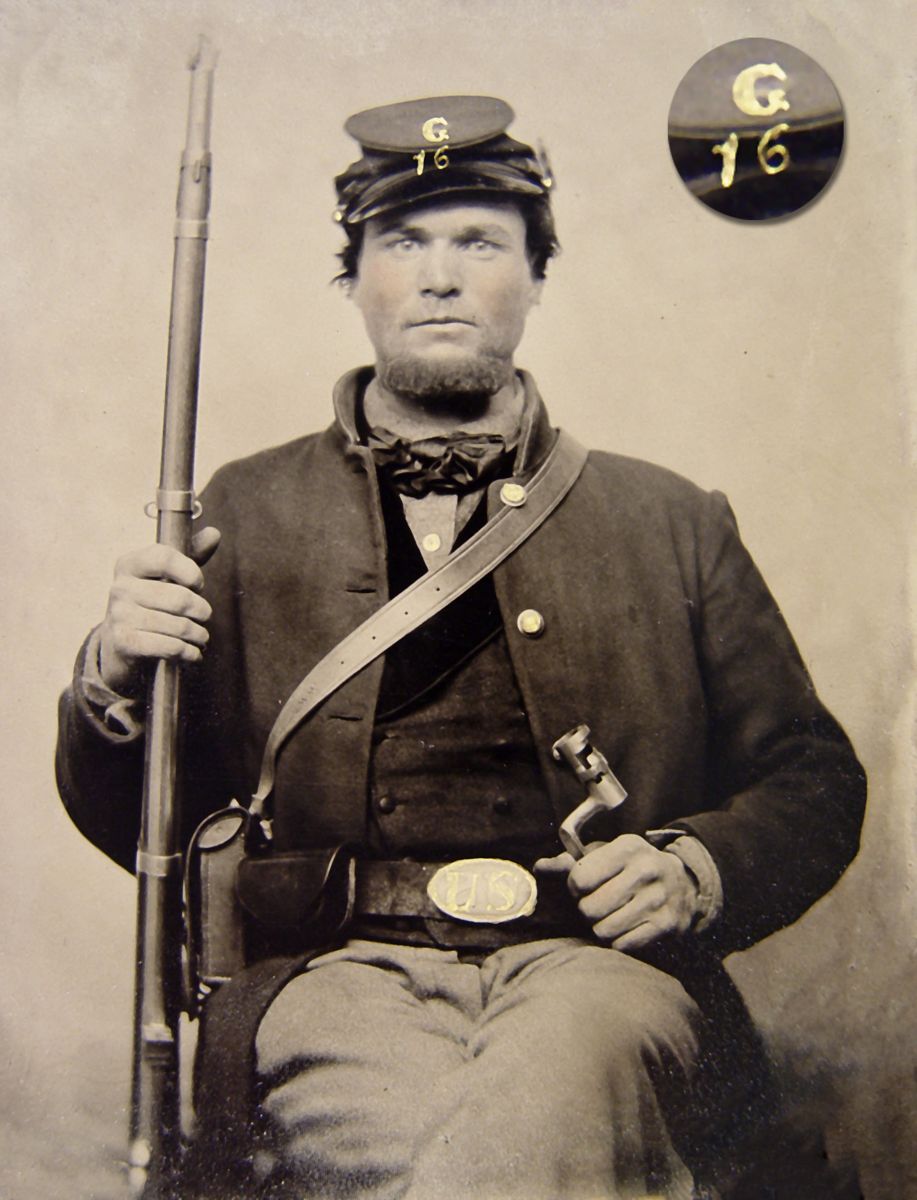
Horace H. Smith, 16th Wisconsin Infantry, Company G.
This is an unusual gold-tinted tin-type of a Union Civil War soldier identified as Horace H. Smith of the 16th Wisconsin Company G. Smith enlisted on November 11, 1861, and was discharged on March 14, 1863, due to an unspecified disability.1 The company was nicknamed the “Chippewa Valley Guards” and was comprised mostly of men from
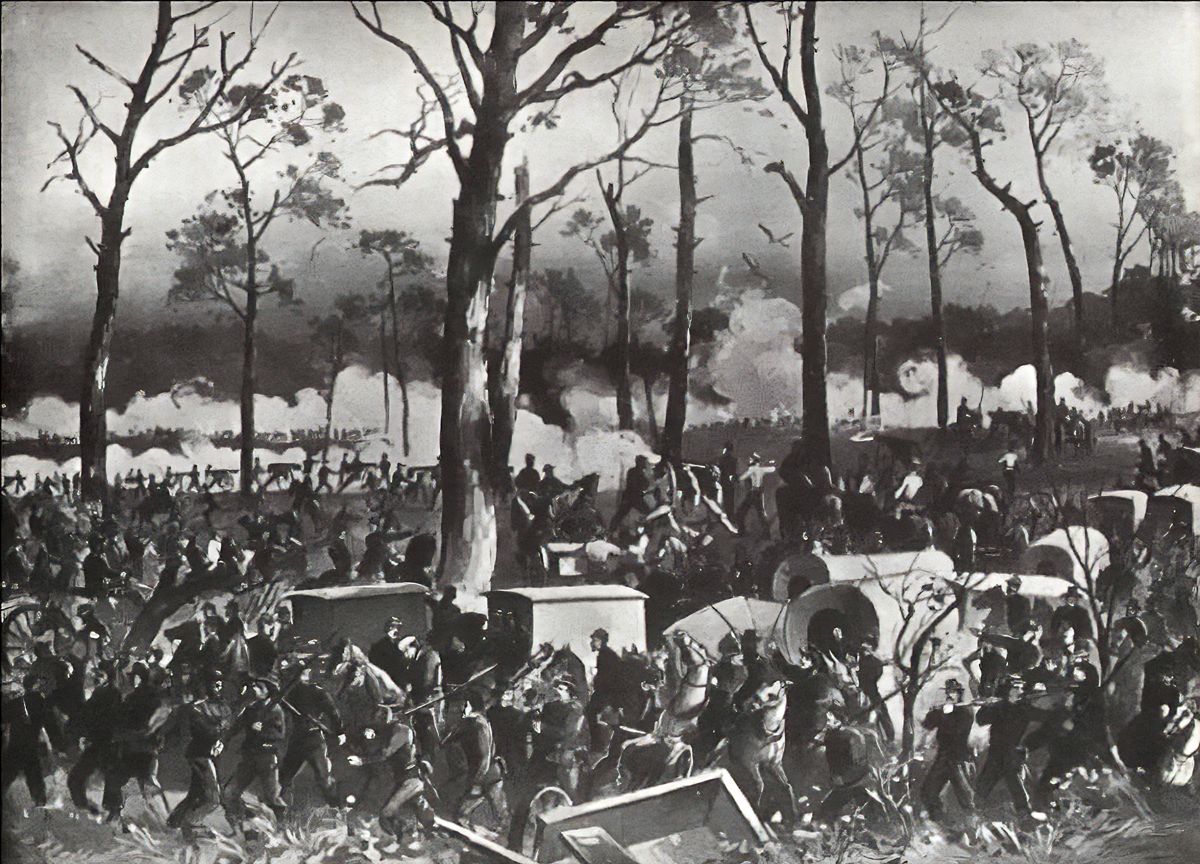
Northern Wisconsin. Horace Smith was from the unincorporated town of Rock Falls, Wisconsin, while most of his comrades hailed from Eau Claire and the surrounding area. The 16th Wisconsin was organized at Camp Randall, mustered into service on January 31, 1862, and was ordered to St. Louis, Missouri, on March 13. They proceeded to Pittsburg Landing in late March, where, along with the 25th Missouri and 12th Michigan, they made up the Sixth Division under General Prentiss. They held the left end of Grant’s line at Shiloh (Seay Field) and were involved in the action early on April 6, 1862, at 4:55 a.m. (In fact, the first officer killed at Shiloh was Captain Saxe of the 16th Wisconsin.) Overall, the unit took moderate casualties. They later fought at Iuka and Corinth and remained in Mississippi much or less of 1862, moving toward Vicksburg during the First Campaign until being driven back into Tennessee after the disaster at Holly Springs in late 1862. In November, the nine companies making up A through I were consolidated into five companies, having been “reduced through casualties of battle and sickness.”2 The History of the 16th Wisconsin Regiment does not specify where or how Horace H. Smith was injured or what his disability may have been. It only lists the casualties in “major” battles and those killed in action. He is not listed among the wounded. Horace H. Smith was discharged as disabled in March 1863, meaning it resulted from the 1st Vicksburg Campaign in late 1862. It raises an interesting point: there were various skirmishes and encounters (large Pittsburg Landing: The Final Stand of Grant’s Army, sketch by H. Lovie. (Public Domain) and small) in Mississippi throughout
1862, and one was no less likely to be injured in a large affix the insignia to the area of the cap above the brim. It battle than in a small one. However, there appeared to be a was a practice of some soldiers to affix brass insignia on pause between the 1st Vicksburg Campaign (1862) and the the top of a forage cap. However, this was not prescribed 2nd Campaign (1863). The last recorded action involving by U.S. Army regulations. Regulations stated that forage the 16th Wisconsin (before Smith was discharged) was Van caps were only to have “…yellow metal letters in front to Dorn’s Raid on Grant’s Supply Depot at Holly Springs, designate companies.”4 The regimental number, company Mississippi, on December 20, 1862, effectively ending letter, and infantry horn were intended for the enlisted dress the 1st Vicksburg Campaign. There were over a thousand (Hardee) hat only. In fact, the number “16” appears to be Union casualties, and it is possible that if Horace Smith was drawn in where it appears, rather than attached. In general, wounded, it was there. He then made the retreat back to hat hardware was not as common in the Western Theater Tennessee and convalesced in a hospital until his discharge of Operations, as there were more civilian-style hats in on March 14. Discharged for disability could also include use. From the soldiers’ perspective, these affected a more sickness while on duty. This is most likely the reason for veteran appearance. If regulation headwear was used, it discharge because Horace Smith later reenlisted in the 48th was often shaped to suit the owner and found with minimal Wisconsin early in 1865 and was promoted to Corporal. to no trimmings or hardware, if most period images are to Therefore, we know he did not lose an arm or a leg or suffer be trusted. In fact, a review of over 400 period images of any permanent disability. His post-bellum career is not Western soldiers where the hat could be made out showed recorded. We also know he was not the Horace Smith who 83% of the soldiers in some kind of civilian hat, 7% wore wrote a Civil War diary called “Two Months: Being an Account of The Life of a Prisoner of War.”3 That particular Horace Smith fought at Gettysburg. So what can we tell about Western Federal material culture from this image? The tin type was identified as Horace H. Smith, partially from the “HH Smith” etched in his musket sling, which he seems to be using as a cartridge box belt (?). It could also be that the cartridge box is being worn on his waist belt and he has casually draped the musket sling across his shoulders, but why? If the cartridge box is being worn on the belt, we can rule out the U.S. 1839 version, which only had provision for a shoulder strap and no waist belt loops. It also does not appear tall enough to be this type of cartridge box. It appears to be the U.S. Pattern 1857 (or 1861) for .69 elongated ball cartridges, which would match his U.S. 1842 rifled musket. With his left hand, he has partially withdrawn his bayonet, clearly the U.S. 1835/42, which also matches the musket pictured in the image. In fact, it appears to be one of the 14,182 U.S. 1842s which were rifled and sighted during the 1850s. These muskets were relatively rare and fired a large .69-caliber conical ball. The waist belt is “waxed flesh,” with the rough side out, which is expected for a pre-1863 image. The cap pouch appears to be the standard Union issue, U.S. Pattern of 1850. Horace Smith is wearing a forage cap with brass hardware. Ten years before the outbreak of the Civil War, some changes were made to U.S. military insignia. The War Department issued brass insignia, which went on U.S. accoutrements, while the Private Horace H. Smith of Company G, 16th Wisconsin Infantry Ordnance Department issued insignia, which Regiment, in forage cap with bayonet, musket, cartridge box, and soldiers wore on their clothing. The collapsed musket sling etched H. H. Smith. (Liljenquist Family Collection of front of the forage cap made it difficult to Civil War Photographs, Library of Congress.)
plain kepis or forage caps, and the remaining 10% wore Hardee hats, only some of which carried the regulation brass hardware. As far as his personal appearance, Horace H. Smith has a neatly trimmed, if longer, goatee with no mustache. It appears to complement his hairstyle, which is also longer and somewhat disheveled. He seems well nourished, even robust in appearance. His fatigue blouse is unbuttoned, which reveals a double-breasted civilian vest, a civilian shirt, and a dark silk bow tie. We cannot see below the waist, but more than likely, he is wearing the standard military bootee, waxed flesh out. The image is unusual for its clarity and detail, which is very rare in an early war tin type. This image was most likely taken shortly after enlistment in late 1861. Endnotes 1.
Janet Hewitt, Roster of Union Soldiers 1861–1865: Wisconsin Volunteers; War of the Rebellion, 1861–1865; Volumes I and II; compiled by Authority of the Wisconsin Legislature, Democrat Printing Company, (Madison, Wisconsin); 1886, p. 117. E.B. Quinner, The Military History of Wisconsin: 16th Infantry, Clarke & Company (Chicago), 1866, p. 632-643. This was the Diary of Horace Smith of the 154th NY, who was sent to Belle Island (near Richmond) after being captured at Gettysburg in mid-1863. Kurt Holman, Insignia of the Common Union Soldier, www.westernfederalblues.com. This article first appeared in Camp Chase Gazette in March 1991.
Craig L. Barry was born in Charlottesville, Va. H e holds his BA and M asters degrees from UNC (Charlotte). Craig served The Watchdog Civil War Quarterly as Associate Editor and Editor from 2003– 2017. The Watchdog published books and columns on 19th-century material. He is the author of several books including The Civil War Musket: A Handbook for Historical Accuracy (2006, 2011), The Unfinished Fight: Essays on Confederate Material Culture Vol. I and II (2012, 2013). He has also published four books in the Suppliers to the Confederacy series on English Arms & Accoutrements, Quartermaster stores and other European imports.
James Country
MERCANTILE
The home of