
Central Virginia Battlefields Trust
By Tom Van Winkle · Originally published May-June 2026 · pp. 52–55
The Civil War’s impact endures both in physical sites and collective memory. Once battlefields, these now peaceful places remind us of division’s cost and unity’s importance, making them essential for understanding American history. “A battlefield echoes with the voices of the men who lost their lives on that land, voices that still speak to those of us who seek to hear them. Only by walking the terrain of a Civil War battlefield can one truly hear the voices and understand the stories of the soldiers who can no longer speak, the depth of the sacrifice they made, and the courage they demonstrated in fulfilling their duties. And since many of the men who fought and died on these fields left no letters, personal effects, or even their names in some cases, the ground itself is all we have left to remember them by. Battlefields are the only remaining link to the memory of these soldiers, their voices, and their stories. By preserving these lands, we honor and preserve the memories and lives of these men. But if we allow this ground to be destroyed, their memories “untethered by physical associations, will inevitably dissipate like morning mist and be lost forever and for all time.” – From a speech delivered by CVBT President Emeritus Dr. Michael P. Stevens. Between 1861 and 1865, the American Civil War left a profound mark on the landscape and the people of the United States. Towns were pummeled by artillery fire, homes were ransacked, and entire populations became refugees as cities fell under siege. Churches, once places of peace, were transformed into makeshift hospitals for the wounded and dying. The serene fields and dense thickets of the countryside became sites of unspeakable violence, bearing witness to casualties of 750,000 or more soldiers, about two percent of the nation’s population at the time. Central Virginia, was the site of four major Civil War engagements between 1862 and 1864. The Battles of Fredericksburg, Chancellorsville, the Wilderness and Spotsylvania Court House are prominent engagements in the war. Collectively, these confrontations resulted in roughly 103,000 casualties. Union and Confederate soldiers were laid to rest in separate cemeteries, establishing the region as an area dedicated to both commemoration and reconciliation. Collaborative preservation initiatives for the battlefields commenced approximately 15 years following the war’s end. Initially, federally recognized national military parks were established in the 1890s at sites of Union victories. The Fredericksburg region, where Confederate victories were more prevalent, obtained unified park status in 1927 with the creation of the Fredericksburg & Spotsylvania National Military Park. Despite these efforts, a sizable portion of the original battlefield land continues to be privately owned. After the war, Fredericksburg’s battlefields stayed rural and mostly undisturbed, with few anticipating the wave of change ahead. When Interstate 95 was completed in 1964, the region experienced rapid growth and development. Subdivisions, shopping centers, commercial establishments, and now data centers and warehouse distribution centers, quickly appeared across the area. Limitless development posed significant risks to all four major Fredericksburg battlefields by the mid-1990s. Local governments frequently gave precedence to commercial expansion over historic preservation and its potential economic benefits from tourism. In response, concerned residents took initiative, leading to the establishment of the Central Virginia Battlefields Trust. Founded by community
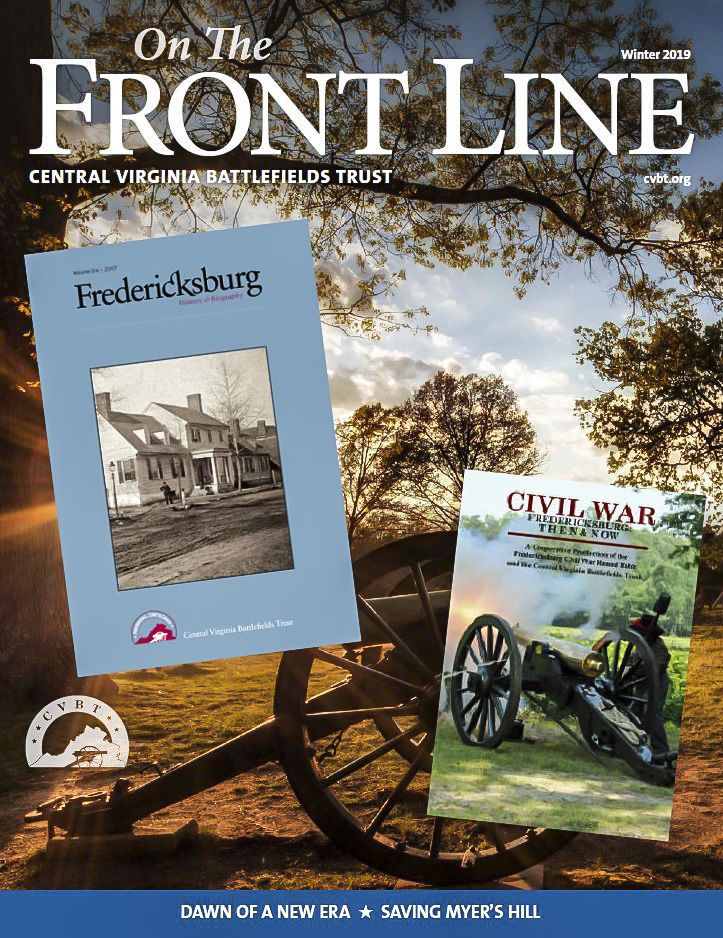
CVBT’s publication, On The Front Line.
CVBT at 30—A Look Back By Tom Van Winkle
CVBT purchases “Jackson Flank Attack.” (Free Lance-Star)
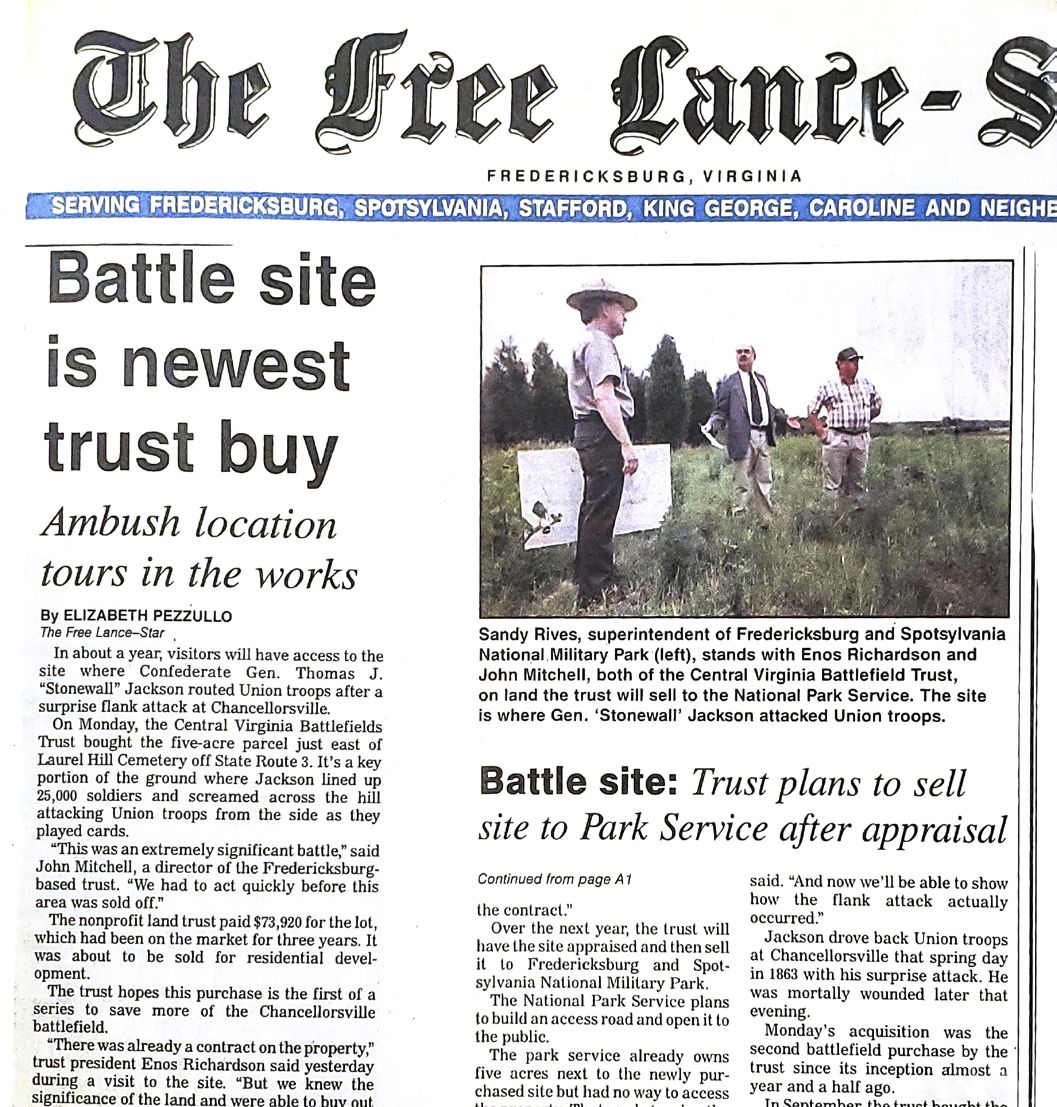
members, the CVBT is dedicated to preserving the sites where both Union and Confederate soldiers fought and lost their lives. The organization aims to honor the legacy of these individuals, represented by values such as honor, loyalty, duty, courage, self-sacrifice, and compassion, and ensure their preservation for future generations. CVBT began operations in September 1996 with no funding or office space; initially, we had access only to a storage facility and a phone. Despite these modest beginnings, our mission was clear and our enthusiasm high.
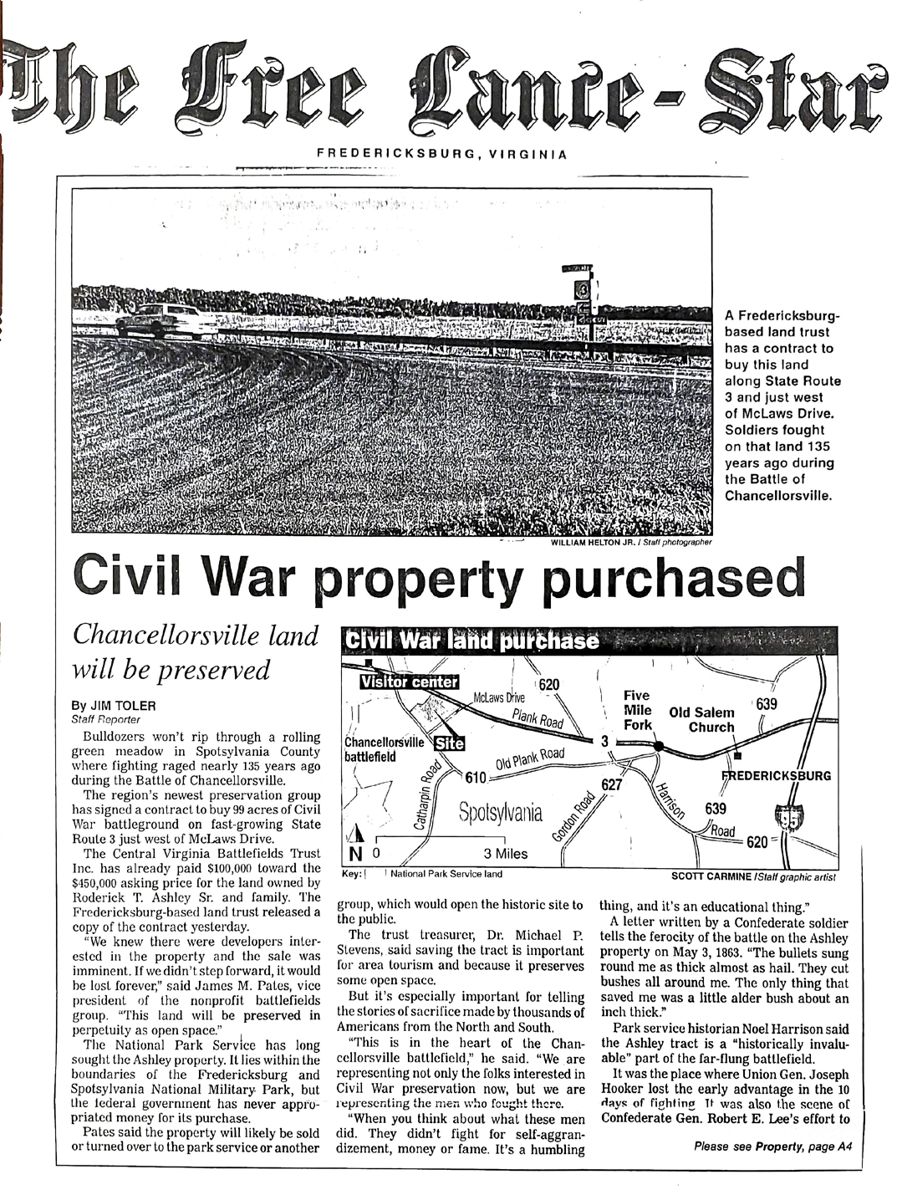
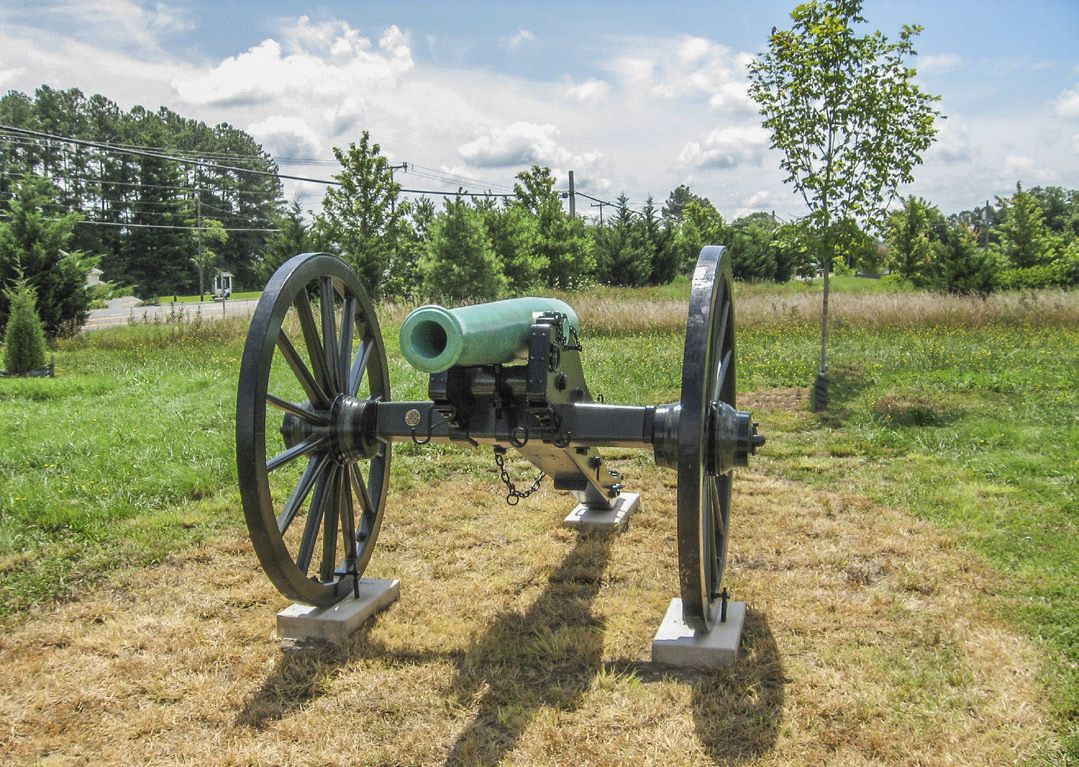
Another early save, McLaws Wedge 1997. (Free Lance-Star)
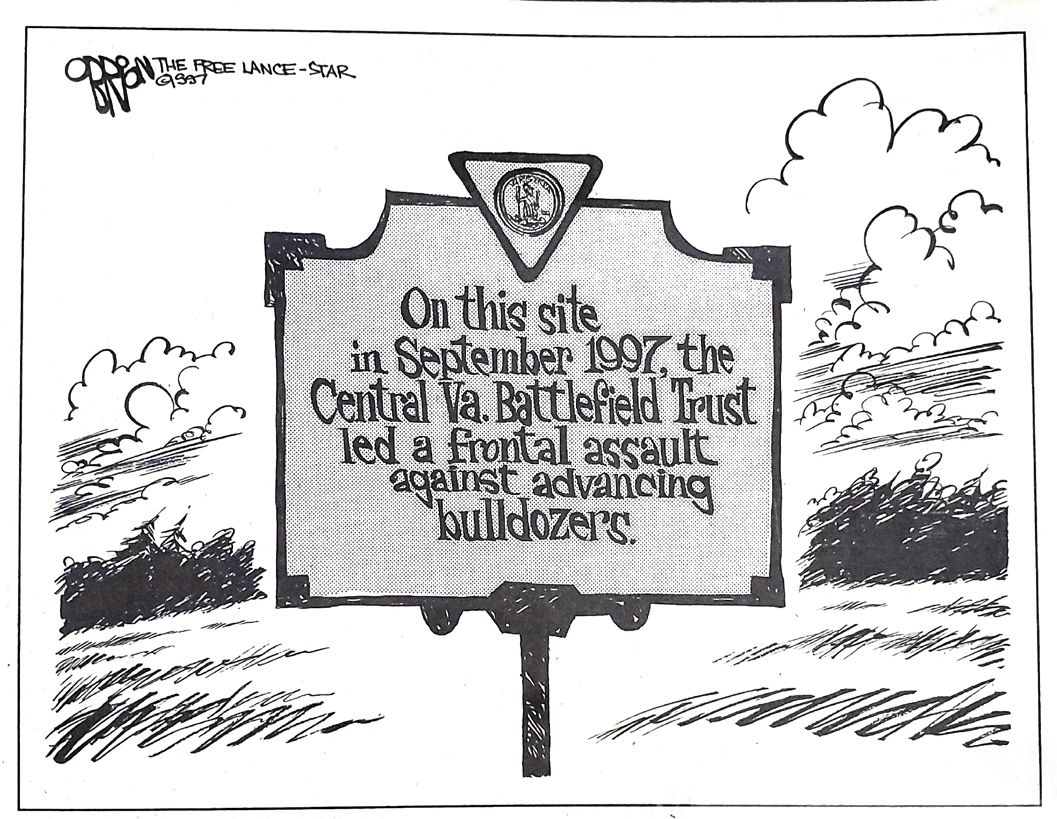
We were immediately called to action. Nothing quite matches the mixture of nervousness and excitement that comes with embarking on a first endeavor, especially when that endeavor is saving a battlefield. Just months after CVBT’s formation, we were already preparing to assume the cause. Fierce fighting occurred in Fredericksburg, Virginia, in December 1862. From their position atop Marye’s Heights, the Washington Artillery of New Orleans looked out over the city and the plains beyond. The area would become the stage for two major battles, with the fighting focused on Marye’s Heights, a ridge about half a mile behind the town. Here, Confederate artillery on the ridge supported riflemen entrenched on the Sunken Road below, making it a pivotal point in the battles. In 1996, the Sisters of Wisdom, a Catholic order, were poised to purchase the site of the closed Montfort Academy from Mary Washington College (now the University of Mary Washington). The sale included Willis Hill and several buildings, notably an 1885 house constructed by Lieutenant Colonel Charles Richardson, a former artillery officer in the Army of Northern Virginia. Through dedicated personal lobbying and cooperation with Mary Washington College, the Sisters of Wisdom agreed to allow the National Park Service (NPS) to match their bid. However, a significant obstacle arose: the NPS was legally unable to pay more than the property’s appraised value, and the bid exceeded that amount. At this critical juncture, two organizations stepped in: the Association for the Preservation of Civil War Sites (APCWS), now known as the American Battlefield Trust, and the newly established CVBT. With what now seems a modest investment of $130,000, of which we contributed $20,000, CVBT and APCWS (ABT) closed the financial gap between the parties, providing the necessary funds to secure the site. The deal was finalized and recorded, and on June 20, 1997, the deed was officially transferred to the NPS. Following the acquisition, the property was restored to its historic wartime appearance.
CVBT played a pivotal role in acquiring this important ground, which overlooks the most visited part of the Fredericksburg battlefields. Situated atop Marye’s Heights, between the National Cemetery and historic Brompton, it is now hard to imagine Fredericksburg and Spotsylvania National Military Park without this crucial connecting parcel, truly a site of undeniable historical significance. This first acquisition, achieved within months of CVBT’s founding in late 1996, was a defining moment for the organization. Currently The Central Virginia Battlefields Trust’s area of operations includes the four major Civil War campaigns: Fredericksburg, Chancellorsville, Mine Run, and the Overland Campaign, which includes the Wilderness and Spotsylvania. Since its establishment in 1996, CVBT has helped protect more than 2,000 acres of essential battlefield land, either partially or entirely. Additionally, at Brandy Station, CVBT contributed $700,000 to support ABT’s efforts in a 56 Acre Acquisition of Fleetwood Hill. We have invested more than $8 million in acquiring over 42 tracts of battlefield land, thereby preserving these outdoor classrooms and green spaces for the benefit of future generations. Our mission has enabled the preservation of several historic battlefields that might have otherwise been lost to development, including sites such as Pelham’s Corner, Willis Hill, McLaws’ Wedge, multiple “Stonewall” Jackson Flank attack locations, Grant’s Knoll, Longstreet’s Counterattack area, the 23rd USCT Battlefield, and Myer’s Hill, among others. With an all-volunteer board, minimal administrative expenses, and only two paid staff members, CVBT ensures that contributions are primarily allocated toward the acquisition, protection, and reclamation of these significant historic sites. CVBT promotes battlefield preservation across all levels, prioritizing cooperation and mutually beneficial outcomes over conflict. This approach respects soldiers’ sacrifices and aims to safeguard their legacy.
Funding these preservation efforts is certainly a significant challenge. Nowadays, acquiring even a small parcel of key battlefield land can easily exceed $1 million. While CVBT seeks federal and state grants to cover most of these costs, there is always a remaining gap. That is why our committed members and donors play such a crucial role; without their support, CVBT simply would not be able to do what we do. Acquiring these threatened battlefields is only the initial step. Many parcels contain contemporary structures, such as residential homes, which must be removed to accurately restore the historical landscape, resulting in significant additional expenses. At present, we are developing trails, installing interpretive markers, and opening multiple properties for public access. I have often said, “Battlefield Preservation is a game of chess, not checkers.” This philosophy applies both to acquiring land and to assembling enough connected property so that we can establish a substantial trail and open the site effectively. The significance of partnership is considerable. For many years, the Central Virginia Battlefields Trust (CVBT) has collaborated effectively with the American Battlefield Trust (ABT). Notable joint achievements include the acquisition of Slaughter Pen Farm on the Fredericksburg battlefield, a project to which CVBT contributed $1 million, as well as cooperative efforts on multiple properties, such as those at Chancellorsville and Wilderness battlefields. These ongoing collaborations have resulted in substantial accomplishments and continue to advance preservation efforts. CVBT has collaborated closely with its members and supporters, whom I fondly refer to as “Partners in Preservation,” for 30 years. Their dedication forms the backbone of our organization, and our achievements would not have been possible without their support. CVBT hosts two remarkable events every year. In March, we organize our highly anticipated annual Spring Seminar, featuring presentations by several historians on engaging topics, historical artifact displays, and a full lunch. This popular event typically sells out quickly. In September, we hold our Annual Conference, a three-day gathering filled with camaraderie, tours, lectures, a silent auction, a banquet dinner, and Sunday breakfast. These events are intended as sincere expressions of gratitude rather than significant fundraising initiatives; however, they typically generate sufficient revenue to cover event costs and contribute modestly to our preservation fund. In the summer of 2019, CVBT launched its full-color magazine, On the Front Line. This respected publication consistently upholds ambitious standards, featuring comprehensive articles contributed by numerous historians. It includes coverage of current and previous CVBT events, as well as communications from the President and Executive Director. In addition, CVBT publishes a monthly online history journal entitled “History Wire,” authored by Tim Talbott, Chief Administration Officer. Executive Director Terry Rensel distributes a monthly e-newsletter to inform members about ongoing land acquisition efforts and community events.
Preserving Civil War battlefields is a complex and challenging task. The process involves thorough research to verify properties, careful consideration of where limited financial resources should be allocated, and extensive negotiations with landowners. After securing the necessary funding and completing the purchase, restoration efforts must be undertaken, taxes addressed, and trails and markers installed on the site. Achieving these goals requires significant effort from the CVBT’s all-volunteer Board, two resolute employees, and support from our members and partners. The timeline from initial contact with a landowner to the final execution of the deed can span several years, demanding patience and steadfast commitment to our mission. Civil War battlefields are not just places of historical significance; they are hallowed spaces shaped by the courage and sacrifice of those who fought there. Walking across these fields helps us connect with history and appreciate the sacrifices made by individuals whose only mark is the land itself. Visiting a battlefield offers a powerful way to learn about the past, giving people of all ages a deeper understanding of history. These sites also serve as valuable resources for military personnel, who study tactics and terrain here— gaining practical knowledge beyond what textbooks can provide. The preservation of Civil War battlefields is an important undertaking that recognizes the contributions of those who participated in the conflict, protects educational resources, maintains open spaces, and benefits local economies. By safeguarding these historic sites, organizations such as CVBT uphold the legacy of individuals from both sides of the war, facilitate continued learning for future generations, and contribute to the conservation of America’s distinctive heritage. As CVBT Vice President Eric Powell noted, the Central Virginia Battlefields Trust has achieved remarkable results with a small team. In other words, “we do big things as a small group.” Over the last 30 years, our accomplishments reflect what can be done through commitment and collaboration. However, threats to these battlefields are expanding rapidly, and CVBT recognizes that we have limited time to preserve our collective heritage. Please visit our website at www.cvbt.org to help.
Tom Van Winkle is the President of the Central Virginia Battlefields Trust. The mission of CVBT is to preserve land associated with the four major campaigns of: Fredericksburg, Chancellorsville, Mine Run, and the Overland Campaign, including the Wilderness, and Spotsylvania Court House. To learn more about this grassroots preservation non-profit, which has saved over 2,000 acres of hallowed ground, please visit: www.cvbt.org.