
Cavalry Hill Cemetery: Rediscovering the Lost Graves
By Robert D. Jenkins Sr. · Originally published May-June 2026 · pp. 36–39
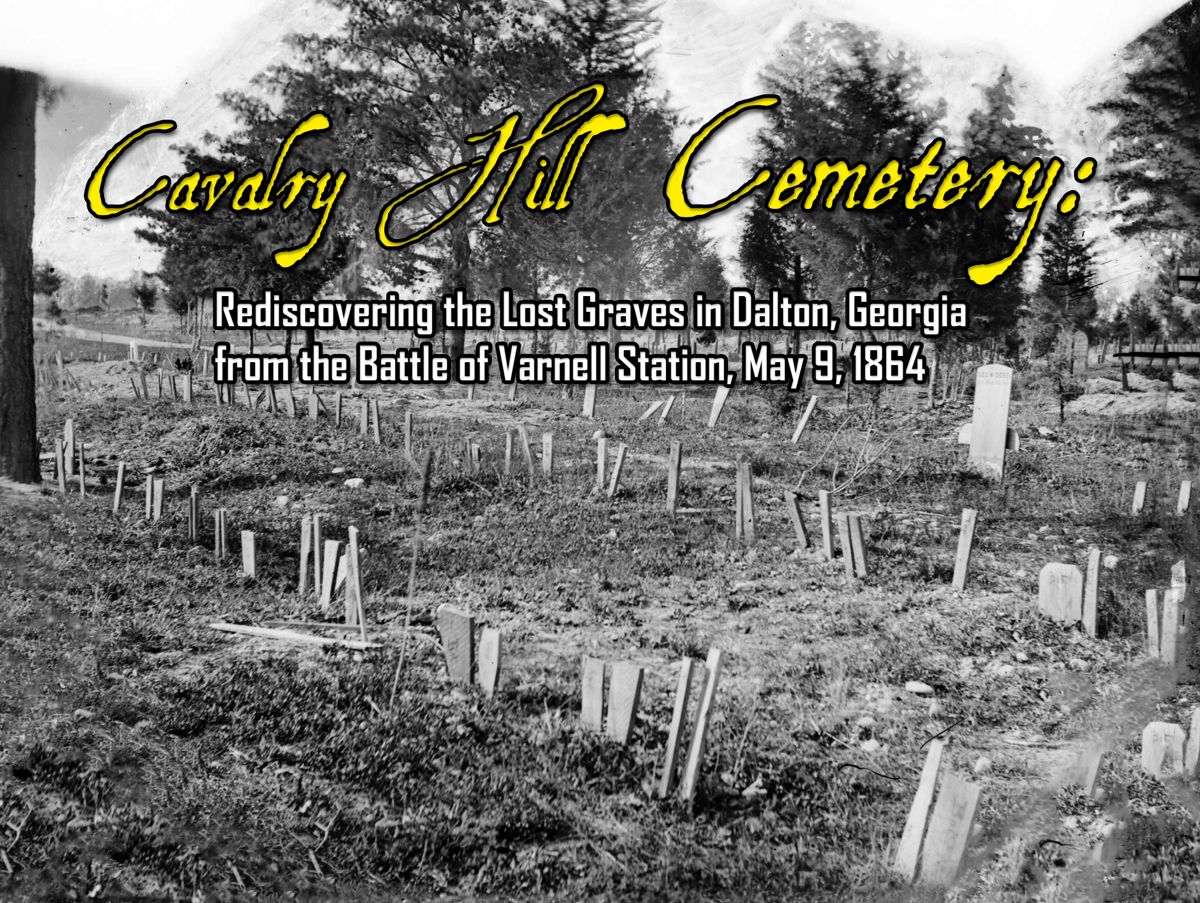
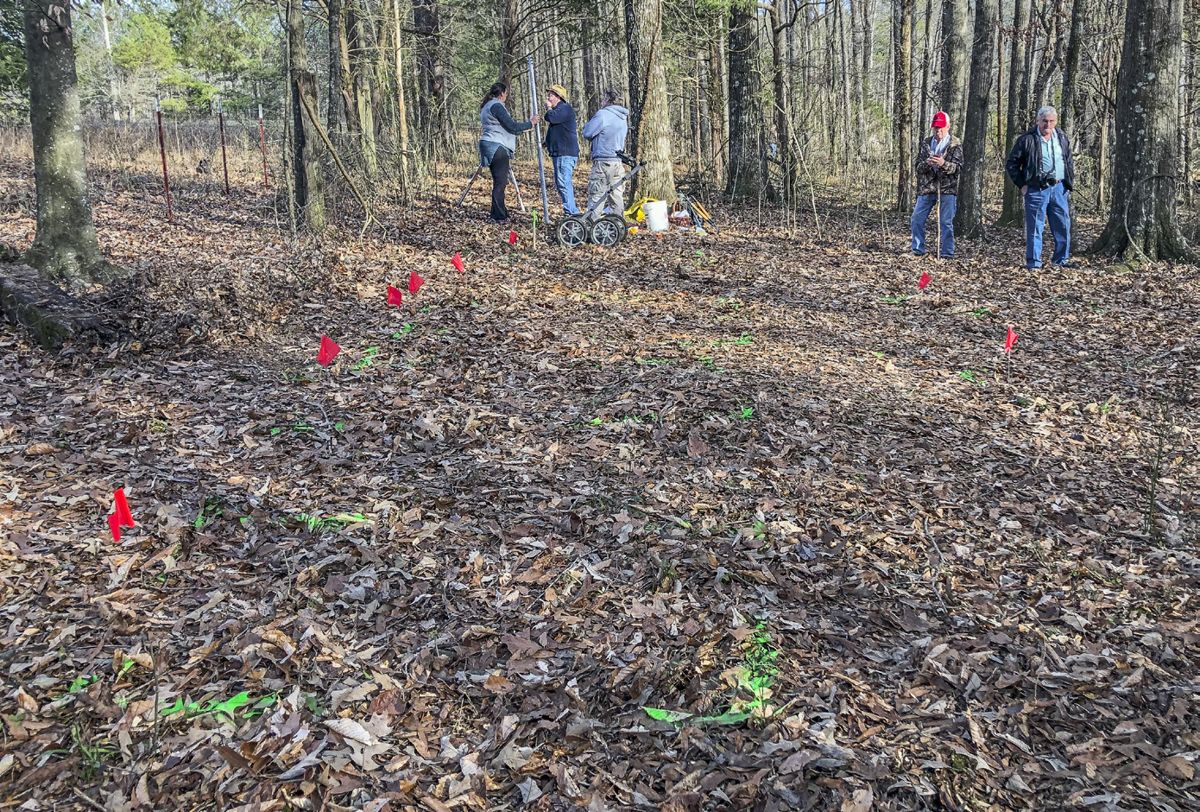
“Iam so excited,” exclaimed retired eye surgeon, relic hunter, and preservationist, Dr. William “Bill” Blackman of Dalton, Ga., as a small task force descended upon a little hill on a warm, early-spring-like day in February 2024. “I first came to this site in 1989,” the doctor explained as he began to recount the day that he had discovered what he was sure must be human graves. “The family had given me permission to hunt the land for Civil War relics,” he continued. Located in an old open forest, the land has been used for grazing cattle over the last halfcentury. Now, after nearly 35 years, Dr. Blackman once again secured permission to return to the land, this time armed with a group of preservation-seeking followers and a special piece of equipment, a high-tech ground penetrating radar (or GPR) detection device, and its owner, and grave identification expert, Bryan Davis, and his wife Bridgette Davis. Joining Bill and the Davises were long-time relic hunting partner Steve Sosbee, photographer Willis Treadwell, Lonnie Eoff, and Robert “Bob” Jenkins. Believing that a Confederate camp might be in the area, Dr. Blackman stepped into a low spot as he was exploring relics. “It was in August of 1989, and it was getting late in the afternoon. The sun was beginning to set,” continued the doctor to the little group as they began clearing away briers and tree limbs from the suspected site. “It was right here,” Bill explained while Bryan and Bridgette Davis unpacked their equipment by an old oak tree nearby, the two generously donating their time, equipment and expertise for the search. “I stepped down in a hole, as I was walking this way (indicating west) and toward the setting sun, and the next step I took I went back up, and then the next step was down again, and then again I stepped up,” Bill described, “and then I stepped down again into a third low spot. And then I turned around, and with the sun behind me as I looked back east, I could clearly make out three depressions in the ground, each separated by an equal distance, and I thought, ‘those are graves,’” he exclaimed to himself, both at the time, and again to his new audience. “They are much flatter now,” explained the doctor as the group looked on, “the cattle have flattened out the ground here over the years since I remember it.” The land, a small hill along an old cattle fence line, overlooks a spring, a beautiful setting for a final resting place. “Periwinkle was everywhere,” Bill recalled, explaining that it covered the ground where he saw the three graves. “It’s all gone now.” They were “all sunken, with a wall of dirt, one foot wide, and each a foot apart.” Dalton Historian and curator at Whitfield-Murray Historical Society’s Huff House (Johnston’s headquarters at Dalton which has been restored and is open for tours) Marvin Sowder, identified eight of the Southern troopers who had been mortally wounded or killed from the cavalry fight and buried on Sapp Farm on a small hill overlooking a large spring just east of the Cleveland-Dalton Road about five miles north of Dalton. Marvin identified the soldiers as:
Captain John S. McElderry, Co. H, (Wade’s) 8th Confederate Cavalry (reinterred), Private Edmond Ross Riddle, Co. A, (Wade’s) 8th Confederate Cavalry, Private J. B. Moore, Co. F, (Wade’s) 8th Confederate Cavalry, Private J. H. Scott, Co. K, (Wade’s) 8th Confederate Cavalry, Private J. Brooks (Wade’s) 8th Confederate Cavalry, Private W. H. Bigelow, Co. G, (Terry’s) 8th Texas Cavalry, Private William H. Hagwin (Hacquin), Co. G, (Terry’s) 8th Texas Cavalry, and Private Charles Pelham, Co. D, (Terry’s) 8th Texas Cavalry.
In preparing this article, the author discovered the identity of two additional Southern soldiers who were killed during the May 9, 1864 action near Varnell were also buried here. These two troopers are: 9. Bugler Charles M. Duff, Co. I, (Biffle’s) 9th Tennessee Cavalry, previously served as Bugler in Co. F, (McLemore’s) 4th Tennessee Cavalry, and 10. Private Jim Buck Smith, Co. D, 11th Tennessee Cavalry.1
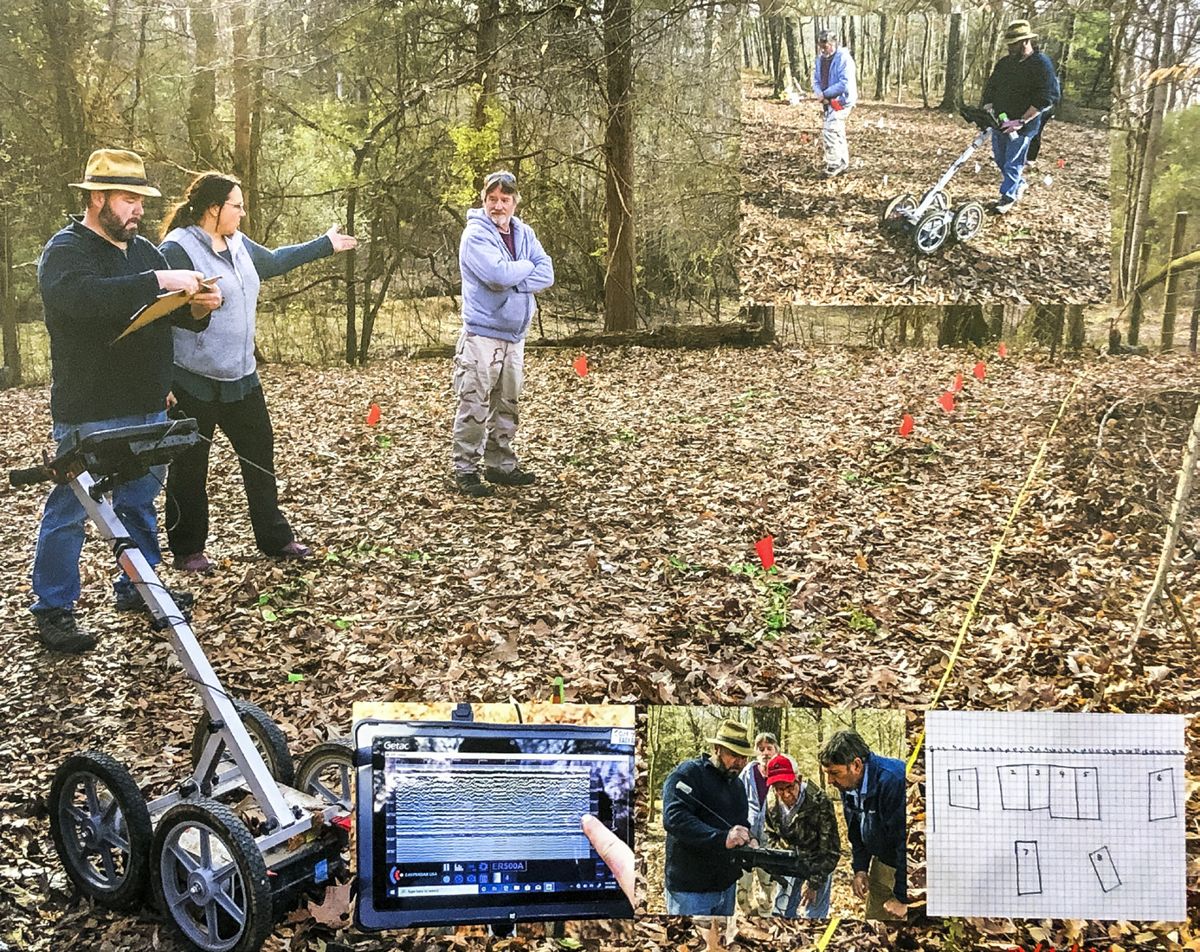
Marvin discovered that the remains of Captain McElderry appear to have been removed and reinterred at the McElderry Family Cemetery in Talladega County, Ala., by his father, Colonel Thomas McElderry. Marvin also found a newspaper article dated April 2, 1872, in Dalton’s North Georgia Citizen, where a memorial dedication of the remaining graves was set to be held on May 9, 1872, on the eighth anniversary of the deaths of the fallen soldiers. Continuing his steady march, Bryan stopped and beckoned Bill and the others to him. “Look at those lines,” pointing to the screen on his monitor. “This line shows the surface, and these lines show the depth of the ground below.” Explaining the patterns on the monitor, Bryan added, “typically, a Civil War grave is only about four feet deep,” not the six feet commonly believed, “and sometimes, even less, like three and a half feet, especially if it’s in a combat zone like here.” Davis continued his crisscross pattern of the ground quietly and calmly, making references and pointing to specific points in the ground where “Bridge,” as he affectionately calls his wife and partner, placed another white flag. Then, Davis began to speak more excitedly. “It is the right size. It has the right return, and I believe it is a grave right here.” Continuing their work, Bryan and Bridge began to identify the signatures and corners of the graves, as the cemetery, the Cavalry Hill Cemetery, where ten soldiers had once been laid to rest, and nine remained, began to take shape right before the eyes of the astonished onlookers. “I knew they were here,” Bill remarked as he choked up, barely able to hold back tears. With moist eyes, he added, “I just knew they were here, and that these were their graves. The periwinkle was everywhere on them here.” As the Davises continued to uncover the shape and size of each grave, it became clear that the bodies had been buried along the slope of the angling hill in two rows, facing south, and overlooking a large spring. Bryan identified the first grave and marked with a red flag, later returning to identify its corners by continuing to run his GPR machine over the site. He and Bridge then marked the corners by spray painting the ground green. He continued this process until he determined the locations of eight graves using a probe each time to determine the ground pressure of each grave as compared to the surrounding soil, providing further confirmation of a positive identification. Returning to the first grave, he explained that it appeared that the grave was a “double” meaning that it was possible that two people had been buried together, because the profile of the grave was wider than the others. At the time that he explained his discovery of the wider grave for grave number 1, Bryan was unaware that one of the soldiers, Captain McElderry, had been removed and reinterred in his family cemetery in Alabama. When told of the removal of one of the bodies in the cemetery, Davis said that it would explain why this grave had a wider profile than the others as the ground would have been disturbed a second time with the removal of the body. “The other two missing graves are likely between some of the ones that we found,” Bryan said, noting that there were a couple of gaps between the discovered graves that fit the probable location of them. Finally, as the Davises began a copious task of measuring all the courses and distances of the cemetery, and the size, shape, and relative distances of each grave, Bob read aloud the 1872 newspaper article that Marvin had discovered to the group:
“Memorial Day, five miles north of Dalton, Georgia. The nine graves near “Cavalry Hill,” on the Cleveland and Dalton Road, where lie buried the mortal remains of ten knights in grey, will be decorated with flowers on the 9th of May [1872], by the fair hands of Southern Mothers and Maidens. On the 9th of May 1864, these fearless defenders of the standards of the 8th Texas, 8th Confederate, and 9th Tennessee Cavalry went into the charge with brave hearts and strong arms. At nightfall, they slept the eternal sleep of death. Victory in the fight, glory in the fall, and flowers to commemorate their daring deeds.”2 Thanks to Bill and Marvin, and to Bryan and Bridgette, and the Lowell Planzer family, who have graciously preserved the land, Cavalry Hill Cemetery has been rediscovered! Efforts are now underway to preserve Cavalry Hill Cemetery. If anyone is interested in supporting this project, Donations may be made payable to “Community Foundation of Northwest Georgia,” reference: “Save the Dalton Battlefields, LLC,” and mailed to Attention: Robert D. Jenkins Sr., P.O. Box 6124, Dalton, Georgia 30722-6124. Endnotes 1.
The Augusta Chronicle & Sentinel, Saturday, May 14, 1864, “The Cavalry Fight on the Cleveland Road, Headquarters, Dibrell’s Cavalry Brigade, Near Dalton May 11, 1864,” 2, copied from correspondence in Atlanta Confederacy, courtesy Dave Powell. Note that the total of ten original graves and only nine graves remaining matches the article. 2. North Georgia Citizen, April 2, 1872.
Bob Jenkins is a trial attorney Dalton, Georgia. He is the President of Save the Dalton Battlefields, LLC, and Field University Director for Blue and Gray Education Society. He has in also authored a number of books
Atlanta Campaign and other Civil War subjects, and is a contributor and consultant to Civil War News. and articles on the
Civil War Back Issues
NEWS
Available for Purchase
To purchase back issues visit our secure website: https://simplecirc.com/shop/civil-war-news or call us at 800-777-1862.
Civil War VOL. 50, NO. 5 | MAY-JUNE 2024
NEWS
$7.99
Civil War NEWS
$7.99
Civil War NEWS
$7.99
Civil War NEWS
$7.99
The Truth At
Featuring
Ken Burns, Martin Sheen, & Sam Waterston
Cassville Was Joe Johnston honest with History?
Maj. Gen. John A. Rawlins On Display:
Vision and Valor: The War Through Women’s Eyes
The Herb Peck
The Enfield at Manassas
Photography Collection
Fresh Views of the War’s Most Famous Fort Battles—and Their Impact on Families
A Surprising Collection of His Personal Belongings is Discovered
Gen. David Hunter and the Newtown Burnings
Medal of Honor for Two of Andrew’s Raiders
The Lawbook Raid
Stephen Lang and Jeff Shaara Star in a Holiday Weekend
Douglas Southall Freeman: Lee’s Lieutenants
Burnside’s Invasion of East Tennessee Remembering Peter Carmichael “Funded by Faith”
Cotton Bonds & The Erlanger Loan
Tragedies and Statistics
PTSD in the Civil War
Shelby Foote’s The Civil War: Fort Sumter to Perryville
Thoughts on Hat Insignia
Lost from the Landscape
Civil War
Civil War
Civil War
Civil War
NEWS
$7.99
NEWS
$7.99
NEWS
$7.99
That Old Yell
NEWS
$7.99
Anesthesia
We Had Learned To Know So Well
Before and During the Civil War
“Behold a Pale Horse”
“Playing War”
Captain Winston J.T. Stephens and the St. Johns Rangers in NE Fla.
Sham Battles During and After The Civil War
Behind The Lines Charleston Free Badge Burnside’s Invasion of East Tenn. Reading Mary Boykin Chestnut
N-SSA’s 150th Nationals Riddick’s Folly Lincoln’s Cabinet Building M1842 Rifle Musket
Dodging the Draft “Armed with Needles” Lincoln Forum’s 29th Meeting Fidelity: The Fighting Swearers
Middle Tenn. 37th Show Fort Fisher’s New Museum Dismantling Slavery in Maryland Soldier’s Winter Quarters in Virginia
Civil War to Civil Rights An Atlanta Collector Only Where the Tiger Couched Fighting for the Forts
Columbus Belmont Battlefield Imagining Emancipation Interview with Harold Holzer Drawn to War: Artists in the Civil War
Ohio Civil War Show
A Blackguardly Trick?
Hoppin John and Limpin Susan
Visiting Picacho Peak
No Idle Hands – Knitting Socks for Soldiers
Wyse Fork Battlefield Anniversary
The Army of the Potomac and the Peninsula
A Regiment Doomed from the Start
Civil War
Civil War
Civil War
Civil War
NEWS
$7.99
Phil Sheridan
NEWS
$7.99
The Pipe Creek Circular
NEWS $10
NEWS $10
The Fight for Manassas Battlefield
Irene Sheridan’s Campaign to Protect Her Husband’s Memory
One of the Fiercest Fights
Andersonville
A Few Thoughts on Military Hospitals
Civil War Show News
The Belgian Musket in the Civil War
They Swear a Big Oath
Battle of Fredericksburg Letter
CSS Florida Early Trials
USS Hartford Met Ignoble End
Ice Down in the Civil War South
Women Doctors in the Civil War
Joh G. Keyser, Artist Soldier
The Mud March: Union Soldiers’ Perspectives
Retesting Your General Knowledge
Early Visitors to Central Virginia’s Battlefields
The Dentist, the Emperor, and the American Civil War
Confederate Grand Strategy: Is What Historians Think About Robert E. Lee All Wrong?
Crisis in Charleston N-SSA Nationals – 75th Anniversary Women Nurses in the Civil War Civil War Politics: Abolition and Election Fort McAllister: Southern Sentinel Battle of Roanoke Island Letter
Teaching Former Slaves Monocacy Junction Middle Tennessee Civil War Show News Early Visitors to Central Grant’s 1864 Reception at the White House Virginia’s Battlefields Part II William Loring: Controversial Confederate Commander