
William Loring:
Originally published March-April 2026 · pp. 32–41
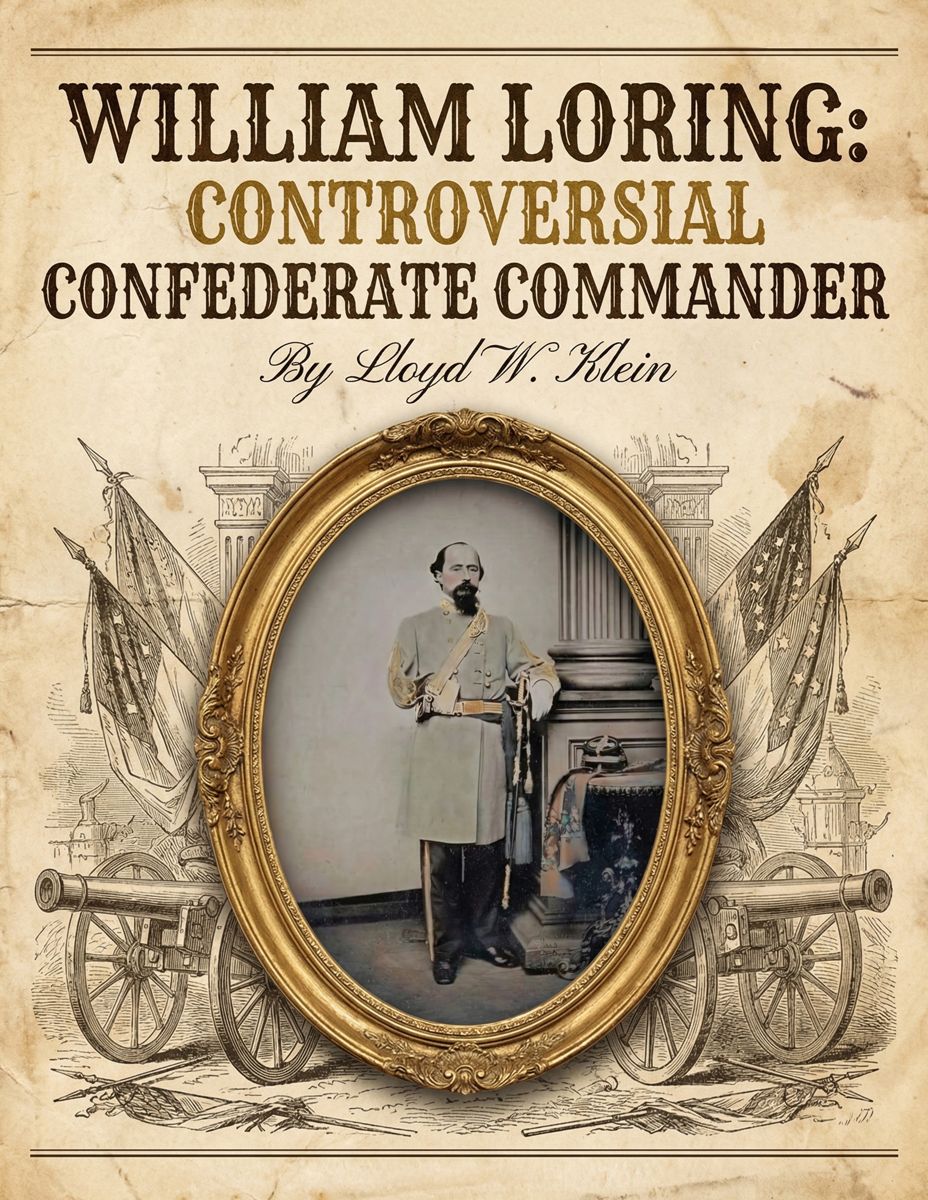
Major General William Wing Loring had a notable military career that spanned several significant conflicts, including the Texas Revolution at the age of 14, the Mexican War, the Seminole Wars, the Civil War, and the Egyptian-Ethiopian War. Born in 1818 in North Carolina, Loring’s family relocated to Florida, where he famously ran away to join the fight in Texas, prompting his father to bring him back home. His relentless determination in combat earned him the moniker “Old Blizzards,” a name derived from his rallying cry to his troops to “give them the blizzards.” By the time the Civil War commenced, Loring had already established himself as a seasoned battle commander, embodying the principles of military professionalism. Loring’s reputation as a distinguished military leader and battle commander is well-founded, characterized by his personal courage and tactical acumen. He was a consummate professional who mastered the art of warfare. However, his Civil War record was not without challenges, as he frequently found himself in conflict with his superiors, resulting in tensions and controversies during his service. Despite these disputes, Loring’s leadership and valor were acknowledged, and the interplay of his strengths and weaknesses significantly influenced the trajectory of his military career.
Early Military Career
Loring first experienced battle as a 14-year-old when he volunteered for the Florida Militia during the Seminole Wars. By the time he reached 17, he had traveled to Texas to participate in the struggle for independence. He spent a year at Georgetown University before pursuing a legal education. Eventually, he established himself as both a lawyer and a politician in Florida. During the Mexican War, Loring recruited a mounted regiment, ultimately rising to the rank of major. His regiment was involved in numerous battles throughout the conflict, where he was wounded three times. Notably, while leading a charge into Mexico City, Loring suffered a severe injury that shattered his arm, necessitating amputation. For his valor, he was awarded two brevets, one elevating him to lieutenant colonel and the other to colonel. Following the war, Loring was assigned to various posts in the western United States. He successfully led a caravan of 600 mule teams over a distance of 2,500 miles from Missouri to Oregon. After serving as commander of the Oregon Territory for two years, he transitioned to overseeing several frontier forts. Over five years, he engaged in numerous skirmishes with Native American tribes, particularly the Comanches, Apaches, and Kiowas. In December 1856, at the age of 38, Loring achieved the rank of colonel, making him the youngest officer to hold that position in the United States Army.
western Virginia. This region, although part of the seceded state of Virginia, exhibited strong Union loyalties, making it a focal point for some of the war’s earliest confrontations. Loring’s appointment to this command was attributed to his extensive experience in combat situations. The Battle of Rich Mountain, July 11, 1861, before the First Battle of Manassas, saw a brigade led by Thomas Morris triumph over a brigade commanded by Robert Garnett, kin to Richard Garnett, who was killed at Pickett’s Charge. Under the leadership of George McClellan, the Union forces faced initial hesitation, as McClellan believed he was outnumbered. He initiated a siege, but the tide turned when a local boy, sympathetic to the Union cause, revealed a concealed path through the woods that allowed William Rosecrans’s Brigade to outflank the Confederates. This maneuver led to a swift defeat for the Confederates, with Union casualties totaling only 46 compared to 300 Confederate losses and 550 captured, contributing to the prevailing expectation of a swift conclusion to the war. It was subsequently anticipated that McClellan would initiate an invasion from Ohio, prompting Loring to establish a defensive strategy for this potential scenario. In response, President Jefferson Davis dispatched Col. Robert E. Lee to Loring for consultation and support in these preparations. Loring perceived this action as a slight; with his higher rank and greater battlefield experience, he did not think he needed a supervisor. He also felt undermined by Lee who assumed a commanding role by issuing directives through
Onset of the Civil War
At the outbreak of the Civil War, Loring left his post in New Mexico and tendered his resignation from the U.S. Army. Subsequently, he aligned himself with the Confederate forces, receiving a commission as a brigadier general and assuming command of forces operating in
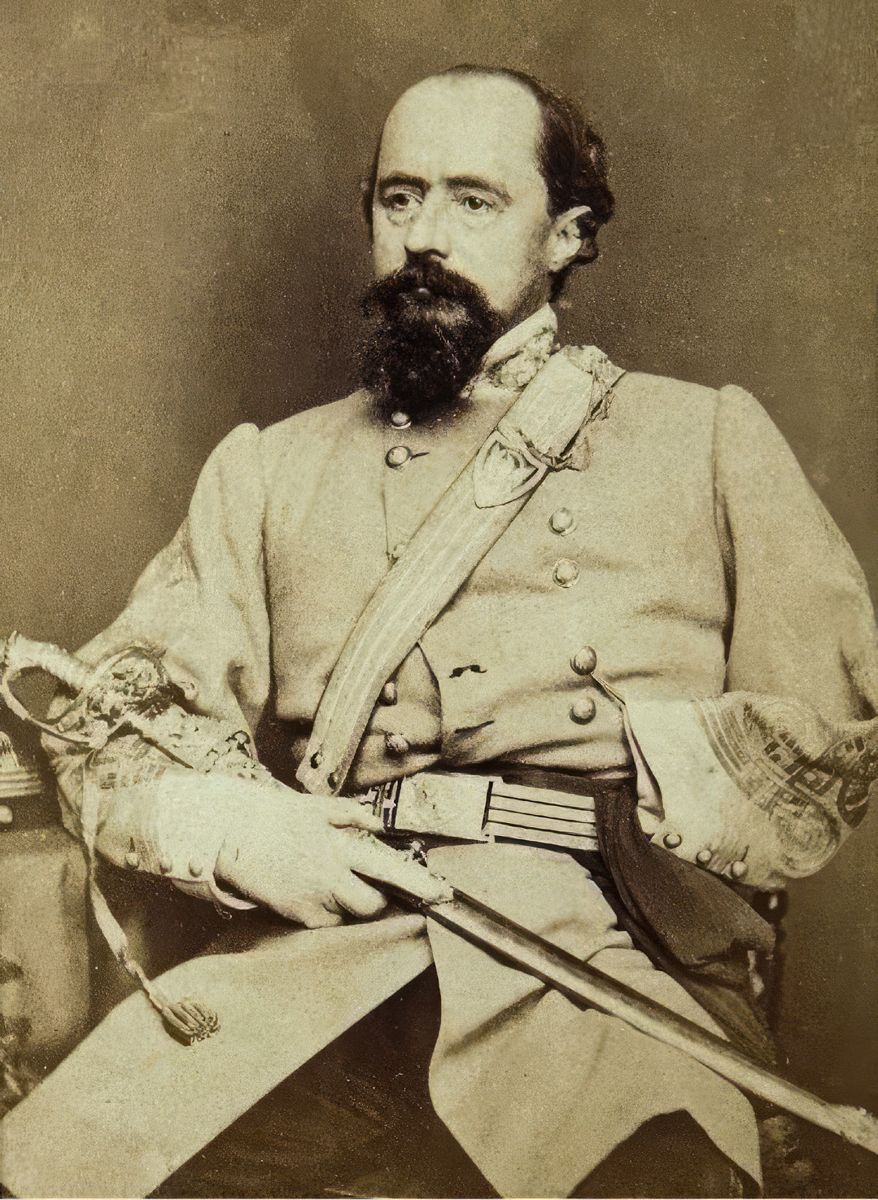
Brig. Gen. William Wing Loring.
Loring. As the commander of the Confederate Army of the Northwest, Loring was tasked with operational control for executing the campaign, while Lee provided overarching strategic direction. Lee and Loring retreated to Cheat Mountain, situated in present-day West Virginia, although McClellan was not yet present in the area. McClellan took the summer to pursue his objectives, during which time he was elevated to command the Army of the Potomac following his victory at Rich Mountain. Loring held overall command of Confederate forces involved in the Cheat Mountain operation, which was strategically important due to its transportation routes and resources. The Battle of Cheat Mountain occurred between September 12 and 15, 1861, and was a key engagement within the Western Virginia Campaign. This battle is particularly significant as it represented one of the earliest major military confrontations in the challenging mountainous terrain of the Appalachian region. Confederate forces sought to dislodge the Union troops from their fortified position on Cheat Mountain, aiming to gain control over this strategically important area, which was vital for managing the local roads and mountain passes. Under the leadership of Col. Nathan Kimball, Union forces had established robust defensive positions on Cheat Mountain. Although they faced a numerical disadvantage, the Union soldiers had fortified their position with trenches and other defensive works, making it exceedingly difficult for the Confederates to launch a successful assault. The Union’s preparedness played a crucial role in their ability to withstand the Confederate offensive. General Lee’s operations involved a coordinated assault from various directions, intended to surprise the Union defenders. Commanded by Loring, the Confederates aimed to execute a complex attack to encircle and overpower the Union troops at Cheat Mountain and Elkwater, utilizing the challenging landscape to their benefit. Loring’s Army of the Northwest was divided into six brigades for the battle, each with its own approach route, within a broad concept that they would converge on the Union position. However, the operation was severely hindered by poor communication, difficult terrain, and inclement weather, which led to disarray among Southern units. The Confederate assaults led by Loring ultimately did not succeed. Union troops maintained their stronghold on Cheat Mountain, compelling the Confederates to retreat with relatively minimal losses. Despite their numerical superiority, the Confederates were unable to capture Cheat Mountain, resulting in a notable setback for Lee’s early military efforts in the conflict. Although the Battle of Cheat Mountain did not result in significant casualties (just 88 total Union and about 100 Confederate casualties) or strategic ramifications, it served as an early assessment of leadership capabilities of both Loring and Lee. Loring had led his troops, and Lee had scouted the area and made the plans for the two–pronged attack that failed. The operation encountered numerous challenges that fostered frustration among Confederate leaders, with Loring and his team voicing their discontent regarding Lee’s cautious strategies. Lee may have felt
disheartened by Loring’s failure to effectively execute the battle plan. The campaign illustrated the complexities of conducting military operations in difficult terrain and emphasized the necessity for effective communication and coordination in military endeavors. The Battle of Cheat Mountain is often recalled as one of the initial confrontations where Gen. Robert E. Lee commanded troops during the Civil War. Lee’s inability to achieve victory at Cheat Mountain led to a temporary decline in his standing with Confederate leadership, although he would later regain his reputation. For Loring, it created significant distance between him and Lee which, when Lee ascended to military command in the Eastern Theater, would impact his assignments.
Loring and Stonewall Jackson
Following the unsuccessful Cheat Mountain operation, Loring continued to lead forces in western Virginia but was soon ordered to join Gen. Thomas “Stonewall” Jackson in the Shenandoah Valley. Loring frequently voiced his dissatisfaction with the strategic decisions and operational directives being implemented. Jackson has been criticized for leaving his subordinate commanders unaware of his operational plans. This growing discontent culminated in a notable conflict known as the “Loring-Jackson dispute,” which took place during the winter of 1861–1862 while Loring’s command was stationed in western Virginia. Jackson instructed Loring to remain in a secluded mountainous region while he returned to Winchester, a directive that Loring found unreasonable and frustrating. Their strained relationship may have influenced Jackson’s decision to keep Loring in a less favorable position. Loring openly opposed Jackson’s command to stay at winter headquarters in Winchester. Loring believed that his troops were being subjected to unnecessary hardships due to their location, leading him to bypass Jackson and approach the Confederate government to request a reassignment for his command. This action not only angered Jackson but also heightened tensions within Confederate leadership. In his efforts to advocate for his men, Loring directly communicated with Secretary of War Judah Benjamin, who concurred that Loring’s forces were not appropriately positioned for the winter months. Following this intervention, Jackson complied with the orders to redeploy Loring, yet he subsequently resigned in protest against what he perceived as interference from Richmond. However, under the influence of Governor Letcher and his superior, Joseph E. Johnston, Jackson ultimately withdrew his resignation. Furthermore, Jackson garnered significant political backing from Alexander Boteler, who served as the congressional representative for the Valley. Boteler is frequently acknowledged for his pivotal role in maintaining Stonewall Jackson’s position within the Confederate Army during this crucial period.
Kanawha Valley
Loring was reassigned from Jackson’s command and appointed to lead the Department of Southwestern Virginia. During his five-month tenure in this capacity, Loring directed a force of 5,000 troops as part of the 1862 Kanawha
Valley Campaign and successfully occupied Charleston for six weeks. In mid-October, Loring was reassigned to the Western Theater, marking a significant shift in the command structure and operational focus of the Confederate forces in the region.
Personality Problems
Loring faced persistent challenges in collaborating with superiors beyond Lee and Jackson. A thorough analysis of these dynamics necessitates an exploration of both his personality and his military history. Loring was characterized by his assertiveness and a pronounced sense of independence and often expressed his opinions candidly, even when they diverged from those of his superiors. This assertiveness could be perceived as either an asset or a drawback, contingent upon the circumstances. Within the rigid hierarchy of the military, such independence frequently resulted in tensions with his commanders, who anticipated unwavering compliance with their directives. Loring had a reputation for being somewhat difficult to work with, as he could be stubborn and resistant to ideas that did not align with his own views. His command style clashed with other Confederate leaders, who valued different approaches to leadership and strategy. This characteristic was evident in his choice to appeal directly to the Confederate government, circumventing Jackson, which illustrated his readiness to confront authority. While this trait underscored his dedication to the welfare of his troops, it also engendered considerable discord within the command structure. Loring did not get along with either General Lee, who was known for his patience and diplomacy, or General Jackson, who was noted for the opposite. Loring was a highly experienced military officer by the time the Civil War began. His combat experience was extensive, and he had earned recognition for his bravery and leadership in battle. This experience gave him a deep understanding of military tactics and strategy. Loring’s extensive military background might have contributed to a sense of rivalry or difference in perspective with other Confederate commanders. While Stonewall Jackson and Robert E. Lee were also seasoned military men and also cited for bravery, Loring’s experience was broader in some respects, and he may have felt justified in questioning decisions he disagreed with. This could have created tension, especially in situations where Loring believed his experience suggested a different course of action. The conflicts between Loring and his superiors were often rooted in strategic disagreements. For example, Loring’s resistance to Jackson’s orders during the Romney Campaign reflected a different understanding of military priorities and the welfare of troops. Loring’s experience may have led him to prioritize certain tactical considerations that Jackson, with his aggressive approach, viewed differently.
Battle of Champion Hill
Reassigned to the Western Theater in the capacity of a divisional commander, he took part in operations that led to the Vicksburg Campaign. His time in this role was marked by a combination of successes and controversies.
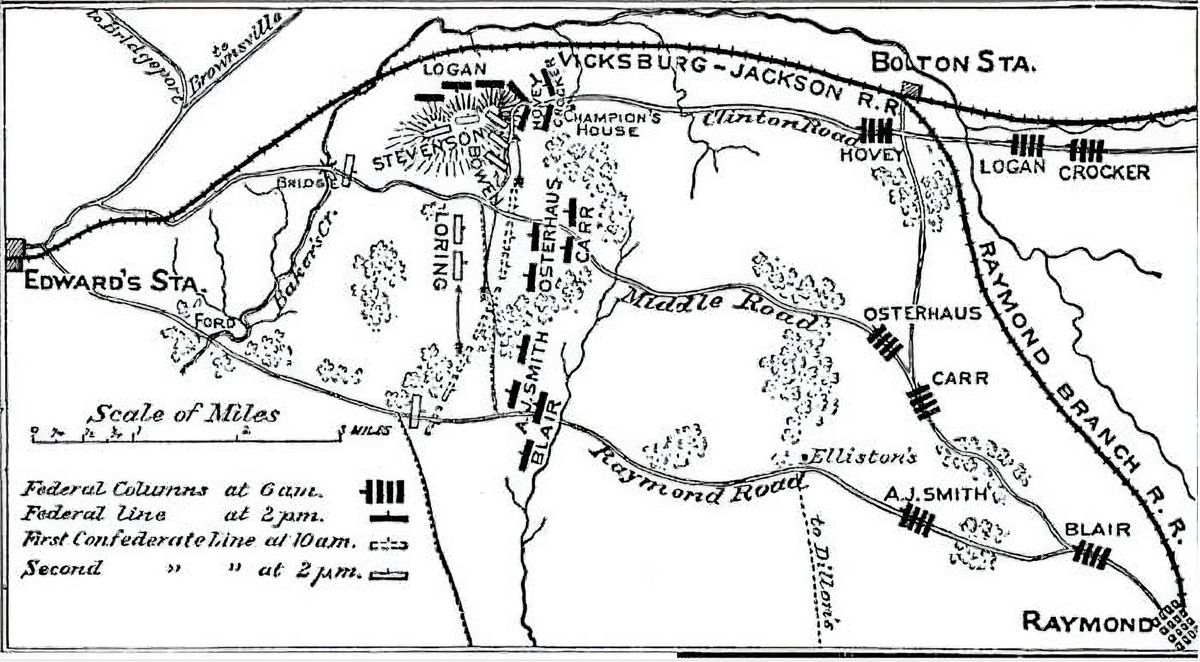
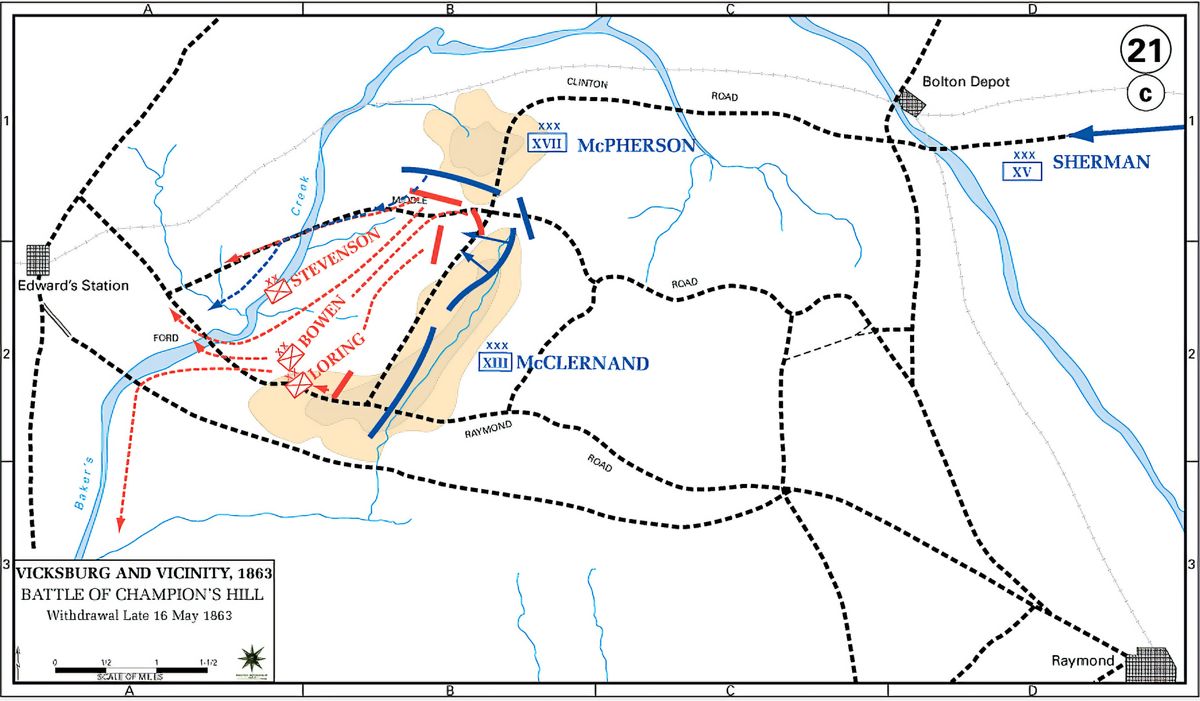
The Battle of Champion Hill, Mississippi, on May 16, 1863, was a critical juncture in the Vicksburg Campaign. This engagement was particularly significant for Gen. John C. Pemberton, as it represented his last opportunity to thwart the advancing troops of Gen. Ulysses S. Grant. Pemberton’s indecision during this crucial battle ultimately contributed to his defeat. Confronted with a significant numerical disadvantage, with his forces totaling 22,000 compared to Grant’s 32,000, Pemberton constructed a defensive position along a ridge that overlooked Jackson Creek, which effectively safeguarded the Middle Road and Raymond Road to the south. On the morning of May 13, three divisions commanded by Generals Bowen, Loring, and Stevenson commenced their movement from the fortifications at Black River, aiming to reach what Pemberton believed to be the rear supply line of the Federal Army. However, Grant was fully aware of Pemberton’s strategic intentions. A Union operative, serving as a messenger between Johnston and Pemberton, conveyed vital intelligence to General McPherson, who then relayed this information to Grant. By the morning of May 16, 1863, the Confederate forces were met not with the anticipated supply line of Grant, but rather with a substantial contingent of his Federal Army at a site known as Champion Hill. The situation grew increasingly dire for Pemberton when Gen. Stephen D. Lee, positioned on Champion Hill, warned him of a Union column advancing along the Jackson Road. This movement posed a significant threat to the Southern forces, potentially isolating them from Edwards Station and the crucial route to Vicksburg. In light of this development, Pemberton redirected troops northward to safeguard both the hill and the Jackson Road. In response to the unfolding crisis, Grant ordered assaults led by Logan and Hovey, while John A. McClernand’s Corps targeted Pemberton’s left flank, and James B. McPherson’s Corps engaged from the right. Despite commendable defensive efforts by Stephen D. Lee, the Union forces succeeded in capturing the hill crest around 1 p.m. McPherson’s Corps continued its advance, seizing a critical crossroads and effectively blocking the escape route via the Jackson Road. Loring dispatched brigades to reinforce the Confederate left and center to shift the momentum in favor of the Confederates. Following a brief counterattack led by Gen. John S. Bowen that nearly drove Federal forces back to the Champion House, Grant responded by deploying the division commanded by General Marcellus Crocker. Despite Bowen’s Division momentarily pushing the Federals beyond the crest of Champion Hill, they could not sustain their gains due to a lack of manpower. Acknowledging the precarious circumstances, Grant initiated his own counterattack, mobilizing all available forces. As the battle progressed, the Confederates faced mounting pressure from Grant’s Union troops. Pemberton instructed Loring to reposition his division to strengthen another part of the line. This moment proved crucial in Loring’s military career, as the situation quickly spiraled into disorder, hindering his division’s ability to carry out the maneuver. Loring either failed to follow orders to advance or was unable to do so, leading to his separation from the
Map of Vicksburg and Vicinity, 1863, Battle of Champion’s Hill, May 16, 1863.
Map from Campaigns of the Civil War: The Mississippi, by Francis Vinton Greene, 1882.
main Confederate forces, and regrettably, he did not inform Pemberton of his predicament. Pemberton’s troops were unable to withstand the fierce assault, leading him to instruct his men to take the sole remaining escape route via the Raymond Road crossing at Bakers Creek. As his forces retreated towards the bridge at Big Black River, just prior to reaching Vicksburg, Pemberton designated John Bowen’s Division and John Vaughn’s Brigade to defend the fortifications at the bridge, aiming to provide Loring with the necessary time to withdraw. To facilitate the army’s retreat, he also ordered Gen. Lloyd Tilghman’s Brigade, along with some artillery units, to establish a rearguard. In their efforts to hold the crossing, they suffered significant casualties, including the loss of Tilghman himself, and by nightfall, the Confederates were in complete retreat towards Vicksburg. In his after-action report, Loring indicated that he sought to reunite with his fellow soldiers at the Big Black River Bridge; however, the advancing Union forces compelled Bowen to withdraw, leaving Loring with no viable route across the challenging terrain. Consequently, he was obliged to abandon a substantial portion of his supplies and artillery. Local residents alerted Loring to the presence of a large Union contingent positioned between him and the bridge rendezvous point. Rather than confront Grant’s forces, Loring opted to alter his course and join Johnston’s troops at Canton. Had Pemberton been cognizant of Loring’s separation, he might have opted against engaging in combat at that particular site, which was originally designated for Loring’s rear-guard action. This choice ultimately resulted in Loring’s Division being absent during the Siege of Vicksburg. While some contemporaries criticized Loring for what they perceived as a dereliction of duty towards Pemberton, others argued that his decision was a prudent measure to protect his division from encirclement. Although Loring’s retreat at Champion Hill could be defended from a tactical perspective, it was interpreted by some as a betrayal of his commander, contributing to the eventual loss of Vicksburg. The contentious relationship between Loring and Pemberton was widely recognized, as Loring often struggled to collaborate effectively with his superiors. Nevertheless, he consistently demonstrated bravery and integrity in the heat of battle, earning respect for repeated acts of valor. The discord between Loring and Pemberton regarding these contentious decisions continued to resonate long after the conclusion of the war.
Atlanta Campaign
Following the fall of Vicksburg, Loring remained active under General Johnston in the Western Theater, engaging in operations designed to disrupt Union supply lines and infrastructure throughout Mississippi. He played a significant role in the defense of Jackson, Miss., where his strategic leadership was instrumental in delaying the advance of Union forces under Gen. William T. Sherman. This delay was crucial in preventing the total annihilation of Confederate troops in the area, thereby allowing them to regroup and reposition further south. Loring’s time in the Western Theater was marked by a series of notable accomplishments.
Loring subsequently joined the Army of Tennessee, which was commanded by Gen. Joseph E. Johnston. He assumed command of a division within Lieut. Gen. Leonidas Polk’s Corps, which was later rebranded as the Army of Mississippi. This corps played a pivotal role in the Atlanta Campaign, contributing to the Confederate efforts in that critical theater of the war. During the Meridian Campaign, Union forces under Gen. William Tecumseh Sherman sought to dismantle Confederate railroads and supply depots in central Mississippi. Loring, leading a division under Gen. Joseph E. Johnston, participated in attempts to thwart Sherman’s progress. However, the Confederates faced significant challenges and were largely unsuccessful in halting the Union’s destructive advance through the region. Loring’s Division was integrated into the Army of Tennessee during the Atlanta Campaign, where he initially served under General Johnston and subsequently under Gen. John Bell Hood. He held divisional command during the battles around Atlanta, adopting a defensive strategy as Confederate forces endeavored to thwart Sherman’s advancing troops. Loring participated in several significant engagements, notably the Battle of Kennesaw Mountain on June 27, 1864, and the Battle of Atlanta on July 22, 1864. Throughout the campaign, Loring’s Division was actively involved, showcasing remarkable resilience despite facing the Union Army’s overwhelming numerical and material advantages. The Atlanta Campaign commenced with the strategic advance of Gen. William T. Sherman towards the city of Atlanta. This military operation was initiated with the Battle of Rocky Face Ridge, alongside the defense efforts in Dalton, Ga. Loring’s Division was strategically positioned to counteract Sherman’s early movements, playing a crucial role in the Confederate defense. In May and June 1864, Sherman executed a series of tactical flanking operations that forced the Confederate army to abandon several of its fortified positions. Loring’s Division was actively involved, participating in rearguard actions and skirmishes designed to hinder the Union advance, thus playing a crucial role in the Confederacy’s overall defensive strategy. Loring’s Division was prominently engaged in the Battle of Resaca from May 13 to 15, 1864, where Confederate forces fought Sherman’s troops. Although the Confederates ultimately had to retreat, Loring’s forces were instrumental in the defensive effort, successfully inflicting significant casualties on Union soldiers during the battle. After the death of General Polk at Pine Mountain on June 14, 1864, Loring temporarily took command of Polk’s III Corps. He led this corps in the Battle of Kennesaw Mountain, which resulted in a rare Confederate victory during the campaign, as the Confederates held their strong defensive position on the mountain. Loring’s Corps played a vital role in repelling Union assaults, contributing to the substantial number of casualties suffered by Union forces. Lieut. Gen. Alexander P. Stewart replaced him on July 7, 1864, and he reverted to divisional command. Throughout the siege of Atlanta, Loring’s Division remained actively involved in defending the city against
Sherman. The soldiers under his command engaged in trench warfare, maintained defensive positions, and participated in skirmishes as Sherman’s troops gradually encircled the city, intensifying their efforts to capture it. Following the replacement of General Johnston with General Hood in July 1864, Loring continued to operate under Hood’s more aggressive strategy. During the Battle of Peachtree Creek, Hood initiated an offensive aimed at defeating a segment of Sherman’s army before it could consolidate with the remainder of his forces. Loring’s Division took part in this confrontation; however, the attack was ultimately unsuccessful due to a lack of coordination, resulting in the Confederates being driven back. Loring’s Division also played a role in the Battle of Ezra Church, when Confederates again engaged Sherman’s ongoing efforts to surround Atlanta. This battle was part of Hood’s strategy to prevent Sherman from severing the last remaining railroads that supplied Atlanta. As with Peachtree Creek, Southerners were unable to penetrate Union lines and incurred significant losses. During the Battle of Ezra Church on July 28, 1864, Loring sustained injuries that sidelined him, leading to his division being commanded by others as the campaign continued Loring’s role in the Atlanta Campaign was predominantly defensive in nature. His division played a crucial part in countering Sherman’s advances, engaging in several pivotal battles, including Resaca, Kennesaw Mountain, Peachtree Creek, and Ezra Church. Despite their determined efforts,
the Confederates led by Hood could not prevent Sherman from seizing Atlanta, marking a significant setback for the Confederacy. The conclusion of the Atlanta Campaign was marked by the capture of Atlanta on September 2, 1864. Although Loring’s Division, along with the rest of the Confederate army, displayed considerable resilience, they ultimately could not overcome Sherman’s advantages in manpower and logistical support.
Franklin
Following the fall of Atlanta, Loring returned to the Army of Tennessee for Hood’s Tennessee Campaign. His role in the Franklin-Nashville Campaign was characterized by participating in two of the campaign’s most critical and destructive battles. The campaign culminated in catastrophic defeat for the Confederates, with Loring’s Division experiencing considerable losses, particularly during the Battle of Franklin. At this battle, he led his division in a fierce yet ultimately futile attack on the Union left flank, resulting in substantial casualties. During the November 30, 1864, Battle of Franklin, Loring led a division within Lieut. Gen. Alexander P. Stewart’s Corps. This division was comprised of experienced soldiers and was among the units assigned the critical objective of penetrating the Union defenses at Franklin. The engagement was characterized by a large-scale frontal assault initiated by General Hood against the well-
“Battle of Kennesaw Mountain, morning of June 27, 1864, campaign map.” House Divided: The Civil War Research Engine at Dickinson College.)
fortified Union troops led by Maj. Gen. John Schofield. Loring’s Division participated in this assault, which is frequently regarded as one of the most ferocious and deadly confrontations of the Civil War. His troops advanced across open terrain while enduring intense artillery and rifle fire from the Union forces. The Confederates incurred significant losses during the assault. Despite their resolve, the offensive failed to breach the Union lines. The Confederates experienced the loss of many of their most capable officers and soldiers; although they penetrated Union lines, they were ultimately unable to maintain their position and were driven back. The battle culminated in a catastrophic defeat for the Confederacy, resulting in over 6,000 casualties within a matter of hours.
Nashville
Following the devastating loss at Franklin, Loring remained with Stewart’s Corps as the Army of Tennessee advanced toward Nashville. The Confederate forces, already suffering from diminished morale and strength, established defensive positions around Nashville, where they encountered a substantially larger and better-equipped Union army commanded by Maj. Gen. George H. Thomas. Within this context, Loring participated in the Confederate defensive maneuvers that ultimately culminated in another
disastrous defeat, contributing to the fragmentation of the Army of Tennessee. His leadership during these critical engagements exemplified the resolve and desperation of the Confederate troops as they confronted increasingly formidable challenges in the war’s concluding phases. Loring’s Division played a crucial role in the Confederate defensive strategy during the Battle of Nashville. On December 15, 1864, the first day of fighting, Union forces initiated a series of well-coordinated assaults against the Confederate defenses. Tasked with maintaining their positions against the relentless Union attacks, Loring’s Division, along with the rest of the Confederate army, faced the daunting challenge of holding their ground amid overwhelming opposition. On December 16, the subsequent day, the Union forces escalated their attacks, focusing on the center and left flank of the Confederate line. Although Loring’s Division fought bravely, it could not endure the fierce assault. The Confederate line started to weaken under the unyielding pressure, leading to a chaotic retreat that further worsened the precarious circumstances for the Confederate troops. After the defeat at Nashville, the Confederate Army of Tennessee was effectively destroyed as a fighting force. Loring’s Division, along with remnants of the army, retreated south through Tennessee into Alabama. The
Battle of Franklin Nov. 30, 1864, Confederate Breakthrough. (American Battlefield Trust)
campaign marked the end of the Army of Tennessee as a significant military force; Loring’s role in the retreat was part of a larger, desperate attempt to salvage what was left of Hood’s shattered army.
Why Did Loring Never Advance to Corps Command Or Beyond?
Sometimes, one sees speculation as to which commanders might have achieved more than Bragg, Pemberton, Johnston, and Hood in the Western Theatre. Various names are often posed, but seldom is William Loring ever seriously considered. Yet we see that Loring was in the thick of the fight from start to finish and never wavered. Loring was a fascinating military man who had trouble dealing with superiors, but his personal courage in battle was tested over and over, and he always reacted with poise and honor. Why a man of his strengths couldn’t be promoted in the Confederate Army must be primarily blamed on politics. Loring had not attended West Point, and he was not a Virginian. His experience came entirely from fighting battles. This held him back throughout the war and forced him into numerous uncomfortable command situations.
He proved to be a capable battlefield commander who contributed significantly to the Confederate war effort, but his career remained colored by the same independent spirit that had both helped and hindered him throughout the war. Loring’s lack of promotion to higher ranks in the Confederate Army, despite his experience and service, can be attributed to several factors, including his contentious relationships with other senior officers, his independent and sometimes insubordinate behavior, and the overall dynamics of Confederate military politics. His relationships with key Confederate leaders like Robert E. Lee and Stonewall Jackson were often strained. His assertiveness and willingness to challenge orders put him at odds with these influential figures. The conflicts, particularly the “Loring-Jackson dispute,” where Loring bypassed Jackson and appealed directly to the Confederate government, likely damaged his reputation among the Confederate high command. Jefferson Davis valued unity and loyalty within the military hierarchy and may have seen Loring as a divisive figure who could disrupt the chain of command. Loring’s actions during the Romney Campaign, where he appealed to Richmond to countermand Jackson’s
Battle of Nashville (Dec. 15-16, 1864).
orders, were seen as a form of insubordination. Although Loring’s concerns may have been valid from a logistical and humanitarian standpoint, his approach undermined the authority of a highly respected commander. In a military system that relied heavily on strict adherence to orders and the hierarchical structure, this kind of behavior would have been viewed negatively by Davis and other Confederate leaders. His controversial decision to withdraw his division during the Battle of Champion Hill was likely seen as a failure to follow orders and support the broader Confederate strategy. Although Loring’s decision may have saved his division from potential destruction, it also contributed to the eventual Confederate loss at Vicksburg, a critical blow to the Confederate war effort. Promotions in the Confederate Army were influenced by a combination of merit, political considerations, and regional alliances. Loring, not being from Virginia and not
a West Point graduate, lacked some connections that might have helped secure higher promotions. The Confederate leadership, especially those from Virginia, often favored officers who were part of their social and military circles. Loring’s outsider status, both geographically and institutionally, may have worked against him in terms of receiving promotions. After the war, Loring offered his services to the Egyptian government and became a major general in the Egyptian Army, where he served for nine years before returning to the United States. He later wrote about his experiences in a memoir titled A Confederate Soldier in Egypt.
Dr. Lloyd W. Klein is a Clinical Professor of Medicine
in the Cardiology Division of the University of California,
San Francisco. He is a nationally recognized cardiologist, clinical investigator, and lecturer with over forty years of experience and expertise in managing myocardial infarction and individual tailoring of coronary revascularization strategies. He is also an amateur historian who has published
extensively on the Civil War. His particular interests include political and military leadership and their economic
ramifications. His book Civil War Q & A was published by
McFarland in 2023.
70TH YEAR 70TH YEAR YEAR THE ORIGINAL 70TH
BALTIMORE SHOW FOR COLLECTORS OF ARMS
SATURDAY AND SUNDAY MARCH 21ST & 22ND, 2026 Held At The Maryland State Fairgrounds Cow Palace 2200 York Road, Timonium, MD 21093
Saturday, March 21st 9:00AM-5:00PM - $15 Sunday, March 22nd 9:00AM-3:00PM - $10 New! (Online Only) 2-Day Pass - $20 Tickets Can Also be Purchased at the Door Both Days of the Event.
Trade Tables - $150 Display Tables - $90 NO AR/AK RIFLES OR ASSOCIATED PARTS ARE PERMITTED FOR SALE TRANSFER AT THE “BALTIMORE SHOW”. NO MD-BANNED WEAPONS ARE ALLOWED. (Go to www.mdsp.org/organization/supportservices/licensingdivision for current list.) MARYLAND LAW MANDATES THAT ALL POST 1898 RIFLES, SHOTGUNS, AND HANDGUNS MUST BE TRANSFERED BY A FEDERAL FIREARMS LICENSED (FFL) DEALER, INCLUDING A NICS CHECK.
All Firearm Sales/Transfers are to Abide by All Federal, State, and Local Mandates.
For Tickets, Tables, and Additional Show Information; Please Go To:
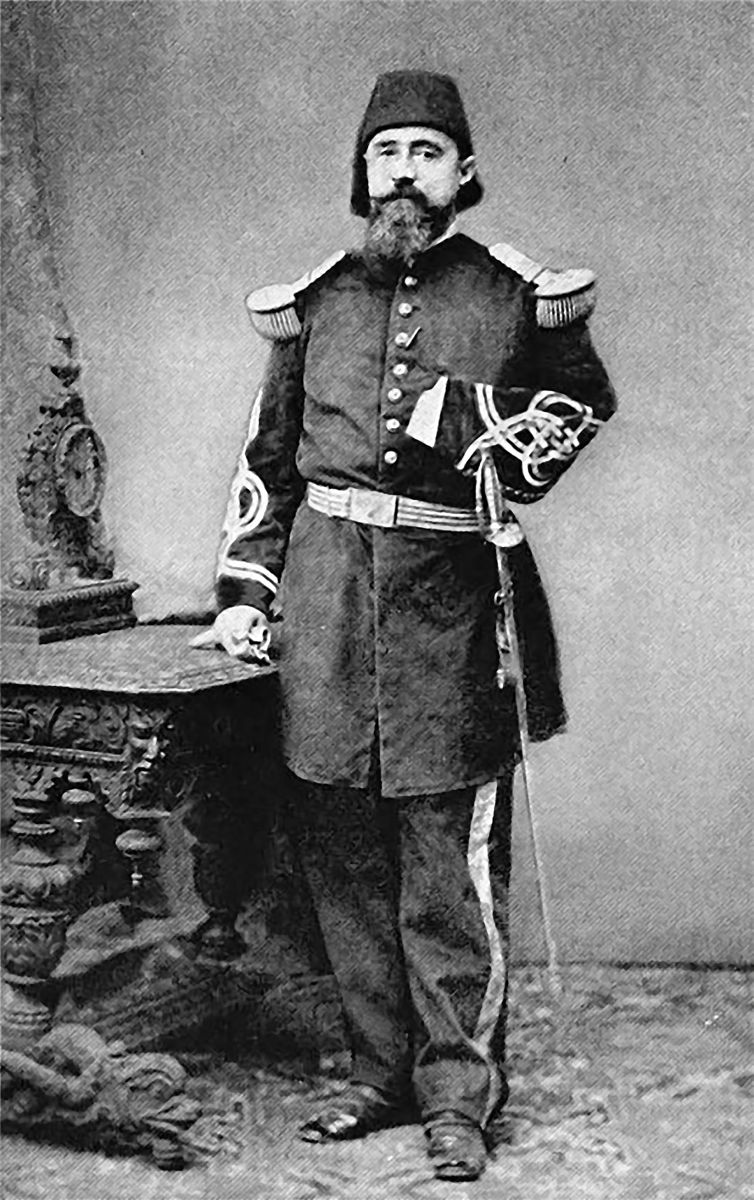
Major General William W. Loring served in Egypt in 1874; he had previously held the rank of Major in the Confederate Army before enlisting in the Egyptian Army following the Civil War. He would emerge as a prominent General during the Ethiopian-Egyptian conflict.
www.baltimoreshow.com www.baltimoreshow.com maca@baltimoreshow.com 410-432-1898 Presented By:
The Maryland Arms Collectors Assoc.
9603 Deereco Rd., #446 Lutherville-Timonium, MD 21094
Photographs from the Original Article
Captions and credits appear in the article text as originally printed.