
Untitled (p. 6)
Originally published March-April 2026 · pp. 6–9

Although preservationists have fought for years to protect Manassas National Battlefield Park in Northern Virginia, a new challenge awaits: data centers. “We can’t predict how future generations will value these places, but we can predict that they will value them,” said John Hennessy, a retired National Park Service ranger and historian. “We can predict that they will use them to understand them, and they tell us about American history and about American culture.” The federal government established Manassas National Battlefield Park in 1940, but efforts to preserve the land, where Union and Confederate armies fought two large battles of the Civil War, began in 1921. At the time, the Sons of Confederate Veterans built a small park on what is now known as Henry Hill. “The United States uses land preservation as a tool for commemoration unlike any other country in the world,” Hennessy said. “Americans probably preserve more battlefield-related land related to the Civil War than the rest of the world preserves in all the wars that were fought in history.” Rapid development in Northern Virginia has continuously threatened the Manassas Battlefield. Preservationists have fought off multiple large-scale development projects on or near battlefield land. There were plans to build Interstate 66 through the heart of the battlefield, a Marriott amusement park, shopping centers and a Disney park. All efforts have been squashed. “It’s an uncommonly American thing to use land and these landscapes as a tool for commemoration and remembrance,” Hennessy said. The latest threat to the battlefield is a data center campus on the western edge of the battlefield. “The data center industry in the state of Virginia had flown under the radar for two decades,” said Kyle Hart, the MidAtlantic senior program manager for the National Parks Conservation Association. “Then these two companies [QTS Data Centers and Compass Datacenters] decided that they’re going to plan this extremely egregious project, and all of a sudden the whole world is talking about the data center industry.” In 2021, QTS Data Centers and Compass Datacenters proposed a plan to build up to 27.6 million square feet of data centers. Dubbed the “Prince William Digital Gateway,” the plan would create the largest data center campus on Earth, if completed. The data center campus would sit between Manassas Battlefield and a state park, Conway Robinson State Forest. “There’s campsites that happened through there,” said Anthony Trusso, an NPS park ranger who worked at Manassas National Battlefield Park. “Someone from the county was saying that there’s [an] African-American gravesite there. It’s within the realm of possibility that there was some shooting over there.” Title page: The viewshed from atop Henry Hill would be permanently altered if the proposed PW Digital Gateway is developed on the border of the battlefield. (Melissa A. Winn)
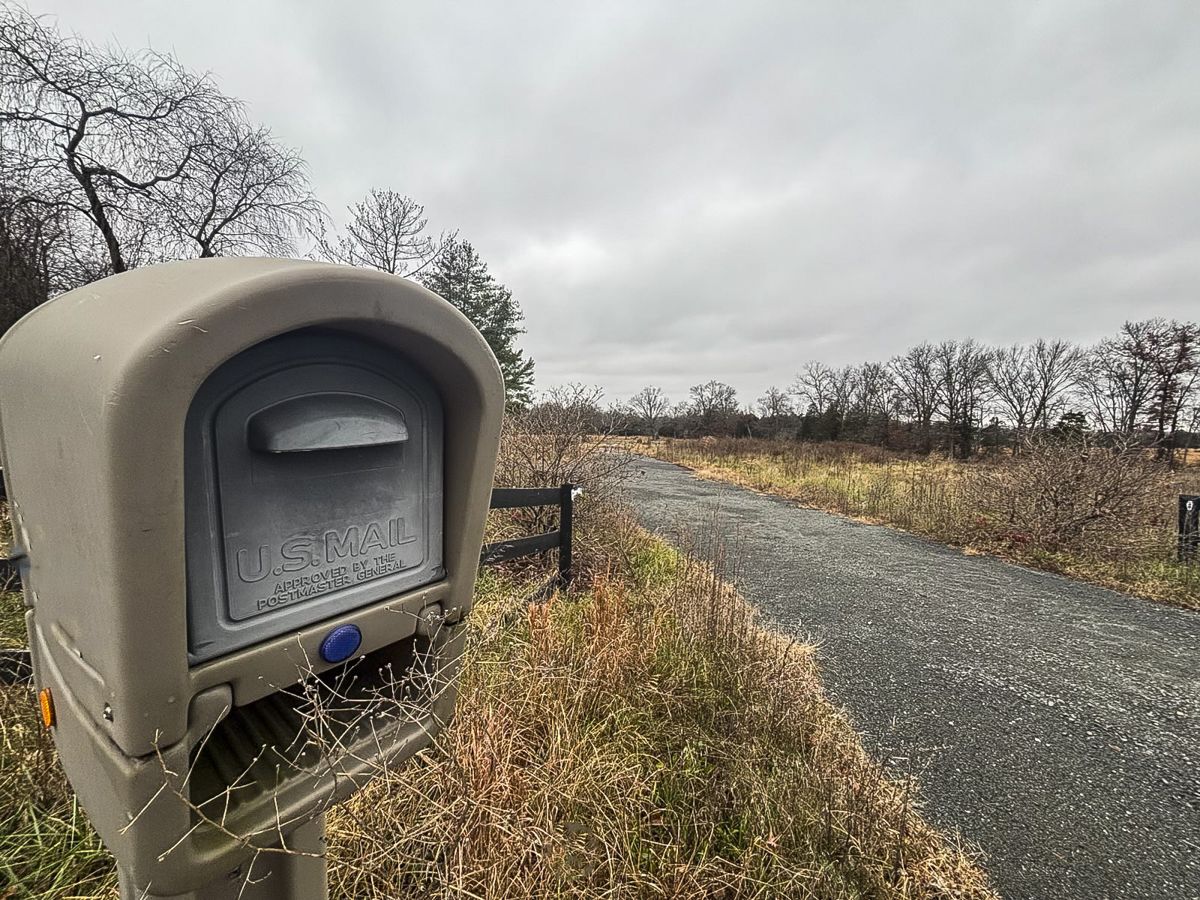
The site of a demolished house that still has the mailbox up, which is now on proposed data center land. (Alex Winn)
An artillery demonstration on the Manassas Battlefield. (Melissa A. Winn)
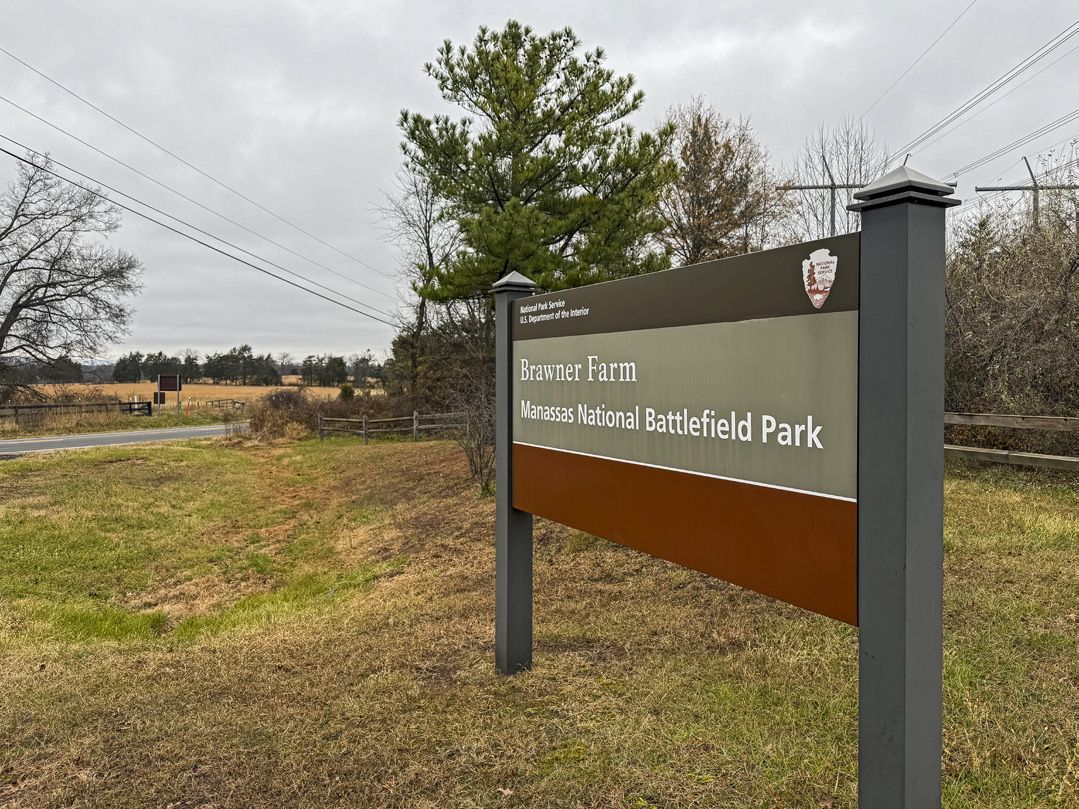
The Prince William Digital Gateway data center farm would sit directly across the street from the park entrance at Brawner Farm. (Melissa A. Winn)
While many localities might welcome a data center project of this size for its capital investment, construction employment, and ongoing tax revenue, the proximity of this project to an historic landscape presents unique challenges, including concern about its impacts to the protected viewshed, visitor experience, historic resources and the ecological character of the park and its surrounding buffer. Opponents of the data center development particularly cite watershed impacts and energy requirements, with specific concerns about grid constraints and water quality, including impact on the National Park’s waterways from sedimentation during construction, increased runoff, pollutants and thermal impacts to streams. A comprehensive plan guides future growth, redevelopment and preservation of Prince William County, including investments in future public infrastructure, according to the county’s government website. QTS Data Centers and Compass Datacenters proposed a comprehensive plan amendment in 2021. “The project is so big. It will require as much energy as New York City needs,” Hart said. “It will completely change the face and feel of the battlefield forever. It will negatively impact communities hundreds of miles away due to increased air pollution and new transmission lines in their backyard.” The Virginia General Assembly called for a yearlong study by the Joint Legislative Audit and Review Commission that concluded in January of 2024. It found that data center growth in Virginia will drive a 183% increase in energy demand by the year 2040 if not stopped
in some way, according to the American Battlefield Trust. “The much simpler solution is to relocate development someplace other than on the edge, and inevitably within, the battlefield,” Hennessy said. On Nov. 1, 2022, the Prince William County Board of Supervisors approved the amendment to the county’s comprehensive plan to account for the new data center project. Next, the Board had to complete a rezoning process to allow the developers to build on the land. “The project had been super controversial from the start. About a year into the comprehensive plan process, there was a primary against the board chair,” Hart said. “A woman named Deshundra Jefferson decided that she was going to primary in the Democratic Party against [incumbent] Ann Wheeler. Her main platform was data center reform, no Digital Gateway.” Jefferson won the primary against Wheeler, and the popular opinion was that Jefferson would win the chair position in the November election. The developers pushed to move the rezoning process through before Jefferson could take office Jan. 1, 2024. “In late summer 2023, the developers demanded a hearing [on the rezoning for their data centers],” Hart said. “The county planning office said, ‘We’re not ready for a hearing,’ and the developers said, ‘We don’t [care].’” The county planning office scrambled to prepare a hearing for the rezoning process. Meanwhile, the developers were required to complete a land use application to formally request permission from Prince William County to develop the land.
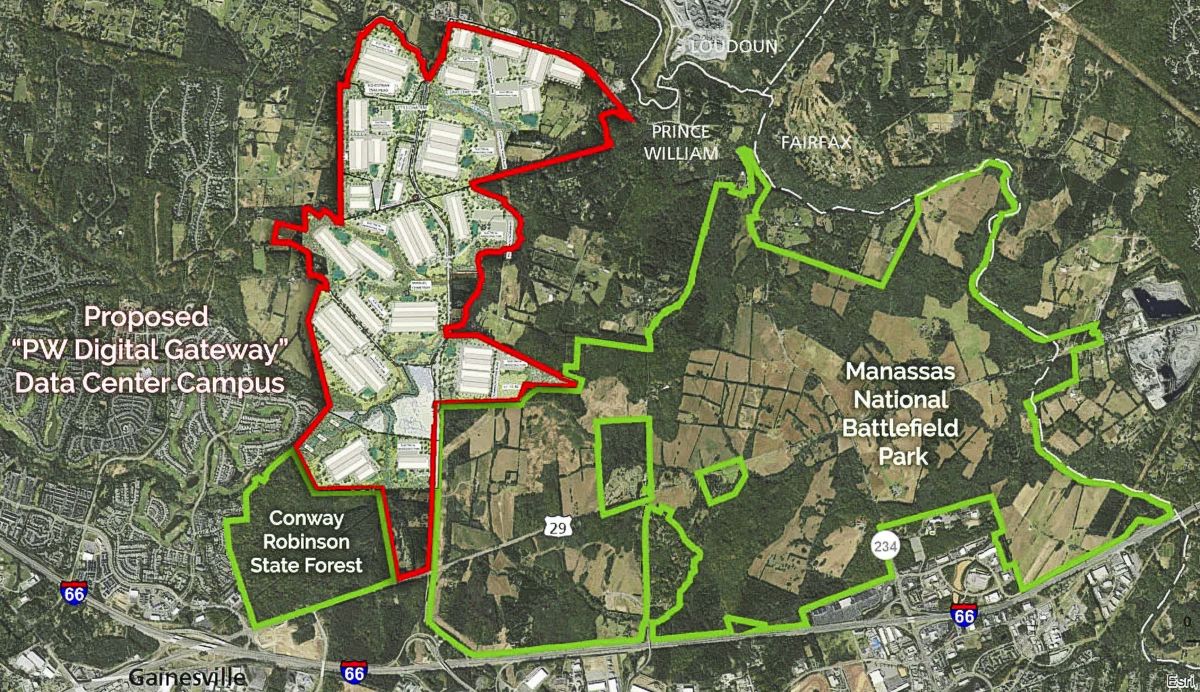
This satellite image overlaying the masterplan illustration of the Digital Gateway data center proposal, illustrates the scale and scope of the project in comparison to nearby Manassas National Battlefield Park and Conway Robinson State Forest. (Courtesy of Piedmont Environmental Council)
After Jefferson won the November election, the Board of Supervisors quickly scheduled two more hearings between Thanksgiving and Jan. 1, 2024, when Wheeler would leave office. “The [developers] start cutting corners,” Hart said. “They start leaving things out and doing things the wrong way.” One of the requirements for the county in state code and county code is public notice. Public notice is information alerting citizens of government or government-related activities that may cause a citizen to take action. Traditionally and effectively, counties have used newspapers to publish public notices because newspapers spark curiosity and are delivered to the interested public, according to the Public Notice Resource Center. The county is required to alert the public about a hearing. Virginia state law requires that the first public notice for a hearing be posted no more than 28 days before, but no less than 15 days before. The second public notice must be posted no less than five days before the hearing and at least a week must separate the first and second public notices. Under the developers’ rushed process, county staff failed to publish the notices on time. “The developer sent an email to the county office and said, ‘We don’t care. We’re willing to take the legal risks, give us our hearing anyways,’” Hart said. A hearing on all three required rezonings was held on Dec. 12, 2024. It lasted 27 hours, ending on Dec. 13. The developers wanted all the proposed rezonings to be heard concurrently before Wheeler left office, leading to the extended hearing. “[The developers] have the audacity to get up to the microphone and say, ‘this is as good as it gets,’” Hart said. “Come on, man, go somewhere else. There’s just some places that shouldn’t be the world’s largest data center campus, and the gates of a national park site is one of them.” This is the defining issue near Manassas Battlefield. Even if the project meets environmental requirements, preservationists argue it’s incompatible with the battlefield’s setting. Civil War battlefield parks are not merely “open space,” they argue, battlefields like Manassas are interpretive landscapes and spatial orientation and visual continuity are central to understanding the history. At the end of the 27-hour hearing, the board voted on the rezonings. The first vote on a motion to veto all three projects was a deadlock, 4-4, potentially killing the Prince William Digital Gateway.
A motion to approve the project was made, and the vote came in at 4-3-1. One supervisor abstained, allowing the approval to pass and the developers to begin their project. “Almost immediately, two different groups, American Battlefield Trust and the Oak Valley Homeowners Association, sued the county,” Hart said. “[They] said, ‘Hey, you didn’t follow the rules. We had rules, and you didn’t follow them.’” The lawsuit argues the county did not post the second public notice on time. The county posted it on Dec. 9, four days, not the required five days, before the December 12 hearing. On Aug. 7, 2025, Circuit County Judge Kimberly Irving ruled in favor of the Oak Valley Homeowners Association, saying the Board of Supervisors improperly approved the rezonings. The county and developers immediately appealed the decision, and on Oct. 28, 2025, the Virginia Court of Appeals issued a stay on Irving’s decision, allowing construction of the data centers to continue while the legal process played out. That decision was neutralized by the Virginia Court of Appeals on Nov. 17, 2025, in a ruling that prohibits building until the lawsuit against the county is finished. “They’ve almost done us a favor by putting a spotlight on an industry that needed a spotlight on it because now people are paying attention, and it’s because of this project,” Hart said. Oral arguments for the lawsuit are scheduled for the week of Feb. 23, 2026. The historic Battles of Manassas may be over, but the struggle for the battlefield continues on a new front.
Alex Winn is a staff writer for the Collegiate Times, an
independent, student-run newspaper serving Virginia Tech since 1903. He is currently pursuing a bachelor’s degree in
Sports Media & Analytics at Virginia Tech. He also works as a production assistant for Hokie Vision. Alex earned an associate degree in communications studies from Northern Virginia Community College, where he attended classes at the Manassas campus next door to the Manassas National Battlefield Park. Its close proximity to the Battlefield sparked Alex’s interest and concern for its preservation.
Photographs from the Original Article


Captions and credits appear in the article text as originally printed.