
Through the Lens More Serious than Expected
Originally published March-April 2026 · pp. 14–17
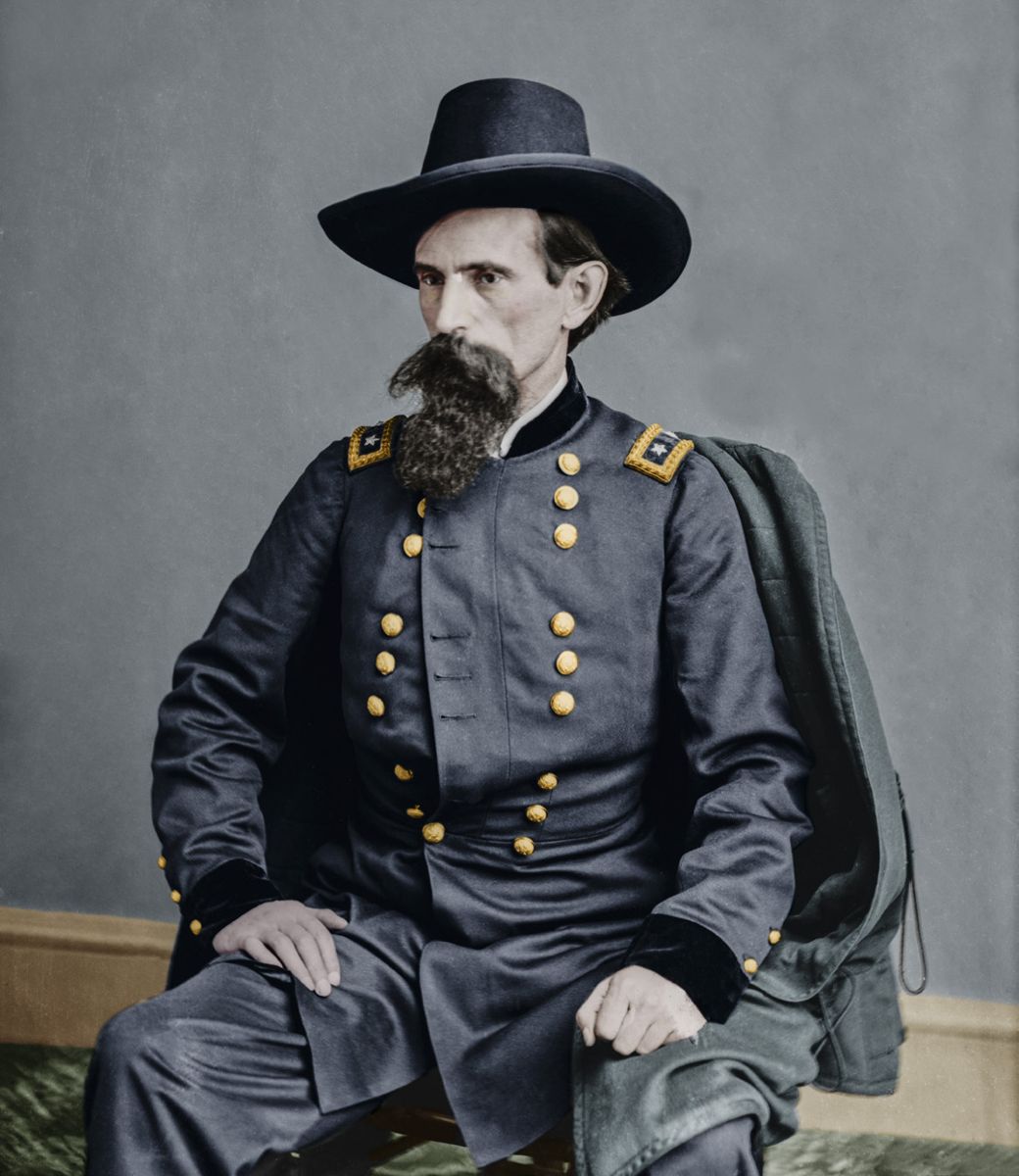
Towards the end of June 1864, C.S. Gen. Jubal Early, Army of the Valley, had left the Shenandoah Valley, Va., to “threaten Washington and if I find the opportunity—to take it.” Believing Early was in Petersburg, Va., U.S. General-in-Chief of the Armies, Ulysses S. Grant, disregarded contradicting intelligence. The approaching column of Confederates was brought to the attention of U.S. Brig. Gen. Lew Wallace, Cmdr. VIII Army Corps, Middle Department, by John W. Garrett, president of the Baltimore & Ohio Railroad (B&O). Garrett had spent over $11,000 repairing the railroad bridge over the Monocacy River, Md., the previous year due to Confederate damage. He did not want to repair it again. Wallace, the future author of the mega-blockbuster Ben Hur: A Tale of the Christ, had been sidetracked to an administrative post in Baltimore. As the bridge was essential to communication with Harpers Ferry, Wallace agreed to protect it.
Brig. Gen. Lew Wallace. Colorization © 2026 civilwarincolor.com. (Library of Congress)
U.S. GEN. LEW WALLACE “… BUCKLED ON HIS SWORD SAYING HE WOULD GO DOWN TO POINT OF ROCKS (THE EXTREME LIMIT OF HIS DEPARTMENT) AND LOOK AFTER A GANG OF GUERILLAS THERE, WOULD BE BACK DAY AFTER TOMORROW. ONCE THERE HE FOUND THINGS MORE SERIOUS THAN HE EXPECTED.” – MRS. SUSAN WALLACE
Wallace had 3,200 men, consisting mostly of three units of hundred-days enlistees intended to replace trained soldiers headed South, two traditional three-year regiments, and an artillery battery. Wallace had instructed Gen. Erastus B. Tyler, “if necessary push … any other available troops forward to Monocacy Junction.” Wallace convinced U.S. Lt. Col. David Clendenin’s 8th Illinois Cavalry, 230 men, with Capt. Frederick Alexander’s Baltimore Light Artillery, to stay in the area. Col. William Henry, 10th VT, was persuaded to ignore orders and disembark at Monocacy Junction. Grant sent Gen. James Ricketts, 3,350 men, to Monocacy. The men marched the 15 miles from Petersburg to City Point, Va., traveled by steamer across the Chesapeake Bay, were ushered into cattle cars, and immediately brewed coffee upon arrival at Monocacy Junction, “pretty tired of [the] U.S. transporting us around.” On July 8, at about 4 p.m., Wallace watched thousands and thousands of Early’s infantry and artillery trains coming down from South Mountain. During the rainy night, the Federals crossed the Monocacy River and spread out over a five-mile front. Washington took the threat seriously after Wallace had sent word that he would “put myself in position on the road to cover Washington, if necessary.” On July 9, a beautiful summer day, Ricketts’s brigade was on the high ground left of the Georgetown Pike. Tyler’s brigade was along the Baltimore Pike. The Battle of Monocacy began at 6 a.m. with skirmishing on the Baltimore Pike and on the Georgetown Pike. Early’s intention was to economically dislodge the Federals. Washington, D.C., was only 40 miles away. About 10 a.m., Ricketts spotted the Rebels. Alexander’s big howitzer began firing. The Confederates’ nine batteries, consisting of 36 big guns, returned fire. Frederick Wild of Alexander’s battery said, “For every shot fired, we received two in return.” C.S. Gen. John McCausland crossed the Monocacy River and was making his way through the waist-high corn toward the fence line. Wallace, spotting him, sent a message to Ricketts to “advance to the cornfield fence, concealing yourself behind it.” The Confederates charged towards the only man visible, Ricketts on horseback, with “a tempestuous tossing of guidons, waving of banners and a furious trampling of the young corn that flew before them like splashed billows.” On Ricketts’s signal, his men rose as one and fired. “My God,” cried Wallace’s aide, “They are all killed!” According to Wallace, the entire Confederate line “had disappeared. Not a man of it was to be seen, only the green of the trodden corn, some horses galloped about riderless and a few mounted officers bravely facing the unexpected storm.” The Federals fired at will at anyone who moved. The Rebel officers tried to rally the men and threatened to kill anyone fleeing. From the cellar of her home, Mrs. Worthington could hear the threats and exclaimed, “Poor creatures, it means death to them either way.” U.S. Capt. Charles Brown’s 1st Maryland Potomac Home Brigade, 200 men who had just begun their hundred-days enlistment, and Lt. George Davis’s 10th Vermont Infantry,
75 veterans, were tasked with defending two bridges. About 8:30 a.m., C.S. Gen. Robert Johnson’s men approached. Brown refused to fire on the men dressed in blue clothing. Davis “stoutly protested, telling him our friends were behind us.” Johnson fired on the men, “dropping a handful of Marylanders. Brown insisted that Davis take over command. Davis brought up the Vermonters to return fire for an hour before the Rebels retreated. About 11 a.m., the Rebels approached from the right and rear of Davis’s men. Wallace and Ricketts watched from across the river. Wallace ordered the wooden bridge connecting the pike burned. His top priority was blocking the Confederate route to Washington. Yet Davis was able to change position and repel the attack with the aid of vigorous artillery from the heights. Davis returned to his previous location to protect the railroad bridge and the junction. The third attack came about 3:30 p.m. The Confederates sent in more men. The Federals held with the help of artillery from across the river. The hundred-days men melted away, crossing the 40-feet-high railroad bridge with cross ties intended for trains, not foot traffic. The 10th continued to fight for about an hour. Davis called for a retreat. Together they made their way “stepping tie by tie, under fire at close range and forty feet in the air.” Davis and Alexander Scott, who carried the state and national flags to safety, were awarded the Medal of Honor. C.S. Gen. John B. Gordon’s 3,600 men were being held in reserve. “We made ourselves comfortable and lay down under the shelter provided, Lt. John W. Worsham, 21st VA Infantry wrote, “to look at a battle, something we had never done before.”
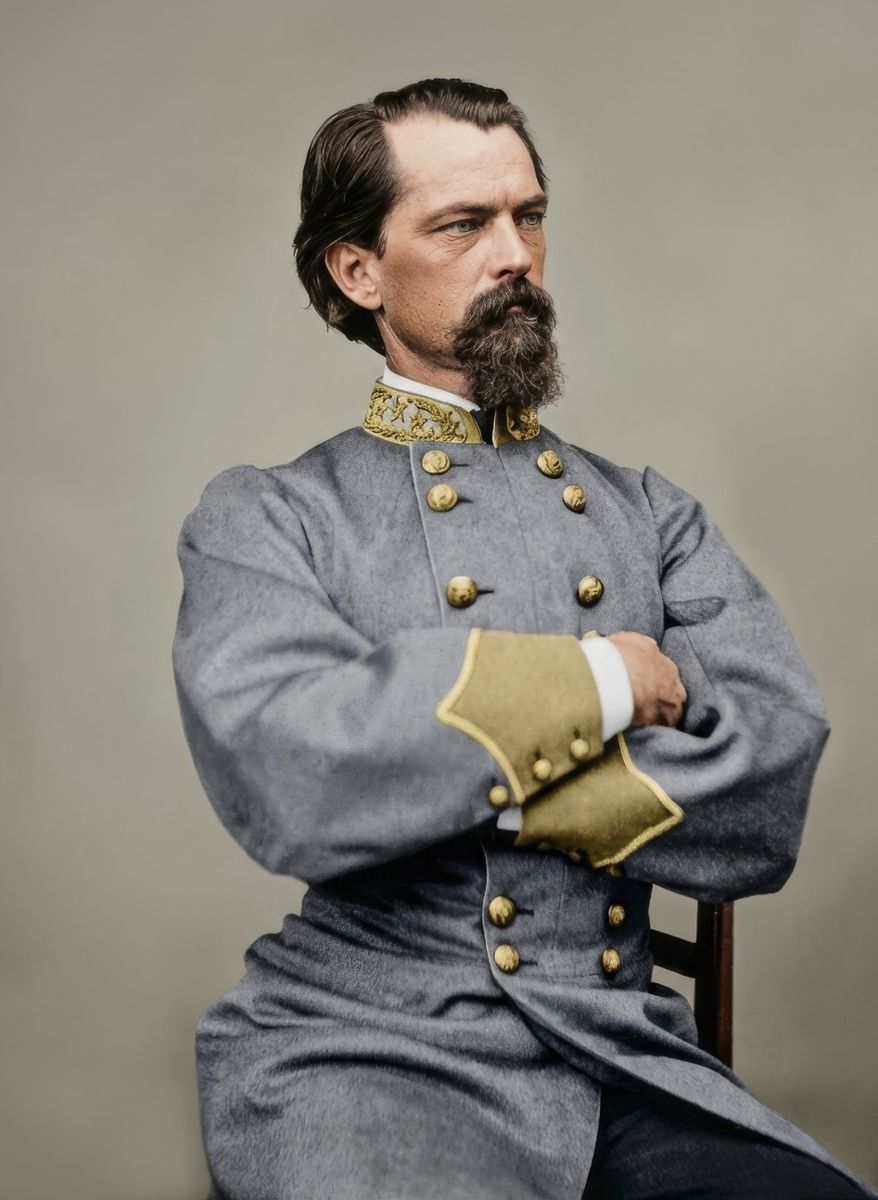
Orders came to quickly enter the fight. The battlefield was an obstacle course with strong fences and recently harvested grain stacks. Lt. Col. J. Floyd King, Monroe Virginia Artillery, positioned his guns. About 3:30 p.m., Gordon’s men entered the field. “Up went our old yell all along the line of our division, and it was answered by our comrades on the other side of the river,” wrote Worsham. According to Gordon, “The fighting was desperate and close quarters.” Gordon’s favorite battle horse was shot out from under him, “in the very crisis of the battle.” A “thoughtful officer” supplied him with another. Gordon rode over to Gen. William Terry, Stonewall Brigade, to request the Virginians outflank Ricketts’s right, leading to the collapse of the Federal line. It was 4:30 p.m. The Federal infantry and artillery were running out of ammunition. The men were losing ground. Wallace ordered a retreat. He sent a message to Washington at 11:40 p.m. “… I am retreating with a foot-sore, battered, and half-demoralized column. Forces of the enemy at least 20,000. They do not seem to be pursuing.” Grant wrote in his memoirs that Wallace’s contribution, “by the defeat of the troops under him a greater benefit to the cause than often falls to the lot of a commander of an equal force to render by means of victory.” Monocacy would be Wallace’s last battle. As a memento, he was given the captured 17th VA flag. Wallace would hang it in his hallway where “the light breaking over my shoulders has a trick of turning the starred symbol into a red flash of such electrical effect that I must stop and look at it.” Sources f Leepson, Mark. Desperate Engagement: How a Little-Known Civil War Battle Saved Washington, D.C., and Changed American History. Thomas Dunne Books, 2013. f Wallace, Lew. Lew Wallace: An Autobiography. Harper & Brothers, 1906. f Haynes, Chaplain E. M. A History of the 10th Regiment, Vermont Volunteers with Biographical Sketches… Tenth Vermont Regimental Association, 1870; reprint, Tuttle, 1894. f Quint, Ryan T. Determined to Stand and Fight: The Battle of Monocacy, July 9, 1864. Savas Beatie, 2017.
Monocacy Junction. (Library of Congress)
ACE
pyro llc editor for CivilWarInColor.
CivilWarIn3D.com. She also writes a column for HistoryInFullColor.com that com and covers stories of photographs of historical interest from
1850s to the present. Her articles can be found on F acebook , T umblr , and Pinterest. the
Subscribe Today!
MID SOUTH MILITARY HISTORY & CIVIL WAR SHOW The South’s Oldest Military History Show
March 6 & 7, 2026
Only $34.95 /year for
Friday 1-6 PM • Saturday 9-5 PM
6 issues or
LANDERS CENTER
I-55 at Church Rd, EXIT 287, Southaven, MS 38671
$59.95 for 2 years
15 minutes from Downtown Memphis
ADMISSION: ADULTS $10 (2 day pass $15) • CHILDREN 12 & UNDER FREE
Subscribe and join our thousands of readers at https://tinyurl.com/277vpke9 CivilWarNews.com
QUALITY RELICS FROM THE AMERICAN REVOLUTION - VIETNAM ERA
FOOD TRUCKS • LIVE MUSIC & MORE ! BOOKS DOCUMENTS CANNONS ANTIQUE BOTTLES
WEAPONS CURRENCY UNIFORMS HISTORIANS & SPEAKERS
Fort Fisher items wanted st!