
This & That 2025 Middle Tennessee
By Gould Hagler · Originally published March-April 2026 · pp. 46–49
& I
This & That
A Closer Look at the Cast
n my last column, I wrote about events at Fort Sumter between South Carolina’s secession and April 12, 1861, when the shooting started. In this issue and the next I will take a closer look at some of the men who played a role in these events. Their names will be familiar to most readers, but the details of their biographies may not be so well known. I will cover two in this column and two others in the following column.
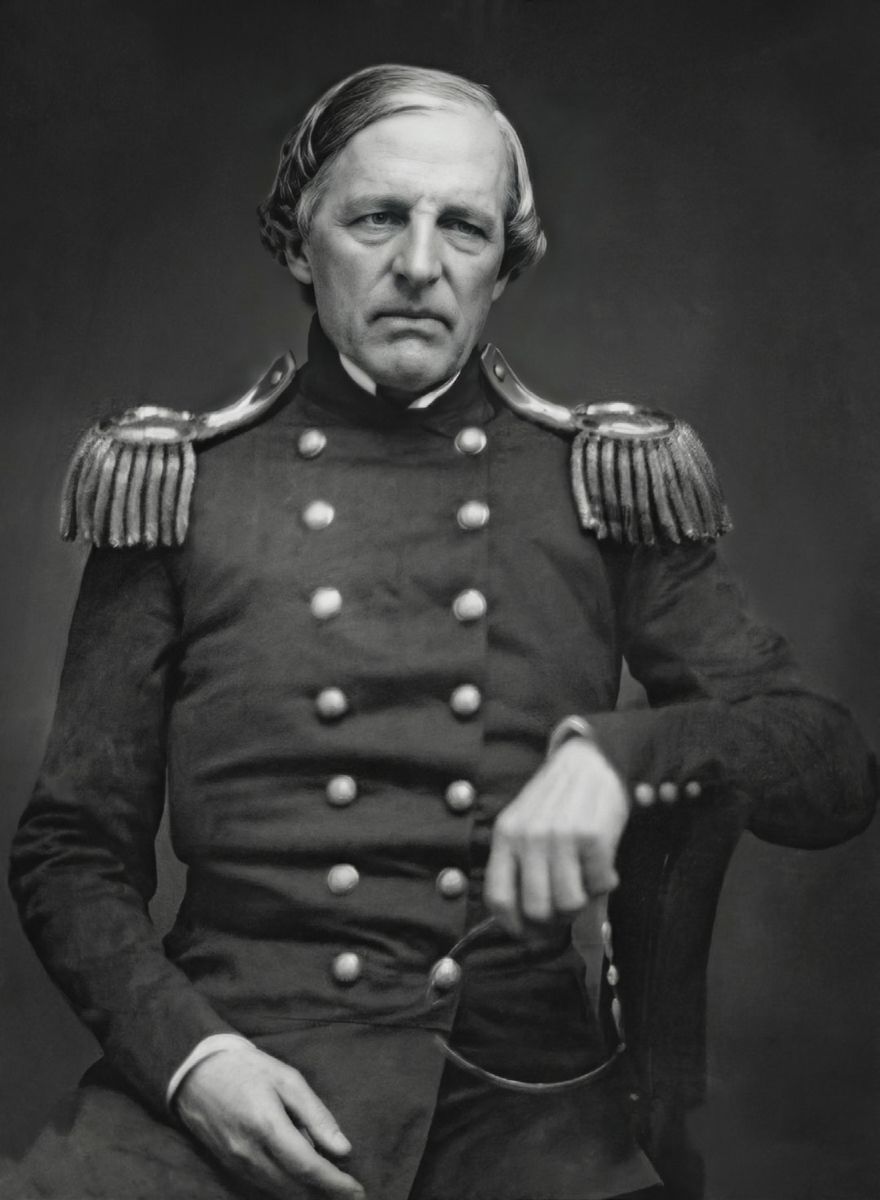
U.S. Maj. Robert Anderson (Brig. Gen. from May 15, 1861). (Library of Congress)
The Commandant
Let’s start with Maj. Robert Anderson, the Kentuckian whose decision to move his garrison from Fort Moultrie to Fort Sumter on Dec. 26, 1860, increased the tension in an already-tense situation. Anderson was the scion of a prominent Virginia family. His father was Richard Clough Anderson, an officer in the Continental Army in the Revolutionary War. The senior Anderson participated in one of the most famous events in American history, crossing the Delaware River with Washington’s force in the final days of 1776. He fought in the war to the finish and, as a lieutenant colonel, served as aide-de-camp to LaFayette at the war-ending Battle of Yorktown. His first wife was the sister of George Rogers Clark and William Clark. His second wife, Robert’s mother, was the cousin of Chief Justice John Marshall. The Andersons moved to Kentucky, where Robert was born in 1805 at “Soldier’s Retreat,” the family plantation. Anderson graduated from the U.S. Military Academy in 1825. Upon graduation, he was assigned to the artillery. However, his military service was delayed while he acted as private secretary to his half-brother, Richard Clough Anderson Jr., a diplomat negotiating a treaty with Gran Colombia. In 1832, Lt. Anderson fought in the Black Hawk War. Among the men in this brief conflict was one of the volunteers from Illinois, Abraham Lincoln.1 Following the war, Anderson formed a friendship with Jefferson Davis when they officered the escort that took Black Hawk and other prisoners from Wisconsin to Jefferson Barracks in Missouri. For two years, Anderson served as an assistant instructor of artillery at the Academy. He was brevetted captain in 1838 for his service in the Second Seminole War. Later that year, as aide-de-camp to Maj. Gen. Winfield Scott, Anderson served in the force that removed the Cherokees west to Indian Territory. Next came the Mexican War, where Anderson was severely wounded in the Battle of Molino del Rey. He was later brevetted major for his “gallant and meritorious conduct” in that bloody assault.2
By 1860, after a decade of peacetime duties, the 55-yearold major would have been, in ordinary times, nearing a quiet end to his long years of service in the United States Army. That was not to be: Anderson was assigned to command in Charleston in November. The commander was, in outlook, a Southern man. His wife was the daughter of Duncan Lamont Clinch, a brigadier general in the War of 1812 and the owner of a rice plantation in coastal Georgia. Mrs. Anderson inherited a number of slaves from her father, and the couple continued to own slaves until they sold them in 1860. In a letter to a friend, written from Fort Sumter, Anderson expressed his views on the national crisis. “Like yourself,” he wrote, “my sympathies are in the matter of the sectional controversy all with the South, but I must confess that I have lost all sympathies with the people who govern this state. They are resolved to cement their secession with blood.” Anderson’s home state remained loyal to the Union, as did he. He had fervently hoped for a peaceful solution to the crisis. He was a quiet and religious man, not seeking fame, but fame was thrust upon him. The much-acclaimed Hero of Fort Sumter was made a brigadier general the month following the surrender. In poor health, he remained on active duty for only a short time. On Feb. 3, 1865, Anderson was brevetted major general “for gallant and meritorious service in defence of Fort Sumter, South Carolina.”3 On April 14, 1865, Anderson returned to Sumter and, just hours before Lincoln’s assassination, ceremoniously raised the flag he had lowered four years earlier. It is interesting to note that while Anderson occupied Sumter, one of the Confederate boats patrolling the harbor to keep an eye on the garrison was the General Clinch, named for the major’s late father-in-law. Like many other families, the Andersons were divided by the conflict. Mrs. Anderson had two brothers who served in the Confederate army. As is well-known, the war also divided many friendships among the professional officers in the small, prewar army. One of Anderson’s close friends was a former student who later became a colleague teaching artillery at West Point, P.G.T. Beauregard, the very man who commanded the guns that reduced Fort Sumter in April 1861. Anderson retired from the army in 1863, “for disability resulting from long and faithful service, and wounds and disease contracted in the line of duty.”4 In 1870, the Andersons moved to Europe. Anderson died in Nice in 1871.
He graduated with the class of 1815 and was assigned to the artillery. In 1827, while he was in Washington with the 3rd Artillery, Cooper married Sarah Maria Mason, a granddaughter of Founding Father George Mason. Her brother James M. Mason was a prominent Virginia politician who represented the state in the United States Senate from 1847 until 1861.5 Another brother, John, was the son-in-law of Gen. Alexander McComb, the army’s commanding general from 1828 to 1841. Soon after his marriage, Cooper was assigned to McComb’s staff, where he remained until 1836. He then served as assistant adjutant general in the War Department. The New Yorker benefited socially and professionally from his connection to the prominent Virginia family into which he married. Samuel and Sarah resided in Alexandria, across the river from Washington, where the officer was to spend most of his career. In William C. Davis’s words, Cooper’s professional life was that of a “desk soldier” operating on a “paperwork battlefield.” There were two assignments far from the capital and its desks and paperwork. In 1841 and 1842 Cooper left Washington for Florida and the Second Seminole War, where he was Gen. William Worth’s chief-of-staff. A decade later, Gen. Winfield Scott, McComb’s successor, dispatched Cooper on an inspection tour of the army’s western forts, during which Cooper traveled 5,000 miles on a two-year trek. Not exactly desk duty, but also not combat.
The Adjutant General While at Moultrie and Sumter, Maj. Anderson regularly reported to his superiors in Washington. Between Nov. 23, 1860, and March 19, 1861, Anderson sent over 60 reports to Col. Samuel Cooper, Adjutant General, U.S. Army. Cooper did not see the last ten: he resigned on March 7 to join the Confederacy. Samuel Cooper’s father was a Revolutionary War veteran who fought from the very start, at Lexington and Bunker Hill. After the war, Capt. Cooper moved from Massachusetts to New York, where he married. Samuel was born in 1798. He entered West Point in 1813, just shy of his 15th birthday.
Col. Samuel Cooper, ca. 1856. (National Portrait Gallery, Smithsonian Institution)
Back in Washington in 1852, Cooper was named adjutant general of the U.S. Army when his predecessor died in office. He continued in this position during the presidencies of Franklin Pierce and James Buchanan. He resigned three days after Lincoln took office. The decision to resign and join the South was probably not a hard decision for Cooper. As William C. Davis wrote, “He had married a Virginia woman and had ties to a distinguished Old Dominion heritage. As a longtime resident of Washington, a predominately Southern city in its social caste, his associations for decades had been Southern.” Cooper switched sides, but he did not change jobs: he was named adjutant general of the Confederate Army and held that position for the entire conflict. On April 2, 1865, he was in the same church service as Jefferson Davis when the message came from Lee informing the president that the army could no longer defend Richmond. “That evening,” wrote William Davis, “the adjutant general boarded the train loaded with most of the cabinet, and along with his clerks, books, and records set off for Danville.” The short-lived government-in-exile moved from Danville to Greensboro, N.C., then to Charlotte. On April 26, tired, unwell and far from young, Cooper advised the president he could go no farther. He stayed in the North Carolina city and preserved the records of the War Department. As ordered by Secretary of War John C. Breckinridge, Cooper surrendered the archive to Federal authorities when they arrived.
How good was Cooper at his job? Some were critical of his performance, but Cooper maintained the support of the person who mattered most. After the war, in The Rise and Fall of the Confederate Government, Jefferson Davis wrote that Cooper was “as pure in heart as he was sound in judgment.” Postwar life was not an easy one for Samuel and Sarah Cooper. After a year in the Charlotte area, they returned to Alexandria to a home as ruined as their finances. They were still living in near-penury when Samuel died in 1876. Sarah lived until 1890. In the next issue we will have a look at a Federal general who managed to dodge two (metaphorical) bullets and a senator (U.S. and C.S. both) with a wild streak. Sources: William C. Davis, “General Samuel Cooper” in Leaders of the Lost Cause, edited by Gary W. Gallagher and Joseph T. Glatthaar, 2004; David Detzer, Allegiance, 2001; Erik Larson, The Demon of Unrest, 2024; David Silkenat, Raising the White Flag, 2019; Encyclopedia Virginia, https://encyclopediavirginia.org; Officers of the Army and Navy (Regular) who Served in the Civil War, https://archive. org/stream/officersofarmyna00powe/officersofarmyna00powe_djvu.txt; David Heiby, https://gravestonestories.com/samuel-cooper-confederategeneral,“Samuel Cooper: From Respected Army Officer to Confederate General”; OR, Ser. I, Vol. I; Endnotes: 1. 2.
Ulysses S. Grant
According to Detzer it is unlikely the two ever met. Officers of the Army and Navy (Regular) Who Served in the Civil War Ibid. Ibid. James Mason was one of the two Confederate envoys who, in 1861, were taken from a British vessel in the famous Trent affair.
HQ:
generalgrantbyhimself.com
E-Telegraph:
curtfields@ generalgrantbyhimself.com
Portrayed by E.C. Fields Jr., Ph.D.
Signal Corps: (901) 496-6065 Facebook@ Curt Fields
Gould Hagler is a retired lobbyist living in Dunwoody, Ga. He has been a regular contributor to CWN since 2016. He can be reached at gould.hagler@gmail.com.
The N-SSA is America’s oldest and largest Civil War shooting sports organization. Competitors shoot original or approved reproduction muskets, carbines and revolvers at breakable targets in a timed match. Some units even compete with cannons and mortars. Each team represents a specific Civil War regiment or unit and wears the uniform they wore over 160 years ago. Dedicated to preserving our history, period firearms competition and the camaraderie of team sports with friends and family, the N-SSA may be just right for you.
For more information visit us online at www.n-ssa.org.
Civil War Back Issues
NEWS
Available for Purchase
To purchase back issues visit our secure website: https://simplecirc.com/shop/civil-war-news or call us at 800-777-1862.
Civil War VOL. 50, NO. 5 | MAY-JUNE 2024
NEWS
$7.99
Civil War NEWS
VOL. 50, NO. 6 | JULY-AUGUST 2024
$7.99
Civil War NEWS
VOL. 50, NO. 7 | Sept.-Oct. 2024
$7.99
Civil War NEWS
VOL. 50, NO. 8 | Nov.-Dec. 2024
$7.99
The Truth At
Featuring
Ken Burns, Martin Sheen, & Sam Waterston
Cassville Was Joe Johnston honest with History?
Maj. Gen. John A. Rawlins On Display:
Vision and Valor: The War Through Women’s Eyes
The Herb Peck
The Enfield at Manassas
Photography Collection
Fresh Views of the War’s Most Famous Fort Battles—and Their Impact on Families
A Surprising Collection of His Personal Belongings is Discovered
Gen. David Hunter and the Newtown Burnings
Medal of Honor for Two of Andrew’s Raiders
The Importance of Reputation
The Lawbook Raid
Stephen Lang and Jeff Shaara Star in a Holiday Weekend
Douglas Southall Freeman: Lee’s Lieutenants
Burnside’s Invasion of East Tennessee Remembering Peter Carmichael “Funded by Faith”
Cotton Bonds & The Erlanger Loan
Tragedies and Statistics
PTSD in the Civil War
Shelby Foote’s The Civil War: Fort Sumter to Perryville
Thoughts on Hat Insignia
Lost from the Landscape
Vol. 50, No. 5. May-June 2024
Vol. 50, No. 6. July-August 2024
Vol. 50, No. 6. Sept.-Oct. 2024
Vol. 50, No. 8. Nov.-Dec. 2024
Civil War
Civil War
Civil War
Civil War
NEWS
VOL. 51, NO. 1 | Jan.-Feb. 2025
$7.99
NEWS
VOL. 51, NO. 2 | March-April 2025
$7.99
NEWS
VOL. 51, NO. 3 | May-June 2025
$7.99
That Old Yell
NEWS
VOL. 51, NO. 4 | July-August 2025
$7.99
Anesthesia
We Had Learned To Know So Well
Before and During the Civil War
“Behold a Pale Horse”
“Playing War”
Captain Winston J.T. Stephens and the St. Johns Rangers in NE Fla.
Sham Battles During and After The Civil War
Behind The Lines Charleston Free Badge Burnside’s Invasion of East Tenn. Reading Mary Boykin Chestnut
N-SSA’s 150th Nationals Riddick’s Folly Lincoln’s Cabinet Building M1842 Rifle Musket
Dodging the Draft “Armed with Needles” Lincoln Forum’s 29th Meeting Fidelity: The Fighting Swearers
Middle Tenn. 37th Show Fort Fisher’s New Museum Dismantling Slavery in Maryland Soldier’s Winter Quarters in Virginia
Civil War to Civil Rights An Atlanta Collector Only Where the Tiger Couched Fighting for the Forts
Columbus Belmont Battlefield Imagining Emancipation Interview with Harold Holzer Drawn to War: Artists in the Civil War
Vol. 51, No. 1. Jan.-Feb. 2025
Vol. 51, No. 2. March-April 2025
Vol. 51, No. 3. May-June 2025
Civil War
Civil War
Civil War
NEWS
VOL. 51, NO. 5 | Sept.-Oct. 2025
$7.99
Phil Sheridan
NEWS
VOL. 51, NO. 6 | Nov.-Dec. 2025
$7.99
The Pipe Creek Circular
VOL. 52, NO. 1 | Jan.-Feb. 2026
Andersonville
A Few Thoughts on Military Hospitals
Civil War Show News
The Belgian Musket in the Civil War
They Swear a Big Oath
Battle of Fredericksburg Letter
CSS Florida Early Trials
USS Hartford Met Ignoble End
Ice Down in the Civil War South
Women Doctors in the Civil War
Joh G. Keyser, Artist Soldier
The Mud March: Union Soldiers’ Perspectives
Retesting Your General Knowledge
Early Visitors to Central Virginia’s Battlefields
The Dentist, the Emperor, and the American Civil War
Vol. 51, No. 5. Sept.-Oct. 2025
Vol. 51, No. 6. Nov.-Dec. 2025
Hoppin John and Limpin Susan
A Blackguardly Trick? Visiting Picacho Peak
No Idle Hands – Knitting Socks for Soldiers
Wyse Fork Battlefield Anniversary
The Army of the Potomac and the Peninsula
A Regiment Doomed from the Start
Vol. 51, No. 4. July-August 2025
NEWS $10
Irene Sheridan’s Campaign to Protect Her Husband’s Memory
One of the Fiercest Fights
Ohio Civil War Show
Confederate Grand Strategy: Is What Historians Think About Robert E. Lee All Wrong?
Crisis in Charleston N-SSA Nationals – 75th Anniversary Women Nurses in the Civil War Civil War Politics: Abolition and Election Fort McAllister: Southern Sentinel Battle of Roanoke Island Letter
Vol. 52, No. 1. Jan.-Feb. 2026
To purchase back issues call us at 800-7771862. Limited supply, only $10/each plus mailing.
Photographs from the Original Article
Captions and credits appear in the article text as originally printed.