
The Graphic War
By Salvatore Cilella · Originally published March-April 2026 · pp. 52–55
The Graphic War Hercules and the Serpent The Graphic War highlights prints and printmakers from the Civil War discussing their meaning and the printmaker or artist’s goals.
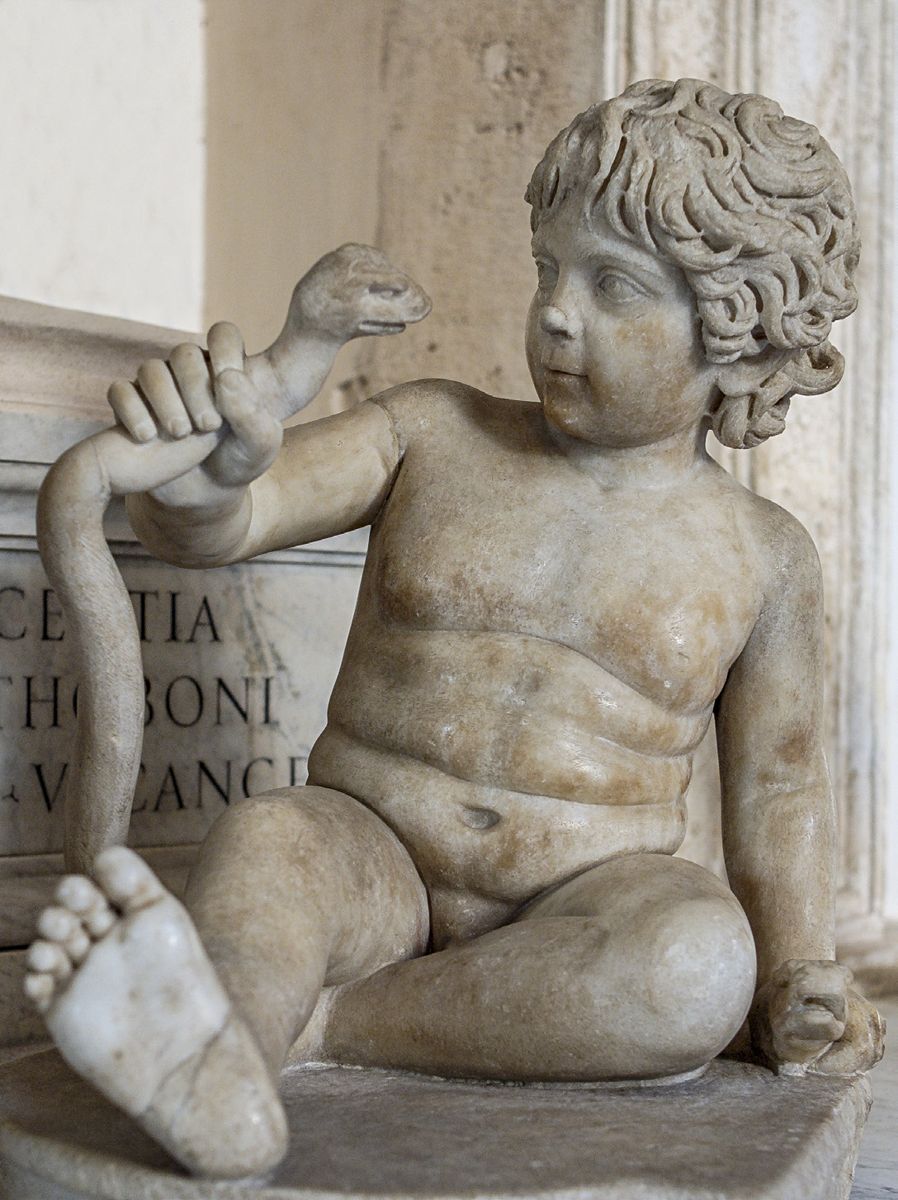
It all began with the Greeks. He was Heracles, the greatest Greek hero and son of Zeus and half-brother of Perseus. Somewhere in the mists of time, the Romans adopted him and changed his name slightly to Hercules. Roman emperors continued allegiance to his cult of strength, viewing Hercules as both a hero and a god. German Scholar of myth and cult phenomenon, Walter Burkert argued that the Herculean myth originated “in Neolithic hunter culture and traditions.”1 From his birth, Hercules was destined to be a model of strength and power. His reputation began in childhood. He was the love child of Zeus. Hera, Zeus’ wife, knew of his adultery, and tried to delay the birth of twins Heracles and Iphicles, so that she could give birth to the line of Perseus. She was foiled in her plot and when the twins were “just eight months old…Hera sent two giant snakes into the children’s chamber. Iphicles cried from fear, but his brother grabbed a snake in each hand and strangled them. He was found by his nurse playing with them on his cot as if they were toys.” The seer, “Tiresias … prophesied an unusual future for the boy, saying he would vanquish numerous monsters.”2 The Capitoline Museum in Rome holds an early marble representation of Hercules in the act of strangling the serpent. (Fig. 1). The prevalence of mythology surrounding snakes and serpents is as old as the cult of Hercules. Adam and Eve in the Garden of Eden personified the snake and evil; images solidified in Western culture and religion. The iconography of snakes, serpents and the story of Hercules was not unknown to 19th century Americans. When war broke out, both sections quickly turned to symbols to advance their cause and rally support. Southerners adopted “a plurality of state symbols.” One was the snake. For example, the back side of the Alabama
Figure 1. Hercules Strangling the Serpent, Roman marble, 2nd Century AD. (Courtesy the Vatican Museum, Rome via Wikimedia)
State flag featured a soon-to-strike rattlesnake beneath the Latin inscription Noli me tangere, “touch me not,” or “Don’t tread on me,” the revolutionary icon of the founding fathers. “Here,” according to historian David Hackett Fischer “in the southern highlands was an updated, modernized, romanticized, slaveholding version of the old back country rattlesnake of liberty.”3 With the advent of war, printmakers, particularly Northern lithographers, adopted both icons to further the union cause. The renowned family of artists, the Sartains of Philadelphia, produced several substantial engravings and lithographs during the war. William Sartain, known for his lush portraits of prominent men of the period, literally reinterpreted the Capitoline marble. The notes from the Library of Congress refer to Sartain’s lithograph as “a symbolic vision of the North’s defeat of the Confederacy.” In Hercules’ place, Young America is portrayed as the “infant Hercules strangling two serpents representing rebellion and sedition.” (Fig. 2) The snakes might also represent “antiwar Democrats…Copperheads.” Young America “reclines on his customary lion’s skin on a large rock. Above him perches an eagle, symbol of both Zeus and American might.”4
Figure 3. Hercules Wielding his Club. Mid-16th century, possibly Venice. (The Metropolitan Museum, New York)
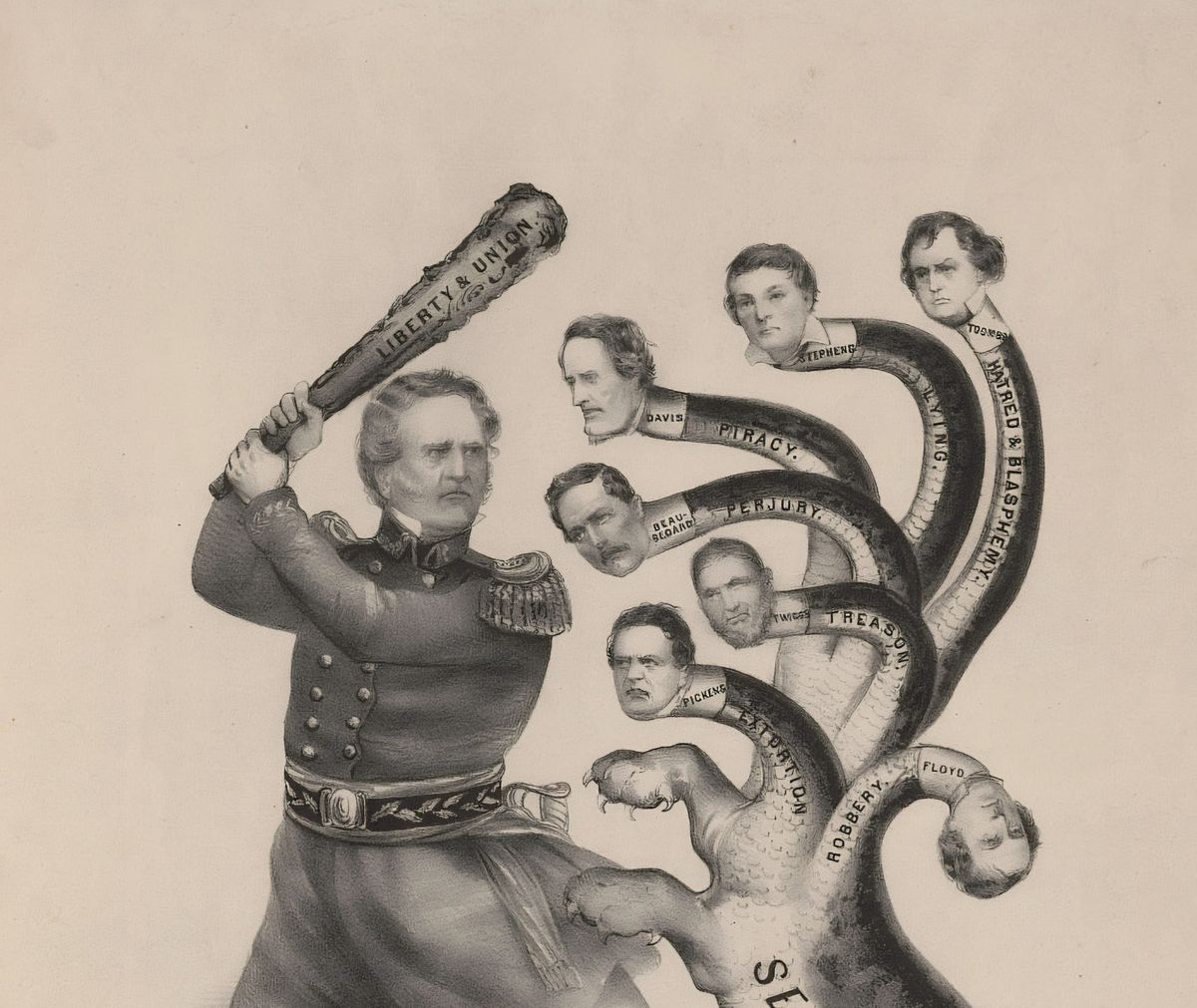
In the first year of the war, liberty and Union were prime watchwords, north and south. In the South it meant states’ rights and the rights of white men to do what they wanted within the law. It was not for the enslaved. In the North, according to Fischer, northerners used liberty and freedom interchangeably but “coupled them with…union.”5 Throughout the ages, Hercules was portrayed yielding a lethal club, usually fighting off a lion. (Fig.3). A Currier and Ives cartoon of 1861 economically combines the concepts of liberty, Union, Hercules and the serpent into one searing indictment of secession. It features General Winfield Scott, the hero of the Mexican War and now the commander of all union forces. It “depicts a gallant—and much younger looking-image of the seventy-five-year-old general as the mythical Hercules slaying a many-headed hydra symbolizing secession.”6 Here Scott wields the club of liberty and union against the primary perpetrators of treason and rebellion represented by seven heads and necks of the hydra. (Fig. 4) The serpent is labeled “Secession.” “The neck of each Southerner depicted is labeled with a vice or crime associated with him. They are (from top to bottom): Hatred and Blasphemy (Confederate secretary of state Robert Toombs), Lying (vice president Alexander Stephens), Piracy (president Jefferson Davis), Perjury (army commander P.G.T. Beauregard), Treason (United States general David E. Twiggs, who in February 1861 turned over nineteen federal army posts under his command in Texas to the South), Extortion (South Carolina governor Francis W. Pickens), and Robbery (James Buchanan’s secretary of war John B. Floyd, accused of supplying federal arms and supplies to the South).”7 The cartoon was not only a call to action aimed at the
Union, but a signal of optimism. It was ill-placed as the Union suffered an embarrassing defeat in July of 1861 at the First Battle of Bull Run. Originally a man of action, Winfield Scott’s declining leadership skills betrayed him. He resigned in October when it became clear the Union needed younger, more imaginative military direction. The Lincoln administration struggled through several consecutive commanders until settling in 1864 for Grant, Sheridan, and Sherman.
Endnotes 1.
Walter Burkert, Greek Religion, Harvard University Press, 1985, cited on Wikipedia, https://en.wikipedia.org/wiki/Heracles#cite_ note-7 https://en.wikipedia.org/wiki/Heracles. David Hackett Fischer, Liberty and Freedom, Oxford University Press, 2005, 315. Hereafter Fischer, Liberty. https://tile.loc.gov/storage-services/service/pnp/pga/12500/12567v.jpg Fischer, Liberty, 313. 6. William Reese, Notes. 7. Bernard F. Reilly Jr., American Political Prints 1766–1876: A Catalogue of the Collections in the Library of Congress. Boston, G. K. Hall, 1991, p. 35 as cited in Reese Notes. And Bryan F. Le Beau, Currier & Ives: America Imagined, Wa s h i n g t o n : Smithsonian Institution Press, 2000, pp. 84-85.

A fter 43
years the museum time to
C ilella devotes
A merican in field, his collecting prints maps and writing .
and
He has written extensively
Emory Upton: U pton ’ s R egulars : A H istory of the 121 st New York Volunteers in the Civil War (Kansas, 2009); a two - volume Correspondence of M ajor G eneral E mory U p t o n , (T e n n e s s e e , 2017), received the 2017–2018 A merican C ivil W ar M useum ’ s F ounders A ward for on o u t s ta n d i n g editing of source p r i m a ry materials . (Library of Congress)
He edited
U pton ’ s love letters 1868-70 to his wife – Till Death Do Us Part (Oklahoma, 2020), and The Memoirs of Dewitt C linton B eckwith of Upton’s Regulars (McFarland, 2023).
McCormick Civil War Institute 2026 Spring Conference
“Quenching the… Embers”: Victory, Defeat, and Challenges After Appomattox to be held on Shenandoah University’s campus in Winchester, VA
Saturday April 18, 2026 9 a.m. – 4 p.m.
Featuring Presentations by: Jeffrey Boutwell William C. “Jack” Davis Caroline Janney Jonathan A. Noyalas
Registration fee: $30 includes all sessions & lunch Additional Questions: Contact MCWI’s director Jonathan Noyalas, jnoyalas01@su.edu or 540-665-4501
Original Rev. War – WWII Guns, Swords, Bayonets, Molds, Flasks, Tools and Accoutrements. Specializing in all Civil War Union & Confederate Artifacts.