
Hercules and the serpent Vision and Valor:
By Juanita Leisch Jensen · Originally published March-April 2026 · pp. 22–25
Vision and Valor The War Through Women’s Eyes
“Living is Not Life… if Lived apart from Nobel Strife” By Juanita Leisch Jensen
his article addresses an often-overlooked role of women during and after the Civil War: that of teaching in schools devoted to the education of former slaves. While this is generally considered a strictly civilian activity, initial efforts burst onto the public scene during the Civil War and in an area under military occupation. Shortly after the November 7, 1861, bombardment of Confederate defenses of Port Royal Sound and federal occupation of South Carolina’s sea islands, the white population fled, abandoning a valuable cotton crop which had been only partially harvested. Their departure left in doubt the planting of the next year’s cotton crop and deserted a large population of slaves. Several thousand additional former slaves forsook their homes and any supplies they had and attached themselves to the military, straining its resources and hindering logistics. Within a month of the November bombardment, Secretary of the Treasury Salmon P. Chase acknowledged his responsibility for “abandoned property” and sent Lt. Col William H. Reynolds of the 1st Rhode Island Artillery to Beaufort to collect contraband cotton. He later assigned to Reynolds the task of managing plantations on the islands and ensuring the following year’s cotton production. In accordance with General Benjamin F. Butler’s May 1861 declaration that slaves in union-controlled territory be considered contraband of war, one of Reynolds’ challenges was to coerce or incent the former slaves to labor in the cotton fields for government profit. Working in parallel (but not always in concert) with military-led efforts to manage the cotton crop were civilianled efforts to provide humanitarian relief to the former slaves. Secretary Chase again took the lead, selecting Edward L. Pierce of Boston, and Reverend Mr. Mansfield French of New York, to lead these efforts. As staunch abolitionists, Pierce and French agreed that this mission was a valuable opportunity to prepare formerly enslaved people for freedom. Accordingly, along with doctors
Tand businessmen, they invited teachers and ministers to participate in the effort they termed the “Port Royal Experiment.” From the start, there was no shortage of women who volunteered to serve in the experiment. For three decades prior to the Civil War, women involved in the abolitionist movement had yearned for “something to do,” and here at last was the long-sought opportunity. Maine native and staunch abolitionist Sarah Jane Foster spoke for many when she expressed her personal sentiment,
Teach me that living is not life, If lived apart from noble strife … Oh teach me that life is to do and dare; That the glory of life is not to spare.1 Equally, there was no shortage of enthusiasm among slaves and former slaves to learn. Enslaved people recognized the power of the written word and yearned for literacy. Indeed, in a February 3, 1862, report to Secretary Chase, Edward Pierce reported that, while some former slaves he interviewed seemed reluctant to express a desire for freedom, all “wished earnestly to learn to read and write …”2 This desire manifested itself in both children and adults, as observed by Mary Ames:
We have announced that we will open school Monday. Many of the older blacks ask if they are too old to learn to read. They cannot come to school during the day as it is planting time, so we have promised to have an evening school at the house twice a week.3 Elizabeth Botume also reported that adults joined her school when their work schedule permitted.
Before Christmas the fieldwork was done. Cotton was picked, potatoes were banked, and groundnuts gathered in. Now children and parents, even the old, gray-headed people, hurried together to the schoolroom. … The schoolroom was filled to overflowing with eager, expectant scholars. “Us wants book-larning, too, bad,” they said over and over again.4
Duties
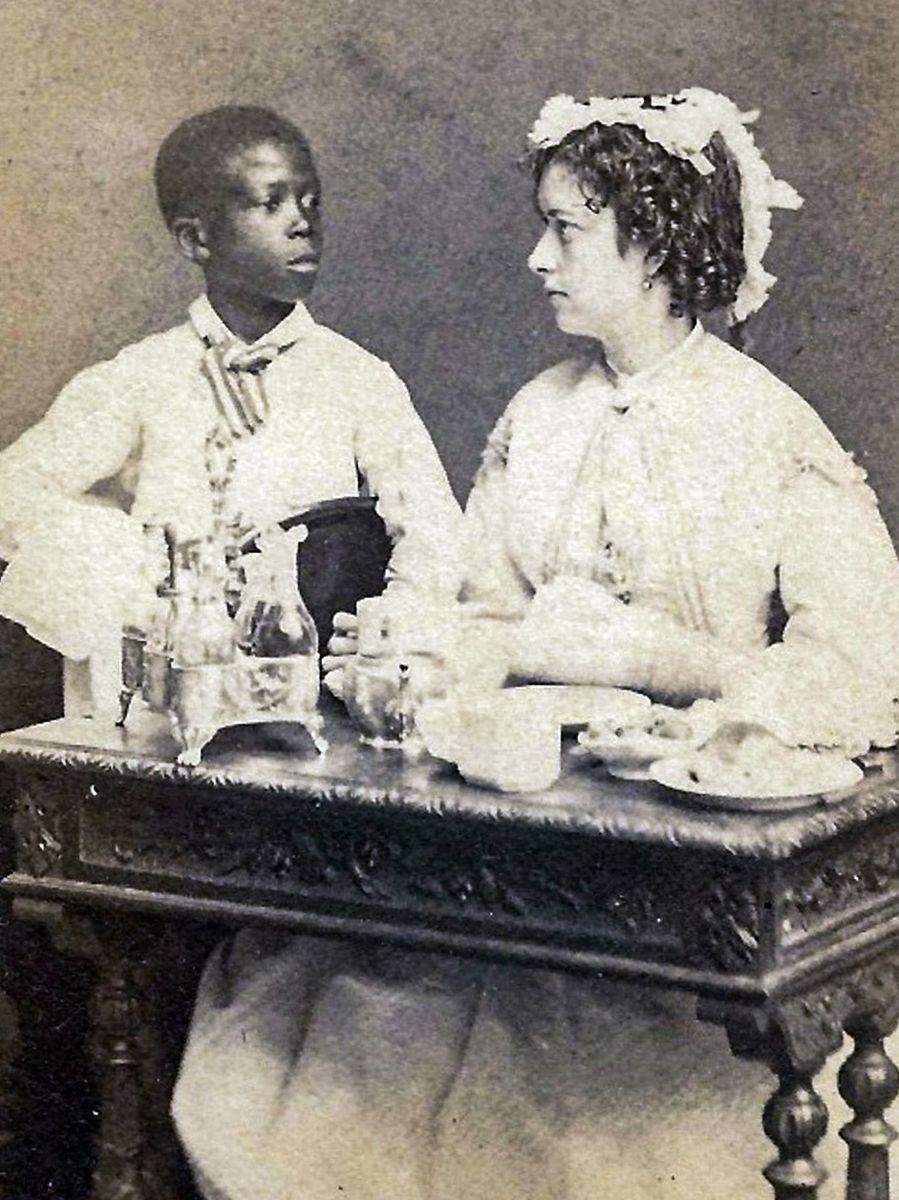
Brister, Lame John and a boy helping her. … Hastings had requested the honor of waiting on the gentlemen, and did pretty well. We were to have had our soup in a yellow bowl for want of a tureen. Hastings told Rina he had a tureen at home and would like to lend it … and so, to my surprise, the soup appeared handsomely dished, but it was stone cold.5
Women who had volunteered to serve as teachers filled many roles; distributing clothing and food, instructing the former slaves in health and hygiene, and teaching them to make and repair their clothing. Schoolmistresses often resided in the plantation owners’ grand homes and employed and paid former slaves to continue domestic duties they had performed for their ‘old mistresses’. In some cases the former slaves boldly expressed their own views on the way things ought to be done.
A hard-working morning getting ready for our dinner this evening. The dinner was not ready at the right time … Rina had in the kitchen Hastings,
This theatrically staged photograph illustrates a woman being served by a young man who appears to take pride in his work. (Author’s Collection)
Soldiers and Scholars
Operating a school in an area also occupied by soldiers provided endless distraction. In June 1862, Elizabeth Ware Pearson reported,
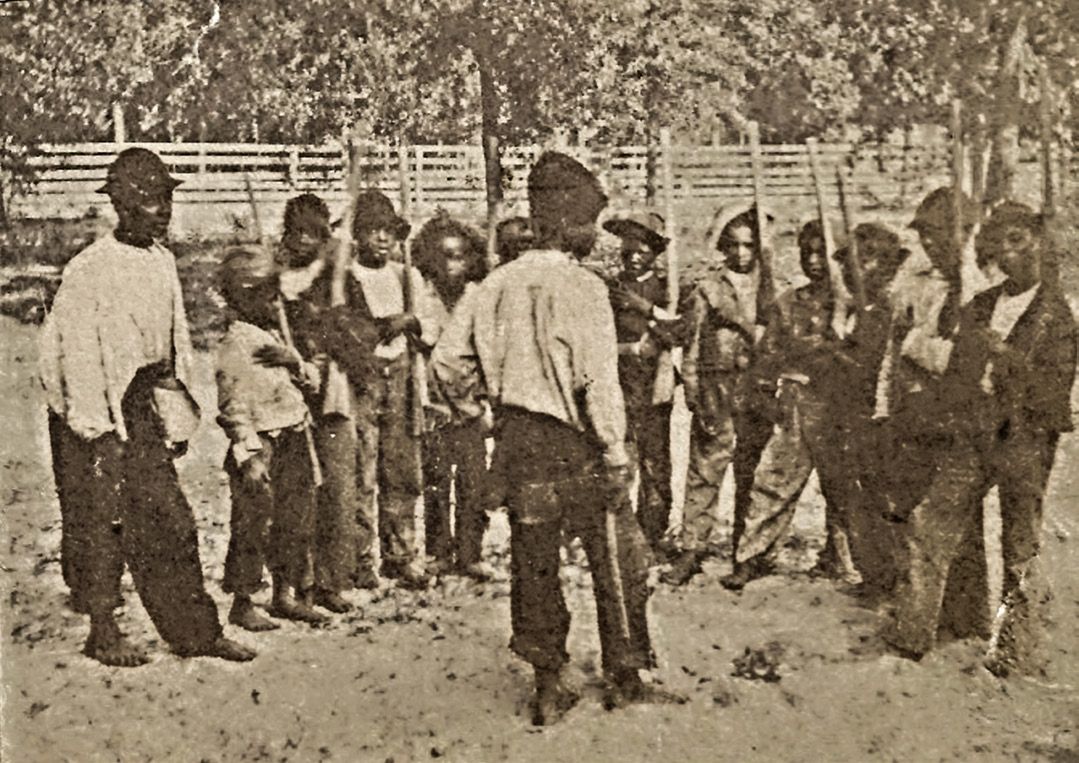
Here came my morning school, for the first time, under Bacchus’ conduct. I heard them singing and went to the window to watch and see how he was bringing them from the quarters. He is a cripple in his hands, which turn backwards, and he has but little control of his arms, but is much looked up to by the other children. Of course he cannot do any work, and Mr. G. has made him a s sort of schoolmaster, and he has always kept school when Mr. G. was away. … Well, soldiers have been stationed on the place, and Bacchus had got some notion of drill, so he marched up the thirty-five children, six or seven in a row, … and with two of the oldest boys for captains on each side to administer raps with their sticks if they did not keep in line, walking backwards himself to oversee the whole company, with a soldier’s cap on his head, and shouting out his orders for them to sing their different tunes all the way….6
This CDV is one of a series of similar photographs showing black children playing soldier with sticks for guns, and an ‘officer’ holding a ‘sword.” (Author’s Collection)
The following day, Pearson reported on a slave funeral,
June 9, 1862 Just after dinner we saw the people assembling at their burying-place, and H and I went down to witness the services. … As we drew near to the grave we heard all the children singing their A, B, C, through and through again, as they stood waiting round the grave for the rest to assemble and for Uncle Sam to begin. Each child had his school-book or picture-book Mr. G. had given him in his hand,—another proof that they consider their lessons as in some sort religious exercise.7
Summary
In the end, the mission of the privately-funded “Port Royal Experiment” was pre-empted by the governmentfunded Freedman’s Bureau. As noted by Willie Lee Rose in Rehearsal for Reconstruction, many of the improvements and advances made in the family economies, education, and living situations of former slaves were reversed during
Progress and Success
Many of the Yankee schoolmistresses documented the progress they—and their students—made. At the start of her efforts in 1862, Elizabeth Botume reported that her adult students had no familiarity with books.
Not one of the grown up people could read or even knew how to handle a book. Indeed, a book was to them a mystery which they supposed would impart knowledge by some occult influence without any effort on their part. They were beginners in every sense of the word as they expressed it. “Us ain’t know nothing, an’ you is to larn we.”8
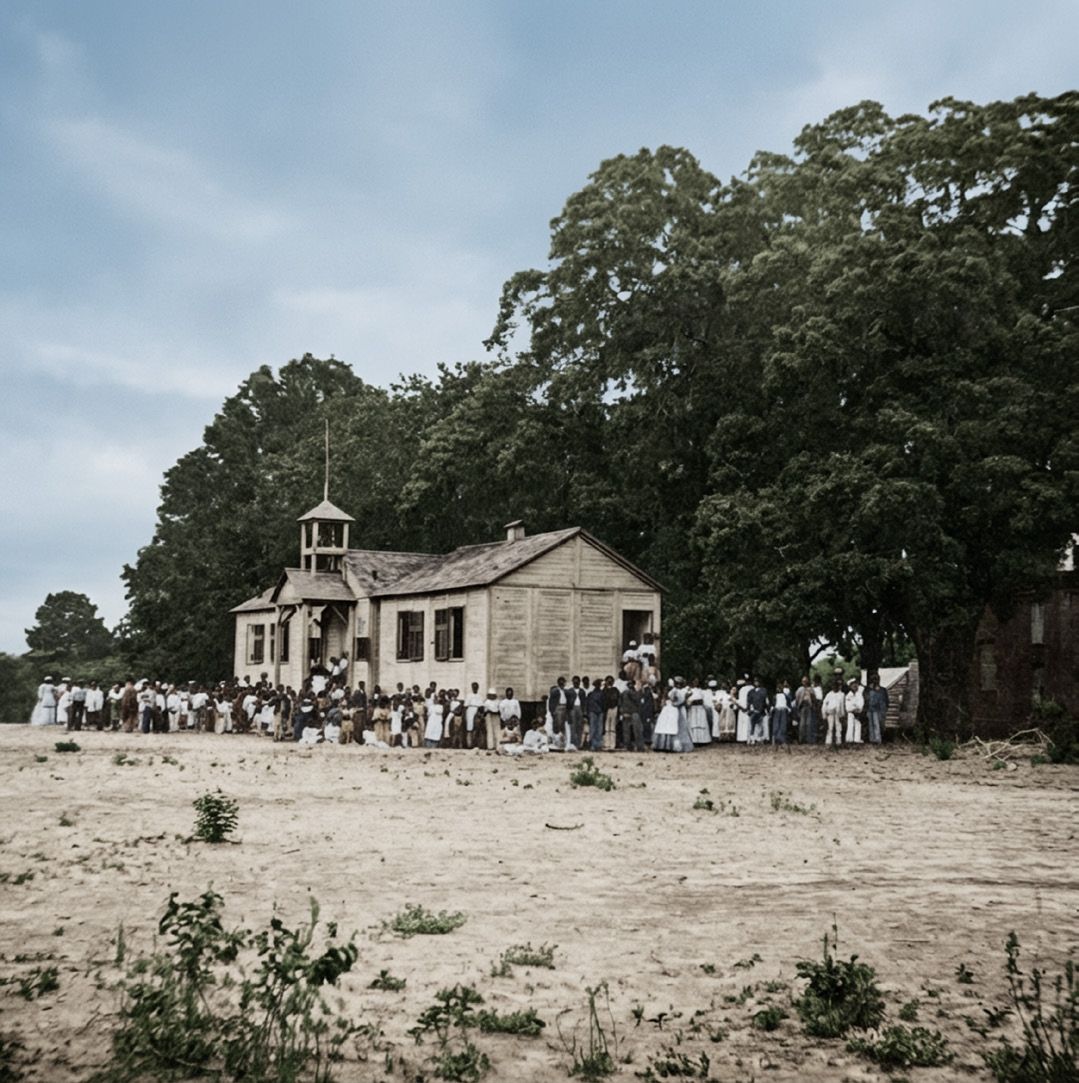
Laura Towne purchased the plantation on which this school was located in order to ensure its security and continuation. (Library of Congress)
By 1865, Laura Towne proudly reported an impressive list of accomplishments.
Our school does splendidly, though I say it. The children have read through a history of the United States and an easy physiology, and they know all the parts of speech, and can make sentences, being told to use a predicare, verb, and adverb, for instance. Ellen’s class is writing compositions. We are going to have a grand school exhibition before we close, with dialogues, exercises in mathematics, in grammar, geography, spelling, reading, etc., etc. We are cramming for it. … Young Gabriel Capus has come back to his place, which was one reserved for his people. He warns them to buy no more of his land, as he shall soon have possession of it again!9 When the government decided to restore the plantations to the former owners, many schools closed. Laura Towne retained her school by purchasing the plantation where it was located.
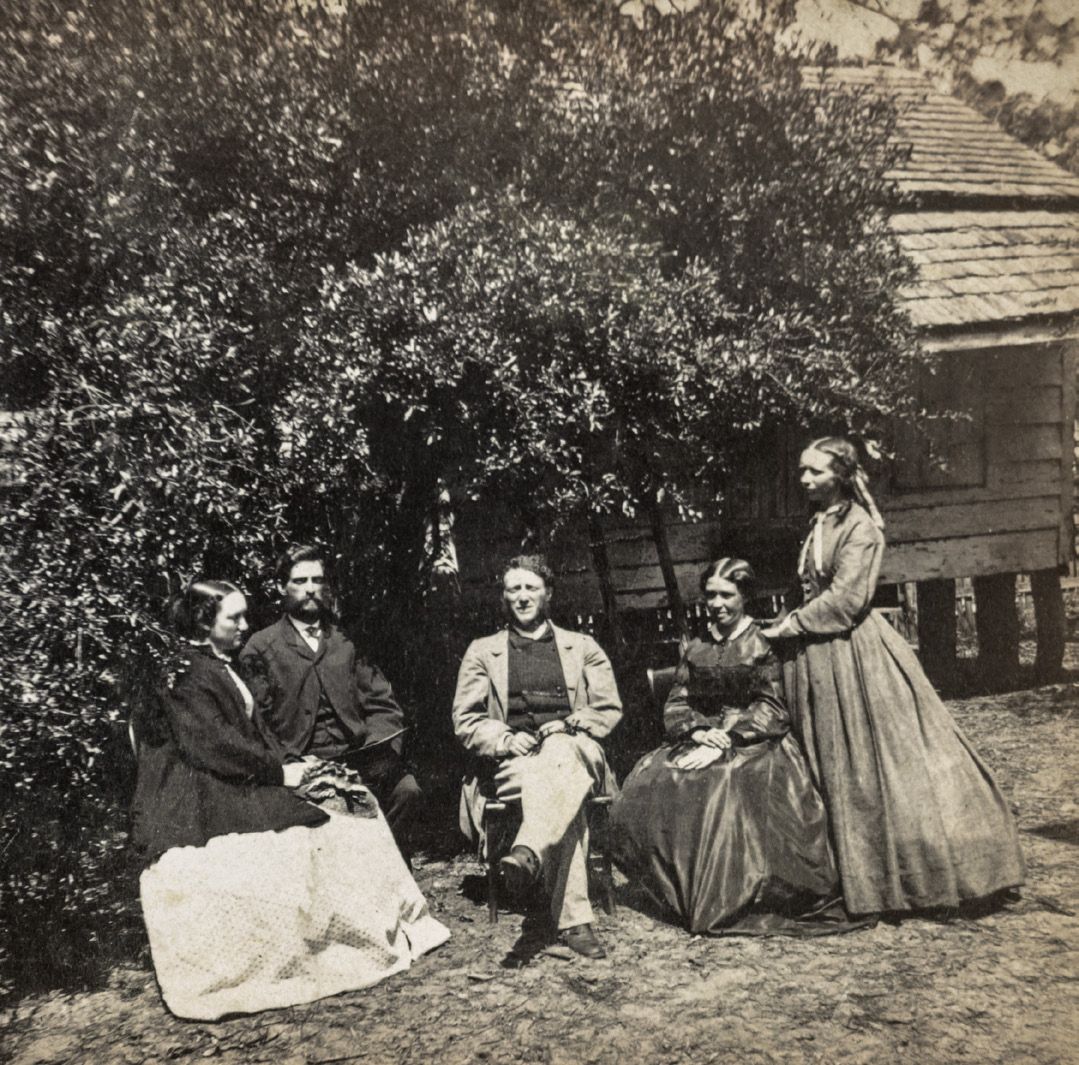
Laura Towne is second from the right in this group, which posed for a photograph in front of the home she purchased in the sea islands. (Library of Congress)
the Reconstruction years. In particular, the quality and availability of schools for former slaves dwindled as …
“… The North … concluded that in granting the franchise the national obligation to the freedmen had been fulfilled. Edward King pointed out the folly of the federal government’s granting voting rights without providing means for … education. By the time South Carolina … had been on its own for five years, the state school system was simply one more tool in the hands of the corrupt.10 Laura Towne had invested two decades of her life and many personal resources in the “Port Royal Experiment, but as reconstruction progressed, even Laura Towne became discouraged and wrote, “The need of education here seems to be greater than ever – the means less, the friends fewer…11
Epilogue Some historians have retrospectively emphasized the importance of the Port Royal Experiment by declaring that it served as a rehearsal for the reconstruction that followed. If it was a rehearsal for reconstruction, it was a lesson not well learned.
From A New England Woman’s Diary in Dixie in 1865. By Mary Ames. Norwood, MA: Plimpton Press, 1906, p. 18. 4. First Days Among the Contraband. By Elizabeth Botume. Boston: Lee and Shepherd, 1893., p. 63. 5. Ibid., Towne, pp. 133-134. 6. Letters from Port Royal. Edited by Elizabeth Ware Pearson. Boston: W. B. Clarke Company, 1906, pp 64-65. 7. Ibid., p. 65. 8. Botume, p. 63. 9. Towne, p. 163 10. Rose, p. 389. 11. Rose, p. 389. 3.
Juanita Leisch Jensen is a nationally recognized speaker,
author, researcher (and avid collector) of topics related to civilians and the Civil War. She can be reached at lesandjuanita 1@ hushmailcom
to
arrange
talks
and
presentations. She is the author of two books: Who Wore
What: Women’s Clothing 1861-65 and An Introduction to Civil War Civilians. Juanita and her husband, military historian Les Jensen, divide their time between homes in New York and Virginia.
SOURCES ◊
The Education of Blacks in the South, 1860–1935. By James D. Anderson. Chapel Hill: University of North Carolina Press, 1988. First Days Among the Contraband. By Elizabeth Botume. Boston: Lee and Shepherd, 1893. From A New England Woman’s Diary in Dixie in 1865. By Mary Ames. Norwood, MA: Plimpton Press, 1906. The Journal of Charlotte L. Forten. Edited by Ray Allen Billington. New York: The Dryden Press, 1953 [reprinted by W. W. Norton & Company, 1981]. Letters from Port Royal. Edited by Elizabeth Ware Pearson. Boston: W. B. Clarke Company, 1906. Letters and Diary of Laura M. Towne. Edited by Rupert Sargent Holland. Cambridge: Riverside Press [ reprinted by New York: Negro Universities Press, 1969. A Literate South: Reading Before Emancipation. By Beth Barton Schweiger. New Haven: Yale University Press, 2014. Rehearsal for Reconstruction. By Willie Lee Rose. New York: Oxford University Press, 1964. Sarah Jane Foster. Charlottesville, VA: University of Virginia Press, 1990.
◊ ◊ ◊
◊ ◊
◊ ◊ ◊
We Buy and Collect Rare Confederate and Southern Obsolete Currency.
Since 1978, we have collected or handled over 80 of the “Big Six” Confederate Notes to include nearly 10% of all known surviving Montgomery Notes.
Endnotes 1. 2.
Sarah Jane Foster: Teacher of the Freedmen. Charlottesville, VA: University of Virginia Press, 1990, p. 3. Pierce’s report to Chase, February 3, 1862, in Moore (ed.), Rebellion Record, Supplement, I, 310, 308. Quoted in Rehearsal for Reconstruction: The Port Royal Experiment. By Willie Lee Rose. New York: Oxford University Press, 1964, p. 29.
Greg Ton
901-487-5944 • gton1@aol.com • Franklin, TN
GregTonCurrency.com
Photographs from the Original Article
Captions and credits appear in the article text as originally printed.