
The Unfinished Fight
By Craig L. Barry · Originally published July-August 2026 · pp. 14–17
THE UNFINISHED FIGHT: GUM BLANKET
Vulcanized Rubber in the Civil War
The vulcanized rubber ground cloth, or “gum blanket”, was a straightforward and utilitarian piece of equipment that was greatly prized by soldiers on both sides. It was a thin sheet of canvas coated with heatand pressure-treated gum rubber roughly 6 ½ x 3 ½ feet in dimensions. The rubber blanket was light and weighed only about 40 ounces. It was a standard item of Union issuance beginning in November 1861. Charles Goodyear patented the process for vulcanizing rubber in 1844, and the patent was extended by a licensee, Union India Rubber Company of Middletown, Connecticut, in 1858. This created a virtual monopoly for Union India Rubber as far as the “manufacture of rubber goods for military purposes.” The seven-year duration of the patent meant that Union India Rubber Company dominated the trade for almost the entire Civil War. They aggressively enforced their patent rights through the courts, and their company and its subsidiaries managed almost $6 million in Union contracts from 1862 to 1864. The pressure of government orders led Union India Rubber Company to open a second plant in nearby Naugatuck (later called The Phoenix Rubber Company) to manufacture gum rubber blankets beginning in 1863.
Union India Rubber Company’s monopoly by filling a large U.S. Government contract for gum rubber blankets for Schuylkill Arsenal. Union India Rubber filed suit for patent infringement and won damages of over $200,000, “… in spite of which it is believed it (Providence) still found its business in blankets profitable.” As a result of the potential for profit, there was quite a bit of patent
“WE DREW SOME NEW CLOTHING TODAY AND I GOT A PONCHO. WE GOT OUR GUM BLANKETS JUST IN TIME AS IT RAINED ALL DAY.” – CIVIL WAR DIARY OF
ALEXANDER G. DOWNING, 11TH IOWA VOLUNTEERS, CO. E.
A number of other manufacturers produced gum rubber blankets and ponchos despite the potential patent infringement lawsuits. In one such incident, Providence (a/k/a National) Rubber Company attempted to break the
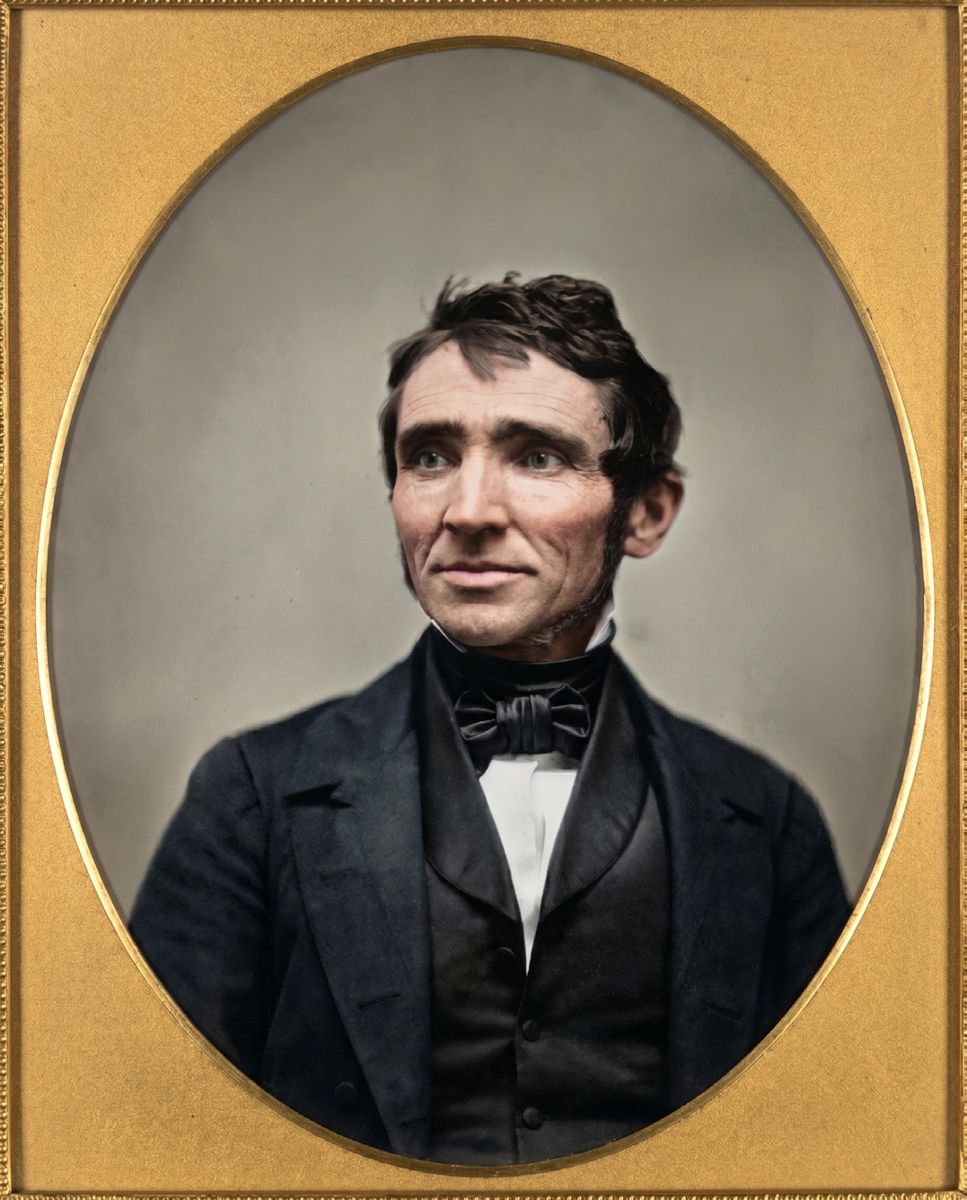
Charles Goodyear, colorized. (Public Domain)
infringement going on, which kept Union India Rubber in court and also led to some variation in the dimensions and construction, depending on the contractor who made the item. Some surviving gum rubber blankets are as large as 46 inches by 79 inches. One poncho measures 46 inches by 72 inches and has a 14-inch slit for the head; another is 45 inches by 70 inches with a 12-inch slit. A careful inspection of four surviving gum blankets recovered from the wreck of the USS Maple Leaf (1864) shows some variation in dimensions and construction methods. In addition, not every Union soldier was issued a vulcanized gum rubber blanket manufactured by the Goodyear patent process. There were also sizeable Union contracts for “infantry tent blankets”, which were actually painted or tarred canvas, especially before mid-war. Note the following:
“Sept. 13, 1862 You are authorized to furnish at the Schuylkill Arsenal, 30,000 Painted Infantry Tent Blankets, 46 by 71 inches with 18 grommets, and tape for tying as a shawl, at $1.39 each. Grommets to be placed 2 inches from the edge to the centre of grommet, on one side and one end, and one inch on the opposite side and end, not exceeding 14” apart, and equidistant. Quality of cloth used and coating like sealed sample.
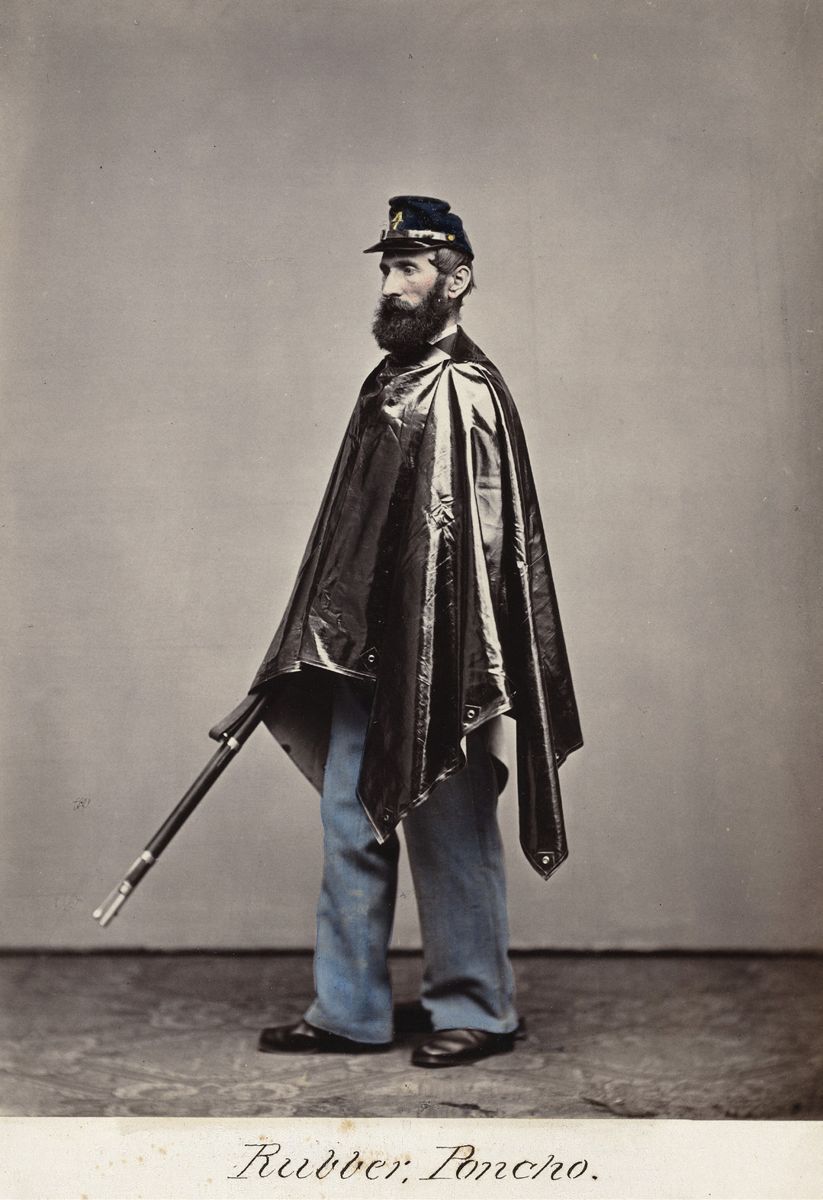
the gum rubber blanket to infantry. This much is known: prior to the Civil War, cavalry was issued a rubberized raincoat of sorts called a “talma.” The poncho, being less expensive to produce, replaced the “talma” for cavalry use. This may have been true, or at least that was the intention, but in practice, the poncho was favored by both infantry and cavalry as it could be used as a ground cloth, and in rainy weather, it was easier to wear. The rubber ground cloth had to be draped over the shoulders, held together with a clasp, or tied and worn like a cape. In addition to keeping the soldier dry, the gum rubber blanket could be put to effective use wrapped around the soldier’s musket, so it was ready to fire in rainy weather. On the cold, wet march from Washington, D.C., to Fredericksburg in November 1862, a Union soldier recalled being given those exact orders. As might be expected, the waterproof gum rubber blanket was a godsend while camping under such conditions as well. Soldiers often marked the white canvas underside of the blanket with their unit number and name to discourage theft. It must have been a problem; one soldier even included the threat of a curse placed upon whoever might steal his gum rubber blanket. An entrepreneurial soldier was able to profit from the latent demand for this popular item as well. During a long summer march during dry weather, a gum rubber
Respectfully, Major G.H. Crosman, Quartermaster.” The rubber blanket had grommets in the sides and ends, which were reinforced with 1 ¼-inch squares of the same material. The reinforced grommets permitted the rubber blanket to be used in the same manner as a shelter half. Confederate ground cloths were usually painted canvas or “oil cloths” and intended for the same purposes of warding off cold and rain. They were less effective to that end. Along with captured Union canteens, haversacks, and rifle-muskets, the rubberized gum blankets were highly prized and versatile possessions. Civil War diaries are full of testimony concerning the desirability of the gum rubber blanket. A retreating Union soldier at the Battle of Stones River in late 1862 noted the following:
“When we got back as far as my knapsack, I picked it up and attempted to carry it…after about a quarter mile when I found I was getting behind and the bullets came thicker and nearer I dropped it (the knapsack), took out the rubber blanket and went on my way…” The rubber “gum blanket” served as rain gear for both cavalry and dismounted men as well. An item of dispute among historians is the role of the “poncho” or gum blanket with a slit cut in the center for the head. Conventional wisdom has held that the poncho was issued to cavalry and blanket was purchased from a weary comrade for 75¢. Back in camp, the soldier quickly sold it for $3. He claimed to be lucky enough to make an $18 profit on similar transactions. According to Douglas C. McChristian in The U.S. Army in the West, 1870–1880: Uniforms, Weapons, and Equipment (1995), so many rubber blankets and ponchos were manufactured by mid-1865 that the existing Civil War surplus of this item met the U.S. Army’s supply needs until 1893.
Craig L. Barry was born in Charlottesville, Va. H e holds his BA and M asters degrees from UNC (Charlotte). He is the author of several books including T he C ivil W ar M usket : A H andbook for H istorical Accuracy (2006, 2011), The Unfinished Fight: Essays on Confederate Material Culture Vol. I and II (2012, 2013). He has also published four books in the Suppliers to the Confederacy series on English Arms & Accoutrements, Quartermaster stores and other European imports. Left: Confederate soldier from Company E, “Lynchburg Rifles,” 11th Virginia Infantry Volunteers holding 1841 “Mississippi” rifle, Sheffield-type Bowie knife, canteen, box knapsack, and rubber blanket roll. (Liljenquist Family Collection of Civil War Photographs, Library of Congress)
James Country
MERCANTILE
The home of