
General James Henry Lane
Originally published July-August 2026 · pp. 34–42
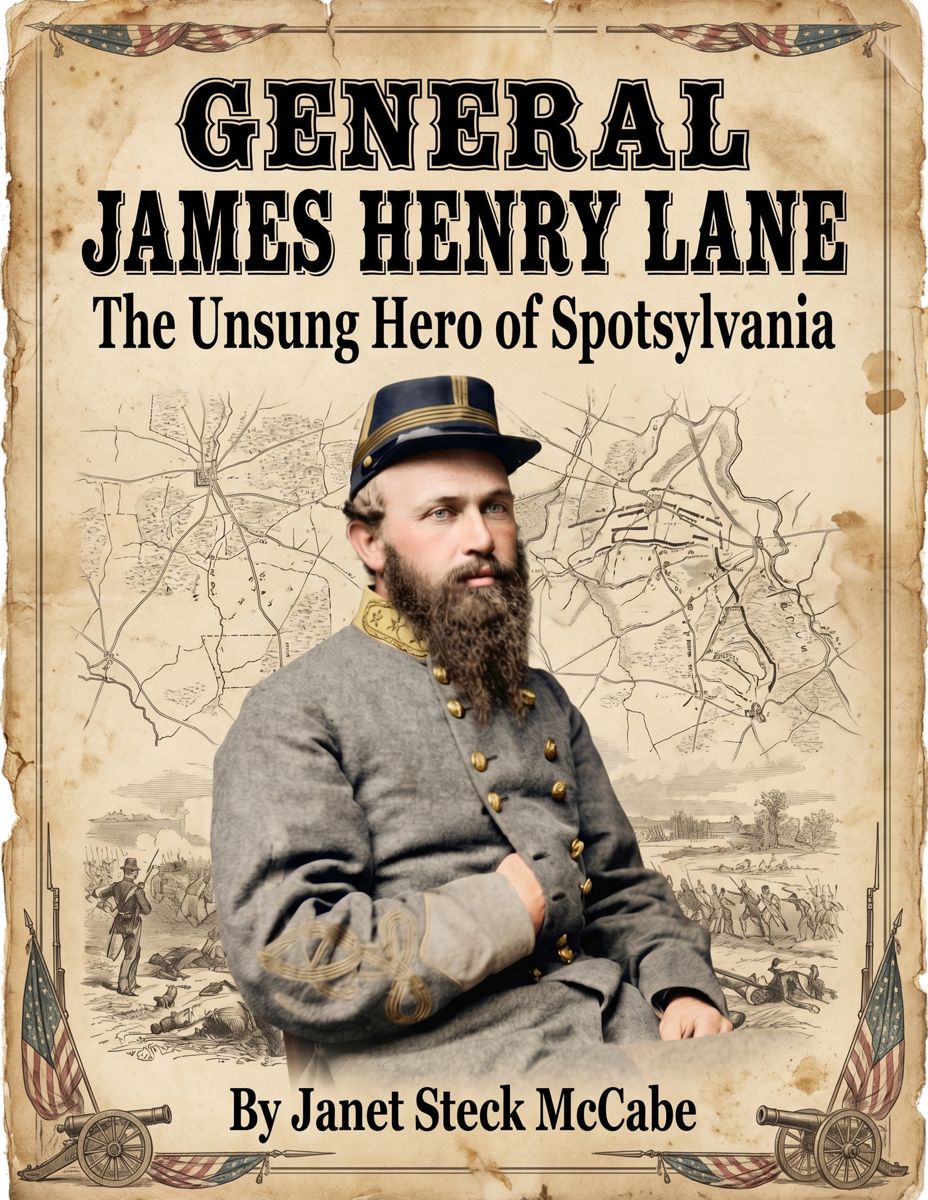
On the battle field near Spotsylvania C.H. May 14, 1864
My dear Father, I barely have time to write to you to tell you that we have been in several terrible engagements with the enemy, first in the Wilderness & then at this place…Day before yesterday we were subjected to a heavy enfilade artillery fire, when Oscar was wounded by an unexploded shell which took off his left foot & two of the toes of his right…My Brigade had the honor day before yesterday of turning the tide of the battle & driving back the enemy after they have [sic] broken through Jones’ Brigade & swept Steuart’s from the trenches. We also made a flank movement on a storming force of the Yankees that day, which is spoken of as a brilliant affair.1
These are the opening sentences of a remarkable letter written by Gen. James Henry Lane of the Army of Northern Virginia just days after the dreadful fighting at Spotsylvania Courthouse. It was quite a letter, describing three narrow escapes from death, his capture by and escape from Federal soldiers, and the wounding of his brother Oscar, who was standing by his side when an artillery shell took off Oscar’s left foot. James Henry Lane is not well known among students of the Civil War, despite being one of the longestserving field officers in the Confederate army, from the very first fight at Big Bethel in June 1861 to the surrender in April 1865. He fought in every major battle in the Eastern theater, from First Manassas to Five Forks, and was wounded three times. At Gettysburg, he led his brigade in Pickett’s Charge, where his North Carolinians claimed to have advanced farther than any other unit in that attack. Of North Carolina’s claim that its soldiers had been “First at Bethel, Farthest to the Front at Gettysburg & Chickamauga, Last at Appomattox,” Lane could claim participation in all of it save Chickamauga.2
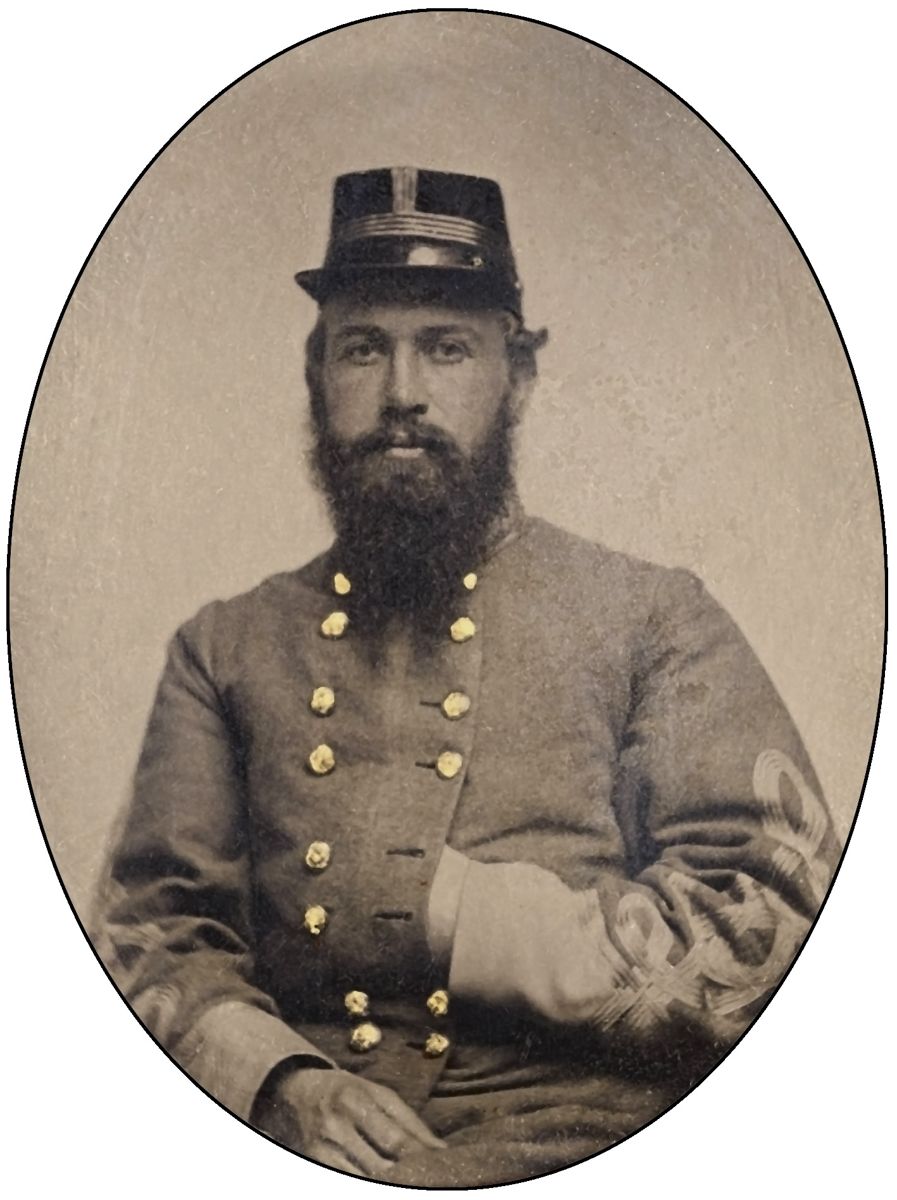
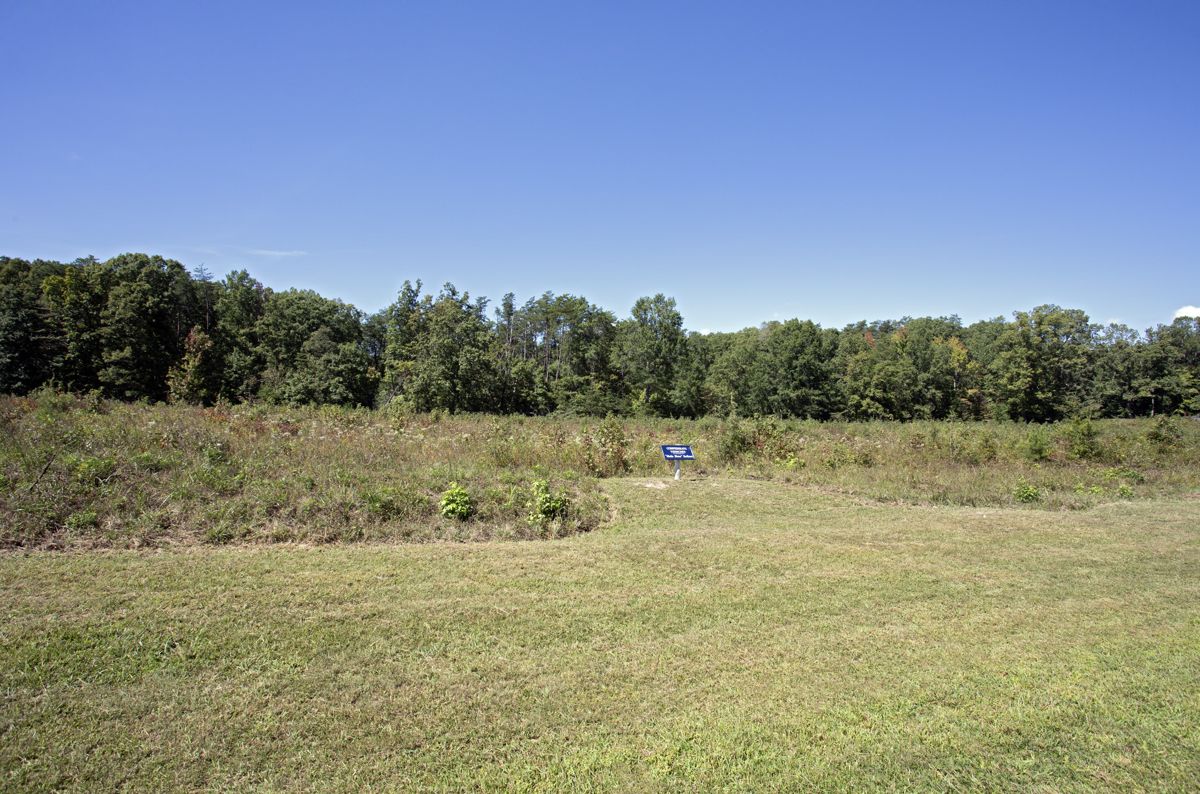
James Lane was born and raised in Mathews County, Va., took part in Pickett’s Charge. Lane led his brigade in that on what is known as the Middle Peninsula, between the York failed attack and was injured when his horse was shot out and Rappahannock Rivers. He was a 1854 graduate of the from under him. After Trimble’s capture and Pender’s Virginia Military Institute, where he studied under the man death, command of the division was given to Gen. Cadmus who later became known as “Stonewall” Jackson. When Wilcox.4 the war broke out, he was a professor of natural philosophy In the opening battle of the 1864 campaign season, the (i.e., science) and instructor in tactics at the North Carolina Army of the Potomac, under the overall command of Military Institute, whose superintendent was Daniel Harvey Lieut. Gen. Ulysses S. Grant, fought the Army of Northern Hill. Almost the entire student body of that institution Virginia to a stalemate in the thickly wooded area called enlisted in the 1st North Carolina Volunteer Infantry, and the Wilderness in early May. Having failed to achieve the 27-year-old Lane was elected major. He was with an outright victory, Grant proved himself different from them at the Battle of Big Bethel, Va., when they previous Union commanders in the East. Instead of successfully repulsed a Union advance from retiring to the defenses around Washington Fortress Monroe in one of the earliest land to lick his wounds, he turned his army battles of the war. Soon thereafter, south in an attempt to outflank he was appointed colonel of the the Confederate army and seize 28th North Carolina, part of the important crossroads at Gen. Lawrence O’Bryan Spotsylvania Court House, Branch’s brigade, and led thus placing himself between that regiment throughout Lee and the southern capital the Peninsula campaign at Richmond. Lee was of 1862, suffering able to beat the Federals minor wounds at the to the crossroads, battles of Beaver Dam h o w e v e r, where Creek and Frayser’s the southern army Farm. After Branch immediately began was killed by a building breastworks sharpshooter at to defend against Antietam that the expected Union September, Lane attack. was promoted to Those defenses, lead the brigade.3 though thrown up They fought hurriedly during the under Jackson at night of May 8-9, Fredericksburg and were formidable. Chancellorsville, Strong earthworks where, as dusk fell were topped by on the battlefield the trunks of felled after Jackson’s famous trees, with smaller flank attack, it was one trees forming abatis in of Lane’s regiments that front of the barricades. fired at what it thought Inside the earthworks, was Union cavalry, traverses—essentially not knowing that it was walls running perpendicular Jackson and a group of aides, to the main ramparts—created returning from a scouting foray. compartments, irreverently The wounds received by Jackson called hog pens by the soldiers, that night ultimately resulted in his that would provide protection should death. one part of the line be overrun. The line Perhaps it was the did have one weakness, stigma of being the however. It was laid out to commander of the men Confederate General James Henry Lane. (North Carolina take advantage of higher that killed Stonewall Collection Photographic Archives, The Wilson Library, ground, but because Jackson that prevented University of North Carolina at Chapel Hill) much of the surveying Lane from being promoted was done under cover of to division command when General Lee reorganized the darkness, it wasn’t until construction was well advanced Confederate army after Chancellorsville. He was given that Confederate engineers discovered that one section of temporary command of his division when Gen. William the line jutted out in front of the rest like a ship’s prow, Dorsey Pender was wounded on July 2, 1863, at Gettysburg forming what in military terms is called a salient. Because but was replaced by Gen. Isaac Trimble before the division of its shape, it became known as the Mule Shoe. The disadvantage of the salient is that it can be fired upon from chase, Lee told his subordinates to prepare for a general three sides, exposing the defenders’ backs to enemy fire movement. In particular, he ordered that all the artillery from the opposite side. By the time this was discovered, it stationed in the Mule Shoe be pulled out at once and moved was too late to do anything about it except strengthen the to the Spotsylvania crossroads. It was a disastrous decision position by packing it with artillery—30 guns in all—and for the Confederate army, and most especially for Maj. constructing a backup line across the base of the salient. Gen. Edward Johnson’s division, which occupied the tip With that, Lieut. Gen. Richard Ewell, whose 2nd Corps and eastern side of the salient. occupied the salient, felt sure that the position could be To preserve the element of surprise, the Union infantry defended. did not begin to move into position for the attack until after Grant made several attempts to pierce the Confederate nightfall. Soldiers were ordered to tie down their canteens, defenses. One such attempt, made on May 10, managed cups, etc., in order to avoid making any noise that would to break the Confederate lines, but the attackers were quickly repulsed when supporting troops failed to arrive. Grant used the lessons learned from that attempt in designing a massive new attack to take place at dawn on May 12 against the Mule Shoe. Twenty thousand men of Maj. Gen. Winfield Hancock’s 2nd Corps were ordered to move from their position on the right of the Union line to a point opposite the tip of the Mule Shoe. Major Gen. Ambrose Burnside’s 9th Corps, positioned along the Fredericksburg Road to the southeast of the salient, was ordered to attack at the same time as Hancock, but from the east. All of these movements caused Lee, who, up to this point in the war, had never failed to anticipate his rivals’ intentions, to misjudge the situation. He interpreted the movements toward his right as preparations for a Union withdrawal towards Fredericksburg. Intending to give Confederate trenches located at the Mule Shoe Salient on the Spotsylvania Court House Battlefield. (Jack W. Melton Jr.)
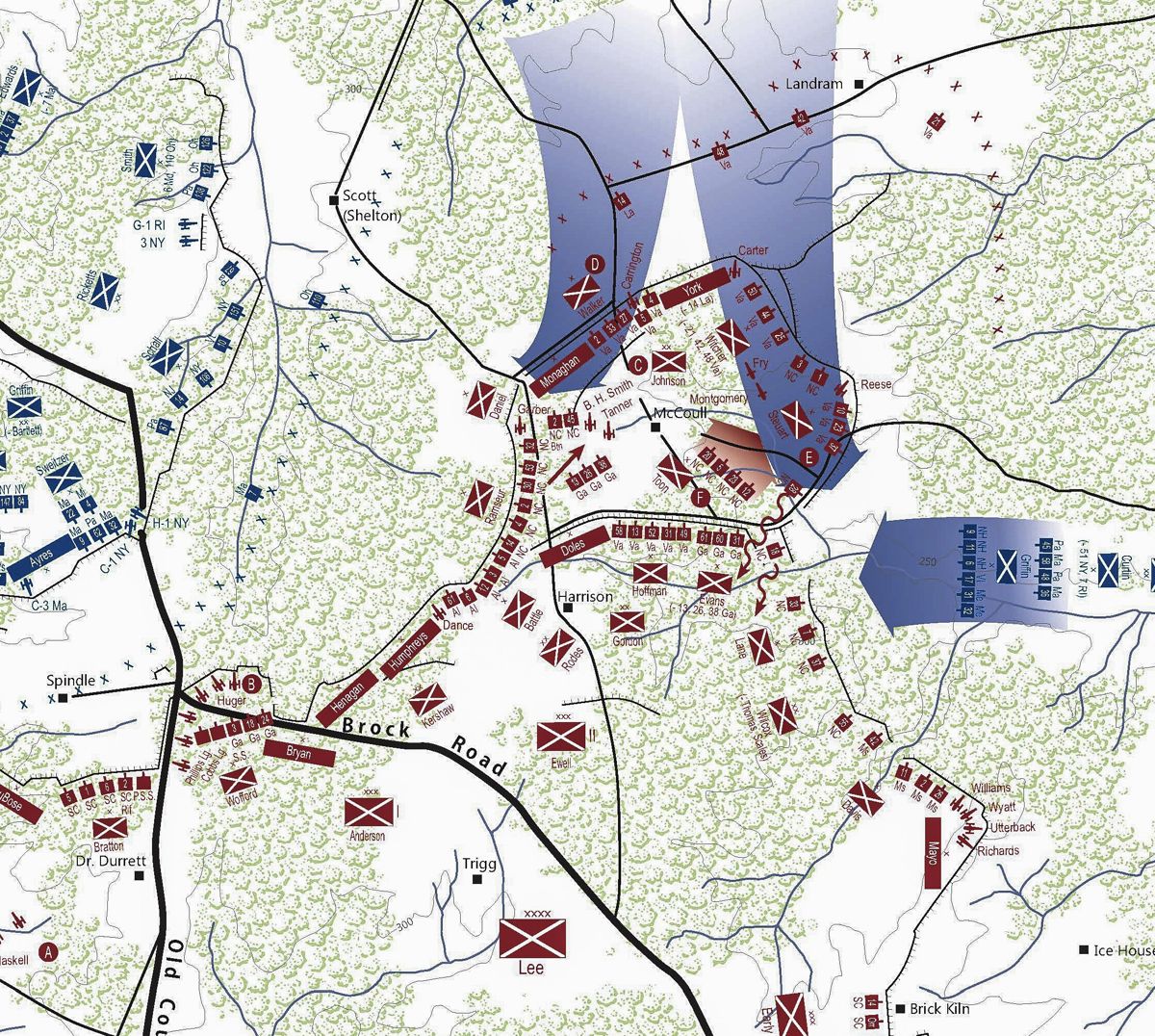
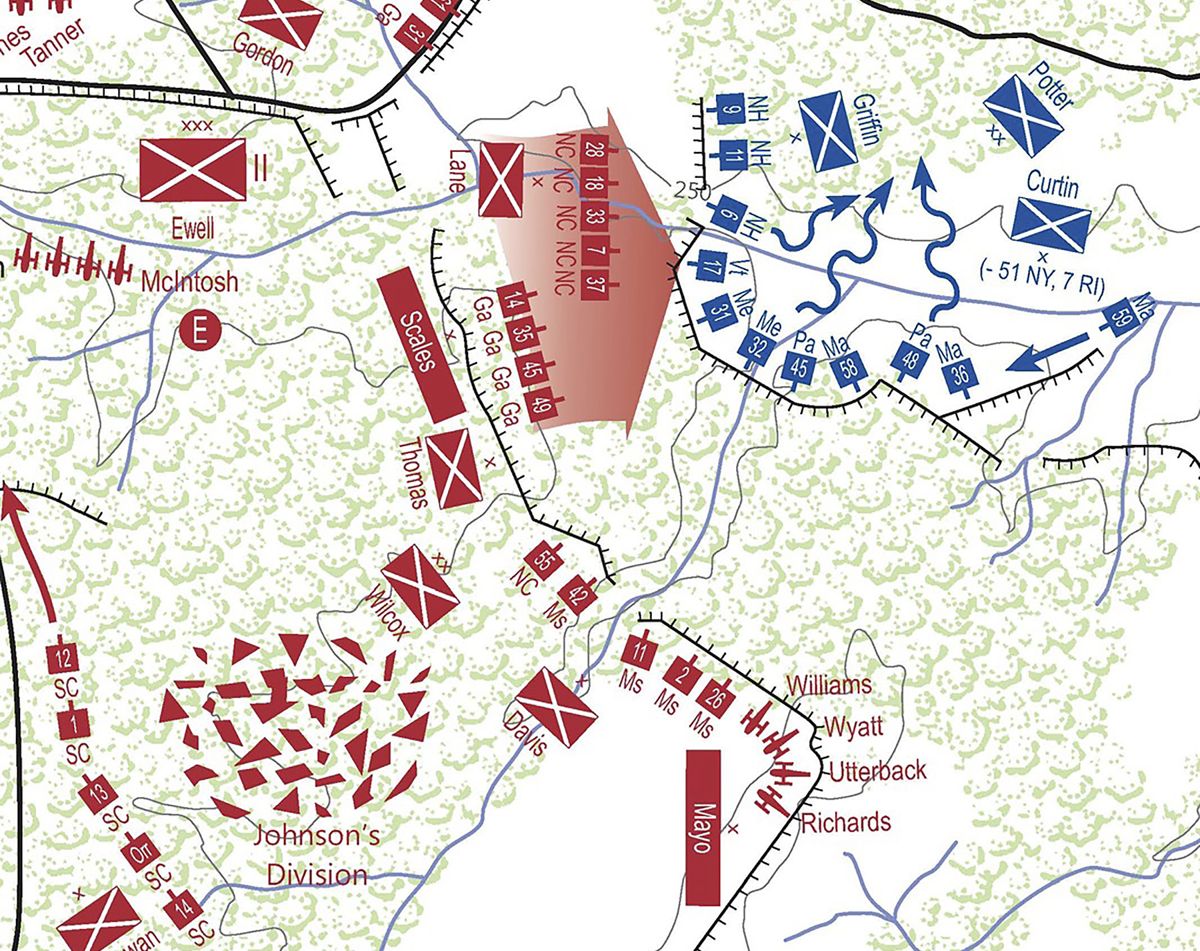
give away their movements. The night of May 11 was a miserable one, with rain and fog making it impossible to see more than a few yards in any direction. Despite the Federals’ efforts to move in silence, Confederate pickets stationed in rifle pits in advance of the Mule Shoe began to report movement in their front. By midnight, Johnson was convinced that something was afoot and rode to Ewell’s headquarters to insist that the artillery be returned. Ewell agreed to issue the order, but for some reason it was delayed, with the result that the guns were just returning when the Federal assault was launched. The Federals charged without yelling, and the fog shrouded their approach so that many of the pickets were captured without firing a shot. The rain and fog also dampened the powder in Confederate muskets, so that most men found pulling the trigger produced only the pop of an exploding percussion cap. Federal numbers were overwhelming, and Johnson and almost his entire division were captured. The only thing that stood between the Confederates and complete disaster was the brigade of General Lane. Lane’s brigade held the line just below Johnson’s division, at the eastern base of the Mule Shoe. It was the northernmost unit in the Confederate 3rd Corps. The 28th North Carolina held the left of Lane’s line, facing slightly southeast, with the 18th North Carolina on its right facing east. To the right of the 18th but separated from it by a boggy stream lay the 33rd, 7th, and 37th North Carolina, continuing Lane’s line southward to connect with the rest of the 3rd Corps. It was not long before Lane’s men found themselves under attack from two sides.5 Initially, their attention was drawn to the noises to their north, though they could see nothing through the dim light of a rain-shrouded dawn. Lane was on the far left of his line, conferring with Colonel W.H.A. Speer of the 28th, when a new threat appeared, advancing from the east. General Simon G. Griffin’s brigade of the Union 9th Corps emerged from the fog and struck Lane’s three right regiments. Lane told Speer that he must hold his position and rode off to the right to deal with Griffin’s attack. It was not until refugees from Johnson’s division began streaming past their rear that the men of Lane’s brigade became aware of the extent of the disaster to their north.6 Soon Speer “found the troops on my left flying in utter confusion in every direction [and] found the enemy coming down the works on both sides. I hastened to the right of my regiment and informed General Lane of the facts. He ordered me to move out my regiment by the right flank [but] by this time, the enemy being on both sides of my regiment…I lost 113 men as prisoners.” To his right, the 18th regiment was partially enveloped as well and lost 141 men captured.7 The colonels of the 33rd and 7th North Carolina, when informed by the colonel of the 18th that the Federals would soon be in their rear, took advantage of a section of earthworks in their rear that had been abandoned when the engineers extended the main line of earthworks farther to the southeast. This section of works ran at nearly right angles to their original position, thus allowing them to fire into the front and flank of the Union 2nd Corps men moving southward through the Mule Shoe. They remained anchored to the 37th on the far right of the brigade, who continued to oppose the soldiers of the Union 9th Corps (Griffin’s) attacking from the east. Lane rallied the survivors of the 28th and 18th behind the new position. “You must hold your ground,” he shouted. “The honor and the safety of the army demand it.” He posted his men in “double ranks; the front rank fired while those in the rear speedily loaded and exchanged guns with the front rank.”8 “Here took place one of the most desperate fights for that time of the war,” wrote Speer. Attacked from the east by Griffin’s brigade and from the north by Gen. Francis Barlow’s 2nd Corps division, the brigade held firm on the high ground behind the boggy stream. Lane experienced his first brush with death when his courier was wounded and the man’s horse killed while standing near the general, so Lane sent his brother Oscar, who was serving as his aidede-camp, to Wilcox to ask for reinforcements.9 While Lane’s lone brigade struggled to hold back the
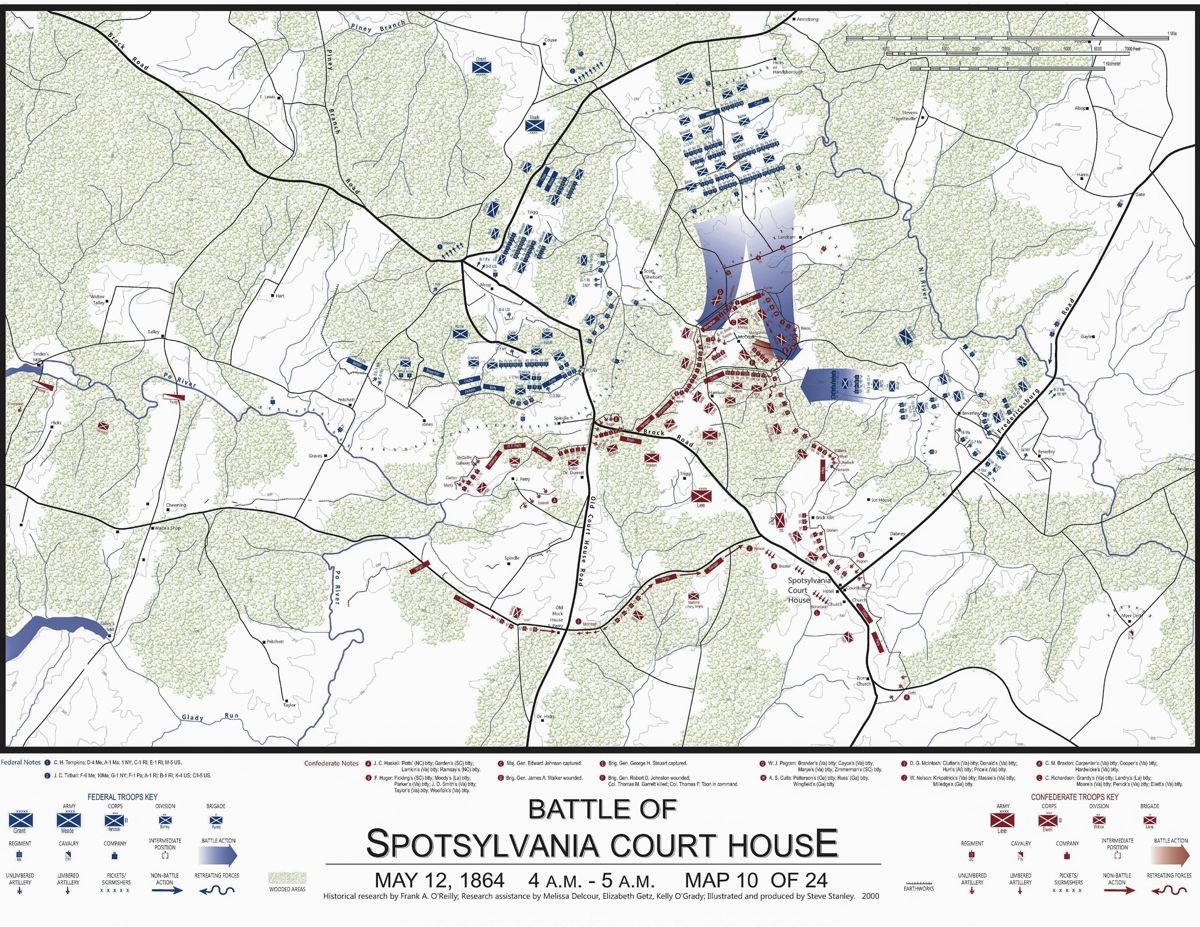
Federal onslaught, Confederate reinforcements were being rushed forward. Fortunately for the southerners, the Union attack was starting to lose momentum. The earthworks themselves broke up unit cohesion, and the need to disarm and usher to the rear hundreds of prisoners further slowed the Union advance. The low-hanging fog, mingled with powder smoke under the trees, also confused matters. Confederate Gen. John B. Gordon seized the initiative and ordered his brigades to attack. The fighting was vicious and at close quarters, but Gordon’s men managed to push back the Federals and recapture part of the Mule Shoe’s eastern face. By this time, however, many were exhausted and almost out of ammunition, so Gordon now looked for support. At that moment, Wilcox sent the brigades of Alfred Scales and Edward Thomas into the fight. They attacked in a northeasterly direction, connecting with Gordon’s men on their left and Lane’s men on their right. Together, Scales, Thomas, and Lane attacked Griffin and, after a hard fight of 10-15 minutes, managed to drive the Federals back through the abatis, across a field, and into a body of woods on the far side, where the Federals started to dig in. The Union attack had stalled.10 At that point, Wilcox ordered his men to return to their lines. Lane’s men found their original position occupied by Scales’ brigade and were moved slightly to the south, to an area that had not yet come under attack but was being enfiladed by artillery fire from Burnside’s 9th Corps. It was
FRSP Spotsylvania map 10, May 12, 1864, 12-3 p.m. detail during this time that Lane’s brother Oscar was wounded and Lane himself nearly killed. “Oscar was wounded by an unexploded shell that took off his left foot and two of the toes of his right,” explained James to his father two days later. “He, Captain Hale & myself were standing close together when he was wounded. The shell struck him in its downward course, ricocheted & exploded some distance beyond us.” It was the second close call for the general.11 While the situation on the eastern side of the salient had stabilized, a desperate fight was being waged for the western side. Federal troops still held onto their lodgments inside the breastworks, where the traverses became the barriers separating friend from foe. Men stood just feet apart, raising their rifles over their heads to shoot blindly into the space beyond. Bodies piled on either side of these barricades, with no time to pull the wounded out of the way. By this time, Grant sensed that his attack was stalling and looked for new ways to regain the initiative. The ineffectual Burnside had managed to put just three of his eight brigades into the attack on the eastern salient. Grant now ordered him to renew the attack with everything he had. Lee was also looking for a way to relieve the pressure on the Confederates fighting to regain the western salient. Having taken Burnside’s measure at Fredericksburg in 1862, Lee knew him to be a less than aggressive commander. He therefore decided to attack and derail Burnside’s assault. From Lee’s vantage point, it appeared that Burnside’s left flank ended at a Union battery located about a quarter of a mile east of the Confederate lines. Lee asked Captain Nicholson of Lane’s 37th North Carolina to confirm that fact, and after a harrowing trip beyond the picket line and back, Nicholson returned to report that there were no Union troops to the battery’s left. Lee then ordered the attack. Lane’s brigade was chosen to lead it, with Gen. William Mahone’s brigade, led by Col. David Weisiger, in support. Lane led his men out to a wooded area in advance of the line, where he formed them into line of battle. Weisiger’s brigade formed behind them, in support. As Burnside’s infantry advanced toward the eastern side of the salient, Lane’s men “rushed upon their battery of six guns…and struck Burnside’s assaulting column in flank and rear.”12 Fighting was fierce and at close quarters. Lane’s task was not helped by Weisiger, whose men fired into his rear for a time. At one point, Lane and a few of his men were surrounded by Federals, who demanded their surrender. Lane related the story to his father in this way: “The Yankees captured me the day before yesterday, but by presence of mind & a little impudence I succeeded in making my escape.” According to an article that appeared in a North Carolina newspaper a few weeks later, Lane bluffed his way out of the situation by telling his would-be captors “Very well, wait a moment until my line comes up.” Thinking that they would soon be overwhelmed themselves, the Federals quickly scattered, and Lane escaped.13 It was not long before he had his final narrow escape of the day. “My life was soon afterward saved by one of my men who shot a Yankee in the act of shooting me,” he told his father. “The rascal was not more than ten yards from me.” Lane mentioned the soldier, Private P.A. Parke of Co. D, 37th Regiment, in the official report he filed after the battle.14
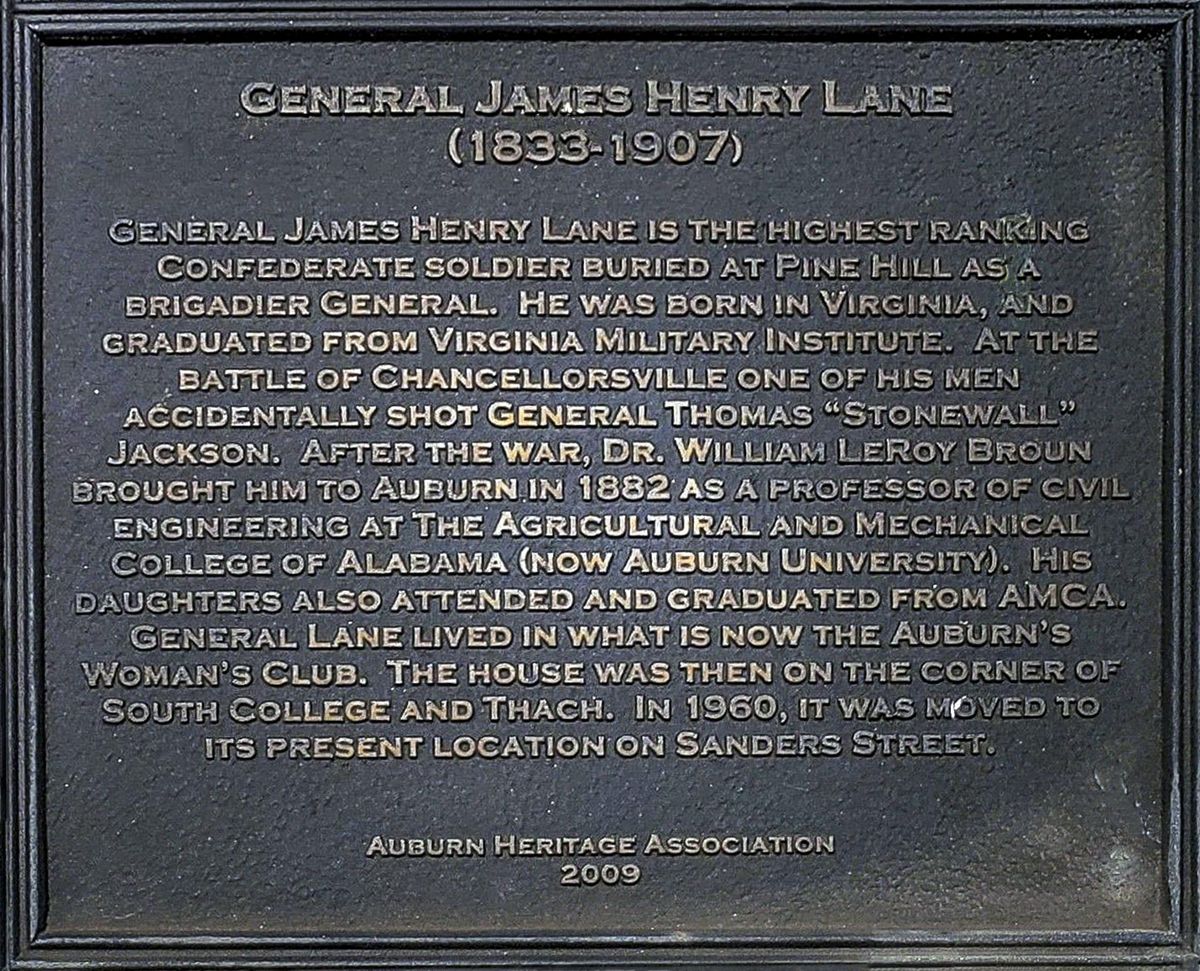
Once the battery was captured, Lane reported that they “turned our whole attention to Burnside’s column, which was taken by surprise.” He sent word to Weisiger to come up on his right, where they would jointly “sweep around to the left and up to our works and add to the captures already made”, but when Weisiger did not comply, Lane was forced to withdraw. He was unable to bring the six guns with him because the horses had been shot, but he did return with about four hundred prisoners and three flags. More importantly, he had blunted the force of Burnside’s attack, which was called off soon afterwards.15 It was, in summary, an eventful day for James Henry Lane. He narrowly escaped death in at least three separate instances and talked his way out of capture in a fourth. It may also have been his finest hour in the service of the Confederate nation when one looks at the role he and his men played in staving off disaster for Lee’s army. It was a costly effort, the brigade having lost 470 men, roughly onethird of whom were captured in the confusion following the collapse of Johnson’s division. They nevertheless had reason to be proud of themselves. In his official report, Lane wrote “we justly claim for this brigade alone the honor of not only successfully stemming but rolling back the tide of Federal victory.”16 His opinion was shared by Maj. Gen. Jubal Early, who was commanding the 3rd Corps in A.P. Hill’s absence. Early wrote that “Lane’s attack on the enemy’s flank and rear contributed materially to the repulse of [Burnside’s] assaulting column, as it was thereby thrown into much confusion.” Carrying more weight than any other compliment, however, was the personal praise given him by General Lee later that day. Lee asked to see Lane and praised his brigade’s “gallant behavior and the cheerfulness with which they had borne the hardships of the day.”17 Although Lane avoided serious injury at the Battle of Spotsylvania Court House, he received his third and most serious wound of the war three weeks later at the Battle of Cold Harbor, a wound that was initially thought to be fatal. While recuperating in Richmond, he was able to see his younger brother Oscar and was with him when that young man finally succumbed to the wound he received at his brother’s side at Spotsylvania. Oscar was the second of Lane’s brothers who died while serving as his aide-decamp. Twenty-one-year-old Julius Rooker Lane was killed at Chancellorsville the year before.18 Lane returned to the Army of Northern Virginia in August and served with it through the rest of the war, surrendering with what was left of his brigade at Appomattox Court House in April 1865. After the war, he returned to academia, serving as a professor of mathematics and engineering at Virginia Polytechnic Institute and later at the college that became Auburn University. He died in 1907 at age 73.19 It may be that Lane’s light remains under a bushel because he was not one of the aggressive, offensive-minded leaders that Lee preferred and promoted. He was instead the kind of solid, dependable soldier who showed his worth when the odds were against him and a position had to be held at all costs. Perhaps after May 12, 1864, General Lee appreciated their value as well.
Primary Sources
Letters
Lane, James Henry, to Walter G. Lane, May 14, 1864. Lane, James Henry, to Mary Ann H. Lane, July 20, 1864.
Newspapers
Fayetteville Semi-Weekly Observer, May 23, 1864, p. 3.
Archives
James H. Lane Collection, Auburn University Archives and Manuscript Department. United States War Department. The War of the Rebellion: A Compilation of the Official Records of the Union and Confederate Armies (O.R.). Washington, 1894.
Official Reports
Barbour, Will. M., Capt., 37th N.C., September 8, 1864. Cowan, R.V., Lt. Col. Com’dg, 33rd N.C., July 9, 1864. Harris, J.G., Capt. Com’dg, 7th N.C., July 19, 1864. Lane, James H., Brig. Genl., Lane’s Brigade, September 16, 1864. McGill, W.M., Lt. Col. Com’dg, 18th N.C., September 9, 1864. Speer, W.H.A., Lt. Col. Com’dg, 28th N.C., July 19, 1864.
Other
Cox, William Ruffin. Sketch of James H. Lane. 1908.
Secondary Sources
Books
Clark, Walter. Histories of the Several Regiments and Battalions from North Carolina in the Great War 1861–’65. 5 vols. Goldsboro, North Carolina: State of North Carolina, 1901. Hardy, Michael C. General Lee’s Immortals. El Dorado, California: Savas Beatie, 2018. Powell, William S. Dictionary of North Carolina Biography. 6 vols, Chapel Hill, North Carolina: University of North Carolina Press, 1979–1996. Rhea, Gordon C. The Battles for Spotsylvania Court House and the Road to Yellow Tavern, May 7–12, 1864. Baton Rouge: Louisiana State University Press, 1997.
Manuscripts
Phillips, Kenneth Edward. “James Henry Lane and the War for Southern Independence.” Master’s thesis, Auburn University, August 27, 1982.
ACE
pyro llc ers d w o P g in Fg Sport Available Now
Endnotes
James Henry Lane to Walter G. Lane, May 14, 1864, Lane Family Papers, Mathews County Historical Society. Maud Thomas Smith, Dictionary of North Carolina Biography, ed. William S. Powell, 6 vols. (Chapel Hill: University of North Carolina Press, 1979–1996); James A. Weston, “Thirty-Third Regiment,” in Histories of the Several Regiments and Battalions from North Carolina in the Great War 1861–’65, 2:562–567. Smith, Dictionary of North Carolina Biography; Phillips, “James Henry Lane and the War for Southern Independence.” John H. Thorp, “Forty-Seventh Regiment,” in Histories of the Several Regiments and Battalions from North Carolina in the Great War 1861–’65, 3:91; James H. Lane, report, June 3–August 1, 1863, in The War of the Rebellion, Series 1, Vol. XXVII, Pt. 2. Gordon C. Rhea, The Battles for Spotsylvania Court House and the Road to Yellow Tavern, May 7–12, 1864 (Baton Rouge: Louisiana State University Press, 1997), 245. W.H.A. Speer, report, July 19, 1864, in O.R. Speer, report, July 19, 1864; W.M. McGill, report, September 9, 1864, in O.R. R.V. Cowan, report, July 9, 1864, in O.R.; J.G. Harris, report, July 19, 1864, in O.R.; James H. Lane, report, September 16, 1864, in O.R.; Weston, “Thirty-Third Regiment”; William Ruffin Cox, Sketch of James H. Lane (1908). Speer, report, July 19, 1864; James Henry Lane to Walter G. Lane, May 14, 1864. Rhea, The Battles for Spotsylvania Court House and the Road to Yellow Tavern. James Henry Lane to Walter G. Lane, May 14, 1864. James H. Lane, report, September 16, 1864, in O.R. James H. Lane, report, September 16, 1864, in O.R; James Henry Lane to Walter G. Lane, May 14, 1864; Fayetteville Semi-Weekly Observer, May 23, 1864. James Henry Lane to Walter G. Lane, May 14, 1864; James H. Lane, report, September 16, 1864, in O.R. James H. Lane, report, September 16, 1864, in O.R. James H. Lane, report, September 16, 1864, in O.R. Weston, “Thirty-Third Regiment.” Smith, Dictionary of North Carolina Biography; James Henry Lane to Mary Ann H. Lane, July 20, 1864, Lane Family Papers, Mathews County Historical Society; Michael C. Hardy, General Lee’s Immortals (El Dorado, California: Savas Beatie, 2018). Smith, Dictionary of North Carolina Biography.
J anet M c C abe earned a Bachelor of Arts degree from the U niversity of V irginia and a M aster of B usiness Administration degree from the Amos Tuck School at Dartmouth C ollege . A lthough she spent her professional career in the financial services industry , she has been fascinated by the
American Civil War since her father took her to her first battlefield when she was eight years old.
She currently is a Licensed Battlefield Guide and docent at the George Spangler Farm and Field Hospital outside Gettysburg.