
Vision and Valor: The War Through Women’s eyes
By Juanita Leisch Jensen · Originally published January-February 2026 · pp. 22–27
He Has A Great Work for Me to Do
This article focuses on the women who ministered to sick and wounded soldiers in the Civil War. From the moment war became a reality, women sought roles supporting the military. Some tasks (like sewing uniforms and knitting socks) could be meshed with home routines. But this level of activity was not enough for some. Hannah Ropes, who later served as a Civil War nurse, expressed her frustration with traditional female roles in an 1853 letter,
“… why did you give this homely hen the wings of an eagle? Behold they flap heavily against her sides, for the want of proper use – and fret away the life which as yet finds no fit element, or finding, cannot, dare not, accept.”1
was giving her an opportunity to nurse soldiers. She wrote to Miss Dorothea Dix, Superintendent of Army Nurses, offering her services on a Thursday. She received a response on Monday and started work at Georgetown Hospital on Thursday. She continued serving in Georgetown (and later Columbia) hospital through the end of the war.
“I am very happy in mind, still have hold of my Saviour’s hand, and believe he has yet a great work for me to do.”2
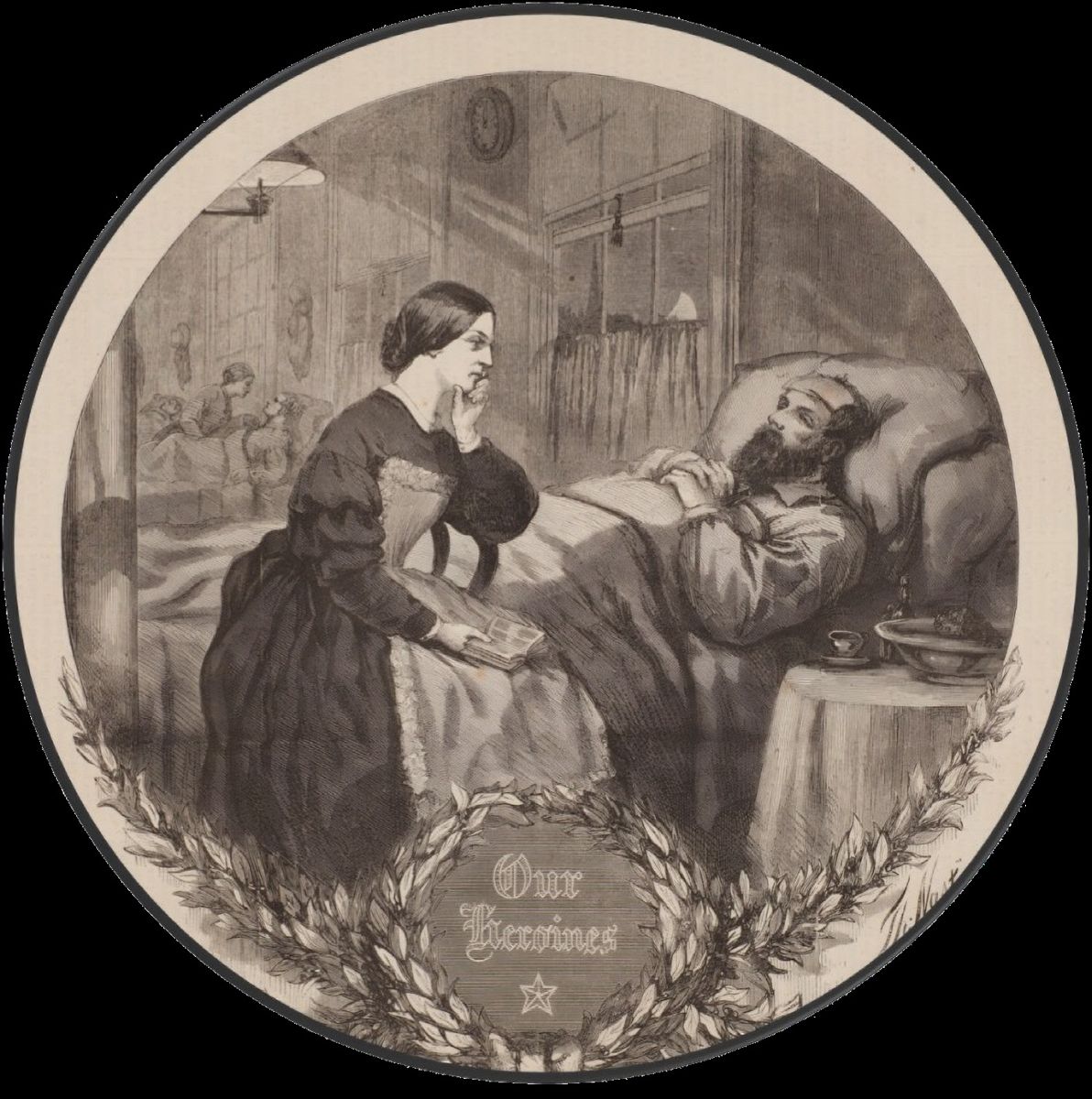
At the outset of the war, both U.S. and C.S. governments anticipated an expeditious end to hostilities and made little preparation or arrangements for medical care of soldiers. Both eventually adopted systems of providing immediate care as and where possible, then (when feasible) removing soldiers to field With her only living son away at hospitals in improvised facilities war, widow Rebecca Pomroy found until they could be transported to herself living alone, and decided God Illustration captioned “Our Heroines.” larger and more permanent general and convalescent hospitals. Many women who served as nurses did so in general hospitals, though some (including those who served on hospital transports) experienced fieldhospital conditions. A much larger number ministered to sick and wounded soldiers in their homes. Only a small number of women provided any sort of immediate nursing assistance during battles or on actual battlefields. Traditionally, women were trained from childhood to provide health and medical care for family and friends. By the Civil War, a small handful of women had received formal training in medicine, but it was very unusual for women to imagine they would ever nurse anyone other than a personal friend or family member. The primary exceptions to this were Catholic nuns and others in religious orders with a mission to provide nursing care. Many Catholic nuns nursed soldiers during the war, and in some cases (as with the Visitation Convent in Frederick, Md.), even brought wounded soldiers into a cloistered compound. The rumor that women of ill repute worked in hospitals did nothing to improve the reputation of women nurses, and led to much suspicion about the sort of woman who might want to be nurses during the Civil War. Against this cultural backdrop, early in the war, Miss Dorothea Dix was appointed “Superintendent of Army Nurses” with a mission to develop and implement a program to recruit, train, employ and assign nurses for general hospitals. Her strict rules on age, appearance and deportment were intended to counter negative public opinions of women nurses. The Confederacy never developed an official or federal army nurse organization, but women found employment in general hospitals, with state organizations, and as independent volunteers. As many battles took place in southern states, countless women found opportunities to nurse soldiers in their homes. Unlike the efforts of women who worked in more structured arrangements, the Information on the countless women who nursed soldiers in their homes is often anecdotal. James Gore consulted his mother’s journal in preparing a biography of her exemplary life. He discovered she had been invited to serve as a nurse at a Civil War hospital, noting he did not recall there was ever a mention made in the family circle of the suggestion. He found in her journal the invitation her thoughts and her response
“I can scarcely refrain from going, so [seldom] on the way to heaven do these posts of duty appear. Yet I believe the widowed mother’s first duty is to her orphaned children.”3 Gore noted that his mother still managed to nurse soldiers, regularly invited the military to bring any soldiers needing special care to her home. In his book, Women of the South in War-Times, Matthew Page Andrews cited an incident that took place in Tennessee near the ironically named “Medical Grove” estate.
“… a fair-haired young boy from Illinois, who seemed greatly to appreciate the kindness shown to him … asked Evaline [Dulaney] to pray with him, which she did, and then drawing a ring from his finger asked her to send it to his mother and write her that he had been tenderly cared for in his last hours. She wrote the letter and sent it, with the ring and a lock of his hair, to the address given, but no response ever came.”4 A similar anecdote from Virginia had a very different conclusion. After the Battle of New Market, the mother of Thomas Garland Jefferson received letters from both Jefferson’s VMI roommate Moses Ezekiel and New Market resident Eliza Clinedinst. From these letters, she obtained a lock of his hair, and the information that Ezekiel and Clinedinst nursed Jefferson through the few days he lived after the battle. Mrs. Jefferson invited Miss Clinedinst to come to Jefferson’s home—a visit that lasted months—and resulted in a correspondence between the two families that continued into the second quarter of the twentieth century.5 Moses Ezekiel went on to create the sculpture “Virginia Mourning Her Dead” honoring Thomas Garland Jefferson and other VMI cadets lost as a result of the Battle of New Market. Perhaps because the position of “lady nurse” was new and unusual, several nurses provided accounts of their activities in letters and memoirs. Katharine Prescott Wormely left a well-to-do family in Newport, RI, to serve for three months on hospital transports.
“We begin the day by getting them all washed and freshened up, and breakfasted. Then the surgeons and dressers make their rounds, open the wounds, apply the remedies, and replace the bandages. …When it is over, we go back to the men and put the ward in order once more; remaking several of the beds and giving clean handkerchiefs with a little cologne or baywater on them….We sponge the bandages over the wounds constantly, which alone carries us round from cot to cot almost without stopping, except to talk to some, read to others, or write letters for them; occasionally giving medicine or brandy…. Then comes dinner, which we serve … feeding those who can’t feed themselves. After that we go off duty, and get first washed and then fed … our dinner-table being the top of an old stove, with slices of bread for plates, fingers for knives and forks, and carpet-bags for chairs. – all this because everything available is being used for our poor fellows. After dinner … we sit on the floor of our staterooms resting, and perhaps writing letters, as I am doing now.”6 Amanda Akin Stearns worked in Ward “E” of Armory Square Hospital, describing for folks at home the new patient process:
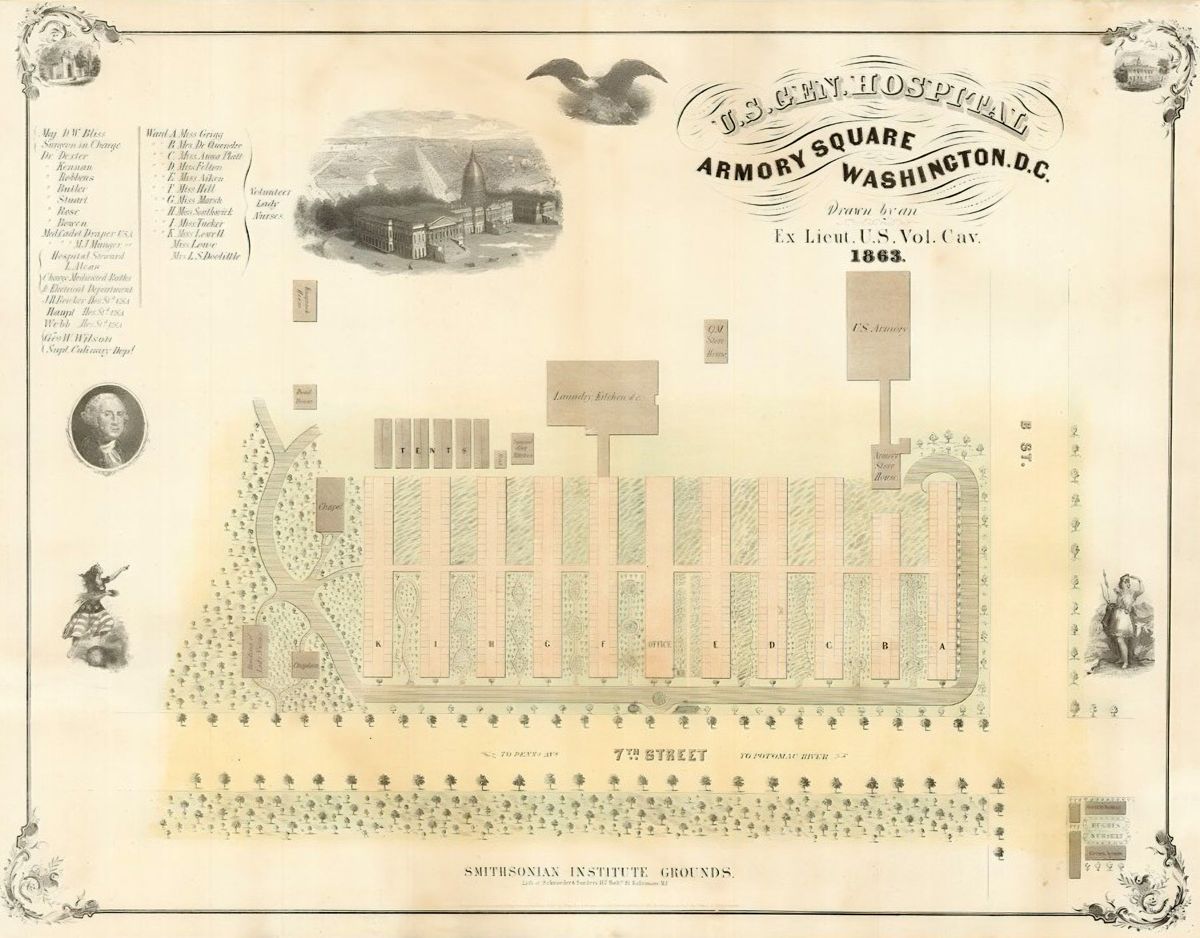
“The same routine must be followed before the poor man is put to bed: his card made out and hung at the head of his bed; his clothes, which are taken off, made into a parcel, labeled for the knapsack room; and an account entered in the ward-mater’s book, which in ‘Ward E’ is kept by the ‘lady nurse.’”7 While many of the tasks these two women listed are logistical and administrative, In some hospitals, women were called upon to perform medical procedures.
“They have put me to blistering all the patients under my care, who have typhoid, and you must know it is no pleasant task to perform for so many soldiers morning and evening; but they think I do just right and the physicians give me much credit.”8 One stressful duty was to sit with the dying,
“Sergeant Colburn (a Massachusetts soldier) … had suffered long months … I sat by his bedside some two hours bathing his parched lips and heated brow, and watching the flickering taper of life, slowly yet surely burning out …”9 The work of a nurse could leave little time for attention to appearances. Katharine Wormely reported,
“My dresses are in such a state that I loathe them, and myself in them. From chin to belt they are yellow with lemon-juice, sticky with sugar, greasy with beef-tea, and pasted with milk-porridge. Farther down, I dare not inquire into them. Somebody said, the other day, … that he wished to kiss the hem of my garment. I thought of the condition of that article and shuddered.”10 There were also a few women who served “in the field.”
“Mrs. Sullivan went with the [First Tennessee] regiment. Not in the rear, working in a hospital, but on the battle ground with her boys, carrying bandages and with canteens of water suspended from her shoulders, she bound up wounds and stanched the life blood of many soldiers, moistened the lip of the dying, and closed the eyes of the dead. … She marched on foot with her knapsack on her back through the mountains of West Virginia, slept on the frozen ground, under the cold skies, a blanket her only covering – her knapsack, her pillow.”11 According to Andrews’ account, when Mrs. Sullivan’s husband was captured, she even accompanied him to prison. No article on nurses in the Civil War era would be complete without a mention of the luminaries in the field, including: Florence Nightingale demonstrated during the Crimean war that women could and should improve the sanitary and dietary conditions of soldiers. She later wrote Notes on Nursing. Louisa May Alcott served as a nurse during the Civil War. She later wrote Hospital Sketches. Clara Barton serving as a nurse during the Civil War and later spent years lobbying the United States government to sign the International Red Cross’s Geneva Convention. She helped in the creation of the American Red Cross. She also played a significant role in the Missing Soldiers Office assisting families searching for their missing loved ones.
The activities of women nurses during the Civil War so thoroughly demonstrated the suitability of women to serve as nurses that it changed cultural attitudes and the nursing field never reverted to the single-gender male-domination of pre-war years.
Bibliography • • •
• • •
•
•
Andrews, Matthew Page, Compiler. The Women of the South in War Times. Baltimore: The Norman, Remington Co., 1927. Berlin, Editor. A Confederate Nurse: The Diary of Ada Bacot, 1860–1863. Columbia, University of South Carolina Press, 1994. Boyden, Anna L. War Reminiscences: A Record of Mrs. Rebecca R Pomroy’s Experience in War-Times. Boston: D. Lothrop Company, 1884. Brumgardt, John R. Civil War Nurse: The Diary and Letters of Hannah Ropes. Knoxville, University of Tennessee Press, 1980. Gore, James Howard. My Mother’s Story. Philadelphia: The Judson Press, 1923. Harwell, Richard Barksdale. Kate: The Journal of a Confederate Nurse by Kate Cummings. Baton Rouge: Louisiana State University Press, 1987. Davis, Margaret B. Mother Bickerdyke. San Francisco: A. T. Dewey, 1886. (Book published for the benefit of M. A. Bickerdyke.) Livermore, Mary A. My Story of the War. A Woman’s Narrative
•
• •
•
of Four Years Personal Experience. Hartford, CT: A. D. Worthington and Company, 1889. MacCaskill, Libby, and David Novak. Ladies on the Field: Two Civil War Nurses from Maine on the Battlefields of Virginia. Livermore, Maine: Signal Tree Publications, 1996, Stearns, Amanda Akin. The Lady Nurse of Ward E. New York: The Baker & Taylor Company, 1909. Wheelock, Julia S. The Boys in White. New York: The Experience of a Hospital Agent in and Around Washington. Lange & Hillman, 1870. Wormeley, Katharine Prescott. The Other Side of War. Boston: Ticknor and Company, 1889.
Family correspondence archived at Haw Branch Plantation, Amelia Court House, VA. 6. Wormeley, Katharine Prescott. The Other Side of War. Boston: Ticknor and Company, 1889, p, 27. 7. Amanda Akin Stearns. The Lady Nurse of Ward E. New York: The Baker & Taylor Company, 1909, p. 34. 8. Boyden, p. 26. 9. Wheelock, Julia S. The Boys in White: The Experience of a Hospital Agent in and Around Washington. New York: Lange & Hillman, 1870, p. 53.Wormeley, p. 164-165. 10. Newbill, Grace Meredith, “Mrs. Betsy Sullivan, “Mother to the First Tennessee Regiment, quoted in Andrews, pp. 113-114.
Endnotes 1.
John R. Brumgardt, editor. Civil War Nurse: The Diary and Letters of Hannah Ropes. Knoxville: University of Tennessee Press, 1980, p. 12. Anna L. Boyden. War Reminiscences: A Record of Mrs. Rebecca R Pomroy’s Experience in War-Times. Boston: D. Lothrop Company, 1884, p. 26. Gore, James Howard. My Mother’s Story. Philadelphia: The Judson Press, 1923, p. 18. “Caring for Wounded Foes,” Matthew Page Andrews, Compiler. The Women of the South in War Times. Baltimore: The Norman, Remington Co, 1927, p. 109.
Juanita Leisch Jensen is a nationally recognized speaker, author, researcher (and avid collector) of topics related to civilians and the Civil War. She can be reached at lesandjuanita 1@ hushmailcom to arrange talks and presentations. She is the author of two books: Who Wore
What: Women’s Clothing 1861-65 and An Introduction to Civil War Civilians. Juanita and her husband, military historian Les Jensen, divide their time between homes in New York and Virginia.
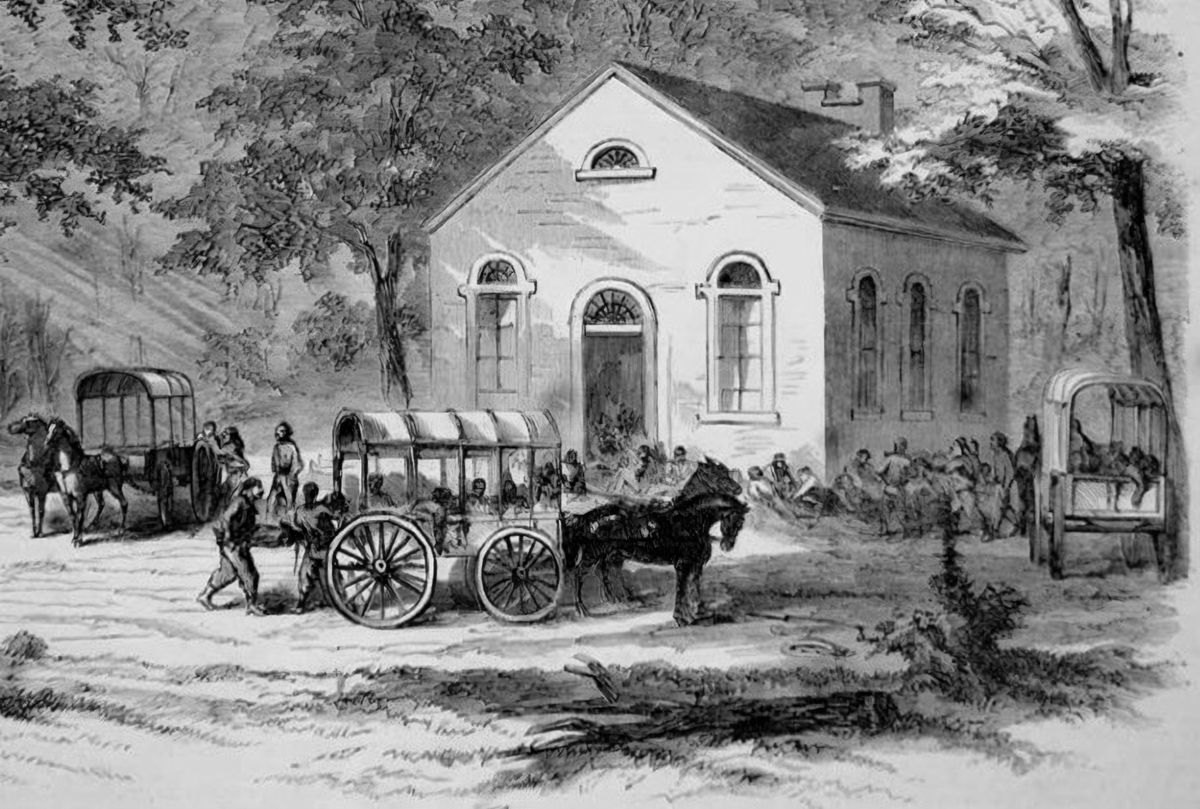
Illustration captioned “The Dying Soldier – The Last Letter from Home.” Published in Livermore, Mary A. My Story of the War. Hartford, CT: A. D. Worthington and Company, 1889, p. 210.