
USCC Massacre
By Charles H. Bogart · Originally published January-February 2026 · pp. 8–9
USCC Massacre at Simpsonville, Kentucky By Charles H. Bogart
In 1864, the 5th United States Colored Cavalry (5th USCC) under Colonel James Brisbin was formed at Camp Nelson, Ky. The Regiment, some 1,000 strong, was made up of freemen, escaped slaves, and slaves released by their owners. Even before being officially sworn into service, the 5th USCC participated in the First Battle of Saltville and the Battle of Marion. Being outfitted with the Enfield rifle, the 5th USCC was poorly armed for a cavalry regiment. This gun could not be loaded or fired from horseback, nor could it be carried with ease when mounted. Thus, when the 5th USCC was committed to battle they fought as infantrymen. When fighting, one man held four horses while the other three men stood in the firing line.
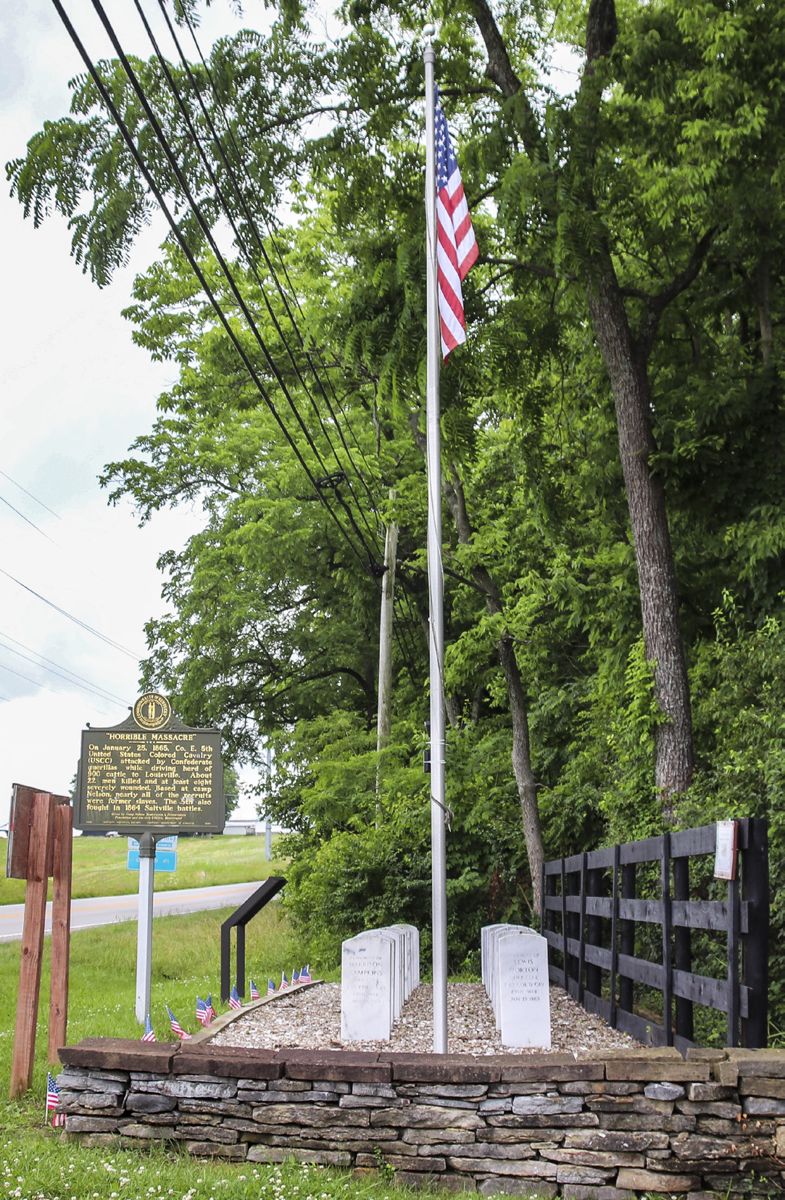
Historical Marker #2283 in Shelby County.
In January 1865, Company E, 5th USCC was instructed to drive a head of approximately 1,000 cattle from the Lexington, Ky., area to Louisville, a distance of 100 miles. Louisville was the location of a large U.S. Army logistical center and was the railhead for the supply line running to Nashville, Tenn. Lieutenant Augustus Flint, an officer lacking command experience, was placed in charge of the cattle drive. The weather was cold and there was snow on the ground when the cattle drive left central Kentucky. On January 24, 1865, the cattle herd reached Simpsonville, Ky., some 30 miles east of Louisville. Here men of Captain Dick Taylor’s Confederate partisan group were lying in wait. The cattle had been corralled by Company E in a large, fenced pasture for the night. Taylor’s men tore down fencing at various locations during the night allowing the cattle with encouragement to wander over the countryside. Flint, instead of staying with the cattle herd and his men, rode off to spend the night in a nearby farmhouse while his men took shelter in barns and outbuildings. The next morning a member of Taylor’s unit posing as a local farmer, aroused Flint at the farmhouse telling him that the head of cattle had escaped from the holding field and was
A view of the monument showing how close it is to US 60. The pull off is behind the photographer. (Charles Bogart)
plot of land on the south side of US 60 near the battle site was chosen. The monument consisted of a flagpole, historical marker, tablets explaining what happened, and 19 gravestones in two rows. Engraved in each gravestone is the wording “In memory of XXX, Private Co E 5th U S Col’d Cav, Civil War, January 25, 1865.” The suspected burial site is a few hundred yards east of the monument on the far side of US 60. Be warned that the only parking at the memorial is a small dirt pull off just west of the monument and there is no warning of approaching the monument site. Traffic on US 60 is heavy and runs by the site at high speed.
wandering over the countryside. He stated that he would offer to help round up the cattle but lacked proper boots for working in the snow. Flint gave the partisan his boots so he could direct the men of Company E in rounding up the cattle. As the man left Flint, he told him that as soon as half of the cattle were rounded up, he would send them off to Louisville under the control of some of Company’s E men. This suggestion met with Flint’s approval. After eating his breakfast at the farmhouse, Flint rode into Simpsonville to purchase new boots. While he was in the general store trying on boots, Simpsonville was attacked and captured by Taylor’s Confederates. Flint hid in the store during the attack and avoided capture. After looting the town, the Confederate raiders rode off to attack some of the Fifth located two miles west of Simpsonville. Taylor’s men attacked on horseback, firing their revolvers at the men of E Company 5th USCC. The attack overwhelmed the men of E company who were unable to dismount and load their guns. The men of Company E were either killed during the attack or shot after they surrendered. All reports agree the men of Company E surrendered after failing to put up any resistance. Some 39 men of E Company were either killed or wounded in this attack. It appears the Confederates shot every member of the 5th USCC they encountered, treating them as armed slaves in rebellion. Official records state that while no Confederate was wounded in the action, 19 USCC soldiers were killed and 20 USCC soldiers were wounded, of whom four later died. After the War, Taylor boasted of killing the 5th USCC soldiers at Simpsonville and, for that matter, other Union men during the war. He was never tried for war crimes and lived post war as a respectful citizen. The 5th USCC dead found on the battlefield were interred by the citizens of Simpsonville in a hastily dug grave. A number of searches have been conducted to find this mass internment, but none have been successful. Recent investigation of the Simpsonville Massacre suggests that the members of the 5th USCC who were killed are buried near the present memorial and plans are ongoing to investigate the site. In 2010, Simpsonville area citizens banded together to create a memorial to recognize the sacrifice of the men of E Company 5th USCC. A 100-foot-long by 10-foot-wide
Charles H. Bogart has a BA from Thomas More University and an MCP from Ohio State University. He is employed as a tour guide at the Fort Boone Civil War Battle Site in Frankfort, Ky., Past-President of the Frankfort Civil War Roundtable, and is a board member of the Kentucky Civil War Roundtable. He has written several books and articles on military and naval history.
For current events visit CivilWarEvents.com
Since 1978, we have collected or handled over 80 of the “Big Six” Confederate Notes to include nearly 10% of all known surviving Montgomery Notes.