
The Graphic War Preserve. Educate. Inspire.
By Salvatore Cilella · Originally published January-February 2026 · pp. 54–55
The Graphic War Civil War Politics: Abolition and Election
The Graphic War highlights prints and printmakers from the Civil War discussing their meaning and the printmaker or artist’s goals.
Americans tend to forget that politics in America has always been a blood sport. They also forget that America once held a presidential election in the midst of a bloody and tragic rebellion that claimed more than 700,000 lives. The election of 1864 pitted a beleaguered sitting president against a General-in-Chief he had previously “hired” and then “fired.” Major General George B. McClellan had been chosen by the Democratic Party to run against incumbent Abraham Lincoln. New York City printer, publisher, and anti-Lincoln agitator, George W. Bromley, used the power of his press to attempt to defeat Lincoln in the crucial election. Information on Bromley is scant. We do know that brothers George W. and Walter S. Bromley operated at 243 Broadway, New York, as civil engineers and publishers of county atlases. According to American print scholar and collector, Harry Peters, “Bromley and Co. were publishers of political caricatures, including ‘Political Caricature No. 2 Miscegenation or the Millenium of Abolitionism, New York, 1864,’ a strong anti-abolition caricature showing Lincoln and other white characters mingling on terms of social equality with negroes. Bromley made many caricatures during the Civil War period.”1 In that election year, it appears that Bromley published at least four anti-Lincoln caricatures, three of which are in the Library of Congress, uncolored and in original black and white. Two are featured here. The Amon Carter Museum of Western Art in Fort Worth reports that “Bromley & Company…did several anti-abolition cartoons during the Civil War.” The museum holds a hand-colored copy of Political Caricature No. 4 which, “ridicules a Lincoln campaign ball, showing blacks and whites dancing together and in various stages of embrace. Some political leaders left the room before the ball began, says Bromley, but many stayed for the party. This print, he claims, is a ‘perfect facsimile of the room, etc., etc.’”2 Bromley’s diatribes are an explosive potpourri of racist, political, and social commentary. “Simple emblems and symbols, and more or less complex allegories, not used in the first instances with humorous intent, were the raw materials of the early American graphic humorist,” wrote William Murrell in 1933. He characterized early caricatures as containing “a touch of exaggeration…here, a touch of the incongruous there, and that which began with solemn admonition rapidly developed into ridicule and burlesque.”3 Bromley’s prints were the epitome of Murrell’s description. They conjured up images of “miscegenation”—a racist trope which animated anti-Lincoln supporters. It is unknown who the original artist of these inflammatory images is, but he or she portrayed a “ludicrous vision of the supposed consequences of racial equality in America” and attacked “the Republican espousal of equal rights.” Political Caricature #2 Miscegenation or the millennium of abolitionism takes place in a park and features Charles Sumner, Horace Greeley, Henry Ward Beecher and, of course, Lincoln. “Miscegenation” was a term first used in the 1864 election designed to accuse Lincoln and the Republican Party of fostering the intermingling of the races. It consists of five explosive tableaus showing African American caricatures talking with Lincoln, dining together, riding in a carriage together, embracing each other, and intermarrying. Not content with portraying emancipated blacks, the artist also lampoons immigrants. “A German onlooker (far right) remarks, ‘Mine Got. vat a guntry, vat a beebles!’ A welldressed man with a monocle exclaims, ‘Most hextwadinary! Aw neva witnessed the like in all me life, if I did dem me!’
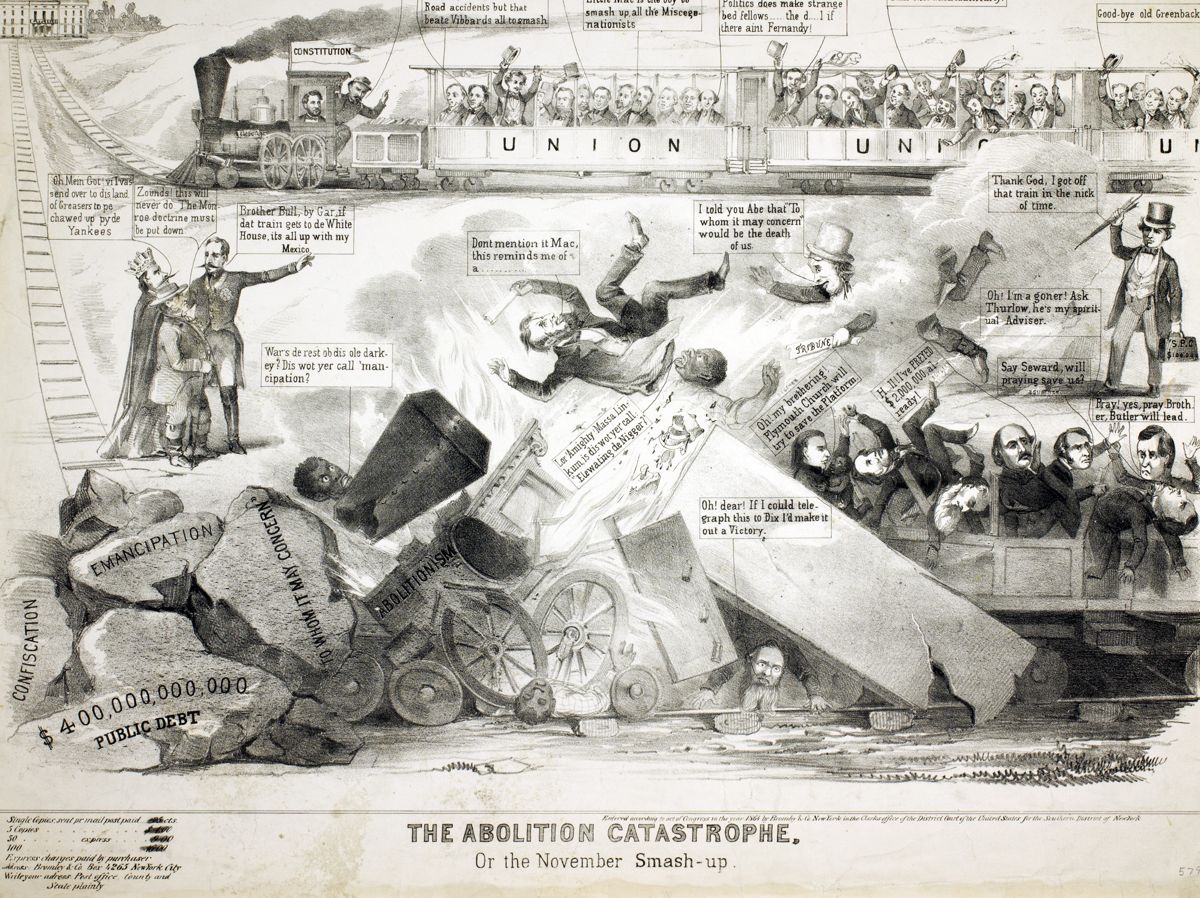
An Irishwoman pulls a carriage holding a black baby and complains, ‘And is it to drag n____ babies that I left old Ireland? Bad luck to me’.”4 Political Caricature No 3 or The Abolition Catastrophe of the November Smash up, is a visual cacophony of images, absurdities, and bizarre claims. The print features two trains, headed for the White House. The top train occupying the upper third of the image carries the hopes of the Democratic Party led by George McClellan. It is steaming unimpeded and confident of victory. One passenger shouts: “Little Mac is the boy to smash up all the Misceganationists (sic).” The lower two-thirds of the print depicts the Republican Party crashing on the rocks of $400,000,000,000 public debt, emancipation, abolition, and confiscation. McClellan taunts Lincoln with “Wouldn’t you like to swap horses now Lincoln?” Cheering Democrats, including New York Governor Horatio Seymour and Mayor Fernando Wood, wave and taunt the passengers on the crashing Republican train. Taunts such as “Thus ends the Abolition Party,” “Goodbye old Greenbacks,” and “Good-bye Horace (Greeley).” The Republican train wreck demeans emancipated black passengers, one of whom is crushed in the melee as he asks Lincoln if this is what he thought emancipation would look like. Lincoln’s response to McClellan’s taunt to replace him is to tell McClellan that it reminds of a story. The four cleanshaven men in the train are Massachusetts senator Charles Sumner, New York journalist and state political leader Thurlow Weed, Secretary of State William Seward, and John McKeon. Sumner: “Say Seward will praying save us?” Seward remarks: “Oh! I’m a goner! Ask Thurlow, he’s my spiritual Adviser.” Weed responds: “Pray! yes, pray Brother, Butler will lead.” Bromley has also mixed in international intrigue, depicting Maximillian of Mexico conferring with John Bull and Napoleon III. Maximillian was reconsidering his involvement with America, while John Bull declares, “The Monroe Doctrine must be put down.” Napoleon III laments that if Lincoln is re-elected, it is all over for Mexico. During the Civil War, Napoleon III tried to establish a puppet state in Mexico under Maximilian.5 At the lower left corner, Bromley announced that single copies of each print would be 25 cents, postpaid; 5 copies would be $1.00; 50 would be $9.00 express shipped, and only $16 for 100. “Write your address, Post Office, County & State plainly,” he instructed. It’s unknown how many of each print he sold. It appears that he produced only four prints in the series.
Figure 1. Political Caricature. No. 2, Miscegenation or the millennium of abolitionism. (Library of Congress)