
The Graphic War Andersonville
By Salvatore Cilella · Originally published September-October 2025 · pp. 46–49
The Graphic War Andersonville The Graphic War highlights prints and printmakers from the Civil War discussing their meaning and the printmaker or artist’s goals.
D By Salvatore Cilella uring and after the war, several printmakers such as Charles Magnus, Edward Sachse, and the Rosenthal’s in Philadelphia produced lithographic images of federal campsites, hospitals and prisons. The intended market was the individual soldier. It was remarkable that, with nearly 700,000 casualties, any participant of that tragic struggle would want something to remind them of the carnage, death and destruction. Even more remarkable was the involvement of the soldier/veteran in producing the images. This was particularly noteworthy in the production of images of prisons, especially Andersonville. As we wrote in our May 2021 article on Libby Prison, Major Otto Boetticher, a prisoner there, produced prints of his incarceration in Libby and Salisbury, N.C. Then, in July 2021, we wrote about the mother of all the prints of Andersonville. Inmate Thomas O’Dea produced his History
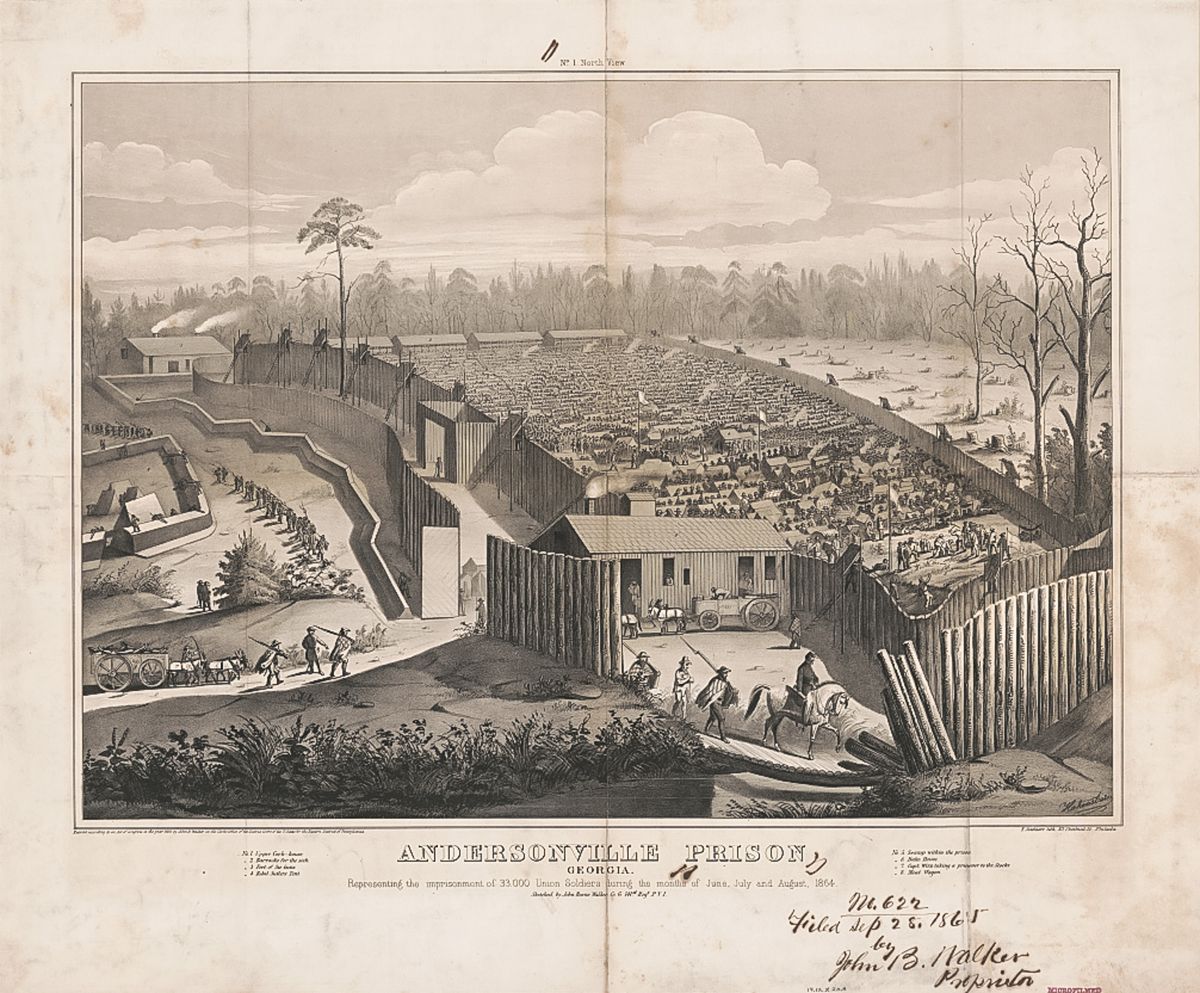
Figure 1. Andersonville, No. 1 North View. (Library of Congress)
of O’Dea’s Famous Picture of Andersonville Prison, in 1887 which accompanied and described his mammoth view of the notorious camp. He wrote: “There is not a man born that can accurately describe the scenes and sufferings of those who were imprisoned in those southern hells. ONE HAD TO BE THERE TO WITNESS AND UNDERSTAND IT!” We don’t know what compelled John Burns Walker to produce two prints of Camp Sumter adjacent to the sleepy southern town of Andersonville except that he was imprisoned there. Between June 16, 1864, until he was exchanged at Vicksburg, April 12, 1865, Walker survived the horrors of war and captivity by making detailed drawings of the camp, which he used as the basis of his two lithographic representations. A native of Salem Township, Wayne County, Penn., Walker enlisted as a private in Company G, 141st Pennsylvania Volunteers on August 25, 1862. Walker fell into enemy hands at Hanover Station, May 8, 1864, during Grant’s Overland Campaign.1 The 141st was quartered with the 2nd Brigade, 3rd Division, II Corps. The regiment crossed the Rapidan with the rest of the army on May 4, and sporadically engaged the enemy from the 6th through the 8th of May. Commanding officer, Lieutenant Colonel C.W. Tyler reported the regiment took into battle “16 commissioned officers and 278 enlisted men,” losing “6 enlisted killed, 2 commissioned officers and 70 enlisted men wounded and 4 men missing.” Walker was probably one of the missing.2 As far as we know, Walker left no diary or notes about his time in Andersonville, but his sketches, transformed into two lithographs, say much. His “North View” labeled as Sketch #1 (Figure 1) bears the cursive notation in the title margin which reads “No. 622/Filed Sep. 25, 1865,” which means it was finished just after the war ended and the Library of Congress accessioned it into the collections. The title margin reads “Andersonville Prison/Georgia/ Representing the imprisonment of 33,000 Union Soldiers during the months of June, July and August 1864/Sketched by John Burns Walker, Co. G, 141st Regt. P.V.I.” The print “was created during a moment of Northern fascination with the arrest, trial, and execution of the camp’s commander, Henry Wirz. Images of Andersonville remained popular in the North after the war and were exhibited in homes as both remembrances of the war’s horrors and alleged examples of widespread Southern cruelty. These prints, by safeguarding memories of the prison, helped to secure the camp’s designation as a National Historic Site, but also amplified sectional hostilities throughout the years of Reconstruction.”3 The sketches were transferred to the lithographic stone by Anton Hohenstein and produced by Philadelphia print maker, Thomas Sinclair. Hohenstein (1819–1869) was an artist and oil painter of portraits and historical scenes with a studio at 329 North Sixth Street in Philadelphia between 1855 and 1870. He arrived in Philadelphia in 1850 and predominately worked as a portrait painter before relocating to Alabama. Hohenstein returned to Philadelphia by 1860 and from 1868 to 1869, delineated “Abraham Lincoln’s Last Reception,” “Baptism of Pocahontas 1813,” and “Franklin’s Reception at the Court of France 1778” for lithographer John Smith. He also created the 1867 portrait of Robert E. Lee for George Spohni and owned “first rate battle scenes” (possibly his own work) according to an 1870 advertisement promoting the sale of his estate in the “Public Ledger.”4 According to print dealer, James Arsenault, “the replicated signature of Anton Hohenstein, who was mainly known as a painter, appears” … in the North View, “suggesting that he created a painting based on Walker’s untutored sketch… which served as the immediate source for the lithograph. While Hohenstein lived and worked in Philadelphia, none of the sources we’ve consulted indicate that he drew on stone for Sinclair.”5 The north view shows prisoners building infrastructure, a meat wagon entering the prison and Captain Henry Wirtz, riding a white horse ushering prisoners out to the stocks. Keys to landmark features identify the cook house, barracks, sutlers tent, bake house, and the meat wagon entering camp. The view from the south, (Figure 2) shows the overcrowding and bodies being carried out on a cart. On the lower right is an escaped prisoner being attacked by two dogs near a riverbank. The wagon bearing the dead reads “Andersonville” / Dead 12,877.” The title margin has a key to eight landmarks, among them the hospital, bake house, sick call enclosure, stocks, and Wirtz’ living quarters. The title margin reads “Numbers 1 and 2 comprise Andersonville Prison an area of 28 acres, nearly 5 acres of which was an uninhabitable swamp. In June, July, and August 1864, 33,000 Union Prisoners were crowded on the remaining 21
acres.” The Library of Congress labeled Walker’s work as “No. 623.” Others, including O’Dea, published prints of their horrific time at Andersonville. John L. Ransom authored and self-published “Andersonville Diary, Escape and List of the Dead” (1882), accompanied by a more stylized view of the notorious camp, which also included a key to 19 landmarks. (Figure 3). He particularly emphasized not one or two stockade fences, but three, uniform and evenly built, whereas Walker’s view shows two, and the two are more realistic, including the gates. After the war, Walker was one of 158 witnesses who testified against Wirz at Wirz’ trial.6 Wirz was convicted and hanged on November 10, 1865. According to the Wayne County Historical Society, Walker died in 1880.
Endnotes: 1.
Wayne County (PA) Historical Society’s Post, December 10, 2019. https://www.facebook.com/waynehistorypa/posts/2526733174030339/?checkpoint_src=any According to the Historical Society, “More men from Wayne County were killed in the Civil War than all other wars combined. Of the total population of 33,586 on the 1860 census, 2,189 men served in PA regiments, with another 300 or so in regiments from NY, NJ, and elsewhere.” Official Records, p. 476-67 “Operations in SC,. Va. And N. C.” Chap. xlviii. [Series I. Vol. 36. Part I, Reports. Serial No. 67.]
National Museum of American History, “Andersonville Prison, Georgia.” https://americanhistory.si.edu/collections/object/nmah_324922. h t t p s : / / d i g i t a l . l i b r a r y c o m p a n y. o rg / i s l a n d o r a / o b j e c t / digitool%3A79316. https://www.jamesarsenault.com/pages/books/7676/anton-andjohn-burns-walker-hohenstein-del/andersonville-prison-georgiarepresenting-the-imprisonment-of-33-000-union-soldiers-duringthe. Witnesses Who Testified at the Trial of Henry Wirz. https://www.nps.gov/ande/learn/historyculture/wirztestimonies.htm.
After 43 years in the museum field, Cilella devotes his time to collecting A merican prints and maps and writing. He has written extensively on Emory Upton:
Upton’s Regulars: A History of the 121st New York Volunteers in the Civil War (Kansas, 2009); a twovolume Correspondence of Major General Emory Upton, (Tennessee, 2017), received the 2017–2018 American Civil War Museum’s Founders Award for outstanding editing of primary source materials. He edited Upton’s love letters 1868-70 to his wife–Till Death Do Us Part (Oklahoma, 2020), and The Memoirs of Dewitt Clinton Beckwith of Upton’s Regulars (McFarland, 2023).