
Emerging Civil War Where Has the Time Flown?
By Chris Mackowski, Ph.D. · Originally published November-December 2025 · pp. 48–51
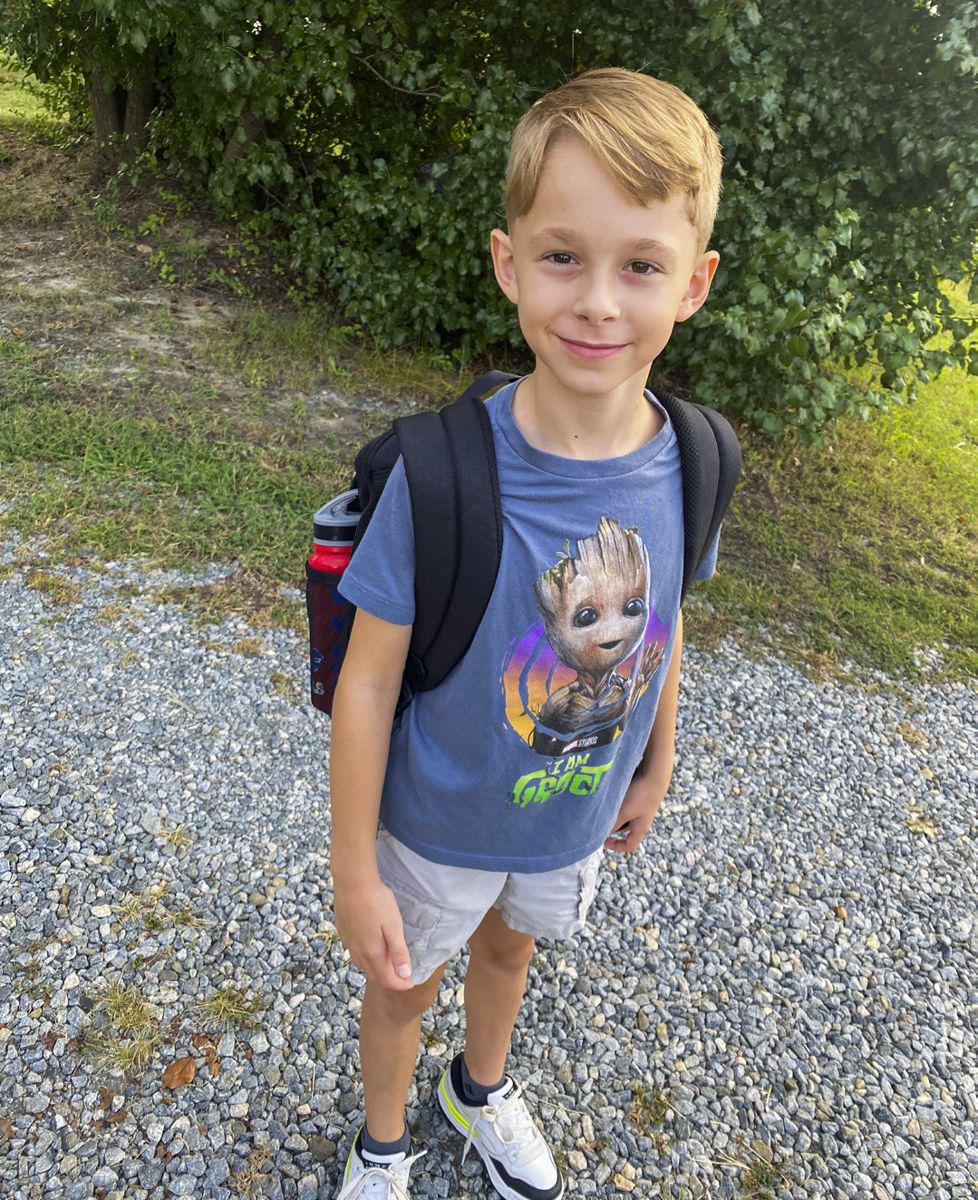
Where Has the Time Flown? Third grade. I could hardly believe it. Wearing his favorite shirt, my youngest son, Maxwell, climbed onto the school bus to start third grade. Where has the time flown? My first memories of the Civil War actually date back to third grade. I was in Mr. Leader’s class at Hershey Elementary School, and we took a field trip to Gettysburg. My passion for the war did not ignite until decades later, but that trip gave me my first exposure. I head back to school myself the first week of September—a relatively late start for the fall semester for me. I have a writing class to teach as well as a class on the Civil Rights movement and the media. I look forward to getting back into the routine. Back-to-school season also usually means the start of a busy travel season for me. Five or six roundtables have regularly tapped me as the lead-off speaker for their seasons, and October and November have been pretty busy months for travel, too. But this year, I’ve scaled way back. One day about a year and a half ago, right after I headed out the door for a talk, Maxwell turned to my wife and asked, “How come Daddy has to keep leaving all the time?” Jenny recounted the story to me after I got home, and after a family discussion, we decided I would stay home more. I spent last year fulfilling obligations I’d previously made, but otherwise began declining most invitations. If I can get someplace and back in a day, those were easier to say “yes” to, but I really want to be home so I can help get Maxwell onto the bus in the mornings. This has called to mind a common refrain I hear from a lot of Roundtables: “We need to get more young people involved.” While we could armchair quarterback that comment round and round, my experience with Maxwell reminds me that many young people have kids at home, and those kids require a lot of time, attention, and rides to soccer practice (or play rehearsal or band camp or karate or whatever). I happen to be an older dad; otherwise, it might be easy for someone my age to forget just how timeintensive parenting is. So, perhaps the lesson there is “Don’t despair about young people.” They’re busy. But at some point, the kids go off to college, mom and dad have more free time, they are older and wiser enough to appreciate history in a way they didn’t when they were younger, and roundtables can offer a chance to get out of the house and do something. And suddenly, they’re wondering, “Gosh, wasn’t he just in third grade? Where did the time go?”
Maxwell James Mackowski heads off to Third Grade. (Chris Mackowski)
ECW Announces Annual Award Recipients At Emerging Civil War’s Symposium in August, the organization announced its annual award recipients. Eric Jacobson, Chief Executive Officer of the Battle of Franklin Trust, was selected as the recipient of the 2025 Emerging Civil War Award for Service in Civil War Public History. The award recognizes the work of an individual or
ECW Editor-in-Chief Chris Mackowski (left) and Vice President Neil Chatelain (right) present the Emerging Civil War Award for Service in Civil War Public History to Eric Jacobson, CEO of the Battle of Franklin Trust. (Melissa Winn)
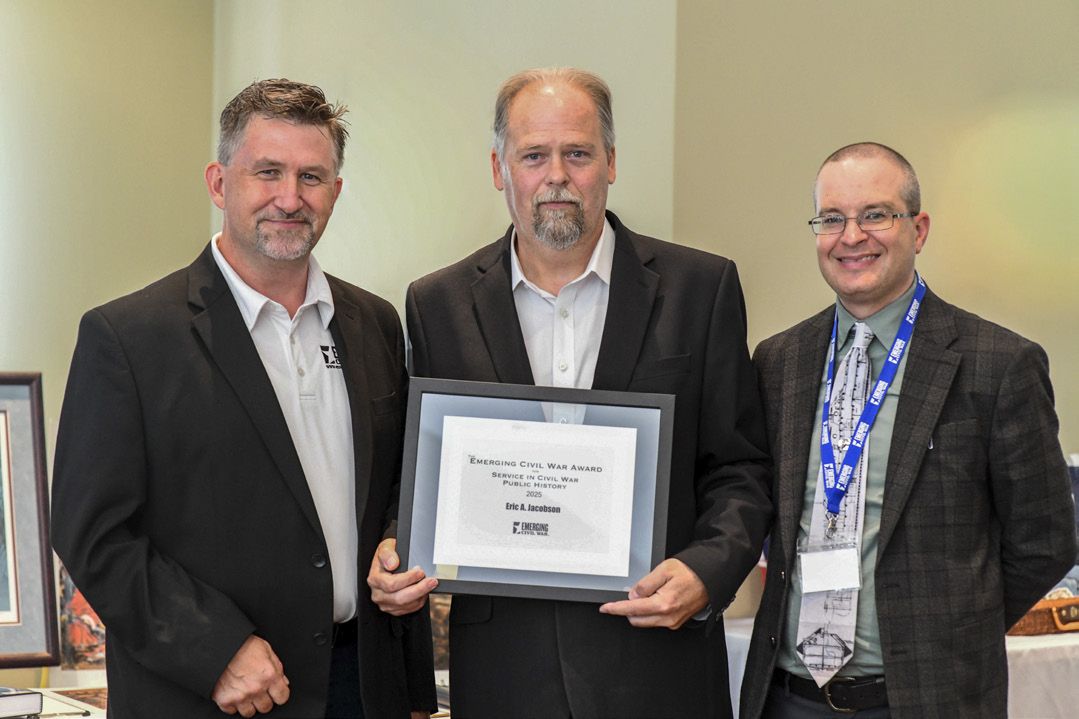
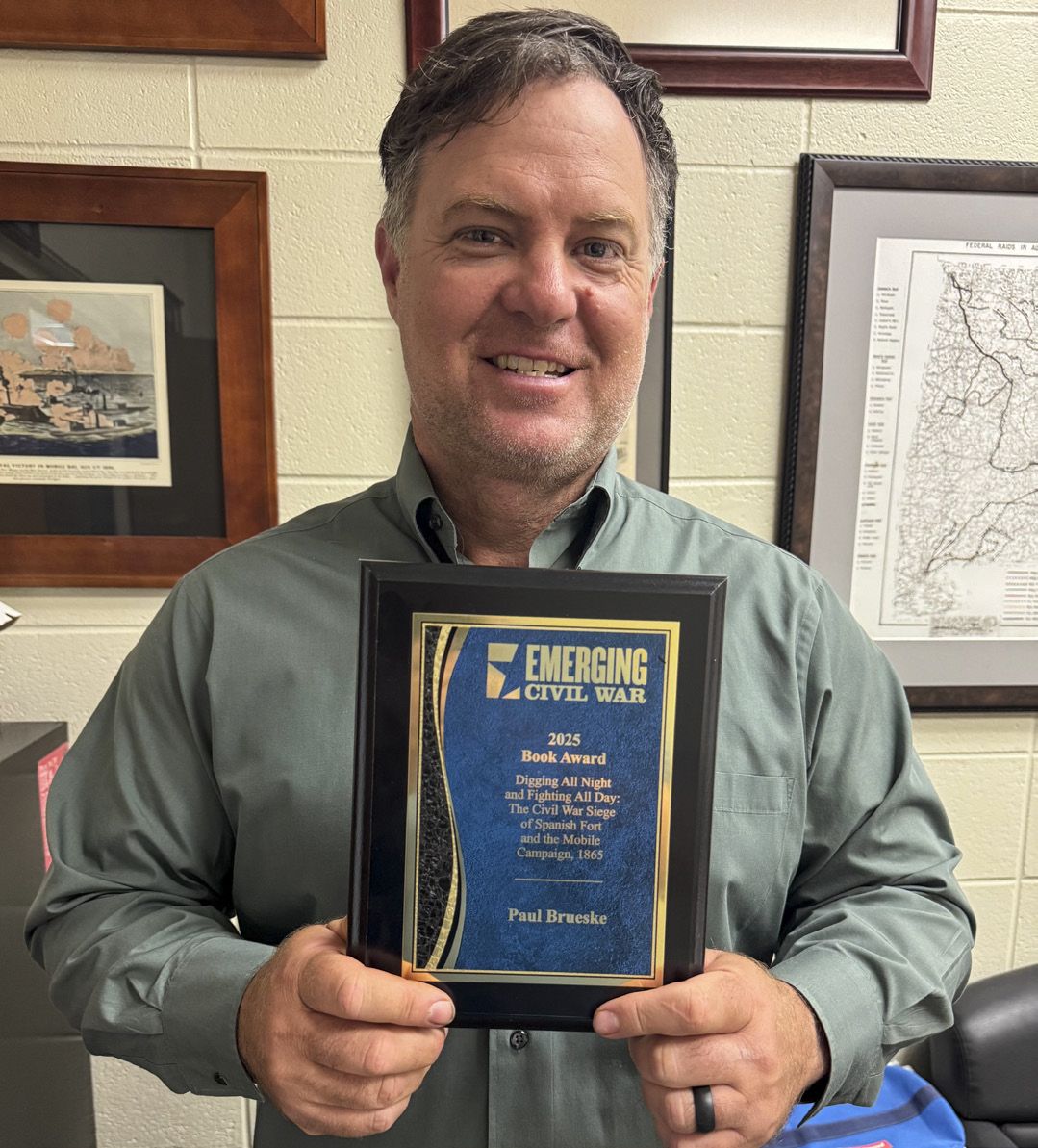
organization that has made a significant impact on the field of Civil War public history in a way that helps the general public better connect with America’s defining event. “The reclamation of the Franklin battlefield is one of the greatest success stories of the modern preservation movement. We would not have that reconstructed battlefield if it were not for Eric,” says ECW Editor-in-Chief Chris Mackowski. “Many, many people have contributed money, time, and effort over two decades to reclaim that battlefield and bring it back to life, but it’s been Eric’s vision and tireless work that have driven those efforts.” The Battle of Franklin, Tennessee, took place on November 30, 1864, as part of Confederate Gen. John Bell Hood’s Nashville Campaign. The battle resulted in approximately 10,000 casualties, about three-quarters of whom were Confederates, including six Confederate generals. Jacobson has been studying the American Civil War for nearly 35 years. A Minnesota native, Eric lived in Arizona for over a decade, then relocated to middle Tennessee in 2005. In 2009, the Battle of Franklin Trust was created to bring together the two historic sites most impacted by the Battle of Franklin, the Carter House and Carnton Plantation. The Trust then began to serve as a spearhead for preservation efforts focused on the battlefield. Long considered “lost,” advocates have slowly stitched the Franklin battlefield back together. Nearly 200 acres, at a cost of nearly $30 million, have been reclaimed and reinterpreted, and a new visitor center is now under construction at the Carter House. “There is no one who has devoted more time, energy, and personal capital to saving what was once considered the ‘lost battlefield’ of Franklin,” says ECW Contributor Joe Ricci, who formerly worked with Jacobson as the historian at the Battle of Franklin Trust. “Others have talked, several have started projects, but none of them have ever finished the race quite like Eric has. The battlefield that we, the public, and future generations can and will visit is a testament to his tireless dedication and vision. He would never admit it, but without him and his guiding hand and leadership, none of this would ever have happened.” In 2021, the Battle of Franklin Trust also began managing Rippa Villa in Spring Hill, a building and community that were also deeply impacted by the Franklin campaign. More than 100,000 visitors annually visit Rippa Villa, the Carter House, and Carnton, with an economic impact of up to $35 million to middle Tennessee. Jacobson also played a key role in the city of Franklin’s “Fuller Story” effort. The project resulted in the 2021 dedication of a statue in the town square that commemorates the United States Colored Troops raised from local Williamson County. Jacobson is the author of For Cause & For Country: A Study of the Affair at Spring Hill and the Battle of Franklin, a project that encompassed nearly 10 years. The book was published in March 2006 and is considered by some to be one of the most important books ever written about the 1864 Tennessee Campaign. Jacobson’s second book, The McGavock Confederate Cemetery, was published in April 2007. His third book, Baptism of Fire, which details the roles of three Federal regiments at the Battle of Franklin, was released in September 2011. He is currently working on his fourth book. Jacobson resides in rural Maury County, Tennessee, with his wife, Nancy. ECW also announced the recipient of its annual ECW Book Award, presented to the best Civil War book published during the previous calendar year. This year’s selection was Paul Brueske’s Digging All Night and Fighting All Day: The Civil War Siege of Spanish Fort and the Mobile Campaign, 1865, published by Savas Beatie. In making its book award selection, the committee also chose a runner-up: Neils Eichhorn and Duncan A. Campbell’s The Civil War in the Age of Nationalism, published by Louisiana State University Press. When most think of Mobile in the Civil War, scenes of David Farragut steaming his squadron at full speed into Mobile Bay in August 1864 come to mind. As Paul Brueske demonstrates, however, that was merely the beginning of interservice efforts by the United States to capture Mobile. Early 1865 brought a renewed campaign by land and naval forces to capture the city and further isolate a collapsing Confederacy. In their way were veteran Confederate soldiers manning Spanish Fort and other positions. Brueske’s text provides clear explanations on why Mobile was critical to the Confederacy, even though the bay was in U.S. hands, why Federal forces launched this 1865 campaign, and how Spanish Fort became the linchpin of the campaign. His trenchant analysis and clear narrative also explore how a few thousand persistent Confederates held back tens of thousands of Federals in efforts to keep Mobile (Josh Frye)
in Rebel hands. Actions of both senior commanders and common soldiers pervade the text, showcasing the decades of research and on-scene experience Brueske has amassed. His work sheds new light on and adds to the complexity of the Civil War’s closing days. Park ranger and ECW member Aaron Stoyack, in his original review of the book published on the Emerging Civil War blog, said, “Brueske gives voices to the overlooked men toiling during the siege and reveals how the coastal environment shaped their tactics. The fast-paced narrative follows the defeated Confederates to their surrender, finally shedding light on this oft-forgotten offensive almost 160 years later.” Brueske is the head coach of track and field at the University of Alabama and a founding member of the Mobile Area Civil War Round Table. In addition to Digging All Night and Fighting All Day, he is author of The Last Siege: The Mobile Campaign, Alabama 1865 (Casemate, 2018).
“What an honor to be recognized for the Emerging Civil War Book Award,” Brueske said. “I am passionate about Mobile’s Civil War era history, and especially the siege of Spanish Fort. I am forever grateful for all of the help that I received from so many great people in making this book a reality. I am especially thankful for the support of Ted Savas and his staff for this opportunity.”
White Returns as ECW’s Chief Historian Kristopher D. White has been named to the post of chief historian for Emerging Civil War. White, an ECW co-founder, also served as the organization’s founding chief historian. He returns to the position following the retirement of Cecily Nelson Zander, who served as ECW’s chief historian from November 2022 through this summer.
“Emerging Civil War would not exist without Kris,” said ECW Editor-in-Chief Chris Mackowski. “The field of Civil War history continues to change, and Kris is well-suited to help us navigate those challenges and keep our brand—and our community of historians—strong. He has a lot of faceforward talent as a historian, and we look forward to having that talent on the front lines for ECW.” White is the Director of Education and Events at the American Battlefield Trust. He holds an M.A. in Military History from Norwich University and a B.A. in History from California University of Pennsylvania. He has served as a ranger-historian at Fredericksburg and Spotsylvania National Military Park. He has also served as a historian for the Penn-Trafford Recreation Board and has worked as a continuing education instructor for the Community College of Allegheny County. In 2008, he successfully passed the Licensed Battlefield Guide Exam at Gettysburg. Co-creator of the Emerging Civil War Series published by Savas Beatie, White is an award-winning speaker and editor who has authored, co-authored, or edited more than two dozen books and numerous articles, covering a wide range of topics from the Seven Years War to the World Wars. A frequent fixture on battlefields around the world, he leads and coordinates tours and staff rides in the United States and Europe. “Kris was also a pioneer in the video content movement that took when the pandemic shut down access to historic sites and conferences,” Mackowski said. “The resulting ‘Zoom Boom’ redefined the way the Civil War community engaged with history. Kris was on the leading edge of that technology.” ECW’s chief historian oversees the quality control of the platform’s historical content, including blog content as well as content in ECW’s various publication projects, including the Emerging Civil War book series.
ECW Hires Sarah Canfield as New Executive Administrator Emerging Civil War (ECW) is pleased to welcome Sarah Canfield as the organization’s new Executive Administrator. As the Executive Administrator for ECW, Sarah will aid in many different areas of the organization’s day-to-day operations. “Sarah holds vast experience in the many facets of public history, from researching information for landmarks to planning public events,” said ECW Vice President Neil P. Chatelain. “Her formal education and extensive involvement in public history projects mark her as someone who can help Emerging Civil War’s historians, editors, and leadership team continue shaping the organization for a sustained future.” Sarah brings an extensive background in public history projects. She earned both a B.A. and M.A. in Public
History from American University and has worked on worked as a fellow for the National Park Service’s National Historic Landmarks Program, researching Revolutionary War landmarks. She currently works with the American Battlefield Trust as an Events Associate, planning events and supporting Trust cross-departmental events, the History Field Trip Grant Program, and Teacher Institutes. “I’ve known Sarah through her work at the Trust and know her ability to effectively manage multiple tasks at once,” said ECW Editor-in-Chief Chris Mackowski. “Sarah is someone capable of juggling ECW’s many hot irons from the fire while simultaneously herding thirty-plus cats. We’re excited for the energy she’ll bring.” Sarah currently resides in Washington, D.C.
Chris Mackowski, Ph.D., is the editor in chief of Emerging Civil War (www.emergingcivilwar.com) and a writing professor at St. Bonaventure University’s Jandoli School of Communication.
For current events visit CivilWarEvents.com