
This & That Forty Year’s Worth of Artifacts
By Gould Hagler · Originally published May-June 2025 · pp. 30–33
& W
This & That
Forty Year’s Worth of Artifacts By Gould Hagler and the Stories They Tell hen he was twelve, John Dietrichs bought a Confederate cannonball. That first acquisition is now on display in the house where John and his wife Carol reside in Dunwoody, Ga. This small item is part of a huge supply of ordnance, sharing space with a vast collection of all sorts of Civil War relics. In addition, John has assembled an eclectic trove of items ranging from a large 4,500-year-old Chinese pot to an array of bits and pieces displayed on a table labeled “Ye Olde Curiosity Shoppe.” After service in the Air Force, John embarked on a career that began with corporate headhunting with an emphasis in the nuclear power industry. He then moved to asbestos abatement and related environmental work. He also was involved in forming and leading several trade associations whose members included companies working in various aspects of this industry. He is now retired.
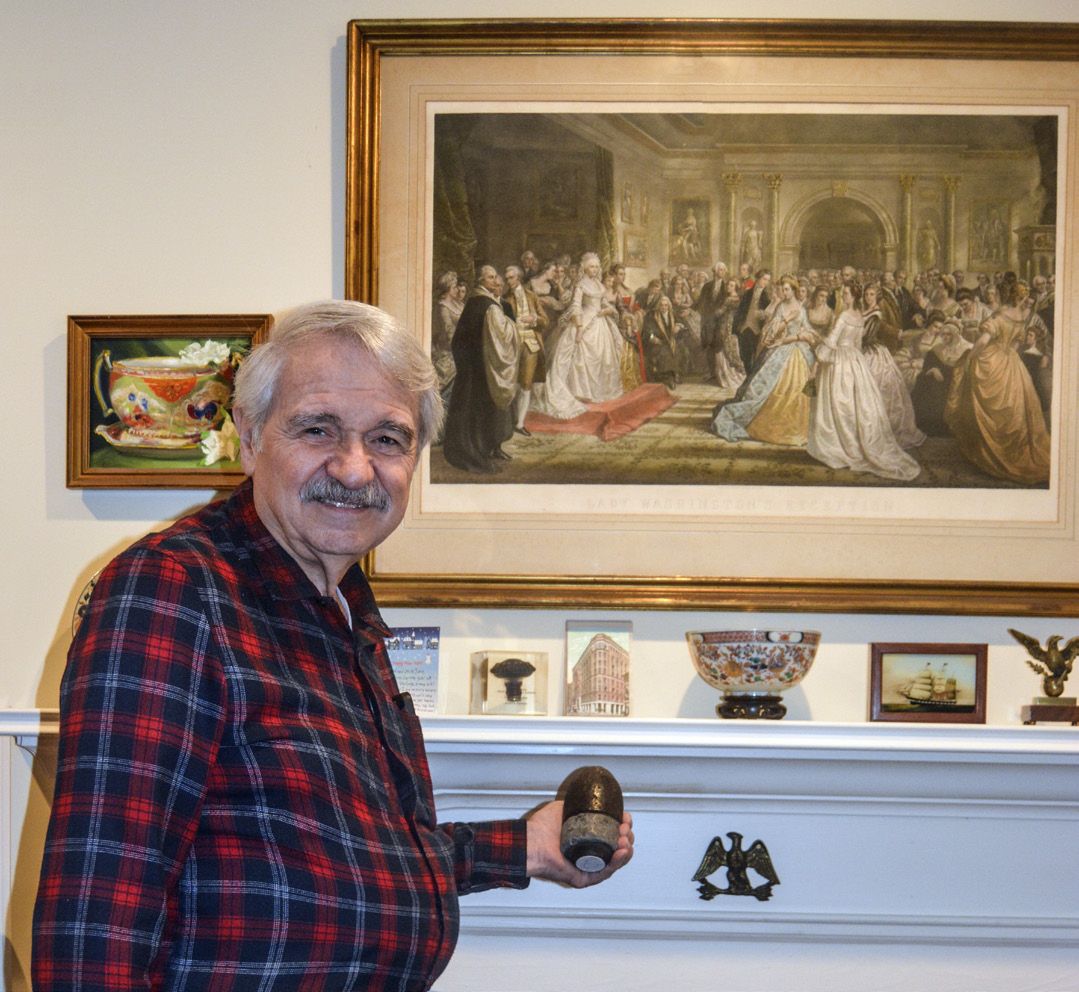
John Dietrichs holding an Archer bolt from Atlanta. (Gould Hagler)
John began his serious collecting in the late 1980s. His focus on the Civil War started a bit later, in 1993, when his friend Bo DuBose* gave him one of the 1,400 artillery projectiles in the DuBose Collection, and said “Here, John, is the start of your artillery collection.” The only difficult part of writing about John’s collection is whittling the topic down to a digestible size. To solve that problem, I asked John to pick a few items and tell the stories behind them. The interview started with a discussion of several items related to Fort Pulaski, which guarded the port city of Savannah. Among the Pulaski artifacts are two James artillery bolts (solid iron shot), named after their inventor Charles T. James, one 6.4-inch and the other in a 7-inch caliber. Rifled 32- and 42-pounder cannon, fired from Tybee Island, hit Pulaski’s walls repeatedly. In the 30-hour bombardment, the artillery projectiles breached the fort’s southwest corner. “That was the end of masonry forts,” John said. Other items related to Pulaski include a document signed by Brig. Gen. Quincy Gillmore, who planned and conducted the siege of the fort, and a page from a May 1862 article from Harper’s Weekly with illustrations of the fort and the siege. South of Savannah is Fort McAllister, on the Ogeechee River. Here, in early 1863, the Confederate raider CSS Nashville, trapped in an estuary, was sunk in shallow water when a shot from the USS Montauk hit the Nashville’s magazine. In the 1950s divers retrieved a number of items from the wreck. Some artifacts, the propeller and shaft, engine machinery, and other things, are in the museum at the fort. Other bits and pieces were acquired by Beverly DuBose, some of which were later given to John, including a piece of coal and some copper sheathing from the Nashville’s mast. Two very heavy items retrieved from other sunken warships rest on the floor of an upstairs room in John and Carol’s home. The blockade runner Modern Greece was run aground off Wilmington, N.C., in June 1862. Its cargo contained a lead ingot marked “Bagillt Works Newton Keates & Co. Liverpool.” Another blockade runner, the
Phantom, was sunk 14 months later, also at Wilmington. This one also carried lead, a pig stamped with “Pontifex & Wood, London.” John explained that lead was critical to the Confederacy as the South had few lead mines. Had the Modern Greece and the Phantom not gone down, lead from these pigs, weighing in at 125 and 150 pounds, would have been used in the manufacture of various things needed for the war effort. The agricultural South had to quickly expand its industrial capacity to produce these necessities. Griswoldville, Ga., was one of the many sites where facilities were established. Samuel Griswold, a Connecticut Yankee, built a cotton gin factory here in 1830. Griswold retooled to turn out pistols and other items needed for the war effort. This was also the site of one of the few attempts made by the Confederates to block Sherman’s 1864 march to the Georgia coast, an ill-advised attack in which the Confederates suffered 1,100 casualties of the 4,500 men engaged. On November 20, two days before this battle, the Federals destroyed the Griswold and Gunnison Revolver Factory along with other industrial facilities in the small town. Today there is very little left of Griswoldville. John has a brick from the pistol factory floor, a recently acquired artifact from this long-abandoned settlement. John’s collection contains many items from Atlanta. Urban development long ago covered up most of the ground on which the battles around Atlanta were fought. In his youth, John lived in two different neighborhoods built where the Confederates attacked at Peachtree Creek on July 20, 1864. John has several interesting artifacts dug up in and around Atlanta. An unfired Confederate Archer 3-inch caliber artillery projectile was found in 1959 or so during the construction of an expressway north of downtown. A garage owner found the shell when his shop was demolished to make room for the road. He parted with the shell at a garage sale, selling it to a lady who later sold it to John. The defensive works protecting Atlanta crossed this area. Who knows what else remains buried today underneath the 12 lanes of I-75/85. The Ponder House stood on another part of the fortifications on the north side of Atlanta. The mansion was made famous by a photograph taken in 1864, located on what is now part of the Georgia Tech campus. John described the photo in a 2018 article in Civil War News. “The elegant and beautiful lines of the two-story plantation mansion remain, but are marred by many artillery shell holes, one section of the second floor wall is blown out, and trees felled by shot lie around it. The bright white plaster finish is cracked and broken, exposing the brick beneath, and hundreds of bullet holes are seen clearly in the original black and white photograph, which has now been colorized.” The brick from this long-gone house was found by Beverly DuBose in the 1930s or perhaps later, and it is likely that Wilber Kurtz accompanied DuBose on this hunt, John said. John does a great deal of research to learn the history of his acquisitions and the details of the stories they help tell. His article on the Ponder House is a fine illustration of the care he takes in his quests. The brick labeled “Ponder House” is not just a brick. It is a catalyst that brings to the open a story of a plantation owner/ slave trader and his much younger, and adventurous, wife; a tale of a house pictured in photographs taken by George N. Barnard that show wonderful details of Atlanta’s fortifications; and the lives of Ponder’s slaves, many skilled craftsmen, one of whom was the father of Henry O. Flipper, the first black to graduate from the U.S. Military Academy. The brick is thought to be the only artifact from the Ponder House known to exist.
Let’s wrap up the tour with an item concerning which John said, “I have never, never, seen another one of these in 40 years of collecting.” This is a small replica of a knapsack, complete with a bedroll, made for a reunion of the Grand Army of the Republic. It stands on a tripod of tiny replicas of Springfield rifles. Inside a flap on the back of this replica were originally two shot glasses, now missing. The cubby hole makes clear the purpose of the item: it was a place “for veterans to drink and swap stories.”
The Ponder House. (Library of Congress)
In the Atlanta Campaign Sherman’s armies fought and maneuvered their way south along the Western and Atlantic Railroad. John’s collection features a section of “U” rail from the early days of this historic line. Like the Ponder House brick, this chunk of iron was found by Beverly DuBose, possibly, John says, in the company of Wilber Kurtz and/or Franklin Garrett. According to John, a stress fracture indicates that the piece broke under the weight of a locomotive and was cast aside when replaced, to lie in situ until the 1950s or 1960s. The road bed along which the W&A ran is still owned by the State of Georgia 190 years after construction on the railroad began. The line is run by CSX Transportation under a 50-year lease. Another interesting item is something John bought from a stamp dealer in Florida for a very modest price, a “cover” for a letter sent in August 1863. The letter was addressed as follows: “To / Mr. Button A. Mauldin, Signal Corps, Care of Major Gen’l J.E.B. Stuart, Richmond, Virginia.” It was marked as received by Stuart’s adjutant on September 3. The ten-cent stamp picturing Jefferson Davis is interesting. A cover addressed to someone in care of General Stuart is interesting. But the piece became a little more interesting as John examined his new acquisition. There was writing on the reverse of the cover, with an address and postmark dated August 27. The addressee was Honorable John Belton O’Neall, who was the Chief Justice of South Carolina’s highest court. When the judge wrote his letter to Mr. Mauldin via General Stuart did he reach for a new envelope from his desk drawer? Nope. He recycled the cover of a letter he had received a few days earlier, addressing the letter to Mr. Mauldin on the unused side. What story does this tell? It illustrates that paper in earlier times was a precious commodity. Even in normal circumstances, paper was far more expensive than it is today, but during the Civil War, the Confederacy suffered from an acute shortage. You had to be frugal with what you had, even if you were the highest ranking judge in the state of South Carolina.
GAR knapsack storage compartment for shot glasses. (John Dietrichs)
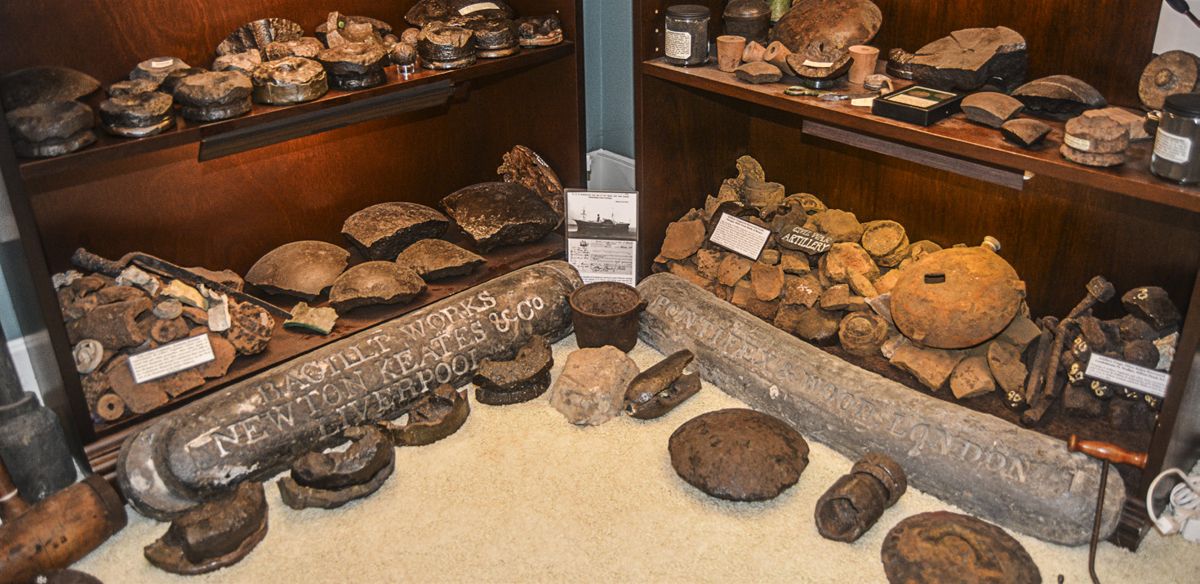
John’s Civil War collection began decades ago when Bo DuBose gave him the Confederate cannonball. This chunk of iron now rests in a sturdy, glass-covered case, with numerous other heavy projectiles. John enjoys showing his collection to visitors and relaying to his guests the stories that these relics convey. If you ever have a chance to visit, take advantage of the opportunity, and John can show you which cannonball is the one he was given some six decades ago. *The name DuBose will appear several times in this column. Beverly DuBose and his son Bo collected a vast range of Civil War artifacts. Most of the collection is now in the Atlanta History Center. Frankin Garrett and Wilbur Kurtz are also mentioned. Garrett was the long-time president of the Atlanta Historical Society (now named the Atlanta History Center) and the author of Atlanta and Environs. Kurtz was an Atlanta artist and historian.
Gould Hagler is a retired lobbyist living in Dunwoody, Ga. He has been a regular contributor to CWN since 2016. He can be reached at gould.hagler@gmail.com.
James Country
MERCANTILE
Richland County Fairgrounds, Mansfield, Ohio
The home of
47th Ohio Civil War / WWI & II Show 32nd Annual Artillery Show Military Material From 1775 Through 1945 Sat. May 3rd – Sun. May 4th 2025 Sat. 9:00 – 5:00 | Sun. 9:00 – 3:00
900 Table Show | Artillery Demonstrations Cannon Firing Demonstrations Civil War & WWII Encampments / Sutler’s Row WWII 801st Med Air Evac Educational Presentation Camp Chase Fife & Drum & 73rd OVI Reg. Band Gettysburg Address by President Lincoln Marlboro Volunteers Traveling Museum Educational Talks & Military Vehicles $8 Admission – Under 12 FREE Handicap Facilities, Food and Door Prizes www.ohiocivilwarshow.com For Information Call: 419-884-2194