
The Graphic War Imagining Emancipation
By Salvatore Cilella · Originally published May-June 2025 · pp. 34–37
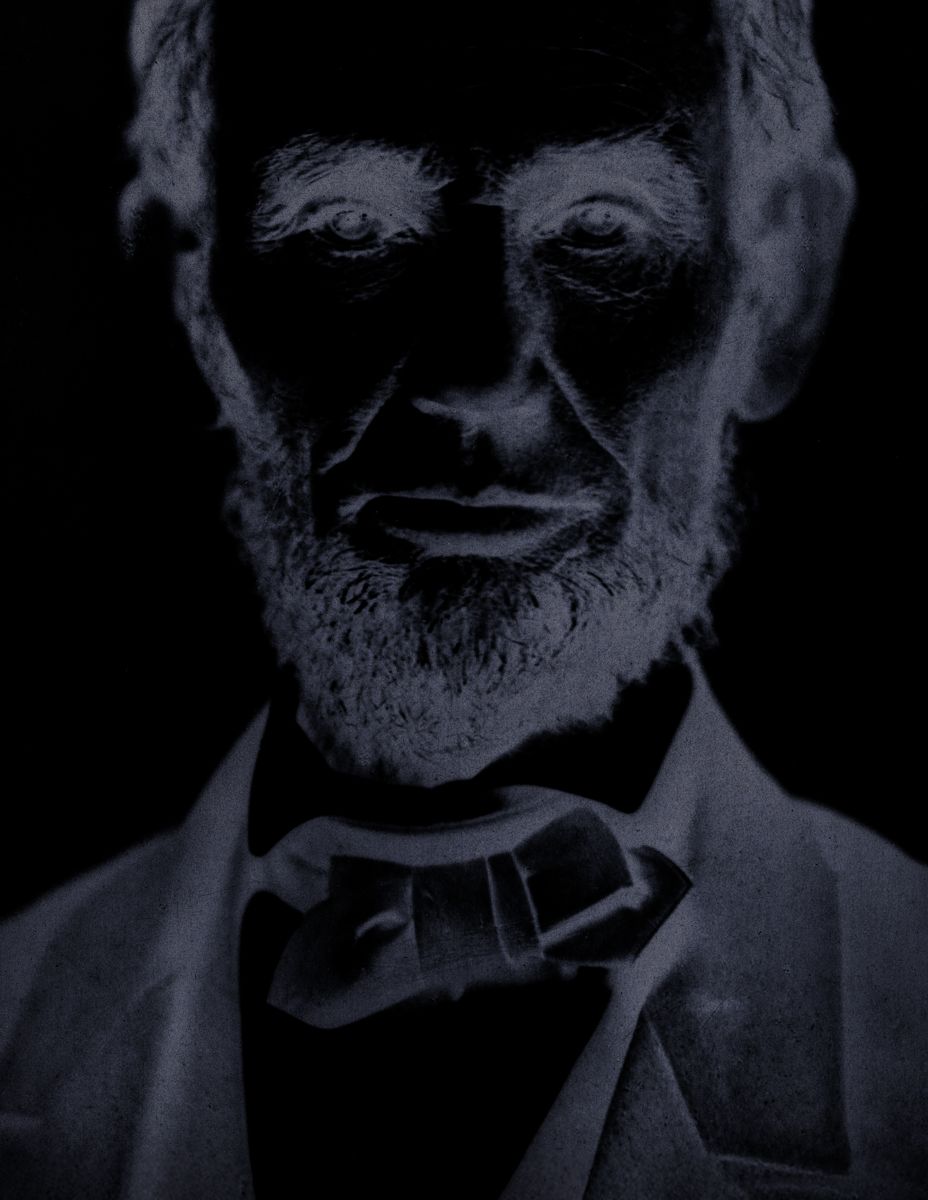
The Graphic War Imagining Emancipation The Graphic War highlights prints and printmakers from the Civil War discussing their meaning and the printmaker or artist’s goals. (Library of Congress)
Historian Richard Hofstadter labeled the legalese in the Emancipation Proclamation as “all of the grandeur of a bill of lading.” Immediately upon proclaiming freedom for slaves held in rebel territories as of January 1, 1863, the decree produced a ground swell of praise and criticism. The central issue was the proclamation’s constitutionality and whether the President had the power to free the slaves. The issue was resolved with the eventual passage of the Thirteenth Amendment. By one estimate “more than twelve thousand books, articles and letters” have been devoted to the Proclamation since 1863.1 Printmakers across the country began churning out lithographs and engravings with the proclamation as a central theme. David Hackett Fischer argues that the initial reaction among lithographers was crude and visceral. One northern and one southern artist “appealed to ideas of liberty and freedom. Union sympathizer David Blythe” saw Lincoln “as the herald of universal freedom” in his lithograph of Lincoln struggling to write the proclamation at a writing desk amid papers scattered about his office. (Figure 1). The artist portrayed the hard-working president in shirtsleeves and slippers. His left hand is placed on a Bible which rests on a copy of the Constitution in his lap. Blythe loaded the scene with symbolism including a bust of Andrew Jackson, an opponent of secession. “A bust of another former President, James Buchanan, who was widely viewed as ineffectual against secessionism, hangs by a rope around its neck from a bookcase behind Lincoln. The scales of justice appear in the left corner, and a rail-splitter’s maul lies on the floor at Lincoln’s feet.”2
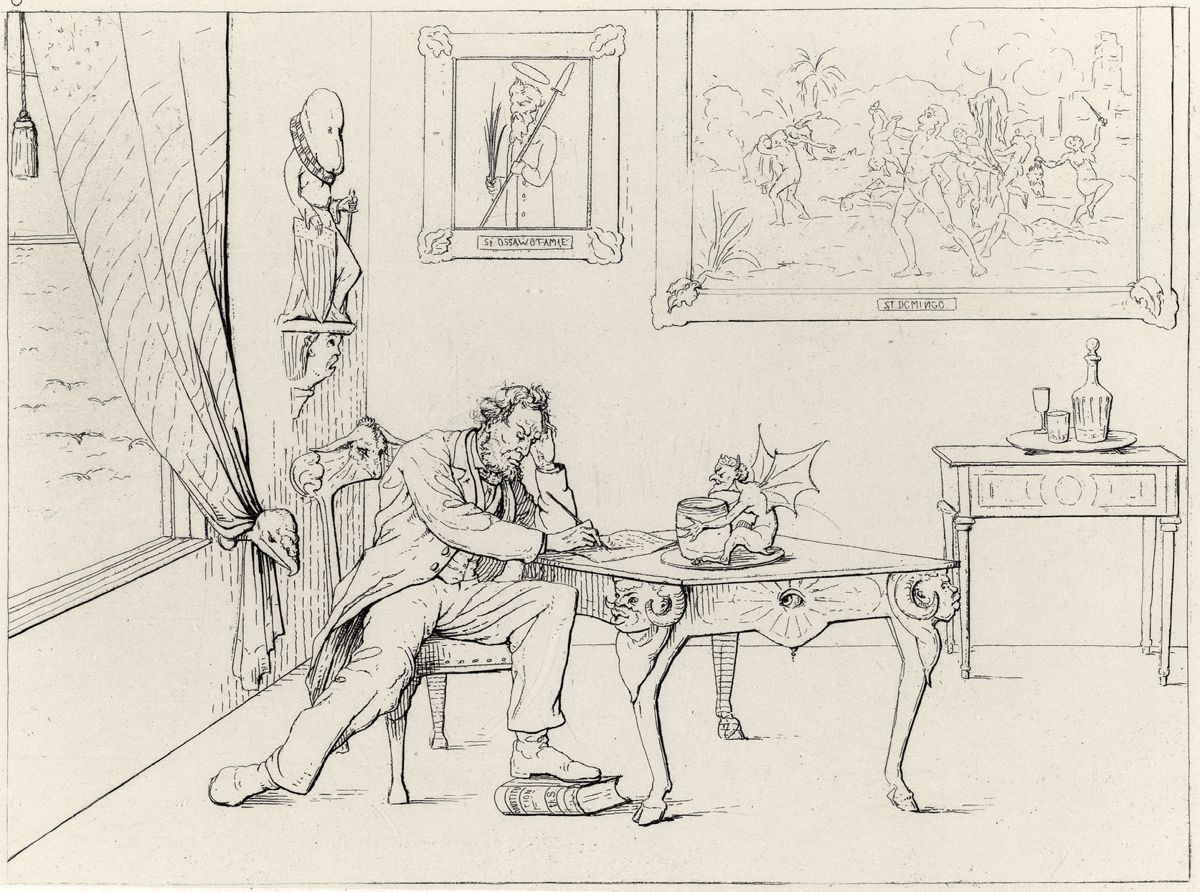
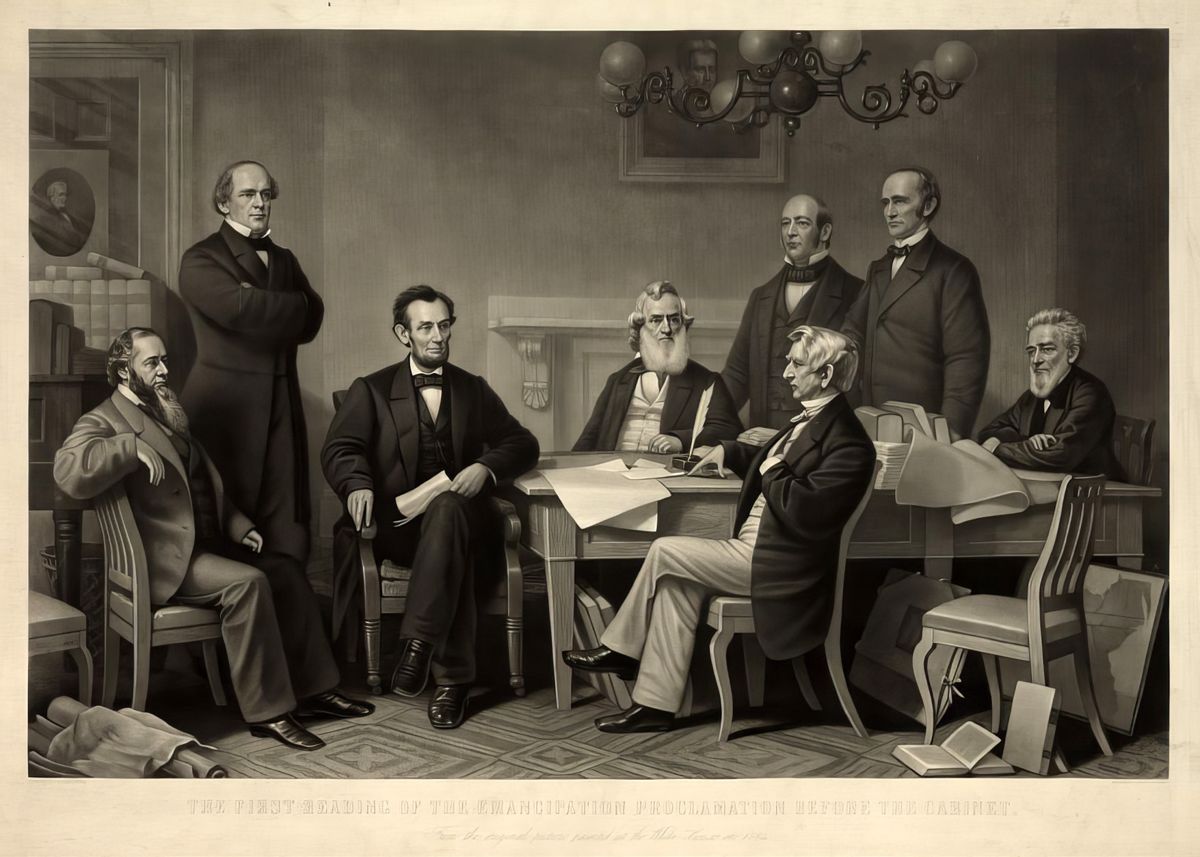
Adalbert Volck, a lithographer from southern-leaning, sympathetic Baltimore portrayed, according to Fischer, the seated Lincoln at his desk “as a tyrant who violated the liberty [of] white masters.” (Figure 2)3 In contrast to Blythe’s interpretation of Lincoln struggling over the monumental task at hand, Vlock’s version is sparce, cold, and unembellished. Two of the most powerful prints produced in 1864 and 1866, were proclamation “friendly.” One depicted the unveiling of Lincoln’s grand idea and the other, the impact of that idea on those it meant to emancipate. Each print highlighted and pinpointed a moment in time and provided a more conciliatory vision of the Emancipation. Alexander Hay Ritchie’s engraving entitled The First reading of the Emancipation Proclamation Before the Cabinet, (Figure 3) was “one of the most widely circulated of all the Lincoln prints published in his lifetime.”4 Ritchie was a Scottish born American artist and engraver who specialized in mezzotints. He emigrated from Glasgow to New York City in 1841. The more interesting story behind this engraving involves the original artist rather than Ritchie. James B. Carpenter, one of nine children, was born in Homer, Courtland County, New York, in 1830. Presumably, in 1844, at age 14, Carpenter convinced his father to send him to study under artist Sanford Thayer in Syracuse. Four years later, one of his paintings won a prize from the American Art Union. In 1852, he “was commissioned to paint a portrait of President Millard Fillmore, a fellow upstate New Yorker born in Cayuga County. Commissions followed for portraits of Presidents Franklin Pierce and John Tyler, and other mid-19th century notables, including clergyman Henry Ward Beecher; newspaper editor Horace Greeley; Ezra Cornell, founder of Cornell University; James Russell Lowell, poet; and John C. Frémont, the first Republican presidential candidate.”5 In his memoir entitled Six Months at the White House with Abraham Lincoln, Carpenter wrote that Lincoln’s bold effort moved him deeply. Through a series of fortuitous encounters with prominent men in Lincoln’s circle, he gained access to Lincoln who agreed to allow Carpenter to paint him. Working mostly from daguerreotypes and real life, he occupied the State Figure 2. The Emancipation Proclamation. Caricature of Abraham Lincoln Dining room as his studio. writing the Emancipation Proclamation. Adalbert John Volck, 1828–1912, Lincoln showed artist, 1864. (Library of Congress) Carpenter’s work to his
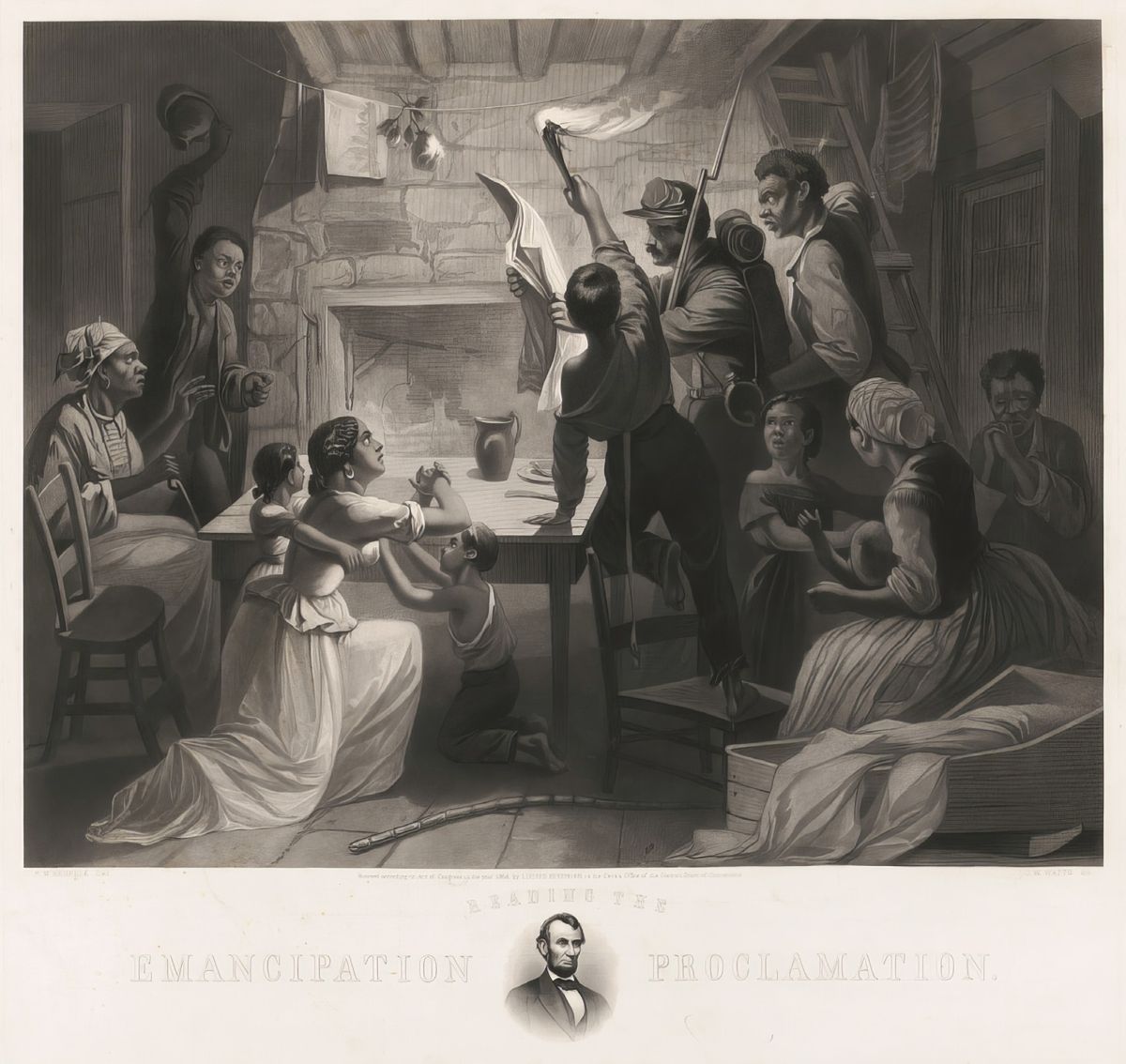
Lincoln administration. Another visualization of the emancipation is embodied in a powerful large folio print simply titled, Reading the Emancipation Proclamation.10 (Figure 4) Above Lincoln’s image in the center of the title margin is a powerful tableau featuring the interior of a slave cabin. Gathered around a center table in front of a fireplace is a multigenerational family “hearing” the proclamation. “This image did not show the president as a fatherly Moses figure reading or signing the document from the rarified isolation of his White House office.” Rather, Figure 3. First Reading the Emancipation Proclamation, with the Cabinet. Print the scene depicts “an by Alexander Hay Ritchie, painting by Francis B. Carpenter. Published by Derby & armed Union Soldier Miller, New York, 1866. (Library of Congress) reading the text” of the proclamation “aloud, by cabinet and once completed, Carpenter exhibited his torchlight, to a slave family gathered around the fireplace painting in the White House’s East Room. “The result was of their tiny cabin.” As Holzer explains “Slaves were freed a huge canvas, nine feet high and fourteen feet six inches by the sword as well as the pen, but Stebbins’s was the first long. The most prominent figure is not the president but print to suggest it.”11 Secretary of State William H. Seward,” a fellow New Lucious Stebbins, of Hartford, Connecticut, published this Yorker.”6 Carpenter unsuccessfully tried to get Congress to powerful print. Stebbins (1810–1901) began his career as a buy the painting, but it stayed in his possession until 1877 map colorist for Hartford map publisher D. F. Robinson and when he convinced Elizabeth Thompson to purchase it for invented a machine to color maps for Smith’s and Olney’s $25,000 and donate it to Congress. Geographies. Stebbins went on to become a subscription In 1866, Alexander Hay Ritchie engraved a large folio publisher, founding the American Publishing Company, print of Carpenter’s work. It became “one of the most best-known for its publication of several of Mark Twain’s widely circulated of all the Lincoln prints published during books. his lifetime.”7 In both versions of the scene, Lincoln is The painter of the piece was Henry W. Herrick. Herrick surrounded by his cabinet. In Ritchie’s print the “text printed spent several years making engravings for New York below the image identifies the men, left to right, as Edwin publisher Appleton’s after illustrations by F.O.C. Darley, M. Stanton (Secretary of War), Salmon P. Chase (Secretary whose influence is evident in the painting upon which Watt’s of the Treasury), President Lincoln, Gideon Welles engraving is based. Herrick’s oil painting was exhibited at (Secretary of the Navy), Caleb Smith (Secretary of the the National Academy of Design in 1865. Interior), William H. Seward (profile, Secretary of State), The print was engraved by J. W. Watts. Holzer maintained Montgomery Blair (Postmaster General), and Edward Bates that the print is a lithograph; but Watts is listed as an (Attorney General).”8 “engraver.” Stebbins called the print a “new national According to Lincoln scholar, Harold Holzer, Ritchie engraving” and accompanied it with a descriptive pamphlet. apparently completed his engraving before Carpenter He wrote: “This is a beautiful illustration of a great event completed his painting. Ritchie captured Lincoln’s portrait in the world’s history—the emancipation of slavery in the from Carpenter’s sketches rather than the completed United States will ever be so considered by all civilized painting.9 nations for all time to come. The sight of this engraving The print was published by Derby and Miller, of New will always produce happy reflections in the minds of every York City. James Cephas Derby was a native of Little Christian and philanthropist and should adorn the dwelling Falls, New York; as a Republican activist, he served under of every family in the country. It is the most appropriate Secretary in Seward’s Department of State during the illustration that can be made, as it represents the only way in which the glorious news could reach the downtrodden and oppressed slaves, viz.: through the faithful soldier, without whom the Proclamation would have remained a dead letter. The design is entirely original, by a bank note artist, and is truly elegant. The engraving is by one of the best workmen in the country and is superbly executed.”12 Prints proved to be powerful public relations vehicles, which after Lincoln’s death, contributed to the passage of the Thirteenth Amendment abolishing slavery. Endnotes: 1.
![Figure 1. President Lincoln, writing the Proclamation of Freedom. January 1st, 1863 / painted by [David Gilmour] Blythe; lithographed and printed in colors by Ehrgott, Forbriger & Co. Cincinnati, Ohio.](/article-images/cwn-2025-may-june/cwn-2025-may-june-the-graphic-war-imagining-emancipation-02.jpg)
James A. Dueholm, “A Bill of Lading Delivers the Goods: The Constitutionality and Effect of the Emancipation Proclamation,” Journal of the Abraham Lincoln Association, Volume 31, issue 1, Winter 2010, pp. 22-38. http://hdl.handle.net/2027/spo.2629860.0031.104. Library of Congress, catalog notes. David Hackett Fischer, Liberty and Freedom, Oxford: Oxford University Press, 2005. 336-337. Hereafter Fischer, Liberty. Harold Holzer, Gabor S. Borritt, Mark E. Neely, Jr. The Lincoln Image: Abraham Lincoln and the Popular Print, New
York: Scribner & sons, 1984, 123. Hereafter Holzer, Lincoln. James B. Carpenter, Wikipedia. https://en.wikipedia.org/wiki/Francis_Bicknell_Carpenter. 6. Fischer, Liberty, 337-339. 7. Holzer, Lincoln, 123. 8. Wikipedia. 9. Holzer, Lincoln, 123. 10. Holzer, et. al. refers to this print as a lithographer in Harold Holzer & Mark E. Neely, Jr. The Union Image: Popular Prints of the Civil War North, Chapel Hill: University of North Carolina Press, 2000, 231-232, but J. W. Watts who is credited on this image, was an engraver. See David M. Stauffer, American Engravers Upon Copper and Steel, Part I, 286. Stauffer indicates that Watts was a line-engraver of landscape in 1850 who “etched some very good portraits.” He also worked several years for the American bank note Company. Hereafter Holzer, Popular Prints. 11. Holzer, Popular Prints. 12. James E. Arsenault & Co. Catalog Description. Stebbins included an advertisement in a book “entitled Life and Death in Rebel Prisons, which sheds some light on how it was meant to be viewed and by whom.” 5.
A fter 43
years the museum time to
C ilella devotes
A merican in field, his collecting prints maps and writing .
and
He has written extensively
Emory Upton: U pton ’ s R egulars : A H istory of the 121 st New York Volunteers in the C ivil W ar (K ansas , 2009); a two - volume Correspondence of M ajor G eneral E mory U p t o n , (T e n n e s s e e , 2017), received the 2017–2018 A merican C ivil W ar M useum ’ s F ounders A ward for on o u t s ta n d i n g editing of source p r i m a ry materials .
He edited
U pton ’ s love letters 1868-70 to his wife – Till Death Do Us Part (Oklahoma, 2020), and The Memoirs of Dewitt C linton B eckwith of Upton’s Regulars (McFarland, 2023). (Library of Congress)