
The Columbus Belmont Battlefield Through the Lens
By Stephanie Hagiwara · Originally published May-June 2025 · pp. 48–51
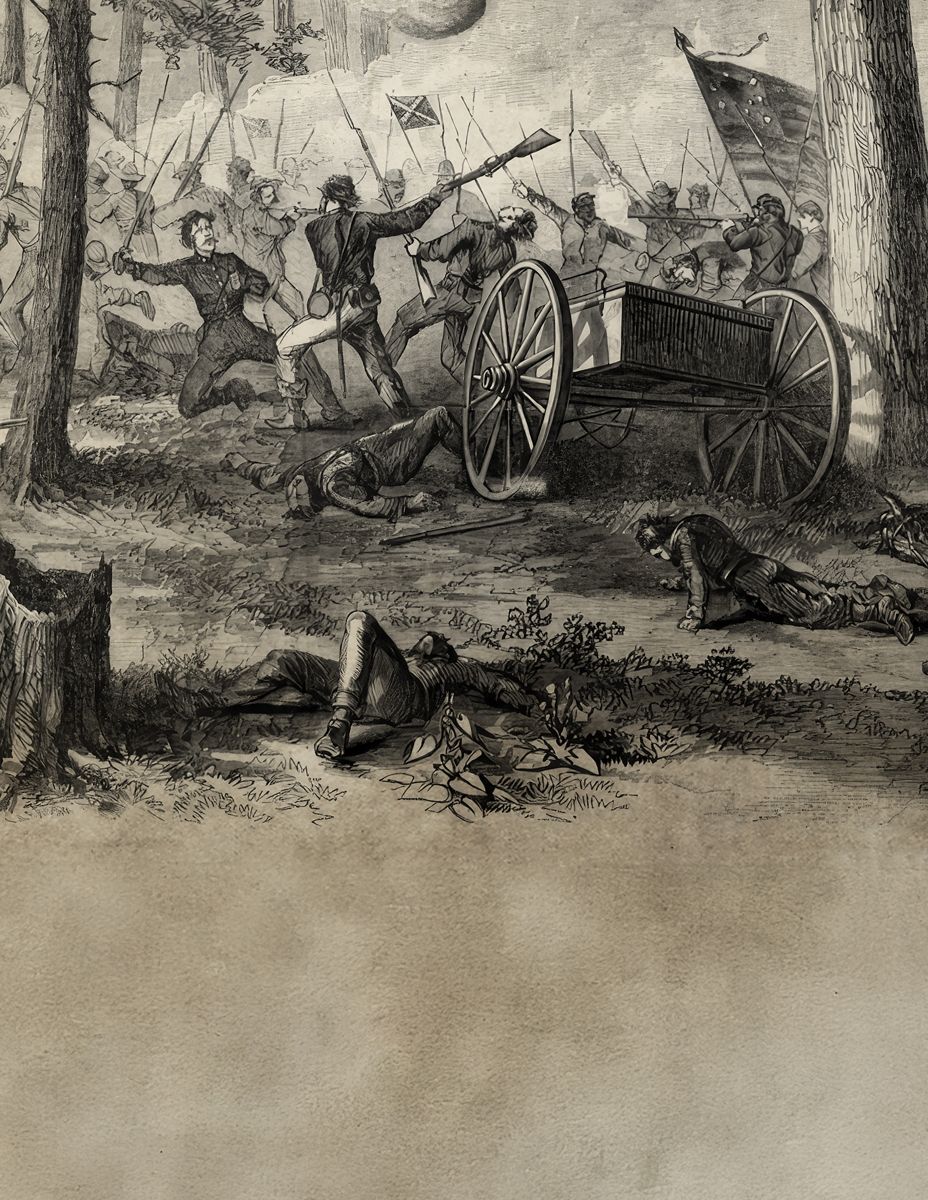
The Battle of Bentonville, N.D. Major General Mower, Commanding First Division, XVII Corps. Turning the Confederate Left, Half a mile from Bentonville – March 20th, 1865. (Courtesy Frank Leslie’s Illustrated History of the Civil War)
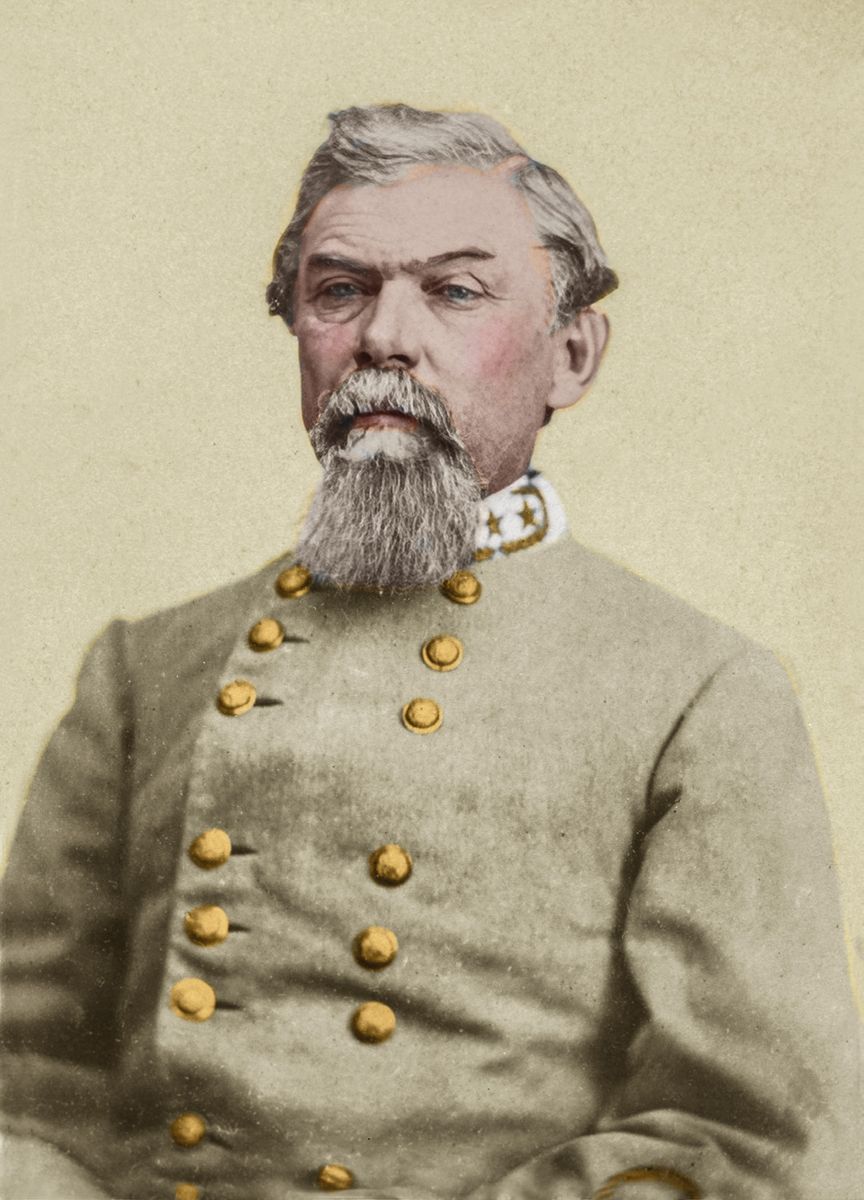
On March 3, 1865, U.S. Gen. William T. Sherman’s Around 2:30 p.m., the 21st Mich. Infantry could see the Army of the Tennessee entered North Carolina Confederates “swarm over their works. As far as we could marching in two separated wings miles apart. see on both right and left, they were coming in unbroken Sherman intended to keep the Confederates guessing lines with that old yell we had learned to know so well.” whether he was heading to the state capital at Raleigh or to To Col. Charles W. Broadfoot, 1st N.C. Junior Reserves, Goldsboro, a major railroad hub. the attack looked thrilling “but it was a painful sight to see On February 25, 1865, C.S. how close their battle flags Gen. Joseph Johnston assumed were together, regiments being command of the Army of scarcely larger than companies Tennessee. Having been and a division not much larger dismissed before the 1864 than a regiment should be.” “Well, General, I find a great Battle of Atlanta, Johnston The Federals held out until deal more than [C.S. Brig. Gen. suspected his return was only Gen. George Buell ordered a George] Dibrell’s cavalry; I “to be the one to surrender.” retreat. Two guns of the 19th find infantry entrenched along Johnston returned to the Indiana Independent Light our whole front, and enough field, “with no other hope Artillery were abandoned. than of contributing to obtain Someone shouted, “For God’s of them to give us all the favorable terms of peace; the sake, bring out that battery!” amusement we want for the only one that a rational being Pvt. Peter Anderson, 31st Wis., rest of the day.” could then entertain. For the Company B, returned to the result of the war was evident battery. Unassisted, he drove a – U.S. Lt. Col. Henry. G. to the dullest.” team of six horses under “hot Litchfield, XIV Corps Johnston hoped to surprise rebel fire from both sides” a Sherman before both wings half of mile to save the gun. joined together. Gen. Wade Anderson received the Medal Hampton sent word that he of Honor. found the spot about two miles southwest of Bentonville, alongside Goldsboro Road on 100 acres of uncultivated plantation land next to woods. Both Johnston and Gen. William Hardee were handicapped by incorrect maps. Hardee was farther; the Federals were closer to the suggested battlefield. On March 18, Hampton’s dismounted cavalry began skirmishing with the Federals to slow them down. The March 19-21 Battle of Bentonville began at dawn. Johnston had positioned the right flank of his army on the Goldsboro Road, horse artillery holding the spot reserved for Hardee on the left, with Gen. Braxton Bragg on the right flank in the woods beyond the road. A swamp was at their front. When U.S. Gen. William P. Carlin’s, 1st Division, XIV Corps men emerged from the swamp, they were stunned to find a line of earthworks where “dirt from thousands of shovels was flying in the air.” Heavy musket fire and artillery stalled the Federals crossing an open field near the Willis Cole house. Not realizing Johnston’s entire army was in front of him, Gen. Henry W. Slocum decided to repeatedly assault different points. Attacks were ordered on both the Confederate right and left flanks. Fierce fighting compelled Bragg to request reinforcements. Gen. Lafayette McLaws’s Division was the first and the largest division of Hardee’s men to approach. Johnston “most injudiciously” sent McLaws as reinforcement. By the time McLaws made it through the swamp and thickets, the Federals had been repulsed. Nevertheless, Johnston had lost the window to destroy the advance before reinforcements arrived. Slocum changed orders to bring reinforcements forward but rejected “a Lt. Gen. William J. Hardee, C.S.A. Colorization bold dash.” Slocum stated, “I can afford to be charged with © 2024 civilwarincolor.com, courtesy being dilatory or over-cautious, but I cannot afford the civilwarincolor.com/cwn. (Library of responsibility of another Ball’s Bluff [Va.] affair.” Congress)
That Old Yell We Had Learned To Know So Well By Stephanie Hagiwara
The Federal panic looked “like a stampede.” According to Lt. Charles S. Brown, 21st Mich., “We however showed to the Rebs as well as our side some the best running we ever did.” The battle of “Acorn Run” ended with the arrival of three fresh Federal divisions. Acorn referred to the badge of the XIV Corps. U.S. Gen. James Morgan’s Division swiftly dug in and built breastworks. As the fleeing men rushed past, Morgan’s “were swinging into line with all the precision of a dress parade. Morgan always went into battle that way.” Smoke filled the air as the woods caught fire. Rebels wearing captured blue clothing confused the situation. U.S. Maj. Aaron B. Robinson, 121st Ohio, had his men lie down and cease firing until he could determine whether the oncoming men were friend or foe. The firing “became a perfect tempest.” Attacked on three sides, the Federals had to climb over their own works, turn about, “changing front to rear,” and then recross. “Many trees had numbers of ‘ramrods’ sticking out of them showing that our men, upon reloading did not take time to remove them from their guns.” Six assaults were made on Morgan’s position as it changed from a “T” into a rectangle. The defenders were running out of ammunition. “Every captured rebel was made to shell out that remaining in his box, to be fired at his own friends.” U.S. Gen. William Cogswell rushed at the double quick for eight miles to reach the battlefield. “Through thick bushes and in water nearly up to their waists,” Cogswell assaulted the two Confederate lines striking Morgan’s rear, breaking the Confederate attack. Perched on the high ground near the Morris house, 16 Federal cannon roared. “Until darkness set in, the air was thick with hissing bullets.” On March 20, Sherman united Slocum with Gen. Oliver Howard’s Right Wing. The armies engaged in a minor afternoon fight from behind trees. Sherman wondered why Johnston stayed; Johnston was evacuating his wounded. On March 21, heavy skirmishing occurred along the Confederate line. U.S. Gen. Joseph A Mower, XVII Corps, requested “making a little reconnaissance.” Emerging from the “arm-pits” high swamp, Mower’s brigades charged up hill to capture the rifle pits and cannon. The Federals had reached Johnston’s headquarters in the John Benton house. Down the road was Johnston’s only escape route, over a bridge across the rain swollen Mill Creek. Johnston entrusted Hardee with driving the enemy back. He swiftly organized every reserve to counterattack “with (Library of Congress)
Sources: f f f f such dare-devil ferocity as to throw it [the Federal line] into great confusion.” Hardee rode with the 8th Texas Cavalry in the final push. “We rode them down and emptied our pistols at close range,” recalled Gen. Joseph Wheeler. Alas, hours before, Hardee agreed to allow his only son Willie to join the regiment. In his first charge, the “scarcely sixteen” boy fell. Word was sent through the lines to Howard, who had tutored the lad back at West Point. As requested, Howard sent guards to protect the home where the dying boy was sent. Mowers had been forced back to the swamp. By 5:30 p.m., Howard was preparing the XVII Corps for a counterattack. Sherman recalled the men, explaining “that there had been enough bloodshed already.” Howard would continue to fire projectiles about every fifteen minutes throughout the night. At nightfall Johnston withdrew to the other side of the creek, burning the bridge behind them. Morale was high. The Confederates had proved they could still whip the Yankees. On March 22, Johnston sent Lee a message, “Sherman’s course cannot be hindered by the small force that I have. I can do not more than annoy him. I respectfully suggest that it is no longer a question whether you leave your present position; you have only to decide where to meet Sherman. I will be near him.” Bentonville was the last major battle fought by either army.
Hughes, Nathaniel, Cheairs Jr.. Bentonville: The Final Battle of Sherman and Johnston. The University of North Carolina Press, Chapel Hill, 2000. Barrett, John G.. The Civil War in North Carolina. The University of North Carolina Press, Chapel Hill, 1995. Symonds, Craig L.. Joseph E. Johnston: A Civil War Biography. W.W. Norton & Company, NY, 1994. Aten, Henry J.. History of the Eighty-fifth Regiment, Illinois Volunteer Infantry. Hiawatha, Kan., 1901.
Stephanie Hagiwara is the editor for Civil War in Color.com and Civil War in 3D.com. She also writes a column for History in Full Color.com that covers stories of photographs of historical interest from the 1850’s to the present. Her articles can be found on Facebook, Tumblr and Pinterest.
Ashley R. Rhodes Revolutionary War through WWI
- Specializing in Civil War Documents * Visit my eBay store at: www.ebay.com/str/reddevilsmilitaria
Over 16,000 sales and 100% Positive Feedback
Ashley Rhodes