
Spared & Shared
By William Griffing · Originally published May-June 2025 · pp. 26–29
We are thrilled to welcome William J. Griffing to Civil War News with his new column, Shared & Spared. Known for his dedication to preserving American history, William has focused on uncovering and sharing unpublished Civil War letters and diaries from private collections. In this column, he will bring these invaluable personal accounts to light, offering readers a rare glimpse into the lives of those who lived through this transformative period in American history.
“Only where the tiger couched” he 9th New York Cavalry was mustered into United States service late in 1861 and the organization was anything but smooth. Some men even claimed to have been fraudulently enlisted and were later discharged by the Secretary of War. I’ve transcribed many letters by soldiers in this regiment, but I found two soldiers had something particularly interesting to write their loved ones back home regarding the Siege of Yorktown and their commanding general George B. McClellan. These two Chautauqua county soldiers were Theodore E. Smiley, a single, 23-year-old laborer from Jamestown enlisting in Co. C, and Eben Buel, a married, 33-year-old carpenter from Westfield enlisting in Co. B. From Theodore’s letter we learn of his dissatisfaction with Co. C after having been involuntarily detached (with Co’s. F, K, and M) in March 1862 and distributed among batteries of the Reserve Artillery with whom they served until May 22, 1862, while the other companies of the 9th N.Y. Cavalry were on detail guarding railroads. A history of the 9th N.Y. Cavalry tells us that Co. C was divided into three detachments of about twenty men each. One detachment with Lt. R.H. Baker was assigned to Captain Carlyle’s Battery; one with Lt. J. W. Upham to Capt. Horatio Gates Gibson’s Battery, and the third detachment to Capt. Henry M. Benson’s Battery, all under the overall command of Colonel Hunt. Most of the batteries were flying artillery with 10-pounder rifled guns and the men all mounted. The exception was Carlyle’s Battery which had 30-pounder guns, and the artillerymen rode
Ton the limbers and caissons or walked. Carlyle’s Battery took a fixed position with its heavy guns in an earthwork before Yorktown but did not advance so it seems certain that Smiley was with one of the other two batteries of U.S. Regulars. The displeasure expressed by Private Smiley and other 9th New York troopers assigned to these flying artillery units so rankled the senses of General McClellan that he charged the protestors with “displaying a spirit of cowardice” and recommended that the entire regiment be returned to New York and discharged. Only the intervention of Secretary of War Stanton prevented this extreme measure. Even though the troopers were eventually reunited with their regiment, the feeling of being misused was apparently more than Smiley could endure, for he deserted on June 30, 1862, at Washington, D.C. To avoid the provost marshal, he may have made his way to Michigan, where there is some notice of him later in life.
Camp Winfield Scott, [near Yorktown] Virginia April 20th 1862 Dear Father, …Our camp is only a short distance from the rebels and for our amusement they send us over some shells once in a while but they burst so high that they don’t do any harm. But for all that, our captain came to the conclusion that he would return the compliments so yesterday morning before daylight the orders came to fall in for to march. So the battery was hitched up and at four o’clock, we started for what place we knew not. But we were soon aware of our place for after we had went a short distance, the orders came for to make a little noise as possible. We went about two miles and there we came to a large breastwork that our men had built nights for it wasn’t only about a half of a mile in front of the rebels’ breastworks. We got there just at daybreak and when we were running our guns up to the port holes, we could see the rebels walking round but we kept on working away expecting all the time they would send us some iron hail. But we got our guns all placed and the captain told us to sit down and rest an hour or so for he wasn’t in no hurry if they didn’t open fire on us. So we sat round until nine o’clock and then we planted the Stars and Stripes on our breastworks and commenced to fire on them. We fired forty shots before noon and the rebels did not fire one at us so we sat down to rest then and we laid and sat around until four o’clock when all at once the rebels opened fire on us from eight of their guns. Some of the boys saw the flash and hollered,
“Look out, there come some shots,” and then you ought to of seen the boys drop down from off the breastworks where they had [been] watching the rebels, yes, and see us load our guns. You may bet we done it in a hurry and at the third time our battery fired on them [and] we dismounted two of their guns. We kept on until we fired twenty shots and then the captain gave the orders to cease firing and as for the rebels, they didn’t fire but one shot after we commenced firing on them. They wounded one man in our battery but not very bad and as for them, we must of killed a good many for our shots went all among them. We stayed there until dark and then we were relieved by another battery and we came back here to our camp. The rebels are very strongly entrenched here and they have got a very large force here too and it will cost some hard fighting before our men can take the place for the rebels have got a good and a very strong position. After we had silenced the rebel guns, General McClellan and two other generals came down where we were in our breastworks. Our boys all stood the fire of rebels very good. Not one of them flinched a bit. But Father, we little thought when we left home that we should be forced here in artillery. Yes, and among the regulars too. We all feel hard about it but it’s our officers that has done it. When we left Washington, our officers pledged their word and honor that they would take us out [of the artillery] in thirty days and now we have been in nearly sixty days. So you see our officers mean to keep us in. John F. Smith¹ from Jamestown came here with the papers to take us out or at least he told us so, but when our officers found it out, they caused an order to be sent to all the camps for to not allow any citizens in camp and specified him in particular and the Major [Sackett] of our Battalion told him if he came round the camps, he would have him put in irons. So you see what villains our officers are and God knows our company will have revenge if we ever get home.” [unsigned, — Theodore E. Smiley] Eben’s letter was written a few days after the evacuation of the Yorktown defenses and seems to have been prompted by the accolades Gen. McClellan was receiving before and after the fall of Yorktown in the Northern press— particularly the claims of “his masterly arrangements for the subjugation of Yorktown.”2
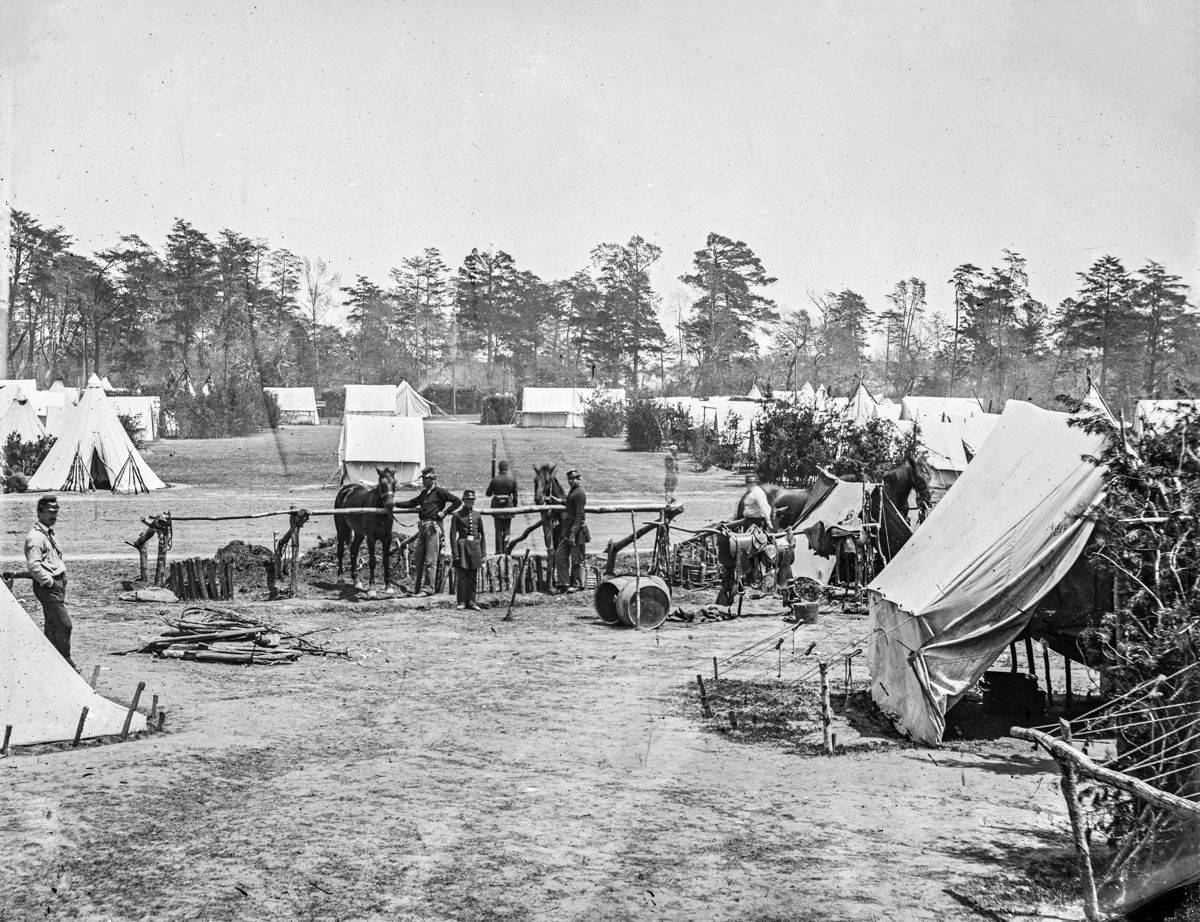
Camp Winfield Scott near Yorktown May 7th, 1862 Dear Wife, I have been hoping for the last three weeks in vain for a letter at each daily arrival of the mail and have been so long accustomed to the disappointment, I hardly know which would disappoint me most— to find a letter for myself in the bag or look the pile through and find none for the Post Master as usual. But I suppose you have been hoping I would start homeward ere a letter would come back & it would be lost. This, however, has become so problematical, I hope you will not defer writing immediately after receiving this. I still hope we are to go home but the issue here at Yorktown is so different from what most people expected. It may be made a pretext for keeping the officers of this regiment in pay awhile longer. I have told our boys for the last ten days I expected Jeff [Davis]—who knows his man—would let Mac [McClellan] putter away & spend as much time as he could induce him to do & exhaust the energies of his men at hard labor, and deplete the national resources as deeply as possible, & then, just as everything was ready for the blow, like a flea beneath a war club, when it was about to hit the little animal, would not be “thar.” And yet I see there is a majority who are determined to make a hero of McClellan in spite of himself, lauding the policy that has given us Yorktown without the loss of a man. But these [people] forget that he has only got the place where the Tiger couched, while the animal is still at large and unsubdued. And though no men were lost at the ditches before the ramparts, still the month before Yorktown has made its record on the death rolls which will never be reported to the world in total, and the blanched cheek of many a lingering sufferer shall tell of exposure to the miasmas & storms of the peninsula. I do not wish to underrate true merit, but after spending the day yesterday in the enemy’s works at Yorktown and along the lines to the Worcester [Warwick] River, I could but feel that while McClellan has lost his game by stopping to forge a heavy cable to bind him, he might have securely held him if he had used the small chain he already possessed. At Yorktown the works are heavy and would have offered a barrier hard to pass by the assistance of artillery alone, but the gunboats in the river could have handled that while the works on the center and left would not have sustained the fire of our rifled field guns for a single day at anytime since we came on here. All I see but the more fully convinces me that the event of this war is being used to elevate a few names upon the scale of distinction, & more pains is taken to insure this than to secure the return of a speedy recurrence to peace and prosperity. But mankind are alike in all ages and in all places & happy is the people who are so fortunate as in their day of trial to be led by truly great men. We have had one Washington who served his day & generation & has gone & it would hardly be expected we should the second time be the exception from the general rule and find a man for leader that so fully ignores all selfish aims in the promotion of the common good. You have no doubt read all the particulars of the affair since the evacuation and it would not be interesting for you to read a recapitulation of them in my poor style. I saw two poor fellows who were killed by the bursting of a concealed shell3 the morning our forces occupied the works at Yorktown. They were most horribly mangled. One had the right leg carried off to the knee & the right arm torn off at the shoulder & the left thigh badly shattered. The other one seemed to be wounded only in the head but it was all torn to pieces. They were both men about 35 or 40 years of age & of Irish descent & came from the City of New York. The weather on Sunday was most unfortunate for advance movements as it set in and rained all day and night and made the roads almost impassable & great difficulty arose from this source in moving the heavy artillery and baggage. It is pleasant now and the roads will soon be good again. The river is full of shipping and I’ll warrant the old dock at York has not been so full for many a day as it was yesterday. In my rambles, I got a number of little trinkets that I shall try to carry home if we go soon as reminiscences of the Rebellion. If I thought it would be long before we should be called out of the service, I should send my carpet bag with a lot of clothes & trinkets home by Express. I will wait a little now, however, and see what is to be the next move. If we march back to Fort Monroe, I will carry the carpet bag, but if we go forward I shall send it. You will find the keys to it and the trunk in the pockets of my overcoat which I shall strap upon the outside of the bag. Steven has not come up from Hampton yet, tho I have expected his coming for some days. I learn he has been quite sick, but if he goes home, I fear he will feel sicker. There are some other preachers in the regiment who will hardly want to go home at present. They will need time for repentance and reform first.4 Do not give yourself any uneasy foreboding on account of my health. I am trying to be very careful in diet and habits and so far feel pretty well. I take a few pills every morning to prevent effects of the climate. I hope to know this week what is to be the final issue with us—whether we go home or stay till the end of the war, and I sincerely hope in either event, it will not be a great while ere you will see me coming down the lane from the railroad some day not far down on the calendar. …I hope to get a letter soon for it is almost a month now since I have heard from you as your last is dated 9th inst. Direct to 9th N. Y. V. Cavalry, Washington, as always before. Affectionately yours, — Eben Endnotes
This was likely the same John F. Smith who later became Colonel of the 112th New York, organized in Jamestown, New York. He died in 1865 due to wounds from Fort Fisher, N.C.
Albany Evening Journal, May 1, 1862. The “concealed shells” mentioned by Eben were landmines used by the Confederates before they left their fortifications in Yorktown. They were triggered by the weight of soldiers’ feet. When they were first used at Yorktown, many in the North were outraged, seeing them as unethical weapons. Few soldiers’ letters question the virtues of Chaplains as effectively as this one.
William J. Griffing has worked at the Department of Labor and the Department of Energy, and later as the ES&H Director at the National Renewable Energy Laboratory and Fermi National Accelerator Laboratory. Since his retirement in 2010, he has focused on preserving American history, mainly Civil War letters and diaries that remain unpublished in private collections. His transcribed Civil War soldier and sailor letters are found at: https://tinyurl.com/sparedshared. Updates on newly transcribed letters are available at: facebook.com/Griff.CWLetters. In 2024, he coedited a book titled A Great and Good Man with Jonathan A. White, which includes rare first-hand accounts of Abraham Lincoln, drawn primarily from about 15,000 letters he has transcribed since retiring.