
Emerging Civil War Civil War to Civil Rights in Montgomery, Ala.
By Chris Mackowski · Originally published May-June 2025 · pp. 44–47
From Civil War to Civil Rights in Montgomery, Alabama
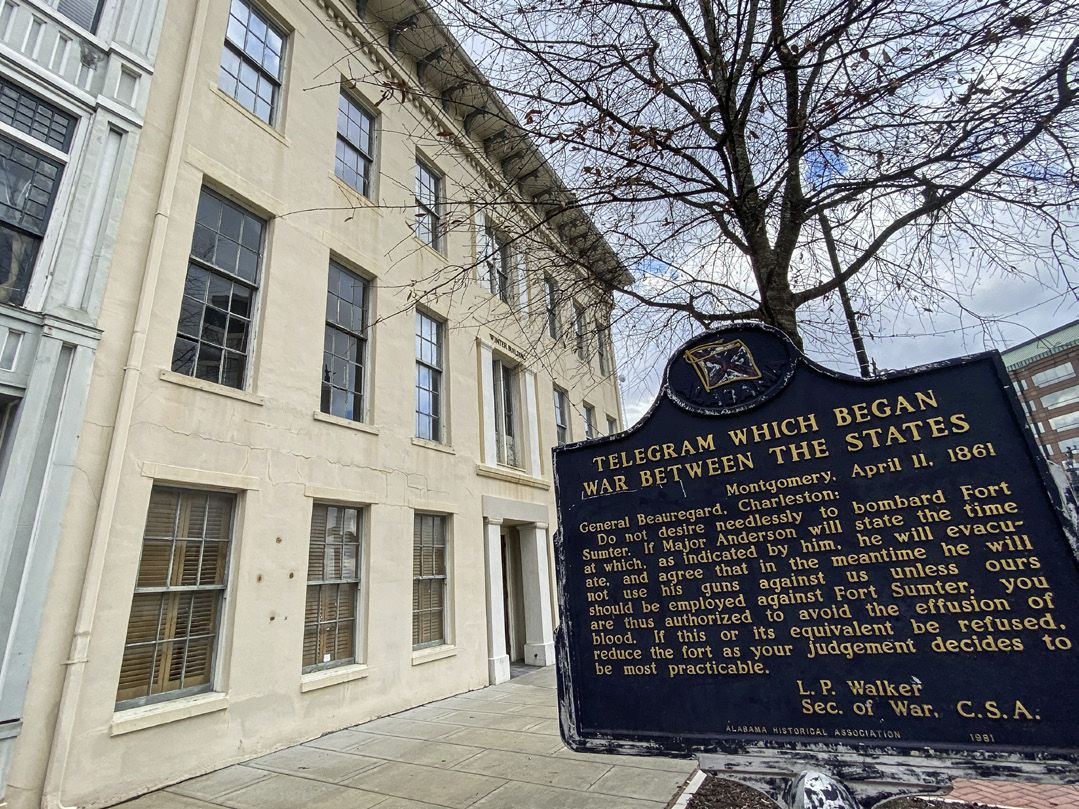
The telegram that began the Civil War: that’s a mighty big claim. But that’s what the Alabama state historical marker at the foot of Dexter Street says, or close enough. The sign calls it the “War Between the States,” a name I see on a majority of the state’s old markers. The rest of the marker’s text reproduces the telegram sent on April 11, 1861, from the nascent Confederacy’s provisional Secretary of War, Leroy Pope Walker, to “General Beauregard, Charleston.” The telegram authorized Beauregard to “reduce the fort as your judgement decides to be most practicable.” The signs stands atop a metal post, paint chipped, outside the Winter Building in downtown Montgomery. According to the flip-side of the sign, the building was built as a bank in 1841 by John Gindrat, who willed it to his daughter, Elizabeth, wife of Joseph Winter. By 1861, the Southern Telegraph Company had an office on the second floor, and from there issued forth the string of dots and dashes that started the war. The authorization conveyed in the fateful tap-tap-taps originated from the Alabama Capitol, standing lofty atop the city’s own “capitol hill” at the opposite end of Dexter Street. There, the provisional Confederate Congress met.
The Winter Building was placed on the National Register of Historic Places in 1972. (All photos by Chris Mackowski)
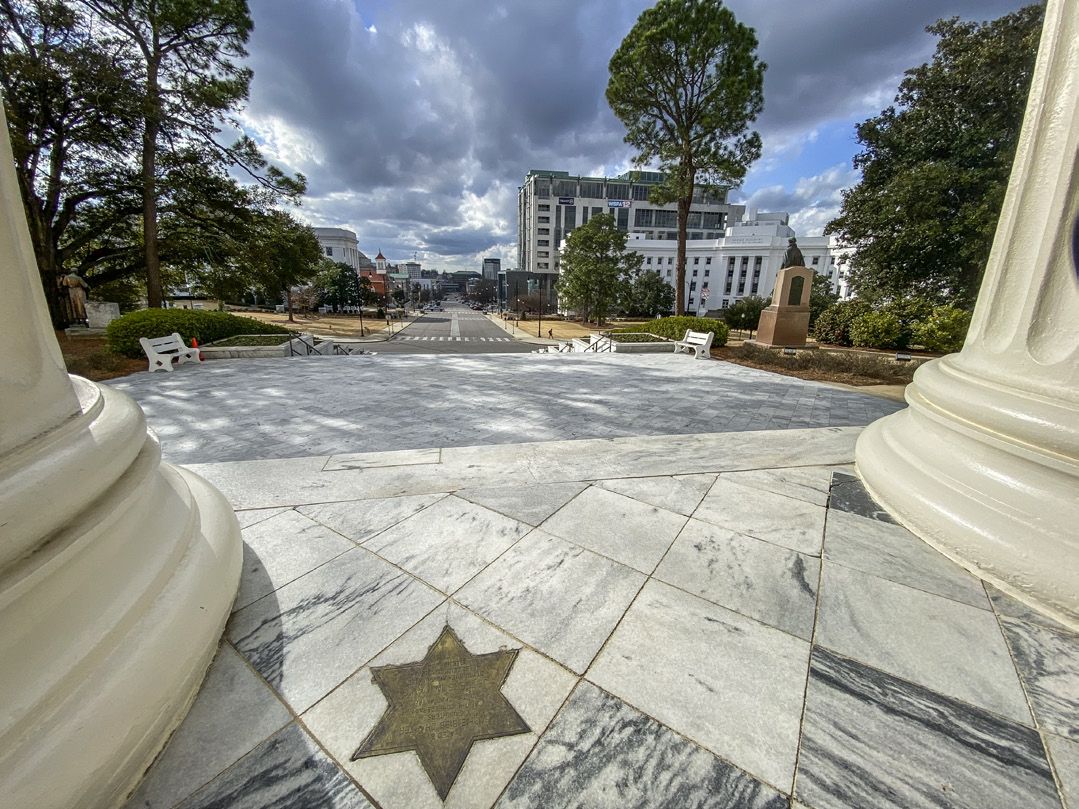
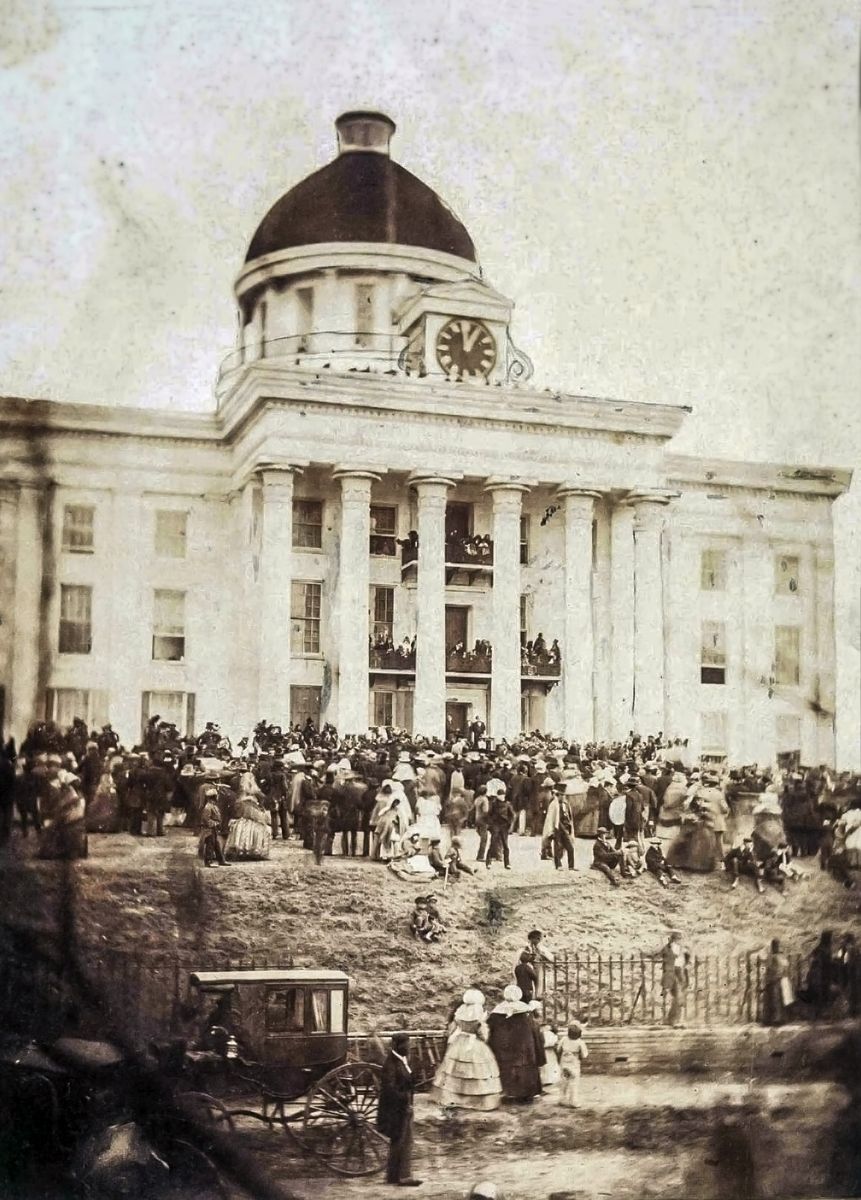
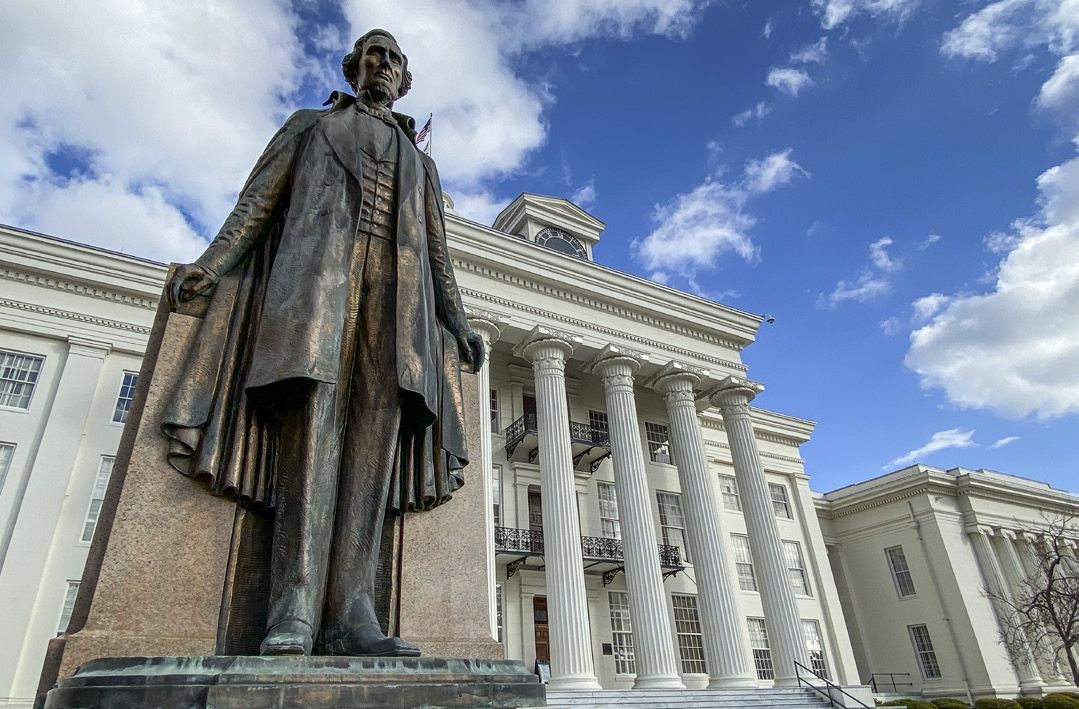
A statue of the provisional president, Jefferson Davis, still stands on the capitol grounds. The spot where he stood for his inauguration is marked with a star embedded in the marble porch between the two center pillars of the building’s mammoth portico. What messenger transmitted the authorization from the capitol to the Winter Building? Was he thrilled? Was he scared? How much did the little slip of paper carrying Walker’s message weigh, really weigh? Did it weigh on that messenger? To stand at the foot of Dexter Street, in front of the Winter Building, to read the state historic marker, if we are to believe it, the rebellion began here. The booms of artillery over Charleston Harbor are only the dots and dashes amplified.
The United Daughters of the Confederacy marked the spot of Jefferson Davis’s February 18, 1861 inauguration. The Dexter Street Baptist Church is the brick building visible in the distance on the left.
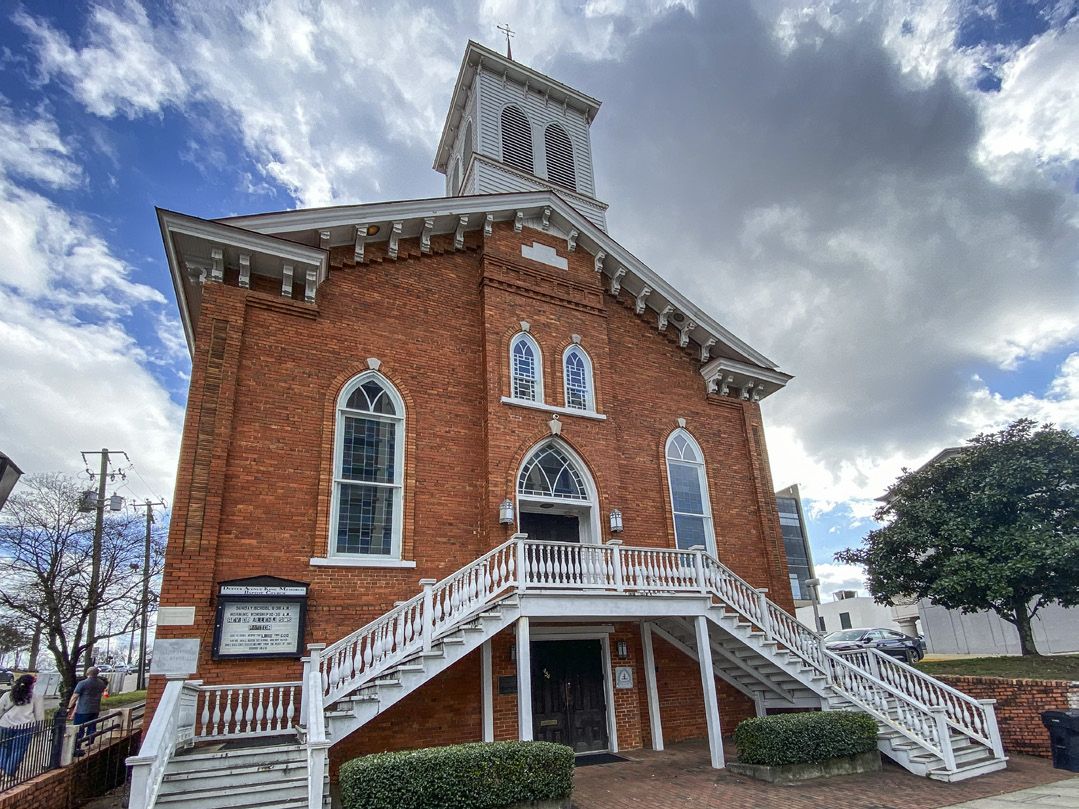
Martin Luther King Jr. served as pastor of the Dexter Street Baptist Church from 1954–1960. The Montgomery Bus Boycott was organized there on December 2, 1955. The Associated Press captured Sheriff D.H. Lackey fingerprinting Rosa Parks on February 22, 1956, following a second arrest—this time for helping to organize the bus boycott. (Public Domain)
The statue of Rose Parks stands on the opposite corner of Dexter Street from the Winter Building, seen in the background.
And so how amazing is it, if we were to walk across this very same intersection to the opposite side of Dexter Street, that’d we’d be standing in the spot where another rebellion began. Hank Williams Sr. has nothing to do with the arc of Civil War to Civil Rights, but he is one of Montgomery’s most famous native sons. A downtown statue of Williams stands just a couple blocks down Commerce Street from the Rosa Parks statue, not far from the Hank Williams Museum. (Josh Frye)
At the next stop, a white passenger boarded, and the bus driver told Parks to give up her seat for the passenger. Parks refused. The driver stopped the bus and called the police. They had traveled a distance of only two blocks. At the Dexter Street Baptist Church, just a few hundred feet in front of the Capitol, on the same side of the street as the Winter Building, a young preacher, Martin Luther King Jr., then unknown, would help draw attention to Parks’s case. The resulting Montgomery bus boycott would spark the Civil Rights Movement. Years later, while leading a march from Selma to Montgomery in support of voting rights, King would deliver a famous speech from a spot not far from where Jefferson Davis was once sworn in. During the Civil War Sesquicentennial, the National Park Service invited people to consider the theme “From Civil War to Civil Rights.” While I think that theme is an illuminating way to look at the arc of American history, it was a terrible theme for a series of site-specific commemorations on battlefields that essentially had littleto-nothing to do with the Civil Rights Movement. It was also a huge lost opportunity for America’s first black president, who embodied that very theme but who showed no real interest in Civil War history. But I have spent considerable time in the decade since the Civil War 150th teasing out that arc of history from Civil War to Civil Rights. The two eras are directly, inextricably linked, and looking at one era can shed valuable light on the other. The telegram from the Winter Building didn’t just start the Civil War, it led to the conditions that put Parks on a segregated bus. As King later said, “the arc of the moral universe is long, but it bends toward justice.” Standing at the lower end of Dexter Street in downtown Montgomery, we can see that arc bend, like a telegraph wire stretched from street corner to street corner.
Chris Mackowski, Ph.D., is the editor in chief of Emerging Civil War (www.emergingcivilwar.com) and a writing professor at St. Bonaventure University’s Jandoli School of Communication.
The N-SSA is America’s oldest and largest Civil War shooting sports organization. Competitors shoot original or approved reproduction muskets, carbines and revolvers at breakable targets in a timed match. Some units even compete with cannons and mortars. Each team represents a specific Civil War regiment or unit and wears the uniform they wore over 160 years ago. Dedicated to preserving our history, period firearms competition and the camaraderie of team sports with friends and family, the N-SSA may be just right for you.
For more information visit us online at www.n-ssa.org.
47 th Southeastern
Annual
Free Parking!
Civil War & Antique Gun Show Antique Firearms up to WWII Aug. 9 & 10, 2025
Saturday 9–5 • Sunday 9–3 Cobb County Civic Center 548 S. Marietta Parkway, S.E., Marietta, GA 30060
• • • • •
Inquires:
Metal Detectors Artillery Items Currency Belt Buckles Bullets and Cartridges Admission: $8 for Adults
STEADILY BUILDING A COLLECTION SINCE 1896 The Civil War artifact collection at the South Carolina Confederate Relic Room and Military Museum is unparalleled. Growing since 1896, it has doubled in the 21st century. The museum seeks to expand to showcase rare artifacts, including the Corky Huey and Colin J. McRae Archival Collections on European arms, as well as South Carolina-made weapons. Recent acquisitions include the Joseph Allen Edens Collection, featuring rare muskets, swords, and a frock coat. None are yet on exhibit, but can be viewed by appointment by calling 803-737-8095. 301 Gervais Street Columbia, SC crr.sc.gov