
Central Virginia Battlefields Trust Drawn to War: Sketch Artists in the Civil War
By Tim Talbott · Originally published May-June 2025 · pp. 38–43
Drawn to War: Sketch Artists and the Civil War In Central Virginia
L By Tim Talbott ooking back on the hardships and risks of his chosen profession providing the public with an accurate picture of the conflict, Civil War sketch artist Theodore R. Davis remembered: “To really see a battle, however, one must accept the most dangerous situations, for in most cases this can not possibly be avoided. There have been occasions when some industrious sharp-shooter troubled me by a too personal direction of his bullets. No doubt the man regarded me as somebody on the other side, and considered he was there to shoot at anything or anybody on the other side.” Davis also noted one particularly close call when he had “a sketch-book shot out of my hand and sent whirling over my shoulder.” Another occurred “one chilly night after the day of a hard battle, as I lay shivering on the ground with a single blanket over me, a forlorn soldier begged and received a share of the blanket. I awoke at daybreak to find the soldier dead, and from the wound it was plain that but for the intervention of his head the bullet would have gone through my own.” Fortunately, numerous sketch artists were willing to hazard their comfort and safety to provide a correct visual version of the war. Because of their work, we have a much better idea of what life was like during the Civil War. As photography became available in the United States during the 1840s, it revolutionized how Americans could depict themselves. For the first time, those who had their image made did not have to worry about an artist’s skill level to produce a high quality final product. Photography, however, had its limitations in its first decades of existence. Camera lenses could only take so much movement by the subject of the photograph before the image blurred, making action photographs virtually impossible. Additionally, large camera boxes proved unwieldy, thus their use outside studios was less than ideal, particularly in unfavorable weather conditions. Finally, technology had not advanced to where media like
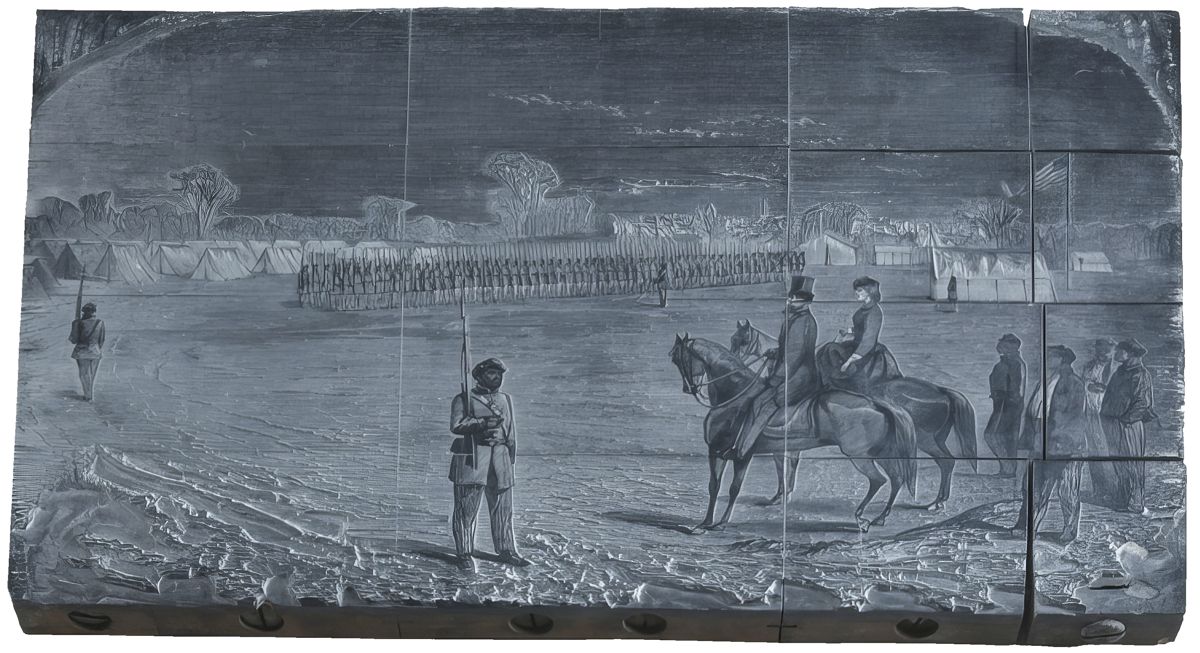
Although this example of a woodcut block dates to after the Civil War, the process during the war was the same. Note the thickness of the wood blocks. (National Museum of American History)
newspapers or magazines could reproduce a photograph utilizing the existing technology for copying images. Books, newspapers, magazines, sheet music, and lithographic images for home display increased rapidly in popularity during the first half of the 19th century. Fueled by advances in printing and communications technology, and amidst an ever-growing literate population, readership exploded. Yet, the ability to rapidly produce visual images in print was still a problem.
Woodcuts even more so after. The following are some, their brief biographies, and examples of their central Virginia sketches.
Alfred Waud
Born in London, England, in 1828, Alfred R. Waud was the oldest of five brothers and sisters. The budding artist studied at the Government School of Design (now the Royal College of Art) but left Great Britain for the United States in 1850 with plans to work as a theatrical backdrop scenery painter. Settling initially in New York, Waud worked as an illustrator for different publications, but eventually relocated to Orange, New Jersey, with his wife whom he married before the Civil War. In 1860, Waud became a member of the New York Illustrated News staff of artists and worked for them through the early months of the war. A better opportunity arose at the end of 1861, when Harper’s Weekly hired him to cover
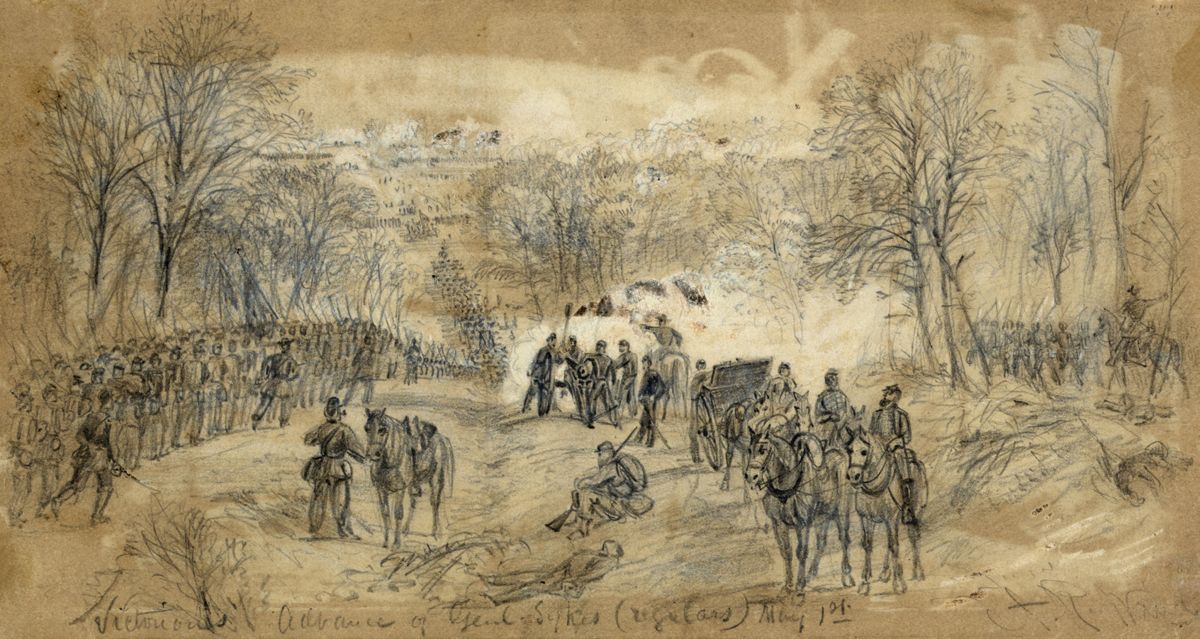
The common process for reproducing images into print form at the time of the Civil War was to utilize woodcuts. Doing so involved a skilled engraver taking a sketched or photographic image and carving it in reverse or mirrored image into a block of wood. Creating the image in mirrored format ensured that (just like setting type, with the woodcut inked and put to paper) the printed image came out formatted correctly. As one might imagine, this took a significant amount of time, effort, and skill, but it was the best quality Alfred R. Waud, shown here on a mount, and most reliable process available to publishers. made scores of sketches depicting scenes The woodcut engravers obviously needed something in central Virginia during the Civil War. to work from. Publishers like those for Harper’s Weekly (Library of Congress) and Frank Leslie’s Illustrated Newspaper, among others, required sketch artists who were skilled enough (and brave enough) to travel with the armies and make quick sketches of battles, field hospitals, and camps that they sent back by mail or courier for engraving and then printing. Many sketch artists kept a book of “memoranda sketches.” These were sketches that included varieties of artillery, different types of tents, soldiers’ equipment, and other key details, that the sketch artist could refer to when refining his work after making the preliminary rough draft sketch. Most illustrated newspapers of the period published from locations in the North and thus naturally sympathized with the Union cause. Although the Southern Illustrated News, which published in Richmond, produced monthly issues from 1862 to 1865, few editions contained any images from the scenes of war, and thus they apparently had little need for sketch artists. The Illustrated London News included coverage of the American Civil War and employed Frank Vizetelly as a sketch artist correspondent, who often produced images from the Confederate perspective. Unfortunately, only a couple of images from the Battle of Fredericksburg represent his time covering the war in central Virginia. Some sketch artists who worked in central Virginia Alfred Waud’s sketch depicting the fighting on the first day at Chancellorsville became well-known is likely the only extant contemporary image showing that part of the during the war, and others battlefield. (Library of Congress)
the Army of the Potomac. At the time, Harper’s Weekly was the most widely read illustrated newspaper in the United States. Waud was joined by fellow sketch artists Theodore Davis, Henry Mosler, and Waud’s brother William, who primarily covered western theater events. During the war, Waud made hundreds of sketches capturing battle actions, landscape scenes, and soldier views that students of the Civil War’s eastern theater are familiar with. Following the conflict, Waud continued to work for Harper’s Weekly and as a free-lance artist providing sketches for woodcut printings of Reconstruction and western expansion events. On a visit to the battlefields around Atlanta in 1891, Waud died of a heart attack.
Edwin Forbes
Probably only exceeded in the field of Civil War sketch art by Alfred Waud, Edwin Forbes produced an enormous body of work and witnessed some of the eastern theater’s most important military events. Forbes produced a tremendous number of sketches, not only capturing battles, but also subject studies of individuals (soldiers, civilians, and African Americans) and camp scenes. Born in 1839 in New York City, Forbes planned on a career as a painter. He studied under Arthur Tait before the Civil War. Forbes joined the Frank Leslie’s Illustrated Newspaper team of talented sketch artists soon after the
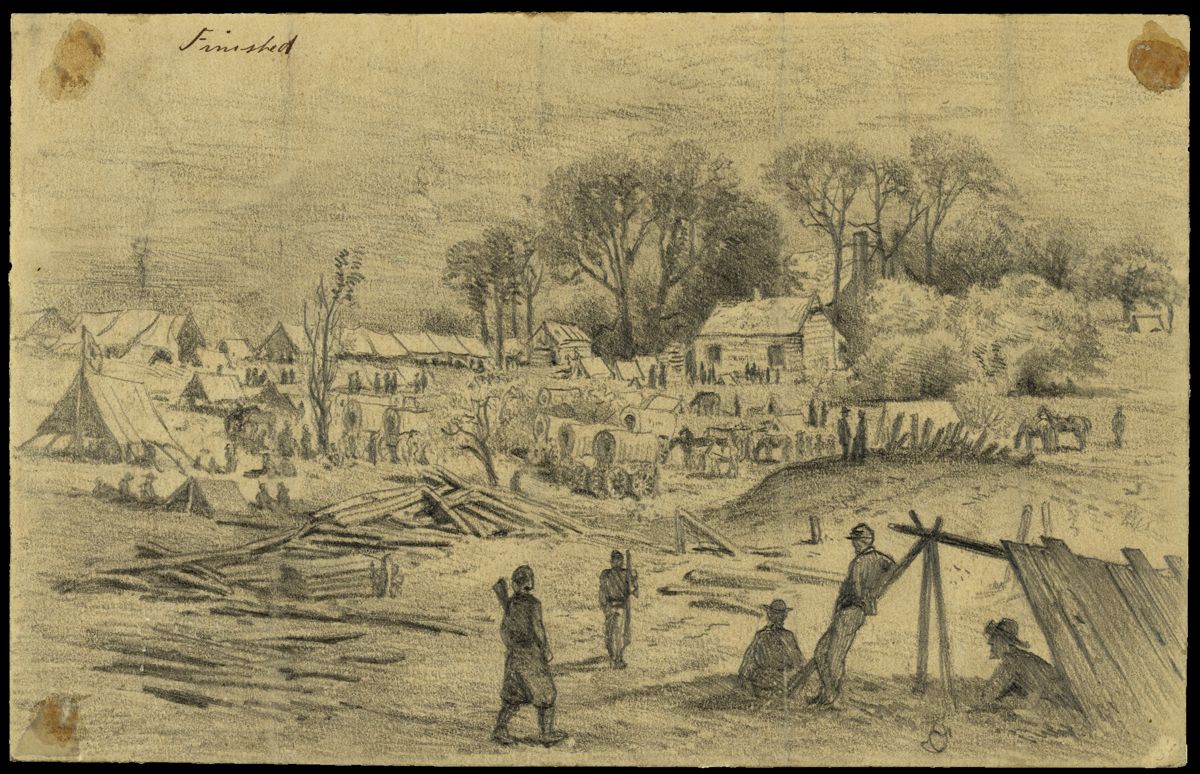
Civil War began and received an assignment with the Army of the Potomac. While Forbes sketched numerous battle scenes, he seemed to excel in the details of his sketches concerning camp life. Unlike some of his contemporaries, Forbes was apparently able to set aside common prejudices of that era that some artists held and depicted African Americans without stereotyped and exaggerated features. Since his assignment was with the Army of the Potomac, Forbes had the opportunity to sketch scenes from Fredericksburg, Chancellorsville, Mine Run, the Wilderness, and Spotsylvania Court House. A fascinating account about Forbes comes from Spotsylvania County citizen Katherine “Kate” Couse, who observed Forbes at work sketching scenes around her house, a V Corps field hospital, during the protracted fighting. Couse noted on May 12, 1864, that, “Mr Forbes the artist sketcher from Frank Leslie called in out of the rain, his right arm is helpless he sketches with left hand, has not the use of all his fingers on that hand.” Forbes’s sketch of the hospital scene is the only known wartime image of “Laurel Hill,” the Couse house. Forbes left Frank Leslie’s Illustrated Newspaper before the war ended, but he continued to sketch war subjects. After the war, Forbes returned to painting and improved a number of his wartime sketches. In 1876, he published a collection of his army works titled, Life Studies of the Great Army.
Joseph J. Becker
Another Frank Leslie’s Illustrated Newspaper artist, who spent considerable time in central Virginia, was Joseph J. Becker, a Pottsville, Pennsylvania, native. Becker, born in 1841, moved to New York City where he became a messenger for Frank Leslie’s Illustrated Newspaper. Unlike Forbes, Becker did not receive formal artistic training but must have demonstrated his natural talents to the newspaper’s staff, who saw his gift and eventually detailed him to the Army of the Potomac, where he made almost 90 sketches for his employer during the last two years of the war. Becker made sketches of the Battle of the Wilderness and Spotsylvania while in central Virginia and later created numerous images of the extended fighting at Petersburg. One wonders how he and Forbes, both working for the same newspaper, decided to divide their work and subject matter. After the Civil War, Becker traveled extensively to cover major historic events and the spread of railroads across the plains of the United States. He sketched the aftermath of the great Chicago fire of 1871 and eventually became the head of the Frank Leslie’s Illustrated Newspaper’s art department. After retiring in 1900, he lived for another decade, dying in Brooklyn in 1910.
The sketch that Henri Lovie made of soldiers crossing a pontoon bridge into Fredericksburg appeared as a woodcut image in the December 27, 1862, issue of Frank Leslie’s Illustrated News. (Becker Collection, Boston College Libraries)
Henri Lovie
Henri Lovie, another of the talented sketch artists on the Leslie’s Illustrated team, was born in Prussia in 1829. He emigrated to the United States and settled for a time in Cincinnati, Ohio, where he worked as a portraitist, landscape artist, and illustrator for numerous publications before the Civil War. Lovie also taught art in Cincinnati, before moving to New York to work for Frank Leslie’s Illustrated News. One of his early assignments was to follow President-elect Lincoln from Springfield, Ill., to Washington, D.C., for his inauguration and the start of his administration. Lovie traveled extensively for Leslie’s, covering the war in the Trans-Mississippi, Eastern, and Western Theaters. How he was able to cover so much ground between his subject assignments is simply amazing. Shortly after covering events in Kentucky, Lovie traveled back east in time to capture numerous sketches of the Union army before, during, and after the Battle of Fredericksburg. His images of events around Fredericksburg are among his finest. Some of Lovie’s sketches include notes to the engravers explaining details and areas to highlight in their reworking of his drawings.
Other notable artists
Although they did not produce the volume of central Virginia subject work that the previous four artists did, a couple of other notable artists worked in or made observations about the area through sketches. Winslow Homer, who gained fame largely after the Civil War for his paintings, sketched “Army of the Potomac –
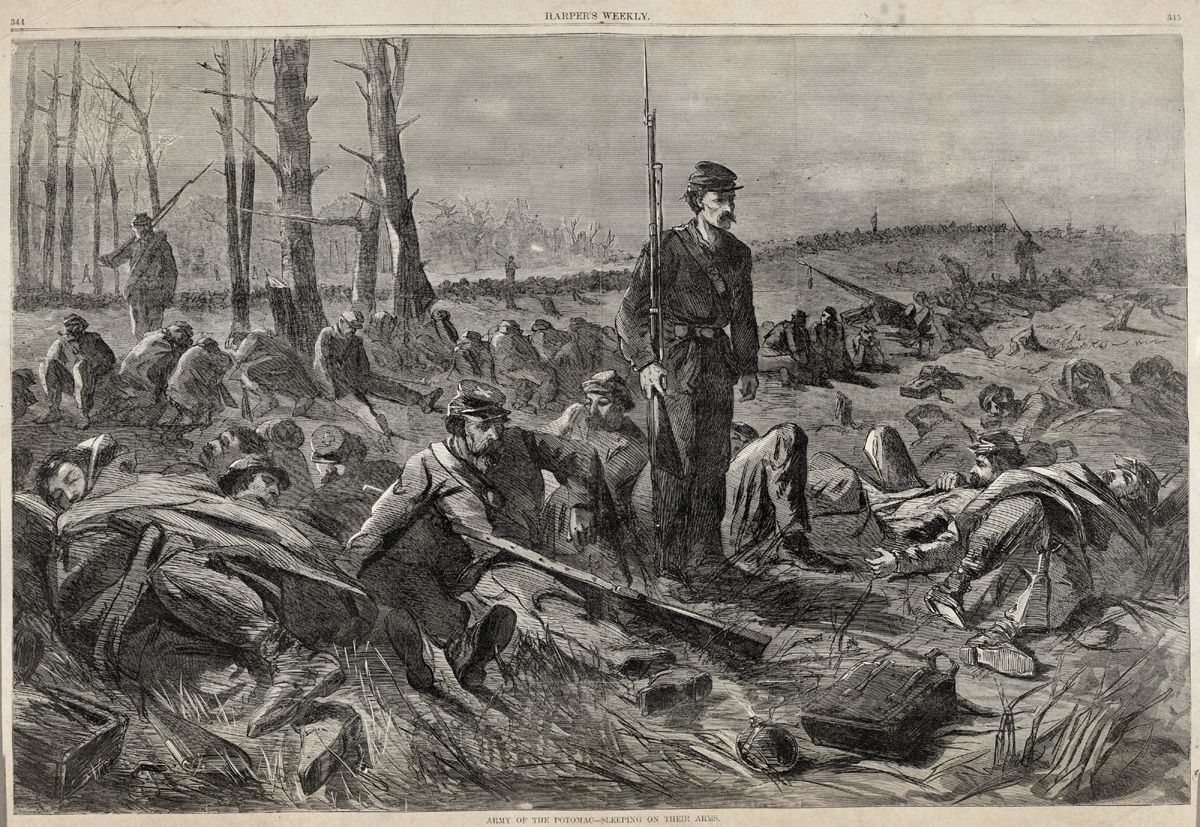
Sleeping on their Arms,” which appeared in the May 28, 1864, edition of Harper’s Weekly. This issue of Harper’s also covered the Battle of the Wilderness, so it is likely that this sketch, which was turned into a woodcut print, was made during that particular campaign. Theodore R. Davis, whose memory about the dangers of his work as a battlefield sketch artist opened this article, was mentioned by Gen. John Logan as the person who “saw more of the war than any other single person.” Davis sketched several images that appeared in the January 10, 1863, issue of Harper’s Weekly depicting actions and places on the south end of the Fredericksburg battlefield. The June 3, 1865, issue of Harper’s Weekly offered a bit of homage and gratitude to the “special artists” of the Civil War: “We may be pardoned for special pride in our own artists who have gone through all the long and stirring campaigns of this war, commemorating its most interesting incidents and noted men, so that the volumes of the “Weekly” are really a vivid history of the struggle. Messers A.R. Waud, Theodore R. Davis, William Waud, Robert Weir, Andrew M’Callum, A.W. Warren and others have been no less busy and scarcely less imperilled than the soldiers. They have made the weary marches and dangerous voyages. They have shared the soldiers’ fare; they have ridden and waded, and climbed and floundered, always trusting in lead pencils and keeping their paper dry. When the battle began they were there. They drew the enemy’s fire as well as our own. The fierce shock, the heaving tumult, the smoky sway of battle from side to side, the line, the assault, the victory – they were a part of all and their faithful fingers, depicting the scenes, have made us a part also.” (MET)
The mission of CVBT is to preserve land associated with the four major campaigns of Fredericksburg, Chancellorsville, Mine Run, and the Overland Campaign, including the Wilderness and Spotsylvania Court House. To learn more about this grassroots preservation nonprofit organization, which has saved over 1,700 acres of hallowed ground, please visit: www.cvbt.org.
ROCK ISLAND AUCTION COMPANY
Premier Auction® FINE, HISTORIC, & INVESTMENT GRADE FIREARMS
May 2nd, 3rd & 4th Rare 1864 Dated Civil War West Point Foundry U.S. Model 1863 3-Inch Parrott Rifle with Carriage
Rare 1861 Dated Civil War U.S. West Point Foundry Model 1861 10-Pounder Parrott Rifle with Carriage
Bedford, Texas
History Lives Here®
Incredible Civil War 1863 Dated Henry N. Hooper & Co. Napoleon 12-Pounder U.S. Model 1857 Light Field Gun with Field Carriage and Caisson
Outstanding Documented Civil War Era Factory Engraved and Silver Plated New Haven Arms Co. Henry Lever Action Rifle, Featured on the Cover of Gun Report’s October 1957 Issue and in “Winchester Engraving” Books, with Wooden Henry Cleaning Rod
Historic Civil War Berdan Sharpshooter Range Sharps Model 1859 Percussion Military Rifle with Double Set Triggers
Outstanding Civil War U.S. Contract Colt Model 1860 Army Percussion Revolver with Factory Letter and Skin Pack
The Greg Lampe Collection
Exceptionally Rare Civil War Confederate Texas Dance & Brothers Percussion Revolver Rare Civil War Confederate Thomas Leech & Co. Memphis Novelty Works Marked Cavalry Saber with Scabbard
Extremely Rare, Iconic, and Highly Desirable Documented Civil War Confederate T.W. Cofer Percussion Revolver