
Critic’s Corner The Civil War: A Narrative Volume Two
By Stephen Davis · Originally published March-April 2025 · pp. 54–55
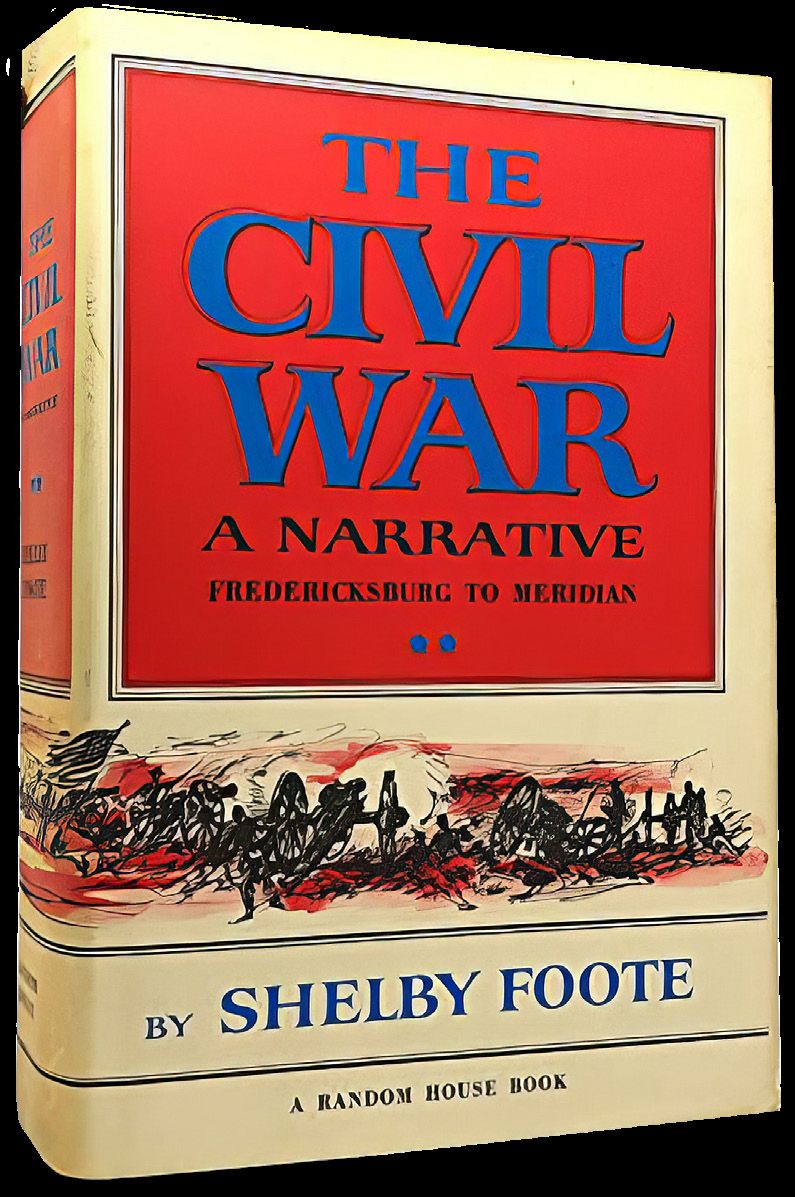
By Shelby Foote fter an absence of two years,” Jefferson Davis declared to the Mississippi legislature upon his return on Dec. 26, 1862, recalling how he had left in February 1861 to become President of the newly formed Confederacy. Shelby Foote begins the second volume of his The Civil War with these words, in which to refer to himself he could have changed two to four, the intervening time since publication of the first volume of his opus in 1959.1 And opus it is, narrating the war from the battle of Fredericksburg through 1863 to Sherman’s Meridian march in February 1864. (Volume One carries the conflict through Antietam and Lincoln’s Proclamation.) Only Allan Nevins and Bruce Catton, by my recollection, wrote a multi-volume history of the war.2 William C. Davis set out to write a trilogy, The Imperiled Union, but stopped after Volume Two, which carried the war through 1863.3 The American Civil War, which took 700,000 lives and cost untold millions of dollars (as if the two metrics are comparable), seems just too hard to compress into words, even allowing for the ability of a novelist-turned-historian (which Shelby Foote was) to alchemically render the event into print. Indeed, even reading this magisterial tome, nearly a thousand pages, seems a magical feat. Divided into just nine chapters, Foote’s text offers a seamlessness that few historians can manage. (I wonder how William Faulkner might have narrated the war, in which his grandfather fought.4) Foote’s second volume was published in 1963, smackdab in the middle of the Civil Rights Movement, but he refrains from relativism, keeping his eyes, and ours, on the War. Using Southerners’ terms, he calls it “this second American war for independence” (20). Similarly, he refers to the Confederates’ revolution in light of Americans’ earlier one (“the First and Second, staged respectively in 1776 and 1861,” 649). In battle, Southerners are the legendary “butternut scarecrows,” the “lean marchers” on scant rations who, under Jackson in the Valley, had been able to amaze the world (28, 43). It was “Lee’s scarecrow heroes,” “the famed, hard-marching rebel infantry” who had won at Chancellorsville (238, 269). Foote, after all, was a Mississippian, born in Greenville, 1916. Gettysburg, of course, is the centerpiece for this volume, in which Foote gives the campaign well-nigh a hundred and fifty pages. It is Lee’s “greatest and worst-fought battle,” a burden shared by an errant Stuart, a dithering Ewell, and a contentious Longstreet. “The truth was,” Foote writes of the Confederates, “the army had slipped back to the disorganization of the Seven Days” (513). Poor Southern staff work and faulty command decisions were outdone on July 2 by the soldiers’ valor that nearly broke the Union center (Rans Wright’s Brigade) and almost overlapped the enemy left (Oates’ 15th Alabama). Then came Lee’s Malvern-like order for assault on the third day. Little wonder that at the outcome of the charge, Lee could only groan, “Oh, too bad!” (581). The Confederate retreat began in the night of July 4-5. Lee dutifully wrote President Davis of what had transpired, and Foote quotes a long passage of the letter in seeming admiration of the gentlemanly prose that back then could be penned even in the wake of disaster. “I hope Your Excellency will understand that I am not in the least discouraged, or that my faith in the protection of an allmerciful Providence, or in the fortitude of this army, is at all shaken,” he wrote. “But, though conscious that the enemy has been much shattered in the recent battle, I am aware that he can be easily reinforced, while no addition can be made to our numbers.”
“With the blessing of Heaven, I trust that the courage and fortitude of the army will be found sufficient to relieve us from the embarrassment caused by the unlooked-for natural difficulties of our situation, if not to secure more valuable and substantial results. Very respectfully, your obedient servant, R. E. Lee.” Upon reading this (p. 586), I could only jot in the margin, “they don’t write like that anymore.” I meant Lee, but the same goes for Foote. With long sentences (I counted 218 words in one, pages 325-26) and archaic words (foison? fuliginous? 175, 879), the author subtly transports us back to a time that is today not easy for us to absorb…which is his intent for us, as well as for himself. Foote wrote his manuscript by hand, in quill-ink, and at least once his copyeditors at Random House misread a word (with for which, 718). Volume Two traces events in the west with a thoroughness that would have pleased Tom Connelly. Chapter 7 begins with Rosecrans and Bragg in Tennessee, June-October 1863; rides with Morgan; and bristles defiance with Confederates at Charleston. The surrender of Little Rock, September 10 (the fourth Rebel capital to fall) is soon countered by Chickamauga, leading to Grant taking command at Chattanooga. The title of Chapter 8, “The Center Gives,” says it all: while Lee and Meade avoid another big battle, Grant assumes the offensive and drives the Rebels from Missionary Ridge (or rather his troops did, as Grant never gave the order). The general himself Foote characterizes as “the killer-arithmetician” (828, 963) whom Lincoln had been seeking to prosecute the war to victory. There are no photographs in this book, a recognition that classic narrative history is its own art form. Forty-eight maps by the Connecticut cartographer George Annand assist Foote’s narrative, particularly on Gettysburg (four maps). Endnotes state that Annand’s art derived from “originals by the author,” further attestation of Foote’s immersion in his work. The very first map, on page 2, traces President Davis’ long trip, Dec. 10, 1862-Jan. 5, 1863, to the western theater, something Lincoln never did (or had to do, I suppose). The volume’s last chapter is entitled “Spring Came on Forever,” which I see is the title of a novel by Bess Streeter Aldrich in 1935 about two Americans heading west. (I wish I could ask Shelby about this.) The chapter tracks events of November 1863-March 1864: Lincoln puts forth his 10% Plan, opening the fight with Congressional Radicals over who would control the course of Reconstruction. Joe Johnson succeeds Bragg as commander of the Army of Tennessee, then quartered at Dalton, Georgia. With the Northern naval blockade pinching tighter, the remarkable Rebel submarine Hunley actually sinks an enemy warship in Charleston harbor. Confederates in north Florida administer one of “the soundest thrashings of the war” (904) to the Yankees at Olustee, Feb. 20, 1864. Forrest whips Sooy Smith at Okolona, but Sherman wrecks his way to Meridian. The abortive Kilpatrick-Dahlgren Raid on Richmond, where papers found on the dead colonel’s body disclose a plan to kill Jeff Davis and burn the capital, inflames the South. “It is as if Lincoln,” Foote judges, “in attempting to soothe and heal the national wounds, had reached blindly into the medicine chest and mistaken an irritant for a salve” (916). Both presidents bring western generals east. In Grant, hero of Donelson, Vicksburg, and Chattanooga, Lincoln sees “the victory formula [he] had been seeking all these years” (947). But in summoning Bragg to Richmond as an advisor, Davis was ridding his western army of an unpopular commander while deriving “a secret satisfaction in triumphing thus over popular sentiment” (957), in the words of a War Department diarist whom Foote chooses not to name (John Beauchamp Jones, we infer). With the war entering its fourth spring, the North wearies of its cost, to the point that Lincoln frets over his possible failed re-election. The South, however, trudges on with a pluck that Foote quietly admires. After all, the Confederacy is waging a “struggle to maintain its national existence” (935). This gives Jefferson Davis an advantage, his “principal advantage,” actually, in that “he did not have to persuade his people of the reality of….what would happen to the South if its bid for independence failed” (949). Indeed, Foote declares Southerners’ patriotism “the South’s chief asset” (879). Numbers showed it. Foote points out that during 1863, “while the Federal over-all strength was declining from 918,211 to 860,737 men, that of the Confederates increased from 446,622 to 463,181” (953). That’s what a novelist can do: from the musty pages of history, create an imagined world of as-yet-possibility. The volume closes with Sherman recalling how Grant met him at Nashville in mid-March 1864 and laid out his plan: “He was to go for Lee and I was to go for Joe Johnston” (966). With that, Shelby Foote’s Volume Three rests there on my bookshelf, beckoning. Endnotes
The Civil War: A Narrative Volume Two
Shelby Foote, The Civil War: A Narrative Volume Two–Fredericksburg to Meridian (New York: Random House, 1963). Allan Nevins, Ordeal of the Union, 8 vols. (New York: Charles Scribner’s Sons, 1947-71); Bruce Catton, The Centennial History of the Civil War, 3 vols. (New York: Doubleday & Company, 1961-65). William C. Davis, The Deep Waters of the Proud and Stand in the Day of Battle (New York: Doubleday & Company, 1982-83). Michael Gorra, The Saddest Words: William Faulkner’s Civil War (New York: Liveright Publishing Corporation, 2020), 60.
Fredericksburg to Meridian (1963)
Stephen Davis has been writing about the Civil War for a long time—“since Jesus was in third grade,” he contends. He is author of Texas Brigadier to the Fall of Atlanta: John Bell Hood (2019) and Into Tennessee
& Failure: John Bell Hood (2020). With Bill Hendrick he wrote The Atlanta Intelligencer Covers the Civil War (2022). His next book, The National Tribune Remembers the Atlanta Campaign: Battles, Skirmishes, Marches and Camp Life as Recalled by the Union Veterans Themselves, is being published by Savas Beatie.