
Central Virginia Battlefields Trust Soldiers’ Winter Quarters in Central Virginia
By Tim Talbott · Originally published March-April 2025 · pp. 40–45
Central Virginia Battlefields Trust “I Am Extremely Comfortably Fixed”:
Soldiers’ Winter Quarters in Central Virginia
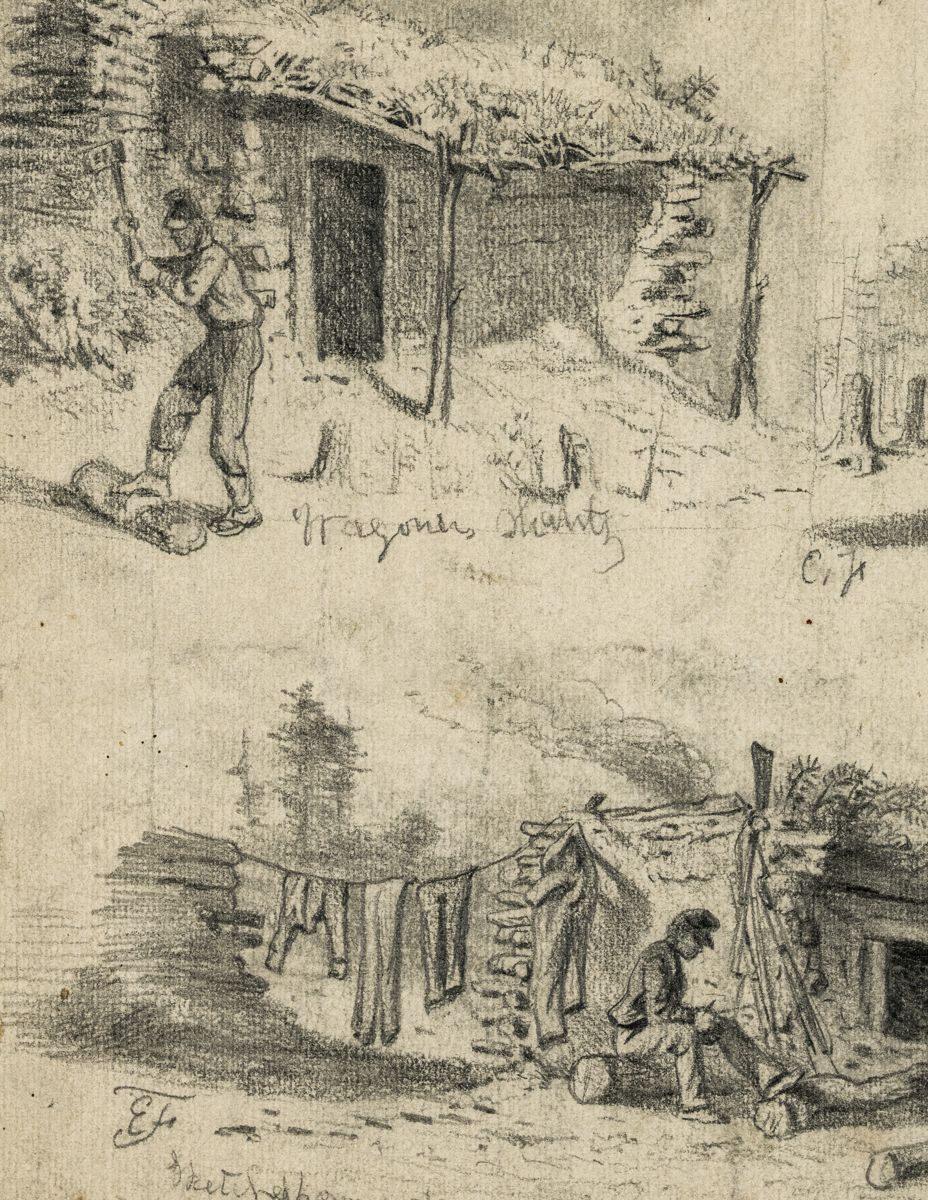
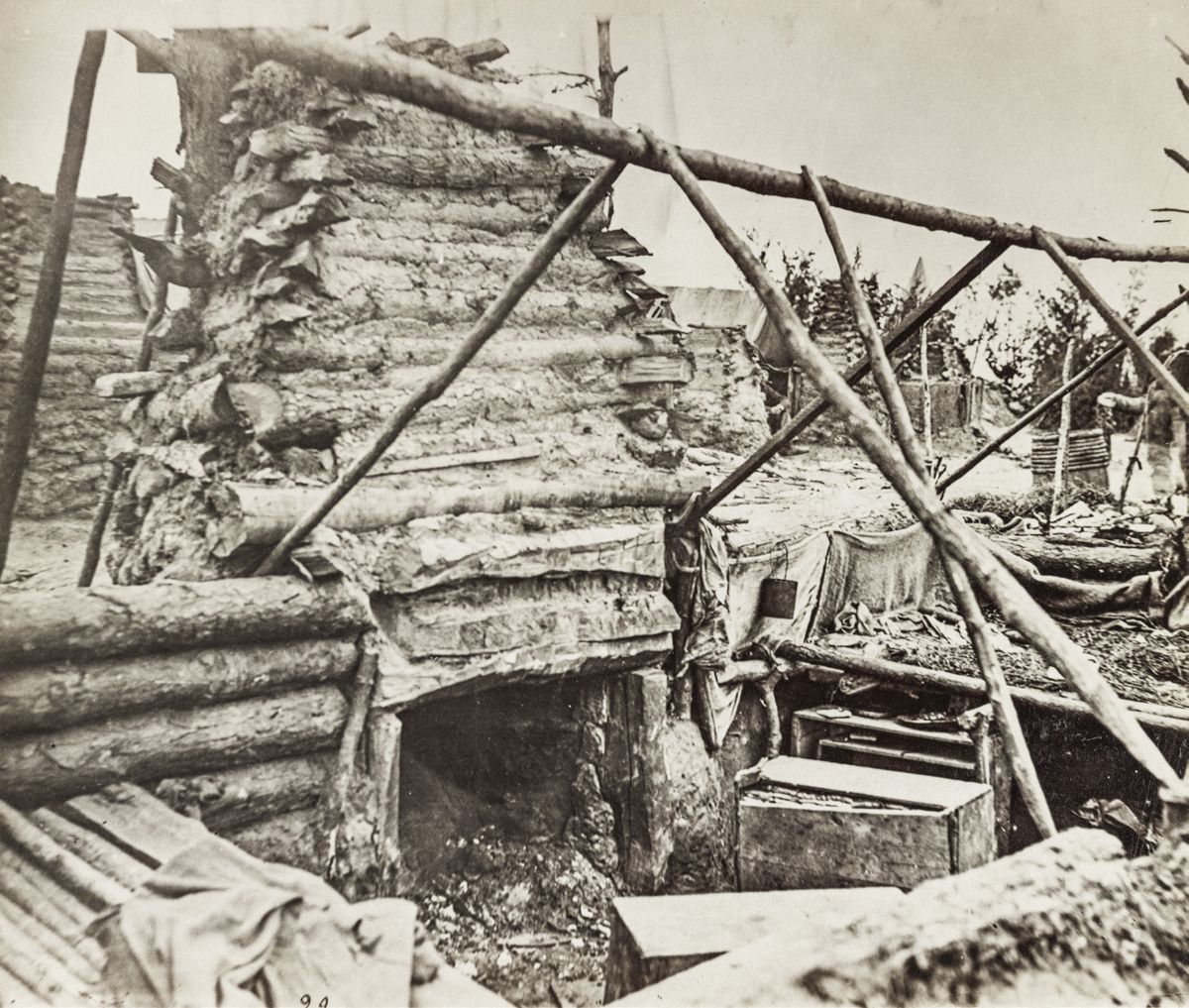
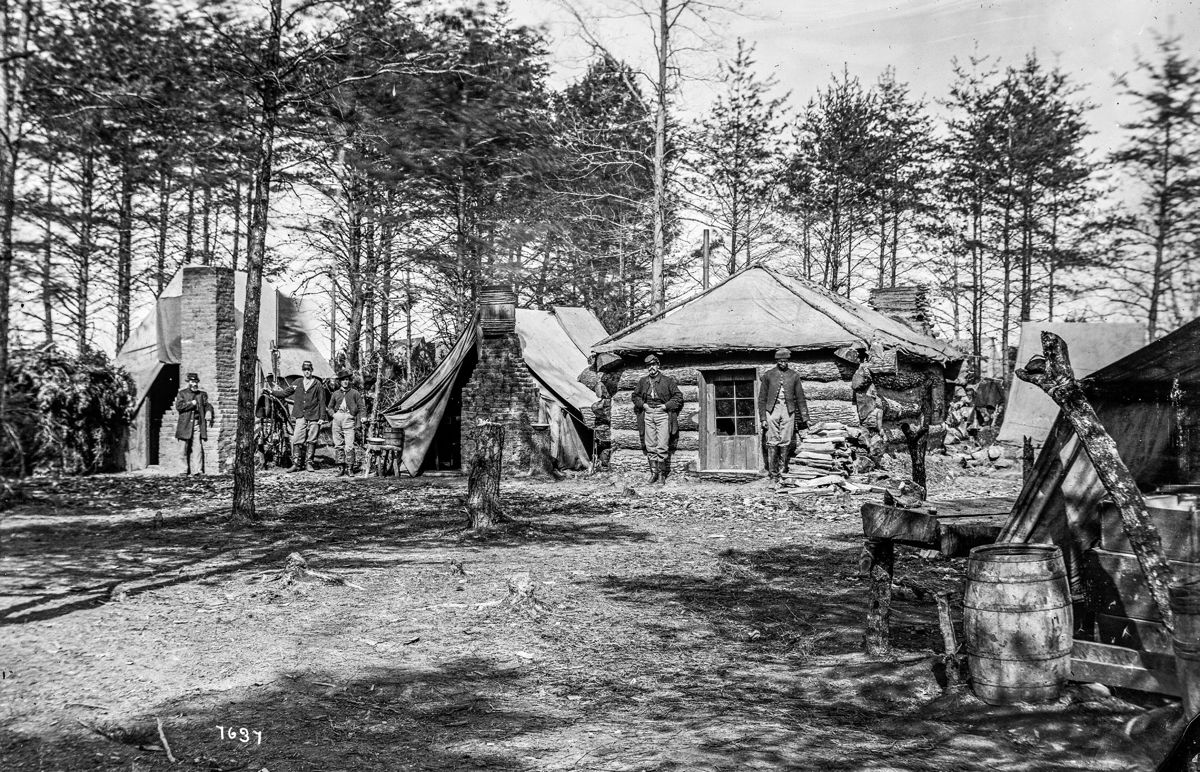
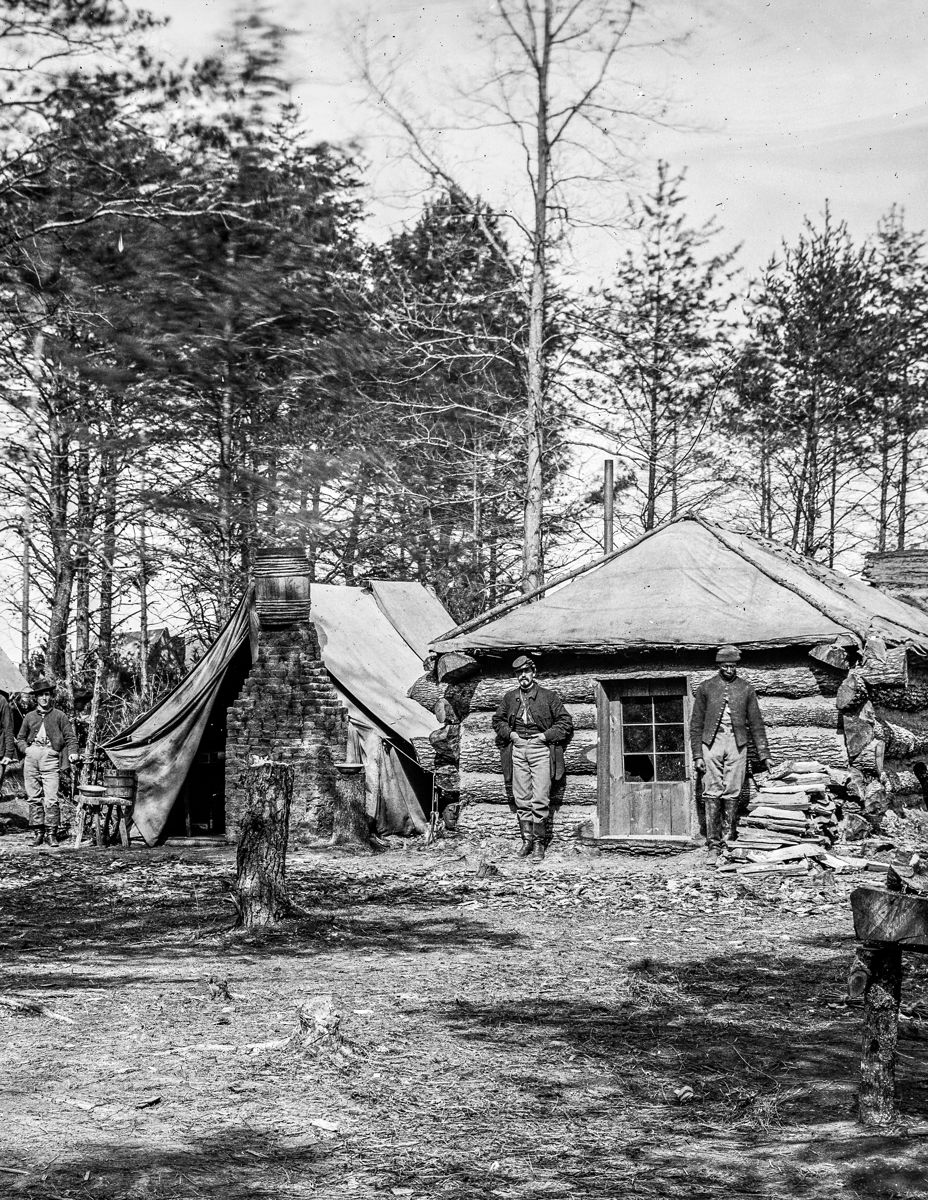
T By Tim Talbott he timing of the Civil War battles and campaigns fought in central Virginia helped ensure that the soldiers spent a significant amount of downtime living in winter quarters. The battles of Fredericksburg (December 11-13, 1862), Chancellorsville (May 1-3, 1863), the Mine Run Campaign (November 26-December 2, 1863), and the Wilderness and Spotsylvania Court House (May 5-21, 1864) all coincided with static periods, either before or after, or both, for the belligerent armies. Some periods in winter quarters were brief, while others went on for months. Many considerations factored into the amount of inactivity. Perhaps the most important was the condition of the roads. Typically, during the winter months in central Virginia, the temperature fluctuations resulted in significant freezing and thawing. Adding rain and snow into the mix created a grand recipe for seas of mud that made it virtually impossible to move soldiers and vital supplies effectively and efficiently. Most commanders fully understood the challenges of attempting large military maneuvers during winter and tried to avoid making such gambles. Another important consideration was the health of the men. Sickness in the ranks was a significant problem during the best of weather. But during winter, extended exposure to the elements could greatly exacerbate an already challenging health crisis. In addition, there were also times when political pressure demanded military action regardless of the time of year, and thus limited time in winter quarters. Whether on active campaign or in winter quarters, picket duty was a necessary part of army life. During winter quarters, when military matters relaxed a bit, it was still important to maintain a vigilant watch for any potential enemy attack or offensive. Few soldiers enjoyed picket duty, but winter’s cold and wet weather especially tried their nerves, physical constitutions, and morale. Lt. Edmund Patterson, 9th Alabama, explained in January 1863, “I go on picket and remain twenty four hours. We stand on our side of the [Rappahannock] river and look at the Yanks. They stand on their side and look at us. Sometimes we exchange [news]papers … and sometimes the boys trade them tobacco for coffee.” Occasionally, soldiers got lucky and moved into the abandoned huts of a regiment that had received orders to move elsewhere. Such was the case for John Walters of the Norfolk Light Artillery Blues, positioned at Bank’s Ford. In January 1863, he wrote, “We found here some well put up breastworks … and then went to work making ourselves comfortable, a not very difficult job from the fact that … we found a number of log huts with good fire places, and … within twenty yards of our cabins, there is a run of excellent water, large enough to supply both men and horses.” This photograph shows an abandoned IX Corps winter camp in Finding abandoned huts was the Falmouth, Va. Note the construction of the log and mud chimney. exception to the rule, so the comfort (Library of Congress)
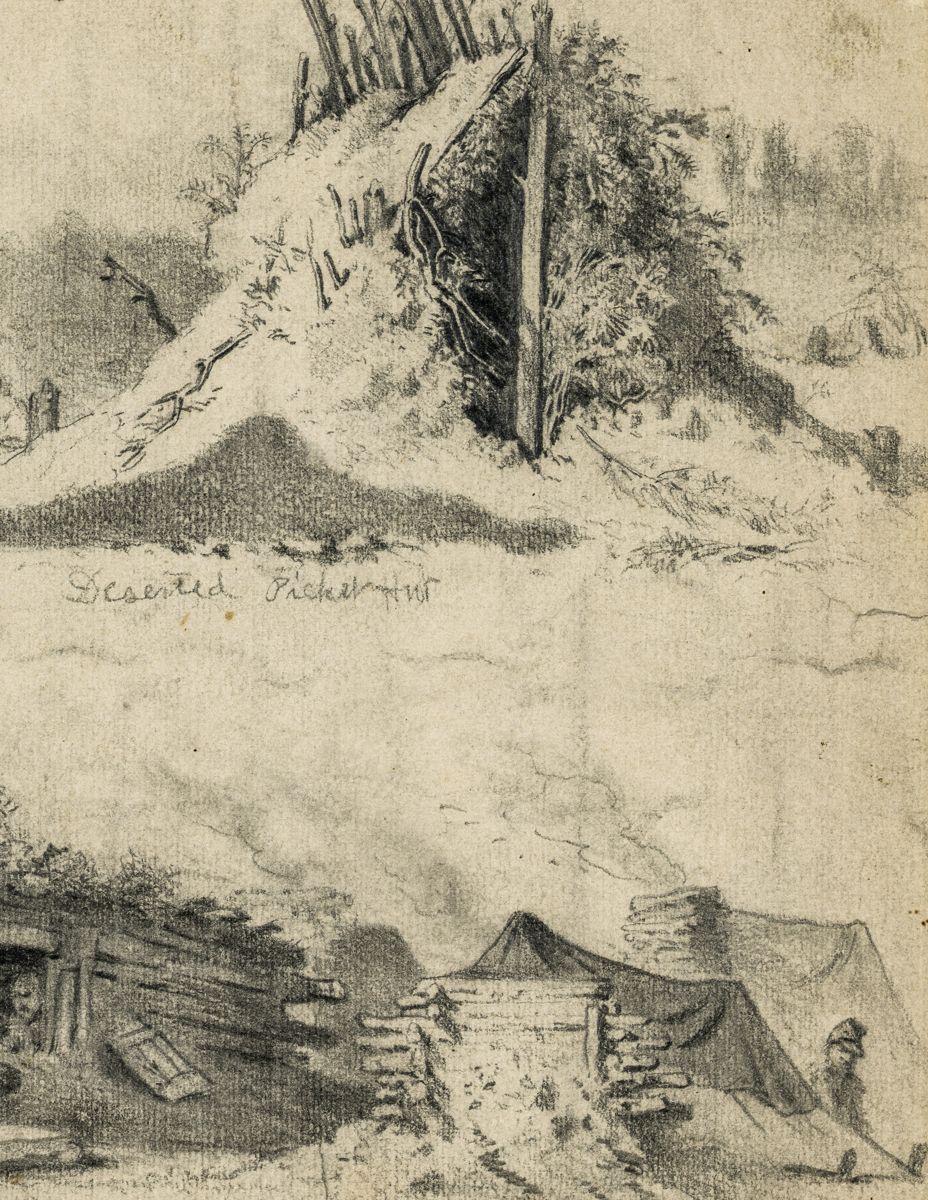
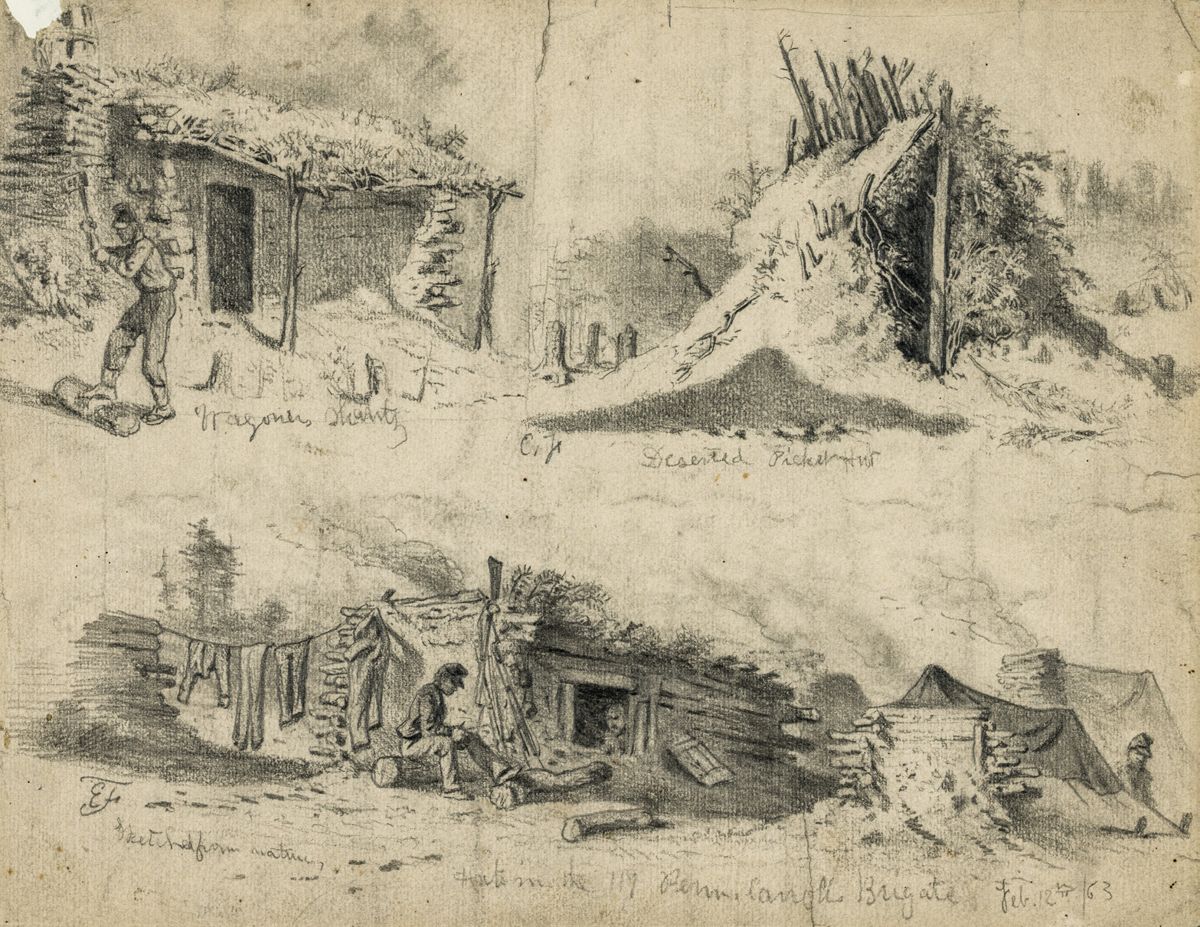
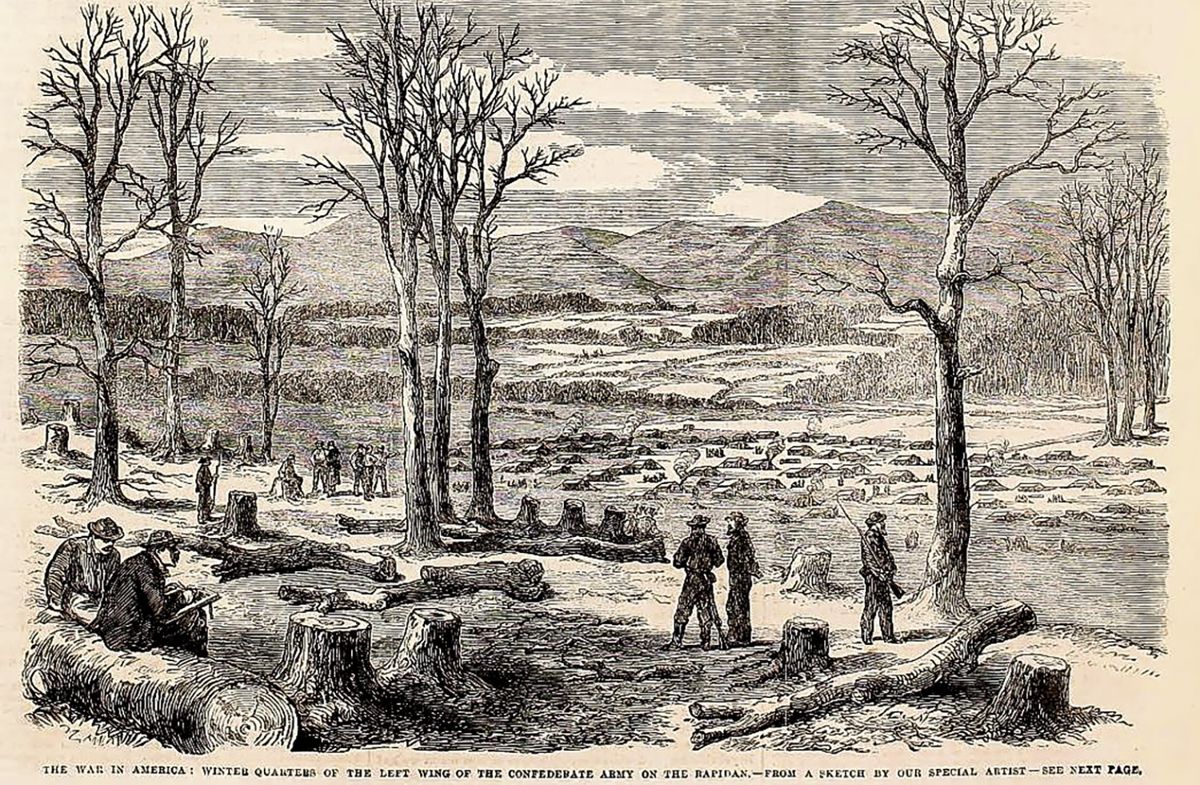
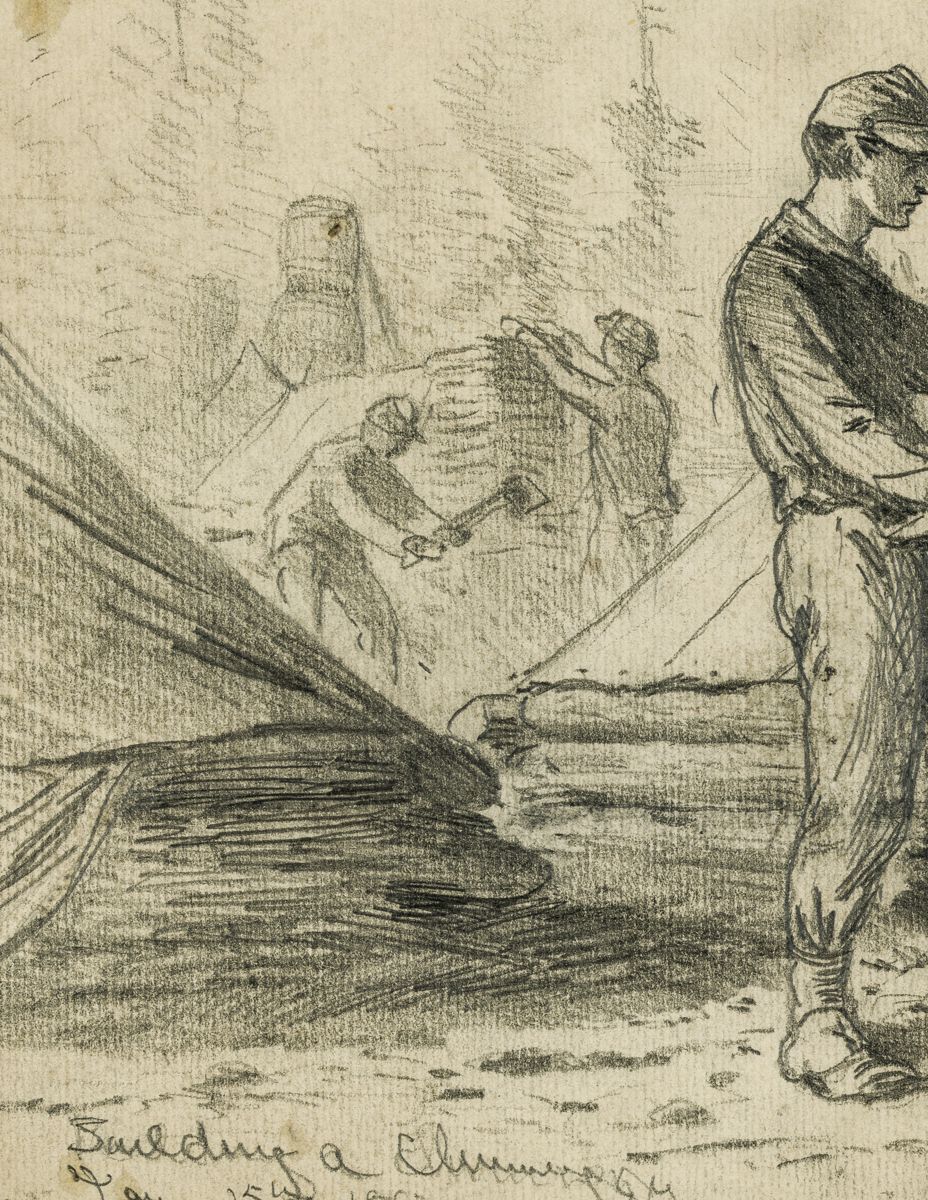
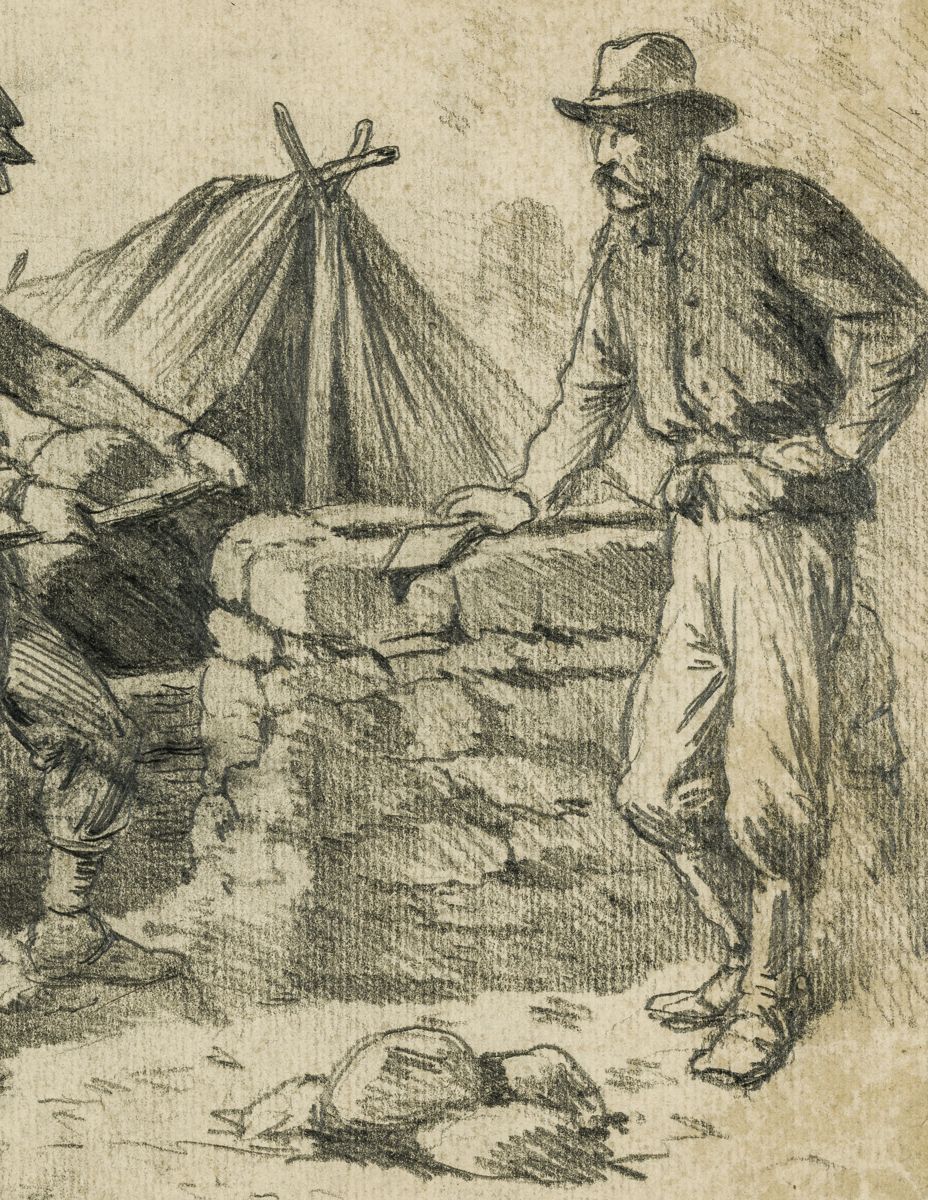
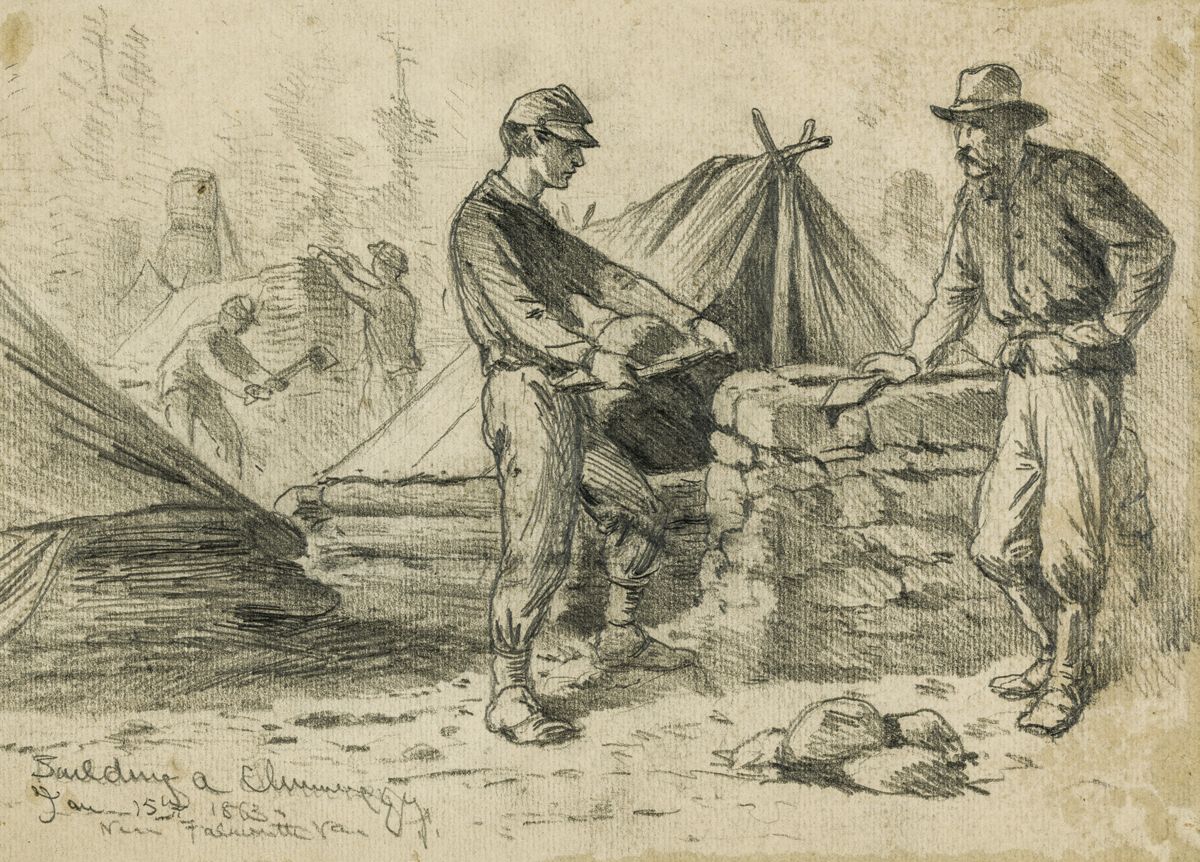
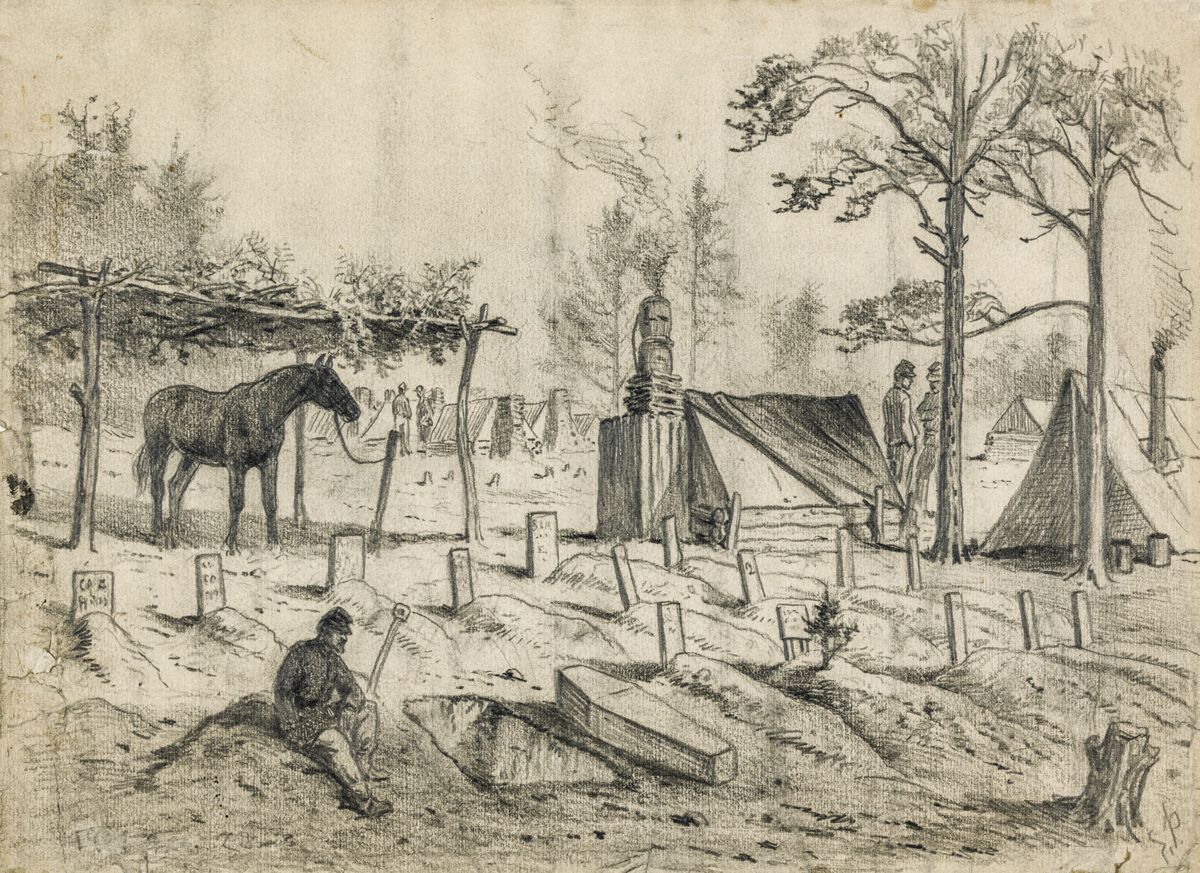
level and quality of construction of winter quarters usually something like the ribs of a huge fan … there can be on depended on the skills the soldiers building them brought to this campground neither order or regularity,” he wrote. A the project. It was common practice for a “mess,” a group New York soldier recorded in his diary his regiment’s camp of about three to six soldiers, to work together to erect their building in Stafford County: “Work of preparing winter temporary living space. quarters commenced. Trees were cut, and the ground laid Construction materials consisted of whatever soldiers out for a beautiful camp. Every one had enough to do in could readily get their hands on. They cut trees and saplings preparing his own quarters & those of H’d Qr’s.” to serve as the walls and roof supports, and scavenged In February 1863, Alabamian Lt. Edmund Patterson planks from abandoned nearby buildings for flooring, doors, and windows. Stones, old bricks, logs caked with clay mud, and even discarded army barrels became chimneys for their dwelling’s fireplace. Robert Robertson of the 93rd New York wrote in his diary just before the Battle of Fredericksburg about his good luck finding building materials. “Considerable ingenuity was displayed in building these chimneys of wood and mud, but some of us were fortunate in discovering a pile of brick, and were looked upon as aristocratic when we got our chimneys built,” Robertson bragged. Canvas tents and shelter halves buttoned together made an improvised if not always Army of Northern Virginia Confederates camped mainly in Orange impermeable, roof. Plentiful County during the winter of 1863–1864. (Illustrated London News) mud daubed the cracks between wall logs to keep out the wind, rain, and snow. Old hardtack boxes nailed to the walls became shelves. Soldiers fashioned space-saving bunkbeds from recycled lumber, saplings, and barrel staves. Pine and cedar boughs padded their beds and, if unfortunate enough not to have a plank floor, served as carpets to keep the dust and mud in their huts at a minimum. The place chosen for a regiment’s winter encampment often determined its layout. Hills, streams, and other geographical features challenged normal expected symmetry. Lt. Millet S. Thompson commented on the 13th New Hampshire’s camp at Falmouth. “The ends of the company … streets, are widest down near the brook, the narrower where they rise upon the slope, though on the whole quite irregular, and thrown This Edwin Forbes sketch of winter camp huts shows a variety of soldier upon the curve of the slope architecture. (Library of Congress)
jotted in his journal from their winter camp near Scott’s Dam northwest of Fredericksburg that “most of the boys have built little huts of pine poles and roofed them over with pieces of tent cloth. They are chinked and daubed well, and have good fireplaces and chimneys.” Camped near Belle Plain in Stafford County, Willard W. Glazier, 2nd New York Cavalry, recalled that, “Nearly everyman has suddenly become a mason or carpenter, and the hammer, the axe and the trowel are being plied with the utmost vigor, if not with the highest skill. Many of us, however, are astonished at the ingenuity that is displayed with this department.” Just after the Mine Run Campaign, Capt. Mason Whiting Tyler, 37th Massachusetts, started construction on his third hut after movements caused him to have to abandon the first two. “To be sure, these houses were not very elaborate, but we found them very comfortable. They were twelve feet long by seven wide, and made of split logs with the cracks filled with mud, with a chimney made of stone or wood at one end. The roofs were made of shelter tents … .,” he wrote. Some soldiers were quite pleased with their carpentry skills and inventiveness. Winthrop D. Sheldon, 27th Connecticut, admired his regiment’s winter huts near Falmouth, “With no little satisfaction we surveyed our rough architecture, pork-barrel chimneys, and cracker box doors, feeling that though the winds might blow, and the rainy season pour down its flood, we were prepared to endure it patiently.” The 23rd New York Infantry’s Seymour Dexter called his winter quarters near Brook’s Station a “Royal Place.” Although it was “somewhat less than 6 feet square and accommodates three persons,” he explained, “It is built up of logs about three feet and then our shelter tents put on for a roof.” Their hut included “a nice fireplace on one side, built in true Virginia style.” Dexter claimed their structure, though perhaps crude, beat a shelter tent when “the cold December winds [came] sweeping around and into it by day, and night creeping more searchingly beneath … scanty blankets… .” In January 1864, after being out on picket duty for three days, Hoosier William Reeder found that his regiment had moved its camp three miles “to a piece of timberland, as the wood had given out where we were.” The move required the construction of winter quarters for a second time for Reeder. He explained, “I have a very comfortable house, ten [feet] by seven [feet].” Reeder noted that he and his cabin mate, Edward Weist, had as much room as four soldiers often have in their winter quarters, but it was only the two of them. Corp. Gibson Hood, 140th New York, wrote to Martha Withrow following the Mine Run Campaign briefly describing his camp. “I wish you was here once to see our nice quarters the 140th looks like a small town Each Co. has its own row of shantys, our Co. has 13 the size of them is 7 ft by 10 ft about 7 feet high with a chimly in one end,” Hood explained. Likewise, but just before Mine Run, Pvt. William Tesh of the 28th North Carolina wrote to his parents about his Orange County winter quarters: “Mother we have taken up winter Quarters we had orders to build us cabins I have got me one all ready dun their is Four of us a gowing to stay in it me and Sam Harding and Berry and William Macy it is 12 Feet square and we have got a splendid chimney and have got beds of[f] the ground and we Fare splendid.” Gathering the materials for building winter quarters dramatically altered the landscape. Soldiers devoured vast forests for construction resources, for fuel to warm themselves, and to cook their meals. Pvt. Wilbur Fisk, 2nd Vermont, writing to a newspaper back home, claimed, “The land here was covered by an oak forest, similar to the camp we have just left, but which has been removed by one or the other of the contending armies. Now and then there is a line representative of the forest’s former glory, but in a week from now, if we stay here, these will have perished with the rest.” Soldier life went on, even in winter quarters. However, the pace of outdoor activities typically slowed. As Pvt. Carlton McCarthy of the Richmond Howitzers poetically put it while remembering: “When the leaves begin to fall and the wind to rush in furious frolics through the woods, the soldier’s heart yearns for comfort. Chilling rains, cutting sleet, drifting snow, muddy roads, all the miseries of approaching winter, pressed him to ask and repeat the question, ‘When will we go into winter quarters.’” In instances like those preceding the Battle of Fredericksburg, where temperatures plummeted, snow fell, and Confederate supplies of proper clothing and shelter had not caught up with its soldiers in many regiments, those without winter quarters suffered terribly. Among those in this situation was the 14th North Carolina’s Sgt. Jacob Patton. Patton wrote to his parents while camped near Fredericksburg on the eve of the battle explaining, “We havent any winter quarters or tents and no hopes of any: we just take every thing as it comes wet or dry cold or hot it maters not what.” And although Patton noted, “Our compa[ny] and reg[iment] are all enjoying very good health: The health of our army is generally good in this part of the country,” that would not last long with continued exposure to the elements. Writing in his diary on February 17, 1863, from his camp in Stafford County, Corp. Andrew J. Boies, 33rd Massachusetts, noted: “It is snowing hard and bids fair to be a severe storm before it is over. I am comfortably seated in my log cabin, before a good blazing fire, and am both dry and warm. Owens, Roth, and Parker, share with me, and they are all good tent-mates.” Also writing in February 1863 but making winter camp near Moss Neck Manor in Caroline County, Capt. George Bedinger, 33rd Virginia (Stonewall Brigade) commented, “I am extremely comfortably fixed, have an excellent tent and stove and would rather prefer bad weather, as it reduces the possibility of our marching until a more favourable season.” If winter quarters residents expected to get along in their tight spaces, sharing duties helped. An anonymous Second Corps soldier at Falmouth, writing to the Lewiston, Maine, Daily Evening Journal noted that, “The number of occupants to each hut is from two to four persons, these mutually perform the agreeable offices of cooks, woodchoppers, laundress, chambermaid, bottle-washer, and kindred employments.” Col. J. Warren Keifer, 110th Ohio, understood the challenges of discipline in winter quarter camps: “The season not permitting much opportunity for drill, discipline is hard to maintain. Sickness becomes prevalent, and there is much unrest, both of officers and soldiers.” Soldiers read, wrote letters home, played indoor games, smoked their pipes, drank, fought snowball fights, attended religious services, and if fortunate, listened to regimental band music. However, boredom drained morale. Confederate William Palmore wrote his grandmother in December 1863, “If the Yankees are to whip us finally, I wish they would do it before tomorrow night, for anything is preferable to this sort of [cooped up] living. I am completely worn out with it.” The mission of CVBT is to preserve land associated with the four major campaigns of Fredericksburg, Chancellorsville, Mine Run, and the Overland Campaign, including the Wilderness and Spotsylvania Court House. To learn more about this grassroots preservation non-profit organization, which has saved over 1,700 acres of hallowed ground, please visit: www.cvbt.org. Tim Talbott is the Chief Administrative Officer of the Central Virginia Battlefields Trust.
“I Thank the Lord I Am Not a Yankee…”
Eliza Frances Andrews (1840–1931) received a strong education and was a successful writer and educator. Her War-Time Journal of a Georgia Girl surely ranks among the most observant and intelligent wartime memoirs by a Southern woman. Edited with commentary by Stephen Davis, I Thank the Lord I Am Not a Yankee includes selections of her wartime and postwar journals which are most expressive of her Confederate patriotism and Southern pride. February 2023 • $35.00, hardback
Stephen Davis is author of ten books on the Civil War, most of which treat the Atlanta Campaign. His two recent volumes on Confederate General John Bell Hood have won several prizes, including the Fletcher Pratt Award of the New York CWRT.
Civil War NEWS
To purchase back issues visit our secure website: https://simplecirc.com/shop/civil-war-news or call us at 800-777-1862. When ordering multiple issues we will refund the shipping difference.
Civil War Civil War Civil War VOL. 50, NO. 5 | MAY-JUNE 2024
NEWS
NEWS
$7.99
NEWS
$7.99
$7.99
The Truth At
Featuring
Ken Burns, Martin Sheen, & Sam Waterston
Cassville Was Joe Johnston honest with History?
Maj. Gen. John A. Rawlins On Display:
Vision and Valor: The War Through Women’s Eyes
The Herb Peck
The Enfield at Manassas
Gen. David Hunter and the Newtown Burnings
Photography Collection
Fresh Views of the War’s Most Famous Fort Battles—and Their Impact on Families
A Surprising Collection of His Personal Belongings is Discovered
Medal of Honor for Two of Andrew’s Raiders
The Lawbook Raid
Stephen Lang and Jeff Shaara Star in a Holiday Weekend
Douglas Southall Freeman: Lee’s Lieutenants
Civil War Civil War
Back Issues
NEWS
NEWS
$7.99
Burnside’s Invasion of East Tennessee Remembering Peter Carmichael “Funded by Faith”
Cotton Bonds & The Erlanger Loan
Tragedies and Statistics
PTSD in the Civil War
Shelby Foote’s The Civil War: Fort Sumter to Perryville
Thoughts on Hat Insignia
Lost from the Landscape
$7.99
“Playing War” Sham Battles During and After The Civil War
Behind The Lines Charleston Free Badge Burnside’s Invasion of East Tenn. Reading Mary Boykin Chestnut
N-SSA’s 150th Nationals Riddick’s Folly Lincoln’s Cabinet Building M1842 Rifle Musket
Available for Purchase
There are a limited number of back issues. There are no back issues of the former newspaper format available.