
Untitled (p. 34)
By William Griffing · Originally published July-August 2025 · pp. 35–39

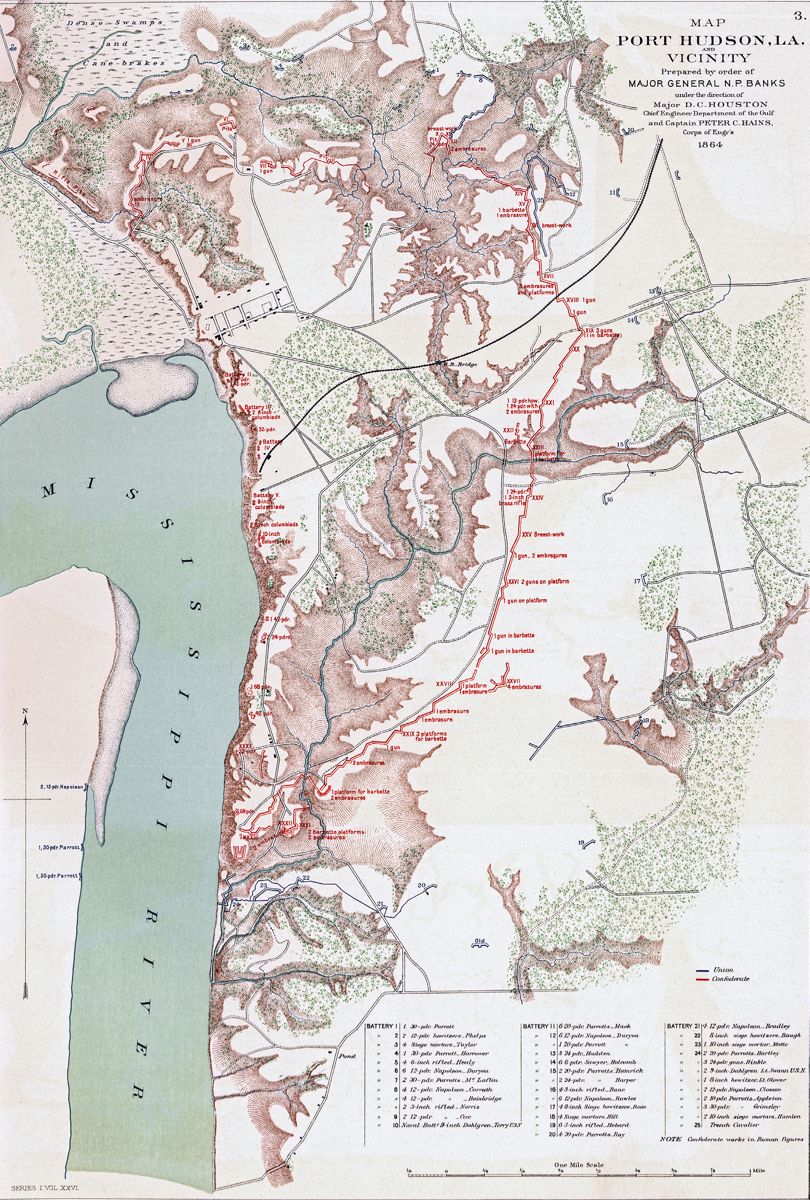
Map of Port Hudson, La., and Vicinity, prepared in 1864. Confederate defenses and fortifications are highlighted in red. Union lines and batteries are blue. (Official Records Atlas)
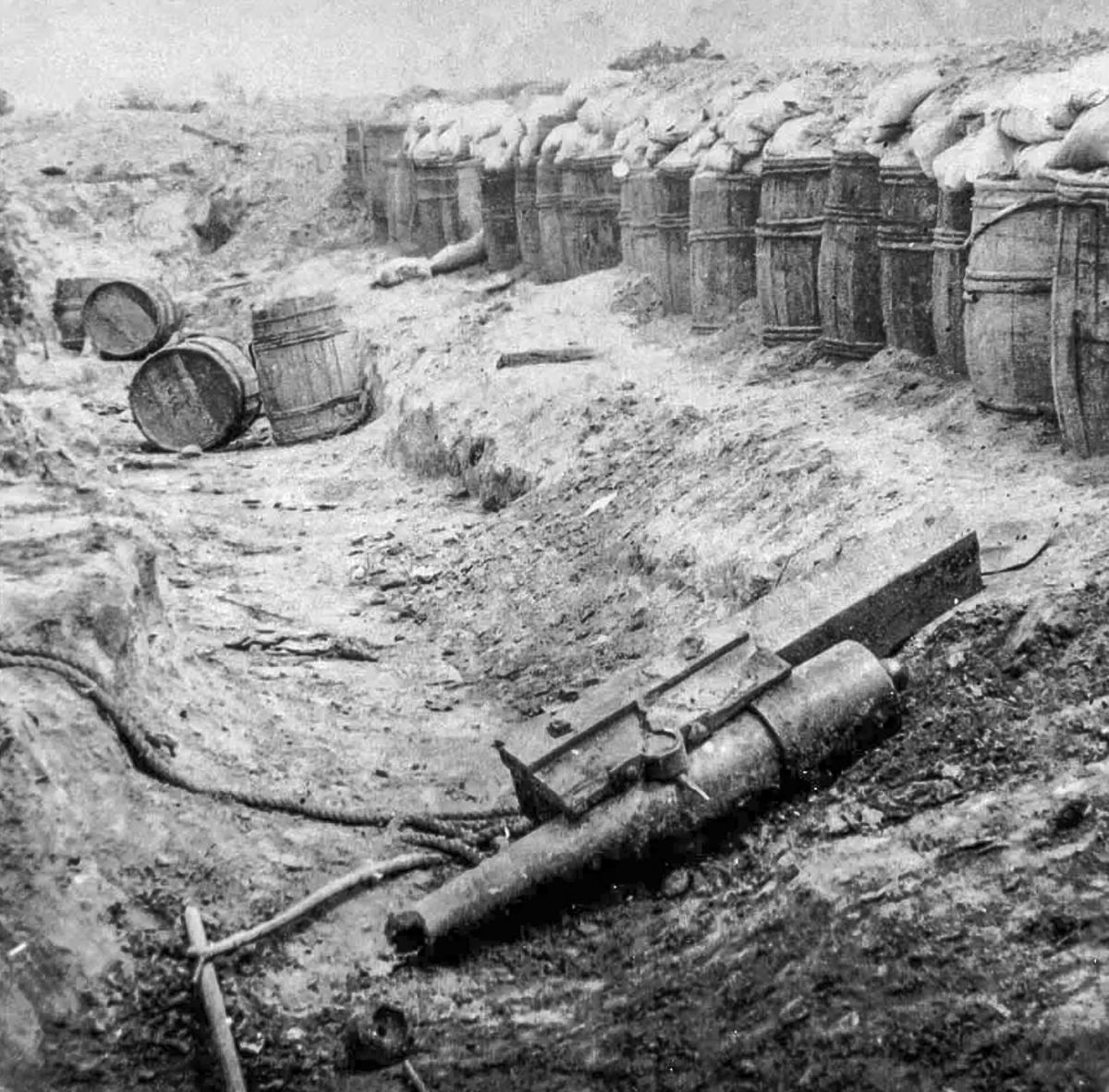
One of the many Confederate cannon dismounted by Union artillery during the siege.
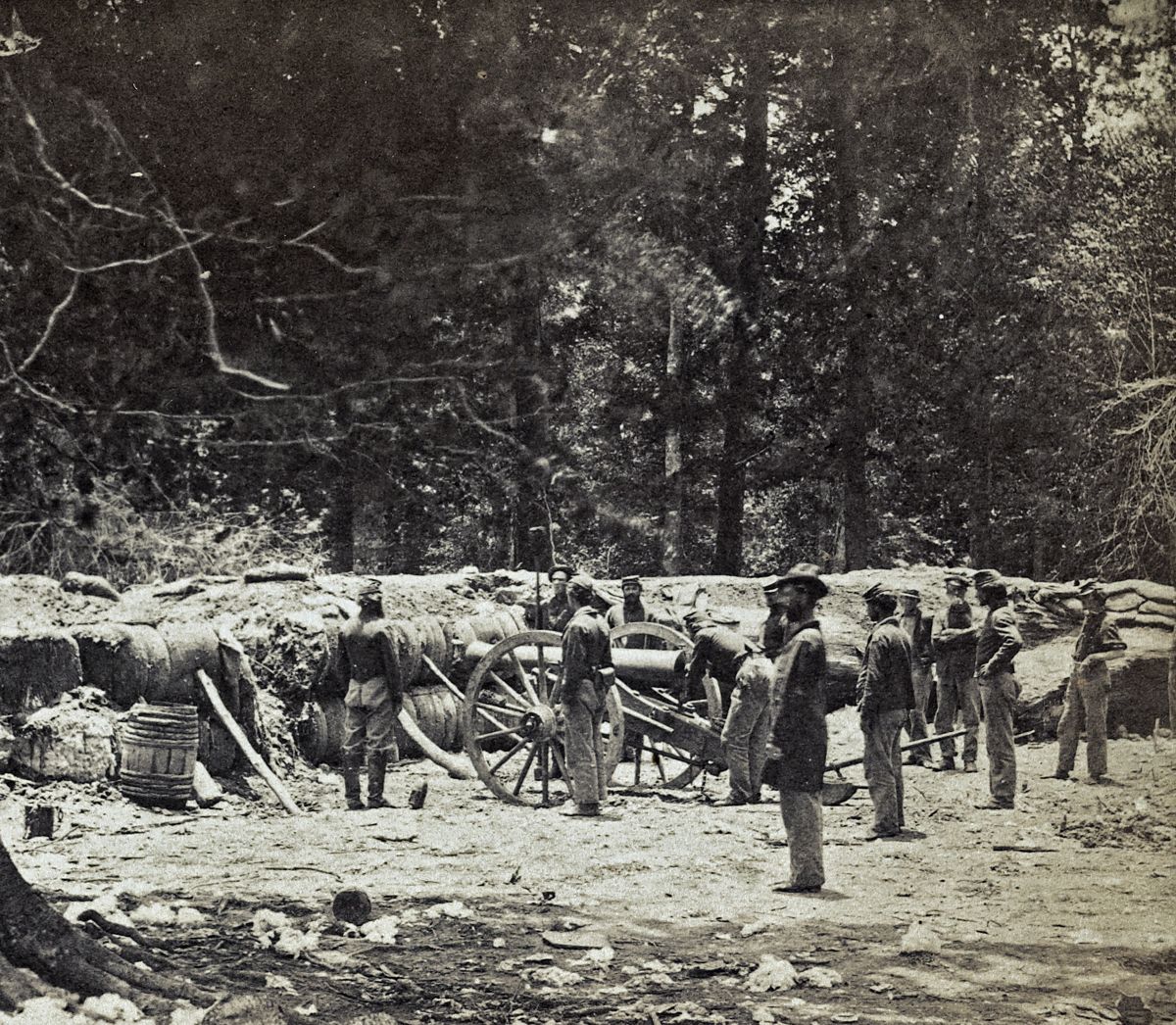
Captain Coxe’s Battery preparing to engage the Confederates at Port Hudson, during the siege. The cotton on the ground is from the bales used as a parapet to protect the gun crews. (Library of Congress)
shall look for the downfall of this place. The last two men shot yesterday—shot out in the trenches. There is more or less lost every day. Our regiment has been very lucky since we have been in the trenches. But the Rebs are death on the Negro regiments here. There is more in proportion of them killed than there is of the white soldiers. But in return, the Negroes are death on them. There doesn’t a Rebel get through near them alive. If there are deserters coming in, it makes no difference. They say that the Rebs will kill them if they get a chance & it is now more than fair for them to do the same to them, they think.1 There was quite a number of deserters came out yesterday. Some of them got shot in coming out. They said there would be more come out but they was afraid to for as sure as a man showed his
head, there is a dozen bullets let loose at it. Our men throwed letters over to them this morning telling them that Vicksburg had fallen. They wrote back asking them to throw over some tobacco for they had none & could not get any. The boys did throw over some & told
Original letter and cover written by Corporal Eben Peck Wolcott to his mother Susan H. Peck.
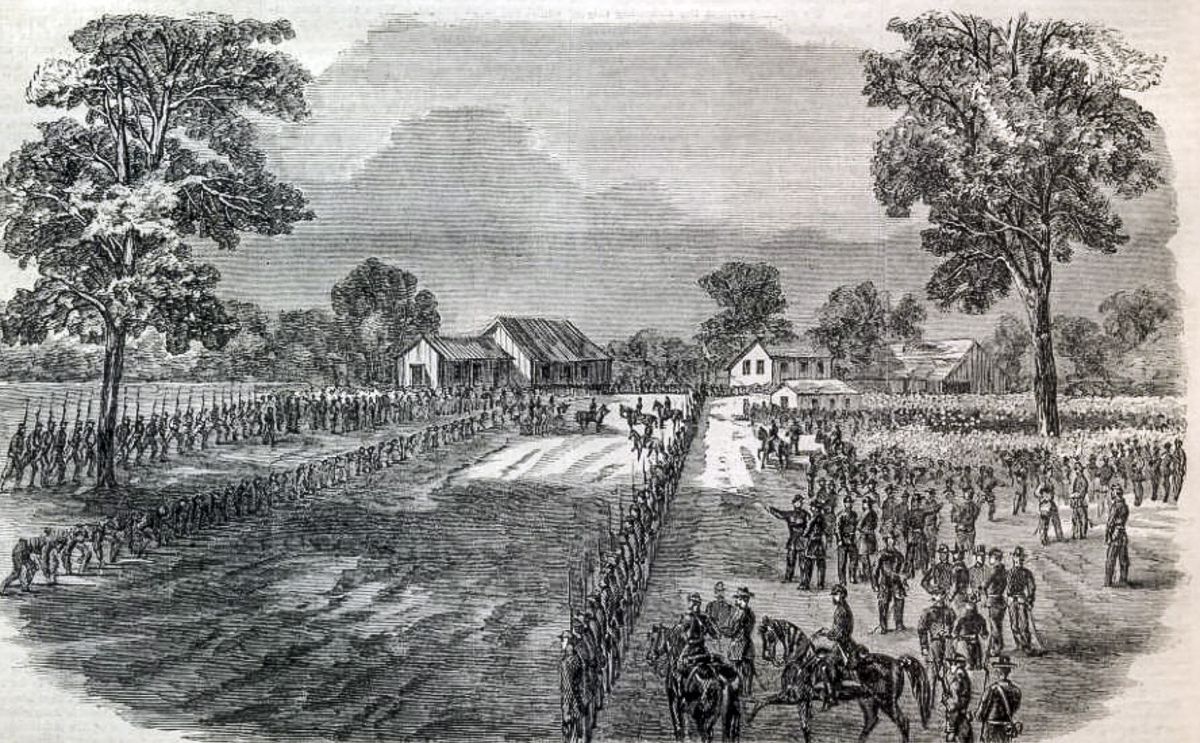
them if they would only come out, that they could get all they wanted. We have been waked up the last two mornings by their throwing a few shells rather close for comfort. This morning there was one struck a tree a few rods from us, cutting it entirely down and struck another glancing, hitting another & struck in the dirt a few feet from us. If it had not hit the tree, it might of come pretty close to some of us. July 9th. The great stronghold of Port Hudson has fallen. Yesterday morning early the Rebel General [Franklin] Gardner sent out & made a request that there might be a meeting of the officials of both sides to see about a surrender of the fort. No sooner than the flag-of-truce was raised & both sides had ceased firing, our men rushed up on the top of our works & the Rebs on the top of theirs. They talked a few minutes & then our men went up to their works (the outer sides) & in a few minutes it looked like a mass meeting or a cattle show for they fairly swarmed around their works. The Rebels fetched out corn beer2 & treated our soldiers. I traded canteens with one of them. They seemed to be overjoyed at the prospect of a surrender. The commissioners met at 9 a.m. I know not the conditions of surrender except the officers retain their side arms. Yesterday afternoon at 4 o’clock there was one brigade of our men marched into the fort.3 This morning the biggest part of the troops marched in at the right and left with the bands playing at the head. The Rebel troops was drawn up in line over near the river side—that being the only level place that I saw inside—and troops marched up in front of their troops so the two armies were a facing each other about three rods apart; our troops forming two lines of battle & theirs only one. After the lines formed, there was a company of marines fetched in a flag staff and it was raised right in the rear of the Rebel line upon a battery of theirs & the Stars & Stripes run up. And then our generals & their staffs rode up in front of the Rebel generals & staff. One of our aides rode up to [Maj. Gen. Franklin] Gardner and told him that all was ready. Gardner rode out, lifted his hat to our general, turned around, called for his troops to [come to] attention. They ordered them to ground arms. Then there was some conversation passed between the two generals that I could not hear & the surrender was over.
The surrender was not made to General Banks but to one of the other generals. I could not learn the name but probably shall see it in the papers. There is about 6,000 troops in the fort in all, between thirty-five and 40 hundred official soldiers at the breastworks. There was hardly a gun in the fort but what had been dismounted & in fact, our gunners would knock them over as fast as they could put them up. The most of the fortifications inside are natural, with a little artificial work added to them, making them very strong—ravines after ravines that was most impossible to get through. Our artillery created havoc with them & they was near starved out. The Rebels were very anxious to know what we was a going to do with them—if we was to parole them or keep them prisoners, and if so, where we would take them.4 The air is very impure in the fort. There has been a great [many] men, horses, and mules killed & have not been buried. If I can get a chance, I mean to go in again but they have a guard on and will neither let a man in or out unless he can steal in through the lines. That was the way I had to do today. I spent seven hours in the fort & did not go half way around it. It was so very warm in the middle of the day that I got pretty near tired out & had to come in. But I saw what I went to see—the surrender. A part of our regiment is out doing guard duty and the rest is still in the woods. You will get the news of the surrender long ere this reaches you & all the particulars with it so I will not try to tell any more. I think there is a prospect of our staying here a week yet and then probably we will start down the river. If I had of only been to home now, there would have been a good chance for me to of enlisted in the 6-month regiment and gone into Pennsylvania but I am not one of the lucky ones. I hear today that Arlo Wolcott of Norfolk was killed in the fight of the 14th of June. He was in the 49th Massachusetts Regiment. He was an orderly sergeant. I should like to know what luck Lee had met with in Maryland & Pennsylvania. I hear that some of the 2 years and 9 months men have volunteered to go into Pennsylvania. We got a small mail yesterday but I got none from home. I got one from Daniel after he got to St. Augustine & one from David Curtis. I wrote to him while at Brashear & one from Ettie Wolcott. She wanted to know what was the matter with you all. She had not heard from you
since she left Salisbury. Samuel was well when he wrote. If I have time, I must write him today for it has been some time since I have written him. I haven’t much time to write and therefore have to hurry it off rather faster than I would like to. I take notice that the sick are getting well fast. They have done remarkably well for the last day and a half. It is possible that I shall not write again very quick for I am thinking we shall begin our way home before many weeks. I am as well as ever at present. I don’t know as I have time to write more today. From your affectionate son, – E. P. Wolcott Endnotes: 1.
The two Negro regiments were the 1st and 3rd Louisiana Native Guards, who had been used by Banks in a futile assault on the Rebel works at Port Hudson on May 27, 1863. Most of these soldiers were recruited in New Orleans and were underprepared for the attack, but their enthusiasm impressed General Banks, who praised them afterward. Due to the chronic shortage of drinking water during the hot summer months and the severe drought, the Rebels made a weak beer with corn, sugar, and molasses, which was kept in barrels at their entrenchments. Though the surrender terms were hammered out and signed on July 8, 1863, Gardner requested that the official surrender not take place until the morning of the 9th. According to Edward
Cunningham’s book entitled The Port Hudson Campaign, 1862– 1863 (page 118), this delay was exactly what the Rebels wanted so that any who wished to try to escape during the night might do so, which many of them did by swimming downriver under cover of darkness. Sometime after the surrender, Banks made the decision to parole the enlisted men and non-commissioned officers who were allowed to go home. Banks erred in releasing the prisoners, however, because the paroles were approved only by Gardner who was himself now a prisoner-of-war. Declaring the paroles illegal, Jeff Davis ordered the men to report for duty after a brief furlough, and they were sent back into action. About half of the Rebel officers were sent to Johnson’s Island prison camp; the other half to the U.S. Customs House prison in New Orleans. [Source: The Port Hudson Campaign, 1862–1863, page 120.]
William J. Griffing has worked at the Department of Labor and the Department of Energy, and later as the ES&H Director at the National Renewable Energy Laboratory and Fermi National Accelerator Laboratory. Since his retirement in 2010, he has focused on preserving American history, mainly Civil War letters and diaries that remain unpublished in private collections. His transcribed Civil War soldier and sailor letters are found at: https://tinyurl. com/sparedshared. Updates on newly transcribed letters are available at: facebook.com/Griff.CWLetters. In 2024, he coedited a book titled A Great and Good Man with Jonathan A. White, which includes rare first-hand accounts of Abraham Lincoln, drawn primarily from about 15,000 letters he has transcribed since retiring.
Formal surrender of Port Hudson, drawn by J.R. Hamilton. (Harper’s Weekly, Vol. VII, No. 345, Saturday, Aug. 8, 1863)
Photographs from the Original Article


Captions and credits appear in the article text as originally printed.