
The Work Of The Very Devil Himself
By Stephanie Hagiwara · Originally published July-August 2025 · pp. 6–9
On July 2, 1863, about 6 p.m., during the Battle of Gettysburg, Penn., C.S. Gen. James Longstreet’s, Army of Northern Virginia, 15,500 men were driving U.S. Gen. Sickles’s Army of the Potomac, III Corps., 10,000 men out of Joseph Shelby’s Peach Orchard. Both generals considered the slight knob useful as an artillery platform to assault the Federal army.
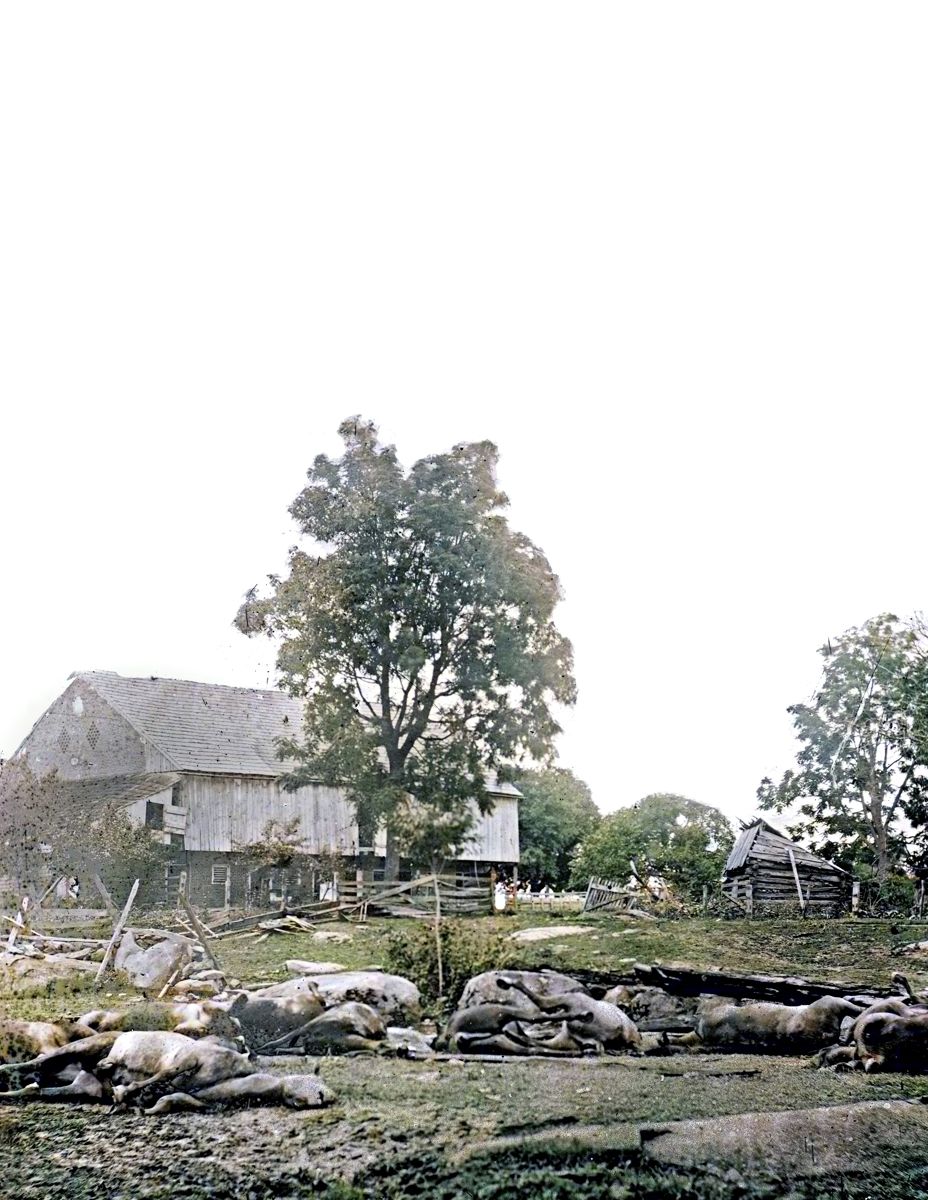
Reserve artillery came to support Sickles. The situation’s urgency required Lt. Col. Freedman McGilvery to position the reserve batteries without infantry to sustain them. About 4 p.m. U.S. captains 23-yearold Harvard graduate John Bigelow, 9th Mass. Battery, and 22-year-old Harvard student Charles A. Phillips, 5th Mass. Battery, arrived under fire to position their six 12-pounder smoothbore Napoleons each on the left center of Sickles command near a belt of woods. Two of Phillips’s gun horses were immediately killed.
View at Trostle’s barn where the 9th Massachusetts Battery was cut up at Gettysburg. (Library of Congress)
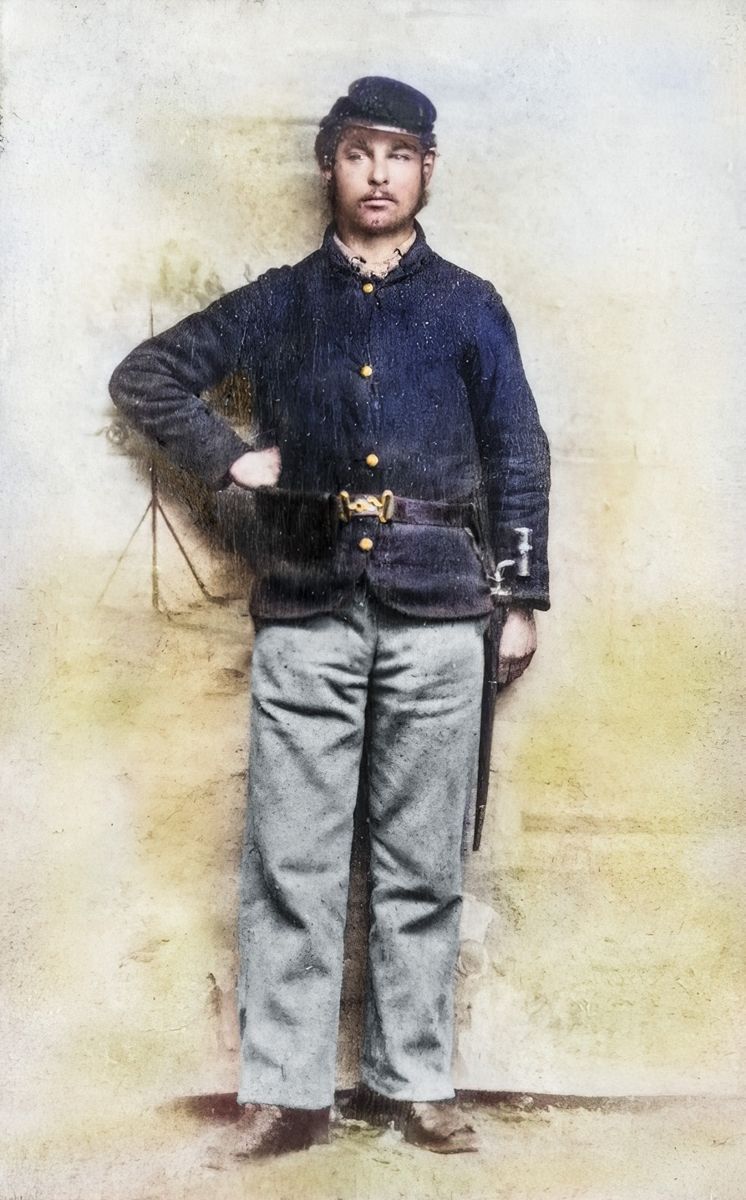
Days earlier, the 9th had been garrisoning in Washington, D.C. Bigelow, in February 1863, had been tasked with turning around the low morale and discipline of the 9th. Bigelow’s actions were not welcomed by all. Charles Wellington Reed, a 21-year-old bugler, described Bigelow as “a regular aristocrat … He is worse than any regular that ever breathed.” Reed, an illustrator/lithographer who drew what he witnessed, would concede as the battery improved that Bigelow’s “… strictness was to make the men know what he is.” Now, the 9th was shelling the Confederates’ 18 guns concealed amongst the trees. Gunner Augustus Hessie needed to drop flat to the ground to see the effects of his shots under the thick smoke. According to Reed, “such a shrieking, hissing, seething I never dreamed was imaginable, it seemed as though it must be the work of the very devil himself.”
“WE, THE GLORIOUS-YOUNG 9TH MASS-BATTERY IN SPLENDID ORGANIZATION AND FOR THE FIRST TIME IN AN ENGAGEMENT – STOOD THE GROUND AND WERE WILLING TO DIE FOR THE COUNTRY.” – U.S. CPL. AUGUSTUS
HESSE, 9TH MASS. BATTERY

The Federals switched to canister as C.S. Gen. Joseph B. Kershaw’s left flank closed in. A South Carolinian recalled, “O the awful deathly surging sounds of those little black balls as they flew by us, through us, between our legs, and over us! Many, of course, were struck down…” Nevertheless, it was not enough to stop the Rebel momentum. McGilvery ordered his last two batteries on the field back to Cemetery Ridge. “Drive on!” shouted Cpl. Benjamin Graham, 5th Mass. Battery. Not moving, Graham realized the five remaining horses of the limber team had been shot. Phillips, holding his horse’s reins in one hand and the other pulling the rope, joined his men, dragging the piece to save it. McGilvery ordered Phillips to place his three usable remaining guns east of Plum Run. The 9th continued to fire as they retreated by prolonge through ground spewed with large boulders. McGilvery galloping through the bullets, his horse shot four times to meet Bigelow at the fence corner and gate across the lane from Trostle’s Farm. McGilvery said, “there is not an infantryman back of you along the whole line from which Sickles moved out; you must remain where you are and hold your position at all hazards, and sacrifice your battery, if need be, until at least I can find some batteries to put in position and cover you. The enemy are coming down on you now.” The 9th was stunned. Bigelow weakly responded, “I will try to do so.” He positioned in a quarter circle Lt. Alexander Whitaker’s section to the left by Trostle’s Lane,
Bugler Charles Wellington Reed, Medal of Honor Awardee. Colorization ©2025 civilwarincolor.com. (Library of Congress)
Lt. Christopher Erickson in the center and Lt. Richard S. Milton in front of the heavy stone wall. Ammunition was stacked beside the guns. The four left and center guns were to fire “solid shot low, for a ricochet over the knoll.” C.S. Col. Benjamin G. Humpherys’s, 21st Miss. Infantry, 400 men appeared on the right front and skirmishers from Kershaw’s Brigade on the left front. According to Bigelow, “…the enemy opened a fearful musketry fire, men and horses were falling like hail.” The 9th blew away with canisters the Rebels that reached the cannon muzzles. Still, the crossfire was decimating Milton. Bigelow ordered the section to retreat if it could. The third piece weaved its way to the gateway before falling and blocking it. The piece’s gun crew worked to save it. The fourth piece’s crew knocked the top stones off the wall and drove the gun towards it, “the horses jumping and the gun … going over with a tilt on one side and then a crash of rocks and wheels” as it cleared the wall, recalled Reed. Bullets were flying in from the flanks. Confederates were “standing on the limber chests, and shooting down cannoneers,” who returned fire. Hand-to-hand fighting ensued. Discipline held the 9th in place. It was time to go. Bigelow ordered a retreat. The men escaped to the rear. All the horses in Whitakers’ fifth-piece team were shot. Whitaker, shot in the knee, would ride off the field, mortally wounded. Erickson was shot five times and fell dead near his right gun. Two bullets shot Bigelow, and he fell from his wounded horse. On horseback, Reed and Bigelow’s orderly came to support him. Bigelow told them, “to leave and get out.” Reed instead had the orderly lift Bigelow on his horse, “then taking the reins of both horses in his left hand, with his right hand supporting me in the saddle, took me at a walk [to the rear].
The 21st Miss. was getting ready to charge McGilvery’s new artillery line that varied in strength between six and 23 guns as batteries arrived and retired. The horses kicked, and Reed resisted with his saber efforts to take them prisoner. A Confederate officer told his men, “not to murder us in cold blood.” The Federals were waiting for the pair to cross the 400 yards of open ground before firing. Enemy shells were “breaking all around us.” An officer was sent “urging me to hurry, as he must commence firing.” Bigelow told him to “fire away.” The 9th’s stand delivered McGilvery “30 precious minutes” to position the “Plum Run” line. Dead or wounded were three of four officers, six of seven sergeants, 19 enlisted men, 80 of 88 horses, and four of their six guns. During the fight, Bigelow had fired three tons of ammunition, including 92 rounds of canister. Reed earned the Medal of Honor for his actions. Through the bursting shells from two fires, Reed shepherded the horses. The pair were greeted with cheers as they entered the Federal lines between two of Lt. Edwin Dow’s, 6th Maine Battery, actively firing guns. Bigelow wrote to Reed 32 years later that “the obligation still remains with myself.” Sources: •
• •
Baker, Levi W. History of the Ninth Mass. Battery. Recruited July 1862; mustered on Aug. 10, 1862; mustered out June 9, 1865, at the close of the rebellion: Lakeview Press, J.C. Clark Publishing Co., 1888. Pfanz, Harry W. Gettysburg–The Second Day: The University of North Carolina Press, 2011. Campbell, Eric. Gettysburg Seminar Papers, “We saved the Line From Being Broken” Freeman McGilvery, John Bigelow, Charles Reed, and the Battle of Gettysburg, 1996.
Stephanie is the
CivilWarinColor.com and C ivil W arin 3D. com . She also writes a column for H istoryin F ull C olor . com that covers stories of photographs of historical interest from the 1850’s to the present. Her articles can be found on Facebook,
Tumblr and Pinterest. Reed, Charles Wellington. “Forward into line, left oblique. Trot!” Ninth Mass. Battery moving into its first action, July 2, 1863. (Library of Congress)