
Burnside’s Invasion of East Tennessee: A More Accurate View of
By Terry L. Futrell · Originally published January-February 2025 · pp. 20–25
Burnside’s Invasion of East Tennessee: A More Accurate View of Troop Movements
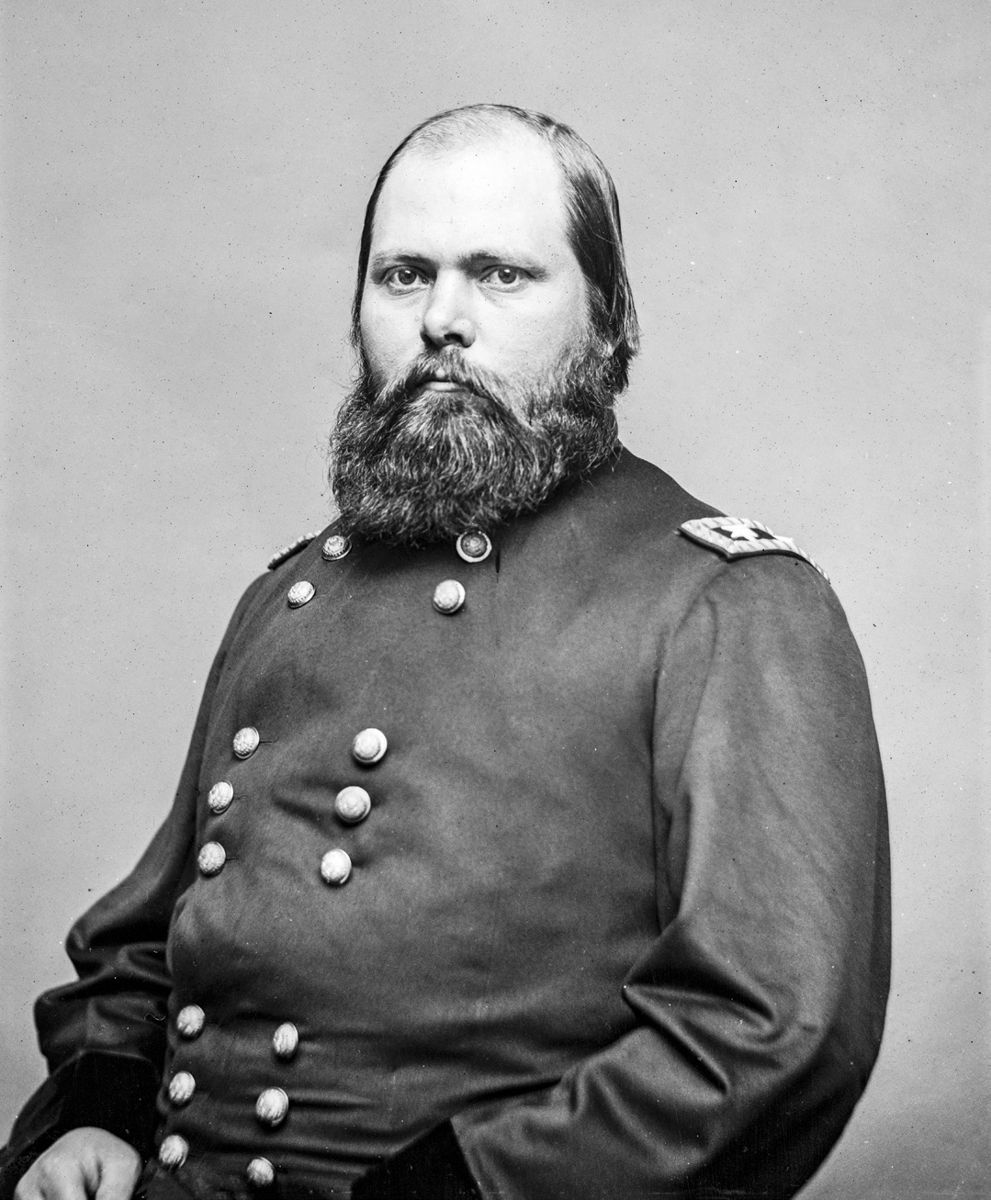
Gen. Ambrose E. Burnside. (NARA–526987)
Introduction
While much has been written about the advance of Maj. Gen. Ambrose E. Burnside’s Army of the Ohio into East Tennessee in late August 1863, many narratives are permeated with errors. Several previously overlooked primary sources offer a more precise and detailed portrayal of Union troop movements and actions during the 20day invasion that freed much of East Tennessee from Confederate control.
Invasion Overview Burnside communicated the planned invasion routes to Gen. George L. Hartsuff on August 20, 1863. Burnside’s plan entailed the convergence of Graham’s cavalry brigade and White’s infantry division at Jamestown, Tenn. Furthermore, Gen. Samuel P. Carter’s cavalry division, accompanied by General Burnside, and Gen. Milo S. Hascall’s infantry division, accompanied by General Hartsuff, would converge near Chitwood’s in Scott County, Tenn. Subsequently, the two merged columns would assemble at Montgomery in Morgan County, Tenn.1
on September 3, and for selected movements leading to the capture of Cumberland Gap on September 9.2
Fourth Division, Second Brigade Cavalry The 2d Brigade of General Carter’s Division, acting as the right flank of the invasion, departed from Glasgow, Ky., on August 18 and arrived at Ray’s Crossroads on August 20. Commanded by Col. Felix W. Graham, the brigade moved from Ray’s Crossroads on August 21 and camped near Marrowbone, Ky.3 Subsequently, they spent two days marching and camped four miles above Celina, Tenn., on August 23. The following day, the brigade advanced towards Jamestown, captured a Confederate detachment and crossed the Obey River. Passing through Livingston, on August 25, the brigade rode through Jamestown on August 27 and camped seven miles beyond Jamestown towards Montgomery.4 On August 28, Col. John W. Foster, senior officer, took command of the brigade from Graham.5 The brigade reached Montgomery, a mile north of Wartburg, on August 29 and camped within a mile of town.6 On August 30, General Burnside issued orders for Foster’s Brigade to advance five miles and camp at Schooler’s [Confederate Camp Schooler], the site of the Indian Tavern.7,8
Maj. Gen. George L. Hartsuff. (Library of Congress)
Invasion Routes Routes taken by Burnside’s five columns, from the westernmost to the easternmost, are summarized as follows. Routes are included for troop movements from the initiation of the invasion to Burnside’s triumphal entry into Knoxville
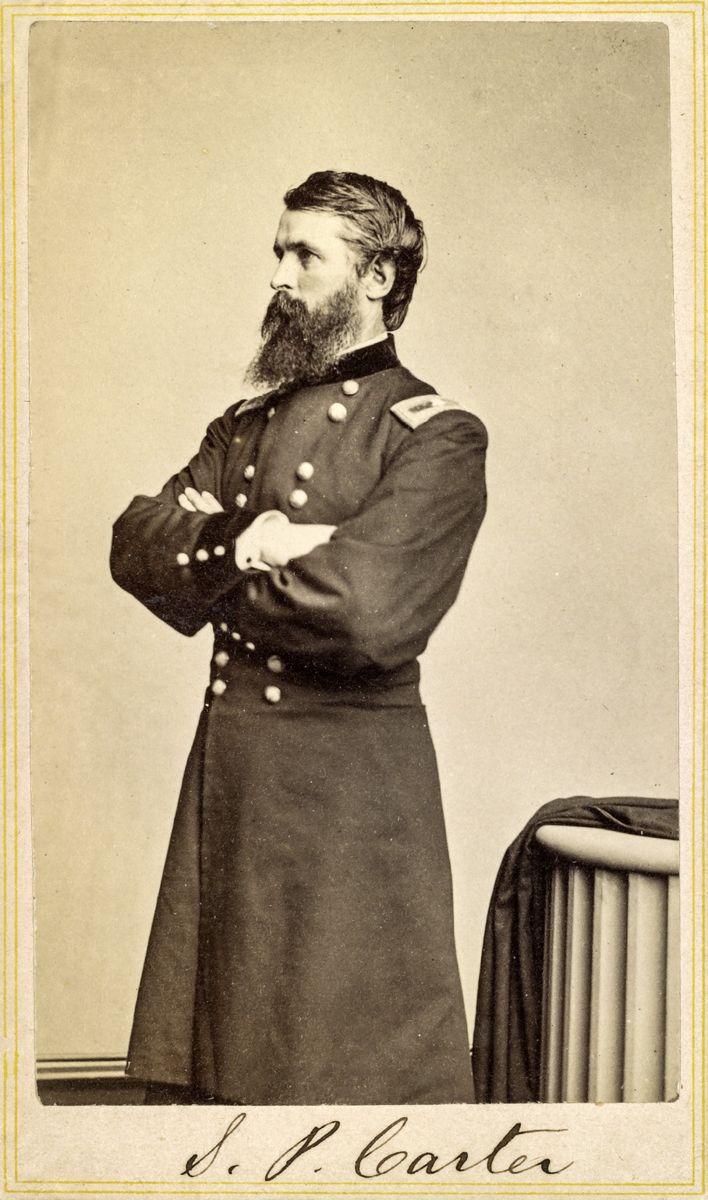
Gen. Samuel P. Carter. (Library of Congress)
Burnside privately met with Foster at Schooler’s on August 31 and directed him to move toward Knoxville through Winter’s Gap. Foster occupied Winter’s Gap that evening and received orders from Burnside early on September 1 to “push on into Knoxville and occupy the town.”9 Traveling through Winter’s Gap and crossing the Clinch River 15 miles from Knoxville, the brigade followed the historic Emery Road and occupied Knoxville late afternoon on September 1.10,11,
Second Infantry Division Gen. Julius White’s Division departed Columbia, Ky., on August 21 for Jamestown, Tenn., by way of Creelsboro, Albany, and Pall Mall.12 The division arrived at Jamestown on August 26 and remained there until ordered to move toward Montgomery on August 29, following Foster’s cavalry brigade.13,14 The division arrived at Montgomery on August 30, and was ordered by General Hartsuff to move forward to Emery Iron Works on September 1.15 The division then moved to Lackey’s on September 3, and ultimately reached Loudon on September 4.16
on August 23 and traveled three miles before camping.17 Hascall’s advance moved within 12 miles of Chitwood’s on August 25, arrived at Chitwood’s on August 26, then advanced to White Oak Creek [today’s town of Sunbright] on August 30.18 The leading brigade reached Montgomery on August 30, while the remaining brigade and reserve artillery reached Schooler’s on August 31. The division moved to Emery Iron Works on September 1, then through Clax Gap and camped near Poplar Creek on September 2. They subsequently moved forward to Lackey’s on September 3, crossing the Clinch River at Waller’s Ferry. Colonel Cameron’s Brigade moved to Lenoir’s Station on September 4, and Colonel Gilbert’s Brigade was ordered to Knoxville on the same day.19
Wolford’s Independent Cavalry Brigade
Brig. Gen. Julius White. (Library of Congress)
Third Infantry Division General Hascall’s Division left Stanford, Ky., on August 18, passed through Danville, and camped near Crab Orchard on August 19, and then arrived near Smith’s Ford on the Cumberland River late on August 22. They crossed the river
Col. Frank Wolford’s Brigade, which had been prepositioned at Somerset, divided into at least three detachments. On August 20, Wolford assigned 300 men to guard the arriving cattle herd at Somerset and then escort the herd to Chitwood’s.20 A dispatch from General Hartsuff on August 24 directed Wolford to move the main body of his force to Hartsuff’s camp location on the Cumberland River south of Somerset, leaving part of his brigade at their current positions in Somerset and Monticello. Hartsuff also specified that Wolford was to guard the general supply train. On August 28, Hartsuff communicated from Chitwood’s that the supply train and Wolford may not arrive at Chitwood’s by August 29 as expected.21 Hartsuff expected Wolford’s arrival at Schooler’s on September 1.22 On the following day, Hartsuff ordered
Wolford to move from Schooler’s to Big Emory with the train.23 Wolford’s brigade moved to Knoxville, Tenn., on September 7.
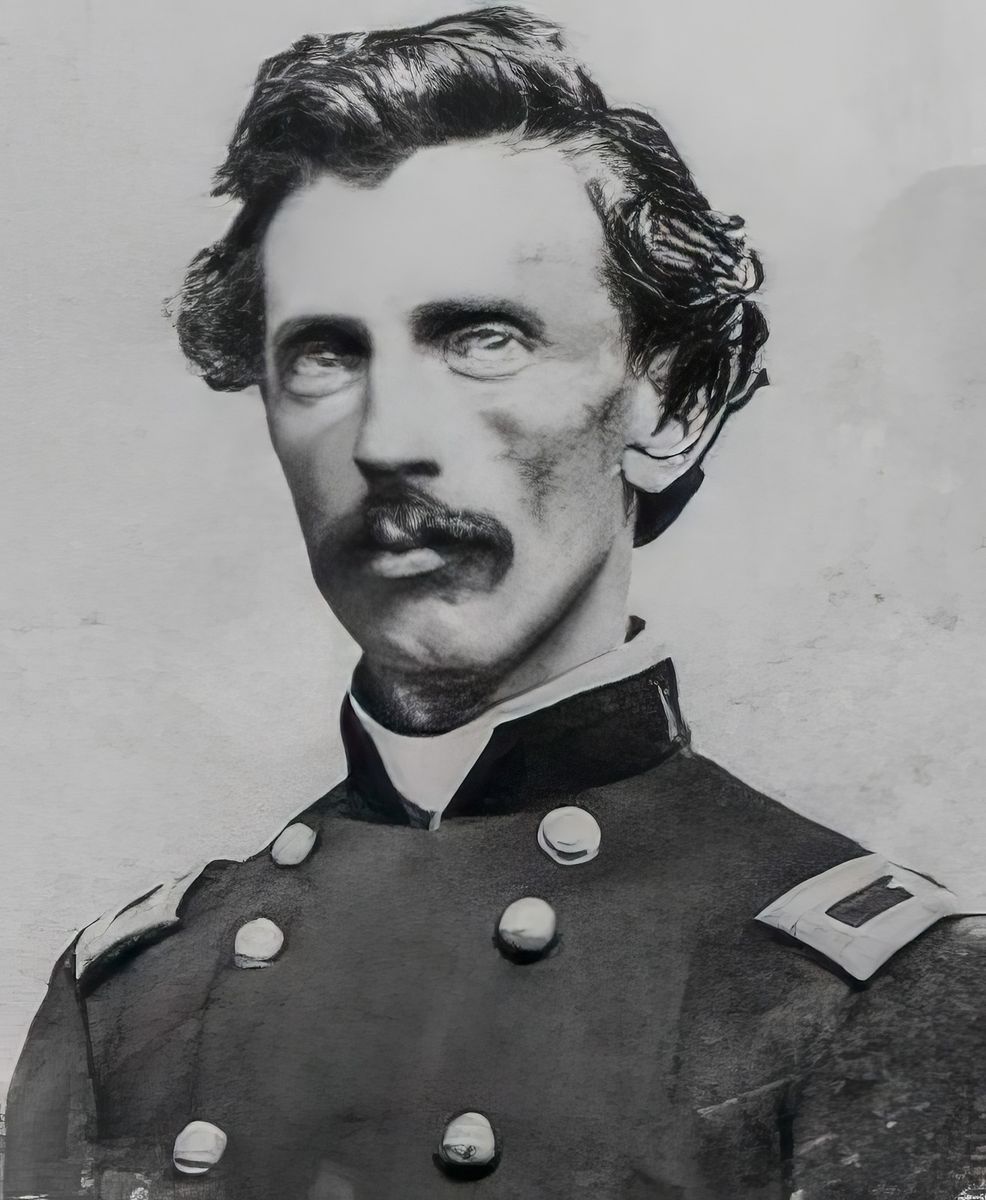
Col. Frank Wolford. (Library of Congress)
Fourth Division Cavalry General Carter’s column included General Burnside with his staff and bodyguard; the 1st Cavalry Brigade, commanded by Col. Robert K. Byrd; and the 3d Cavalry Brigade, commanded by Gen. James M. Shackelford.24 The column left Crab Orchard, Ky., on August 20 with Byrd’s Brigade in the lead and reached Mt. Vernon on the same day. The 1st Brigade was delayed at Mt. Vernon for a day to rearrange the wagon loads. The brigade resumed march on August 22, reached Rockcastle River in late evening, then moved on to six miles beyond London on August 23.25 At London, the 8th Michigan was detached from the 1st Brigade and directed to take the left-hand road to Williamsburg, while the rest of the brigade took the righthand road. The main body of Carter’s column had earlier taken the left-hand road, causing the 8th Michigan to fall behind the division train. Carter ordered the 8th Michigan to act as the rear guard, resulting in its separation from the remainder of the 1st Brigade until they rendezvoused below Chitwood’s in Tennessee. The 1st Brigade rejoined the main body of Carter’s column at Williamsburg on August 24.26 After Carter’s column crossed the Cumberland River at Williamsburg on August 24, the 1st Brigade (excluding the 8th Michigan) was detached and instructed to move on Big Creek Gap in Campbell County, Tenn. The brigade marched about six miles to a place called “Jones” in Kentucky.27 Meanwhile, on August 25, Carter moved the remainder of his column three miles westward and camped at the foot of Jellico Mountain. On August 26, the column crossed over Jellico Mountain and passed through the Marsh Creek
Valley before entering Tennessee north of Chitwood’s.28 One battalion of the 7th Ohio [belonging go Shackelford’s Brigade] under Maj. James McIntyre was placed in advance of Burnside’s command and held that position until they reached the railroad at Lenoir’s Station.29 At Jones, Colonel Byrd learned that the rebels had blockaded the road to Big Creek Gap. In response, he detached the 1st Tennessee to take a different mountain route to Jacksboro, Tennessee. On August 25, Byrd took the remainder of the brigade (112th Illinois, 45th Ohio, 15th Indiana Battery) westward over a little used pathway across the Jellico Mountains to rejoin the main force on the road from Williamsburg to Marsh Creek. Byrd reached the route to Marsh Creek and found that Shackleford’s Brigade had already arrived. The combined column traveled eight miles further and camped at a place called “The Well,” then reached Chitwood’s on August 26.30 Leaving Jones on August 25, the 1st Tennessee crossed into Tennessee on August 26, then crossed the Pine Mountains and camped. On August 27, the regiment crossed the Cumberland Mountains to Jacksboro, where they encountered a rebel force.31 They “put the enemy to rout,” killed and wounded many, and captured 48 prisoners. The 1st Tennessee then retired into the mountains and traveled the route from Jacksboro to Huntsville. The 1st Tennessee moved on toward Chitwood’s and turned the prisoners over at headquarters on the evening of August 28.32 The 1st Tennessee, as well as the 8th Michigan, rejoined the rest of the 1st Brigade, then countermarched and camped on New River.33,34 The next day, August 29, the 1st Brigade traveled from New River near Huntsville to Montgomery in Morgan County.35 Scott County, Tennessee, historian Esther Sharp Sanderson provided detailed information about the passage of Union troops over the Brimstone Road through Hamby Gap to Montgomery.36 By a process of elimination using credible sources, Byrd’s Brigade is the only one that could have traveled the Brimstone Road. Both potential routes of the 1st Brigade from New River to Montgomery are shown on the map in Fig. 1. Byrd’s Brigade left Montgomery on August 30, camped one-half mile from the Morgan-Roane County line, moved to Clax Gap on August 31, and occupied Kingston on September 1.37,38 Carter’s main column, including General Burnside and Shackleford’s Brigade, was located near Redmond’s in Scott County early on August 29, reached Montgomery on August 30, left Montgomery on August 31, reached Lenoir’s on September 2, and entered Knoxville on September 3. Shackelford left Knoxville on September 4 on an expedition to Cumberland Gap, arrived on September 6, and demanded unconditional surrender of Confederate General Frazer on September 7. General Burnside left Knoxville for Cumberland Gap with two regiments on September 7.39 Shackelford’s Union troops encircled Frazer on the south side of Cumberland Gap on September 7, and De Courcy arrived on the north side of the gap on September 8, effectively surrounding Frazer.40,41 General Burnside arrived on September 9 and gave Frazer an ultimatum to surrender or be assaulted.42
De Courcy’s Unattached Brigade
Acting on orders from General Burnside given at Crab Orchard, Col. John F. De Courcy formed an unattached brigade comprised of both infantry and cavalry to move on Cumberland Gap from the north.43 De Courcy left Crab Orchard with his infantry on August 25. The cavalry was unable to move due to lack of rations and forage.44 De Courcy reached camp near London on August 27 with his infantry and artillery, but his cavalry was still unable to move from Crab Orchard. De Courcy remained camped three miles north of London on August 28.45 At Laurel Bridge six miles south of London, De Courcy divided his force into three columns to move to Flat Lick. One column took the direct route through Barbourville, one took the old “State road,” and one flanked to the east through Manchester. The reunited column then crossed the Cumberland River at Cumberland Ford on September 7 and was in position to attack at Cumberland Gap on September 8.46,47 De Courcy requested General Frazer’s unconditional surrender.48 When cautioned by Shackleford on September 7 to prevent escapes from the gap, De Courcy’s response on September 8 was considered insubordinate by General Burnside. After Frazer surrendered on September 9, Burnside had De Courcy arrested.49,50
Map of Invasion Routes
The invasion routes of Burnside’s forces are shown on the map in Fig. 1. Troop movements are shown for the period covering the initiation of the invasion on August 20 to Burnside’s entry into Knoxville on September 3. The map also shows the correct location of the Indian Tavern, approximately four miles east of Montgomery in Morgan County on the road from Montgomery to Winter’s Gap.
Invasion Success Thinking he was surrounded by a much larger force, Frazer responded to Burnside’s ultimatum and surrendered Cumberland Gap on September 9 without a fight, ending the Confederate occupation of East Tennessee.51 1.
Endnotes
United States. War Department. The War of the Rebellion: A Compilation of the Official Records of the Union and Confederate Armies. Ohio State University, Serial 052, pp. 0094-0095. Accessed January 24, 2023. https://ehistory.osu.edu/books/officialrecords/052/0094. (Hereinafter referenced as Official Records). W. L. Sanford, History of Fourteenth Illinois Cavalry and the Brigades to which It Belonged (Chicago: R. R. Donnelley & Sons Company, 1898), 64. Foster, War Stories for My Grandchildren, 120-121.
Figure 1. Map of Burnside’s Troop Movements During the Invasion of East Tennessee.
Sanford, History of Fourteenth Illinois Cavalry, 57-59. Official Records, Serial 052, p. 0210, https://ehistory.osu.edu/books/official-records/052/0210. Sanford, History of Fourteenth Illinois Cavalry, 59. Official Records, Serial 052, p. 0242, https://ehistory.osu.edu/books/official-records/052/0242. Terry L. Futrell and Michael W. Nance, Civil War Sourcebook: Morgan County, Tennessee (Wartburg: Independently Published, 2019), 15. Foster, War Stories for My Grandchildren, 123. Sanford, History of Fourteenth Illinois Cavalry, 61. Foster, War Stories for My Grandchildren, 123. Official Records, Serial 052, p. 0094, https://ehistory.osu.edu/books/official-records/052/0094. Official Records, Serial 051, pp. 0576-0579, https://ehistory.osu.edu/books/official-records/051/0576. Official Records, Serial 052, p. 0208, https://ehistory.osu.edu/books/official-records/052/0208. Official Records, Serial 052, pp. 0292-0293, https://ehistory.osu.edu/books/official-records/052/0292. Official Records, Serial 051, pp. 0576-0579, https://ehistory.osu.edu/books/official-records/051/0576. “Civil War Letters of Lyman Beecher Hannaford,” accessed October 15, 2021, https://lymanbhannaford.wordpress.com/18-august-1863/. Official Records, Serial 052, p. 0169, https://ehistory.osu.edu/books/official-records/052/0169. Official Records, Serial 051, pp. 0576-0577, https://ehistory.osu.edu/books/official-records/051/0576. Official Records, Serial 052, pp. 0096-0097, https://ehistory.osu.edu/books/official-records/052/0096. Official Records, Serial 052, p. 0209, https://ehistory.osu.edu/books/official-records/052/0209. Official Records, Serial 052, pp. 0293-0294, https://ehistory.osu.edu/books/official-records/052/0293. Official Records, Serial 052, pp. 0318-0319, https://ehistory.osu.edu/books/official-records/052/0318. Official Records, Serial 052, pp. 0094-0095, https://ehistory.osu.edu/books/official-records/052/0094. B. F. Thompson, History of the 112th Regiment of Illinois Volunteer Infantry in the Great War of the Rebellion (Toulon: Stark County News, 1885), 82-85. Ibid., 85. Ibid., 86. Frances Andrews Tenney, War Diary of Luman Harris Tenney, 1861–1865 (Cleveland: Evangelical Publishing House, 1914), 85. R. C. Rankin, History of the Seventh Ohio Volunteer Cavalry (Ripley: J.C. Newcomb, Printer, 1881), 10. Thompson, History of the 112th Regiment of Illinois Volunteer Infantry, 87-88. Noah E. Howard, “Yankee Soldier’s Diary Recounts Civil War Action in Kingston,” Roane County News, October 21, 1974, 11. “Civil War Service Records, Union Records,” Digital images, Fold3, https://www.fold3.com/image/272/266058643. Thompson, History of the 112th Regiment of Illinois Volunteer Infantry, 88. Noah E. Howard, “Yankee Soldier’s Diary Recounts Civil War Action in Kingston,” Roane County News, October 21, 1974, 11. Ibid., 11. Esther Sharp Sanderson, County Scott and its Mountain Folk (Huntsville: Esther Sharp Sanderson, 1958), 194. Howard, “Yankee Soldier’s Diary Recounts Civil War Action in Kingston,” 12. Thompson, History of the 112th Regiment of Illinois Volunteer Infantry, 89. Official Records, Serial 051, pp. 0576-0579, https://ehistory.osu.edu/books/official-records/051/0576. Official Records, Serial 051, pp. 0593-0594, https://ehistory.osu.edu/books/official-records/051/0593. Official Records, Serial 052, p. 0473, https://ehistory.osu.edu/books/
official-records/052/0473. 42. Official Records, Serial 051, p. 0621, https://ehistory.osu.edu/books/official-records/051/0621. 43. Official Records, Serial 052, pp. 0207-0208, https://ehistory.osu.edu/books/official-records/052/0207. 44. Official Records, Serial 052, p. 0158, https://ehistory.osu.edu/books/official-records/052/0158. 45. Official Records, Serial 052, p. 0207, https://ehistory.osu.edu/books/official-records/052/0207. 46. Official Records, Serial 052, pp. 0434-0435, https://ehistory.osu.edu/books/official-records/052/0434. 47. Official Records, Serial 052, p. 0503, https://ehistory.osu.edu/books/official-records/052/0503. 48. Official Records, Serial 051, pp. 0617-0618, https://ehistory.osu.edu/books/official-records/051/0617. 49. Official Records, Serial 051, pp. 0596-0597, https://ehistory.osu.edu/books/official-records/051/0596. 50. Official Records, Serial 052, p. 0943, https://ehistory.osu.edu/books/official-records/052/0943. 51. Official Records, Serial 052, p. 0501, https://ehistory.osu.edu/books/official-records/052/0501.
After retiring from a successful career in engineering and technology management in the nuclear industry, Terry Futrell applied the same disciplined approach to researching the Civil War in East Tennessee. Together with Morgan County Historian Michael Nance, Terry published Civil War Sourcebook: Morgan County, Tennessee in 2019, which received an Award of Distinction from the East Tennessee Historical Society. In 2020, Terry published 101: The Men of Company H, 3rd Regiment East Tennessee Infantry (USA) that details the men of the company and their actions during the Civil War. Terry recently published in 2023 Civil War Sourcebook: The East Tennessee Campaign, which compiles and chronologically arranges official records and other primary sources to present a detailed account of communications and actions related to General Burnside’s invasion of East Tennessee.
l l
Chickamauga (Dalton) Civil War Show