
The Graphic War Kimmel & Fo st er : L i t h o g r a p h e r s , Part II
By Salvatore Cilella · Originally published September-October 2024 · pp. 30–33
The Graphic War Kimmel & Fo st er : L i t h o g r a p h e r s , Part II By Salvatore Cilella The Graphic War highlights prints and printmakers from the Civil War discussing their meaning and the printmaker or artist’s goals.
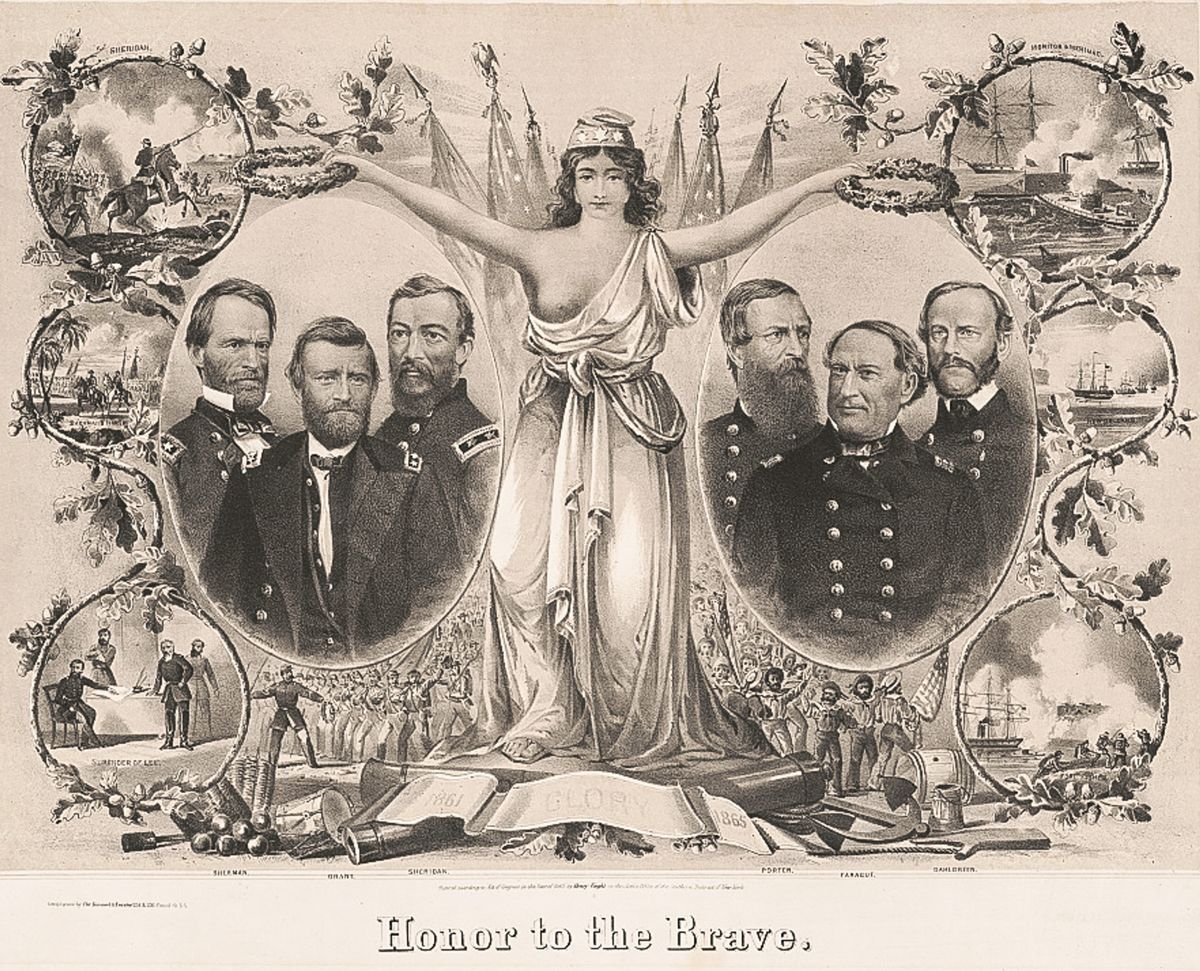
Allegorical prints filled with iconic symbols of authority, justice, liberty and freedom have existed since the invention of the printing press. Nineteenth century political upheaval in Europe and in America, drove printmakers to new heights (or in some cases, to new lows) in search of appropriate symbols to convey the meanings of their printed products to a semi-literate audience. Inanimate symbols were often nudged out by individuals such as Napoleon, Washington, and Lincoln. The presses at Kimmel and Forster must have been in overdrive in 1865. The two lithographers joined forces with printer Henry E. F. Voigt to publish at least three celebratory prints featuring the victorious Union forces. They were entitled respectively: Honor to the Brave, Heroes of 1848-65, and Columbia’s Noblest Sons. In Honor to the Brave, Kimmel and Forster give equal billing to the Federal army and navy. (Fig. 1, above) In the center, Columbia, or Liberty, with one breast exposed holds two “victory” wreaths over the trio of Generals Sherman, Grant, and Sheridan on the viewers left, and on the right, over Admirals Porter, Farragut, and Dahlgren. She wears the Phrygian hat, the ancient symbol that revolutionaries in
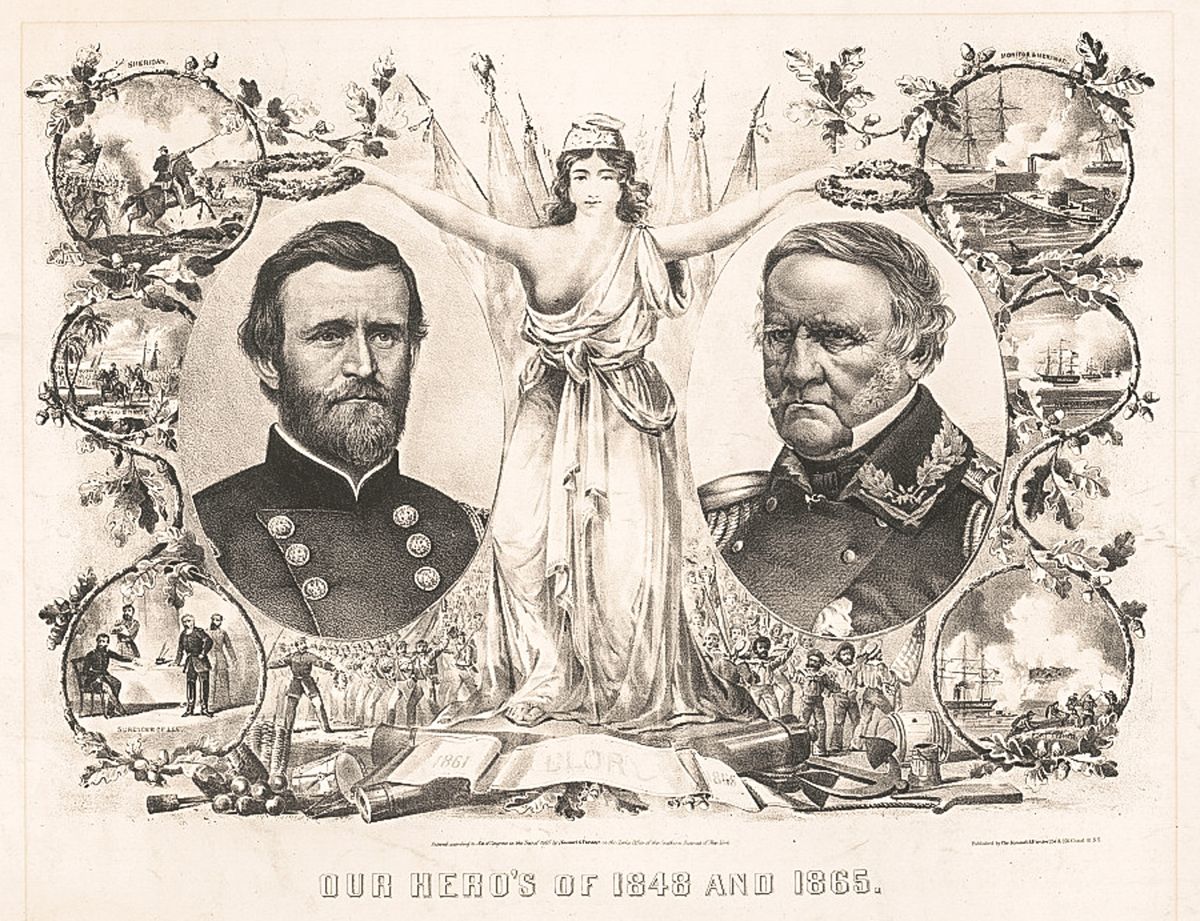
America and France used to represent liberty. At her feet are the symbols of war, cannon, a cannon ball, an anchor, a drum, all draped in a banner that reads “Glory, 1861-1865.” Celebrating soldiers are shown below vignettes featuring Sheridan’s famous ride at Cedar Creek, Sherman’s capture of Atlanta, and Grant’s shining moment at Appomattox. The naval heroes are remembered for (from top to bottom) the momentous battle of the Monitor and the Merrimac, the capture of New Orleans, and Porter’s successful attack on Fort Fisher in January 1865. The obligatory celebrating sailors are featured below the heroes. Our Heroes of 1848 and 1865 is more of the same. (Fig. 2) This time there are only two heroes: U.S. Grant and Winfield Scott. Everything else has remained the same as in Honor to the Brave. Grant, Sheridan, and Sherman have been replaced with a larger portrait of Grant, and the three naval heroes of the previous print have been replaced by a large portrait of Winfield Scott. With Columbia’s Noblest Sons the printmakers displayed little artistic license and or attempt at originality. (Fig. 3) In fact, the central figure of Columbia with her outstretched arms holding peace wreaths, looks absolutely bored. This time her right foot rests on a lion and she is fully clothed. At her feet, in addition to the sleeping British lion, are cannon, cannon balls, and an
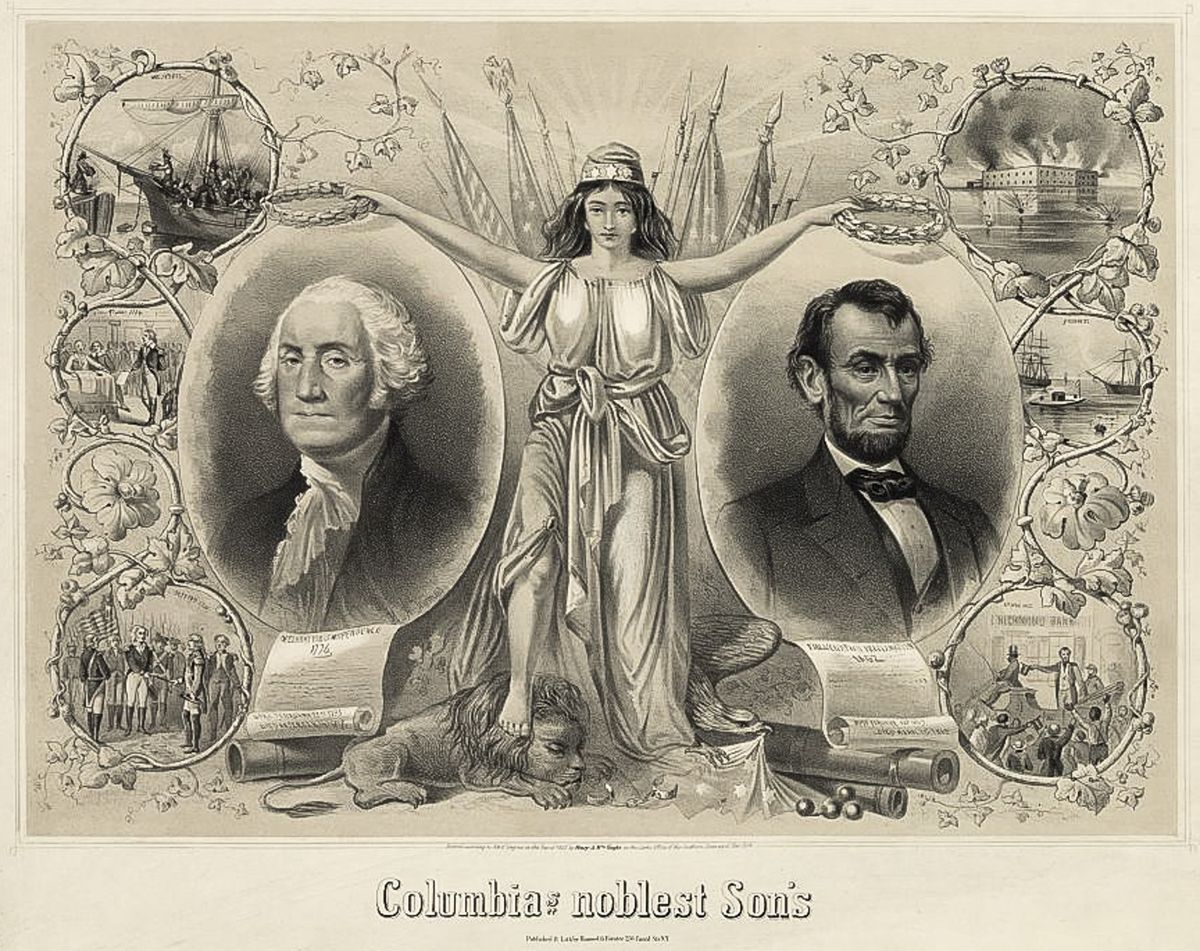
American bald eagle. Importantly, depicted at her feet are the broken bonds of slavery. She is flanked on the left with a vignette of George Washington and to the right, Abraham Lincoln. Beneath Washington, scrolling downward is the Declaration of Independence and below Lincoln is the Emancipation Proclamation. To Washington’s left are three vignettes commemorating, from top to bottom, the Boston Tea party, Washington’s resignation before Congress, and accepting the surrender of the British at Yorktown. Lincoln’s vignettes are more associative rather than depicting actual accomplishments. From top to bottom, the lithographers chose, oddly, to feature Fort Sumter, an encounter between an ironclad and two wooden ships (entitled “Progress”) perhaps evoking the battle of the Monitor and the Merrimac, and lastly Lincoln’s triumphant entry into Richmond, symbolizing emancipation. The Kimmel and Forster partnership lasted only five years, from 1865 to 1870. In 1871, Kimmel joined forces with Henry Voigt. It is unknown when the firm went out of business, but by 1878 they were printing etchings for artists. After 43 years in the museum field, Cilella devotes his time to collecting A merican prints and maps and writing. He has written extensively on Emory Upton:
Upton’s Regulars: A History of the 121st New York Volunteers in the Civil War (Kansas, 2009); a twovolume Correspondence of Major General Emory Upton, (Tennessee, 2017), received the 2017–2018 American Civil War Museum’s Founders Award for outstanding editing of primary source materials. He edited Upton’s love letters 1868-70 to his wife–Till Death Do Us Part (Oklahoma, 2020), and The Memoirs of Dewitt Clinton Beckwith of Upton’s Regulars (McFarland, 2023).
Vigilantes roamed the territories while Democratic legislators in various states took matters into the courts to adjudicate the constitutionality issue to no avail. Also, like today, misinformation reigned. Conscription in the War Between the States would ultimately be only partially successful. From page 29 calling the 1863 Military Act “a dangerous precedent of overreaching federal authority…” and an infringement of powers rightly resting with the states. “Unconstitutional” was the byword. Also angering them was Congress passing an 1864 amendment that limited to one year how long the commutation fee would prevent someone from being drafted. Another imposed loss of citizenship as a penalty for draft evasion or desertion. Again, historians have forgotten the same buy out option was present during the Revolutionary War where groups of men subjected to the draft could pool their resources to hire some to represent the group in the military. Things would become increasingly “downright ugly” as draft activities progressed as the war dragged on. Provost marshals and enrollers were demonized, including being labeled as spies and embezzlers, with their lives threatened. Gangs threw stones, women beat the enrollers about the head with brooms, and threw hot water; some enrollers were confirmed murdered for doing their appointed jobs. Those whose duties included tracking down deserters, the draft agents, fared no better. Others were effectively told to stop their work or else.