
Critic’s Corner
By Stephen Davis · Originally published September-October 2024 · pp. 60–62
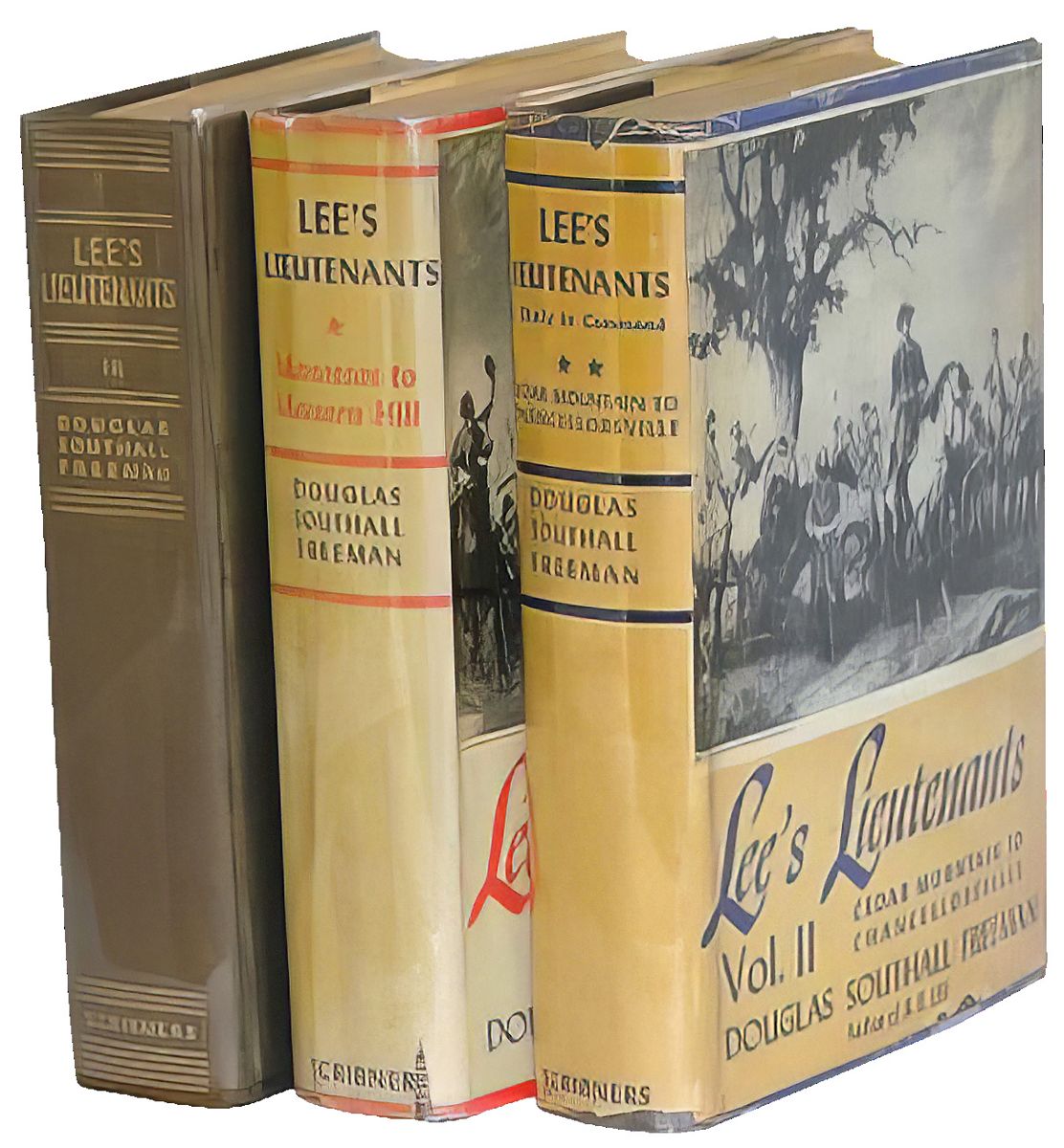
Douglas Southall Freeman, Lee’s Lieutenants: A Study in Command, 3 Vols. (New York, 1942-44)
ou might as well whistle “Old Dan Tucker” to a hurricane (to use the vernacular of the old time) as to write about the Army of Northern Virginia without consulting Lee’s Lieutenants.1
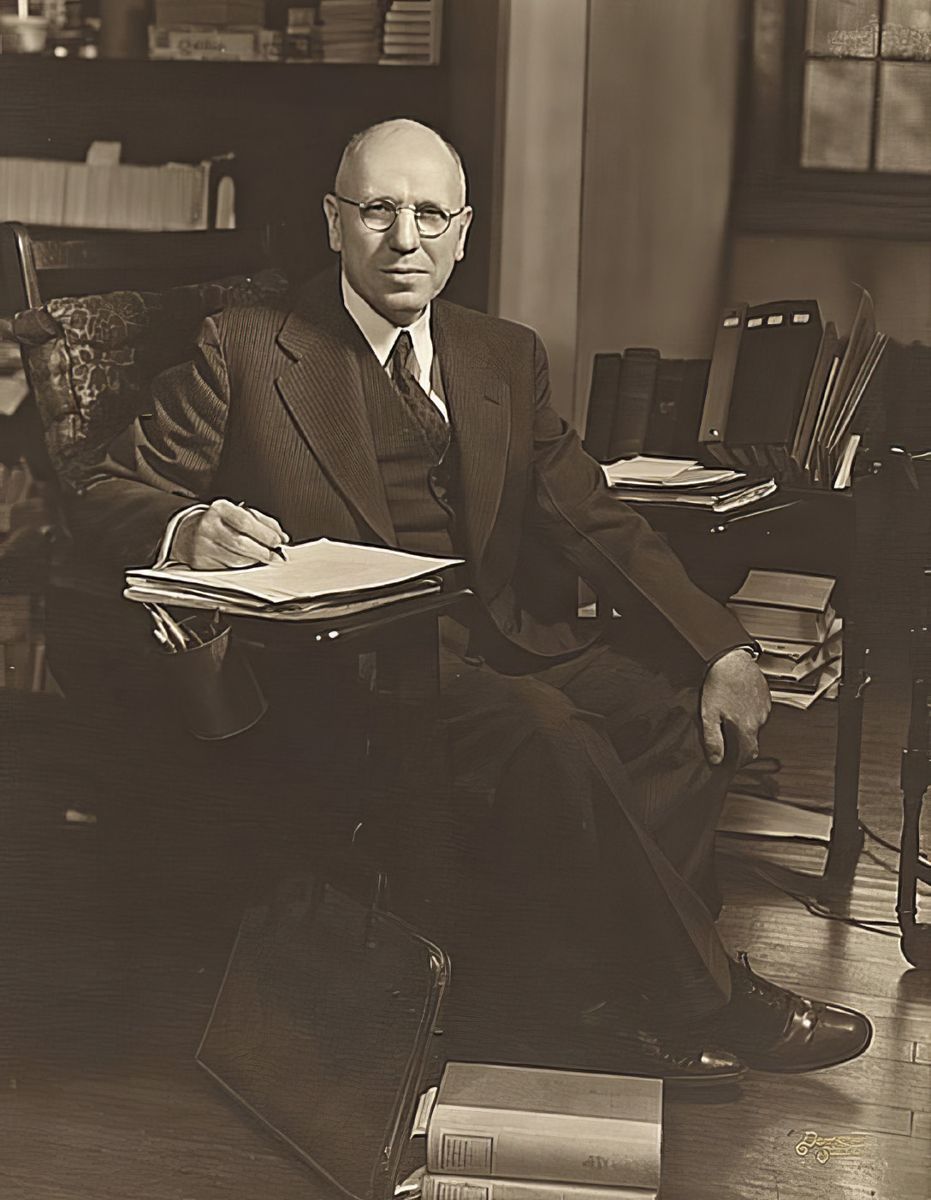
It’s not too much to say that its author, Douglas Southall Freeman, was born in 1886 to write such a book. A Virginian, Freeman was raised and educated in Richmond; his father was a Confederate veteran. After graduation from Richmond College in 1904, Freeman took his Ph.D. in history at Johns Hopkins. Unable to get a college teaching job, he joined the Richmond Times-Dispatch in 1909. In 1915, at age 29, Freeman became editor of the Richmond News-Leader, a position he held for 34 years until his retirement in 1949.2 Freeman’s journalistic vocation, however, could not cloak his passion for Confederate history. He edited Lee’s Dispatches to Jefferson Davis, 1862–1865 (1915) and wrote the definitive (yes, definitive) four-volume biography of Lee (published 1934-35), for which he won the Pulitzer Prize.3 Then he topped it all off with Lee’s Lieutenants: A Study in Command (three volumes, 1942, 1943, and 1944).4 The work was immediately popular. A reviewer in TIME asserted that “Dr. Freeman has written some of the most lucid accounts of military history in U.S. literature.” A critique in the New York Times Book Review hailed Volume Three of Lee’s Lieutenants as “one of the greatest individual achievements in the field of military biography.” Stephen Vincent Benet, Pulitzer Prize-winning author of John Brown’s Body (1928), praised Dr. Freeman’s talent for describing his soldiers as “figures in a great fresco, sharply drawn, superbly characterized.” Another reviewer applauded Freeman’s ability to depict Lee’s officers as human; “they have their temperaments, jealousies.”5 Freeman rounded out his stellar career with a six-volume study of George Washington, published 1948-54, the last number of which appeared after his death from a heart attack on June 13, 1953.6 With its first volume appearing just months after America’s entry into World War II, Lee’s Lieutenants attracted the readership of U.S. military officers. Eisenhower, Nimitz, McArthur, Patton, Bradley—all read Freeman’s work and praised it. General Bradley read sections of it before D-Day; Admiral Nimitz read Lee’s Lieutenants a half-hour every night.7
In his Foreword, Freeman speaks of his trilogy as “a labor of eight years”; he began in June 1936. He makes clear that this work is not a history of the Army of Northern Virginia, but an account of its leading generals. Eighty years after its publication, Lee’s Lieutenants still beckons reading—a daunting exercise given its 2,244 pages. (Even a one-volume abridgment by Stephen W. Sears, published in 1998, runs 852 pages.)8 A charming feature at the start of each volume is a gallery of the major Confederate officers playing a significant role. Indeed, “Dramatis Personae” is the name Freeman gives this section, as in Volume One he limns eight generals (each with a full-page photograph), followed by shorter sketches of another two dozen officers. For each of the octet, the author hints at his strengths and weaknesses. The latter particularly stand out. Beauregard lacks a sense of logistics; Harvey Hill has “an exceedingly sharp tongue”; Johnston clashes with the President; Jackson’s faltering in the Seven Days leads one to wonder “whether he can work in harness.” The author is even attuned to his generals’ appearances: Ewell is “bald, pop-eyed and long-beaked,” resembling “a strange, unlovely bird.” Volume One, Manassas to Malvern Hill, our focus in this article, contains 43 chapters; three deal with Manassas.
“Gen’s. R.E. Lee and J.E. Johnston / D.J. Ryan, Savannah, Ga.” Lee holds a pen and appears to be writing on a piece of paper. Photograph taken during Lee’s farewell tour of the South, this photo was sold to raise funds for the Lee Monument in Richmond, Va. (Library of Congress)
There, the tension between what was assumed at Confederate headquarters and the actual situation on the morning of July 21 is demonstrated by Freeman’s use of twin columns (e.g., Ewell was thought to be advancing when he was holding still). The Federals held the advantage in the battle’s opening hours. But then (I love this) “those traitorous war gods, Chance and Blunder, who had fought all morning against the Southerners, turned on the Federals.” “The Confederates, sounding the weird cry of the Southern fox hunters,” charged and swept the field. Afterward, Beauregard, though the battle’s victor, was sent west, Freeman explains, due to his “injudicious correspondence” with the press after the battle, his fractious relations with Johnston, and irreconcilable differences with C.S. Secretary of War Benjamin. “His star had waned.” That left Johnston in charge of the army, a man, Freeman observes, whose “thin lips were as capable of smiling as of sneering.” The author’s descriptions of other officers are just as provocative. Longtreet: “Although his slight deafness probably contributed to make his slow and unimaginative conversation largely a laconic and reluctant succession of ‘Yes’ and ‘No,’ he had seemed to enjoy a social glass. In poker he had acquired some renown.” Above the battlefield and encampments, Freeman writes as a military magister. March-impeding mud is “the ancestral foe and eternal concomitant of war.” On the morning of May 31, the start of Seven Pines, “by perverse misfortune,” Longstreet took the wrong road and thus began the series of snafus that delayed and ultimately derailed Johnston’s attacking battle. When it was all over, at the cost of more than 6,000 casualties, Confederates had won “a square mile or so of woodland, two abandoned lines, ten guns, some 6,000 small arms, a handful of prisoners and miscellaneous loot.” More, Johnston gave the cause a huge gift when he received wounds to his shoulder (musket ball) and chest (shell fragment). Even Joe admitted this: “the shot that struck me down is the very best that has been fired for the Southern cause yet.” Lee, of course, took command the next day and forged a record for his army that stands prominent in the history of the war, aided by his illustrious lieutenants. Freeman gives a long chapter to Stuart’s ride around McClellan, June 12-15. Almost 200 pages are devoted to Jackson’s Valley Campaign; “that is not thought to be a misplacement of values,” he explains, given Stonewall’s legendary exploits against Banks, Milroy and Fremont. With a force that never exceeded, if indeed it reached, 17,000 men of all arms, he had cleared the enemy from the greater part of the Shenandoah. What was far more important, he had used this small force so effectively that he had forced President Lincoln to change the entire plan for the capture of Richmond. At the end of the campaign, the author asks questions about the effectiveness of Jackson’s cavalry and artillery, and of Stonewall himself. “Was Jackson wise and successful in his handling of his officers?” he asks; “the answer must be in the negative.” (That’s Freeman for you!) A somber element of Lee’s Lieutenants is seeing the army’s officer corps diminished and depleted by the trials of war. As the high command lost officers through “constant and heavy attrition—by death, by disabling wounds, by intemperance and by incompetence,” General Lee struggled unceasingly to find capable replacements. “The connecting thread of this book,” the author explains, “well might be that of the effort to create and to maintain competent senior officers.” It is through the eyes of these officers that we trace the course of the war in Virginia. Freeman explains that his viewpoint is not so much that of Lee, “but that of the men executing his orders or making decisions for themselves.” The Seven Days, of course, are given much attention: twelve chapters, 170 pages. In assessing the generals’ performance, Freeman is both judicious and unsparing. “It was the high command that had failed” at Mechanicsville. “All the Federals had been called upon to do was to wait for the Confederates to come into range and then to mow them down.” As was his practice, after Gaines’ Mill the author evaluated the generals’ performance. “In the praise of the camps, highest honors went to Hood and his fine regiments”—it was the charge of Hood’s Texas Brigade that had cracked the Yankee line. Gregg, Trimble, Winder, Garland, Iverson: all are assessed for their roles that bloody day. The lawyer Maxcy Gregg, for instance, “had given an unequivocal answer to the question whether he would make a soldier.” In Chapter XXXIII, “Magruder Stays Up Too Long,” an “anxiously awake” John B. Magruder fails to pursue the retreating enemy, fearing he is about to be attacked on June 29. Then Magruder envisions launching his own assault on enemy lines (that had already been abandoned). Knowing this, Lee playfully expressed hope that “Magruder would not injure the two engineers of Longstreet’s Division who already had crossed the river and had entered the fortifications.” It is here also that one sees a rarity: Freeman takes a (fleeting) look at McClellan, at least “the Federal commander’s gross overestimate of the forces opposing him.” Freeman analytically approaches one of the campaign’s big questions: why was Jackson so slow in joining the fight at Gaines’ Mill, June 26? He concludes that after the rigors of the Valley, Jackson succumbed to “physical exhaustion and the resulting benumbment of a mind that depended much on sleep.” After the campaign, those lieutenants who had been found wanting Lee quietly removed, seeing to their transfer elsewhere. The excitable Magruder was sent west. Huger, a “do-nothing General,” was also shipped out. The deaf Holmes had proven listless; once during an engagement, as his staff frisked about, he calmly remarked, “I thought I heard firing.” Needless to say, Lee saw to his transfer as well. Mechanicsville, Gaines’ Mill, and Savage Station are all recounted; the slaughter at Malvern Hill is termed “a tragedy of staff.” Freeman sums up the Seven Days thus: “The strategic aim of the campaign had been achieved despite bad co-ordination, worse tactics and the worst imaginable staff work. Richmond had been saved.” But at what cost? C.S. casualties June 25-July 1 totaled 20,141 KWM (against McClellan’s 15,849). Volume One closes with the Seven Days. Complementing the text are twenty-nine artfully drawn maps by John T. Draper of Richmond. The author concludes with a look ahead. “All was well, but…but…John Pope was threatening to advance down the Orange and Alexandria Railroad against Jackson.” The stage was set for Volume Two. Reading Lee’s Lieutenants, one is mindful of Freeman speaking in his Foreword of his trilogy as “a labor of eight years” (1936–1944). Few achievements in Confederate historiography can match it. “One of the epic works on the Confederate armies,” David J. Eicher writes of the series in The Civil War in Books. His judgment that “these exhaustively researched and brilliantly written volumes deserve to be read by all Civil War students”9 stands as one of the most ringing endorsements I’ve ever seen. I don’t need to add anything more. Endnotes
Douglas Southall Freeman, Lee’s Lieutenants: A Study in Command, 3 vols. (New York: Charles Scribner’s Sons, 1942-44). David E. Johnson, Douglas Southall Freeman (Gretna LA: Pelican Publishing Company, 2002), 15, 31, 57, 78, 85, 110, 325. Douglas Southall Freeman, ed., Lee’s Dispatches: Unpublished Letters of General Robert E. Lee, C.S.A. to Jefferson Davis and the War Department of the Confederate States of America 1862– 1865 (New York: G. P. Putnam’s Sons, 1915); Douglas Southall Freeman, R. E. Lee: A Biography (New York: Charles Scribner’s Sons, 1934-35). Volume One: Manassas to Malvern Hill (1942); Volume Two: Cedar Mountain to Chancellorsville (1943); Volume Three: Gettysburg to Appomattox (1944). Stuart W. Smith, Douglas Southall Freeman on Leadership (Shippensburg PA: White Mane Publishing Company, 1993), 5-8. Keith D. Dickson, Sustaining Southern Identity: Douglas Southall Freeman and Memory in the Modern South (Baton Rouge: Louisiana State University Press, 2011), 132, 260. Ibid., 283; Johnson, Freeman, 350. Stephen W. Sears, ed., Lee’s Lieutenants: A Study in Command (New York: Scribner, 1998). David J. Eicher, The Civil War in Books: An Analytical Bibliography (Urbana: University of Illinois Press, 1997), 333.
Stephen Davis has been writing about the Civil War for a long time—“since Jesus was in third grade,” he contends.
He served as General Editor for The Reminiscences of General M. Jeff Thompson (Morningside, 1983), and from 1985 to 2005 worked as Book Review Editor for Blue & Gray Magazine. He is author of Texas Brigadier to the Fall of Atlanta: John Bell Hood (2019) and Into Tennessee & Failure: John Bell Hood (2020). With Bill Hendrick he wrote The Atlanta Intelligencer Covers the Civil War (2022). His next book, Confederate Triumph Volume One: 1861, begins his counterfactual narrative of how the South won the war. It will be out this summer. Steve and his lovely wife Billie reside in Cumming, Ga.