
A Trove of General Rawlins Material Comes to Light
By Juanita Leisch Jensen · Originally published September-October 2024 · pp. 12–17
Vision and Valor The War Through Women’s Eyes By Juanita Leisch Jensen
T “No One Can Count Up the Value of These Things”
he last (July/August) “Vision and Valor” column began with the assertion, “There are few things an army and its soldiers need more than arms and ammunition .” One of those “few things” is food; the subject of this article. It is a most persistent and consistent need; as every soldier needs (or certainly wants) food every day. Raw materials must be procured, processed, and cooked. Unlike other needed things that can be procured and then warehoused indefinitely, those handling food face the additional complication of fighting time before the raw materials, processed food, or cooked portions spoil. Thus, getting the raw material is only a means to an end; getting cooked food to soldiers when and where they need it is the true challenge.
Raw Materials
The first step is to secure fresh and raw materials, which were most commonly produced on family farms. It is a popular myth that women (or at least ‘ladies’) focused solely on the ‘sphere of domesticity’ and knew little about activities outside the wardrobe, kitchen, or parlor. That was not the world of farm wives. We found women everywhere in the field, … driving the reapers, and binding, shocking, and loading the grain-an unusual sight to our eyes. … By-and-by, we came to observe how skillfully they drove the horses around and around the wheatfield, diminishing more and more its periphery at every circuit, the glittering blades of the reaper cutting wide swathes with a crisp, crunching sound, that it was pleasant to hear. … we said to ourselves, ‘ They are worthy women, and deserve praise … like the help-meets God designed them to be, they have girt themselves to the work of men, and are doing it famously. Good wives! good women!’ The raw materials from the operation mentioned above may or may not have made their way to the military. Still, the following incident provides a specific example of a woman providing raw materials to the military.
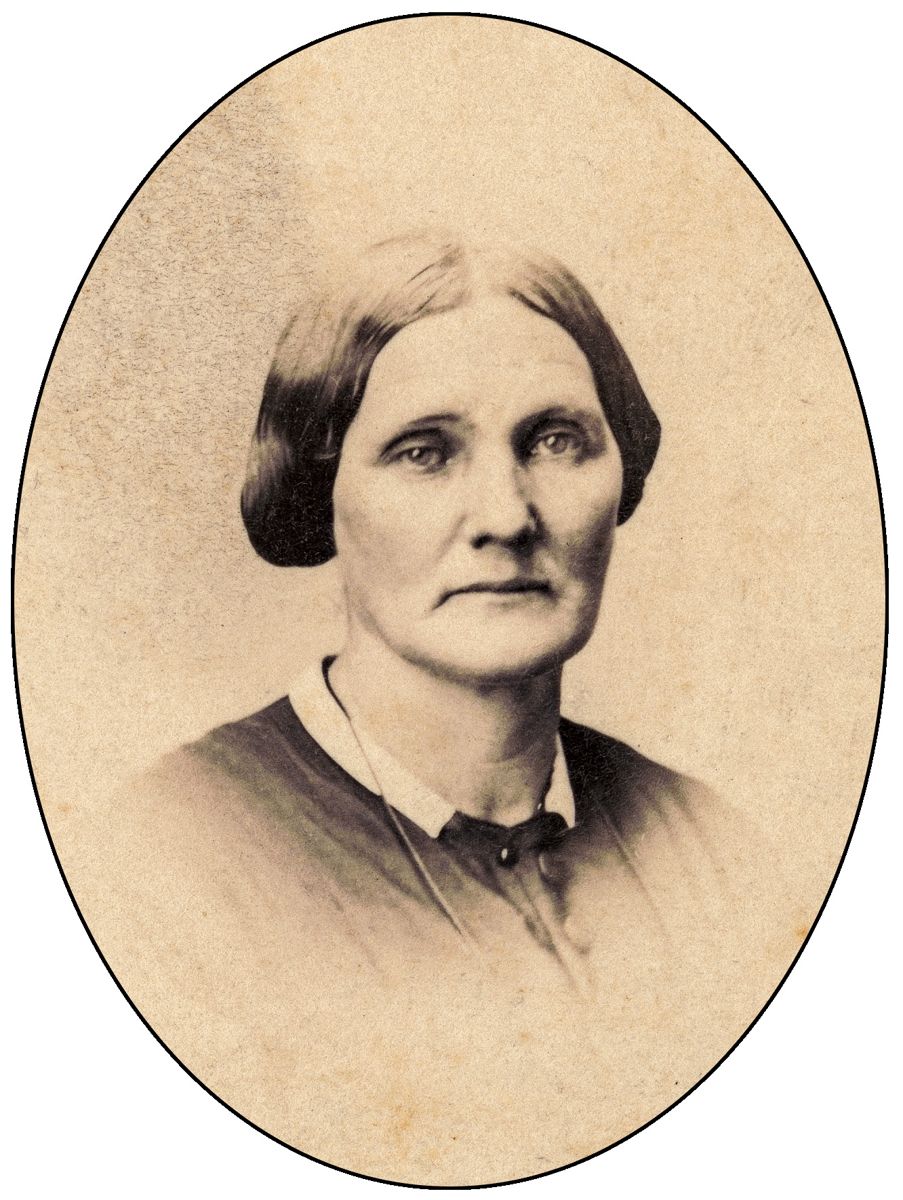
Mother Mary Ann Ball Bickerdyke. (Library of Congress)
At the time of the incident related here, Mother Mary Bickerdyke was a Field Agent for the United States Sanitary Commission supporting hospitals in and around Memphis, Tenn. When military supply channels failed to provide unadulterated milk and fresh eggs for “her” patients, Mother Mary Bickerdyke promised that, given a 20-day furlough, she could secure sufficient milk and eggs to meet the soldiers’ needs for an entire summer. Challenged to fulfill her promise, and warned she could not be provided with any sort of refrigerated transport, she set off for Chicago where she spoke at public meetings.
She ticked off her wants with mock ferocity, warning that she was a farm woman from way back, with a keen eye for a good milker and a good layer. She wanted nothing else. … boys down there in Memphis [were] trying to get well on chalk and water. Were they saving their prize milkers for the county fair? Would they rather have a blue ribbon than save some boy’s life? …Before her twenty days’ leave of absence was ended, Mrs. Bickerdyke was on the return route to her hospital, forming a part of a bizarre procession of over a hundred cows and one thousand hens, … General Hurlbut … gave up … President’s Island … a stretch of land so elevated that it is above the highest stage of water. Contraband were detailed to take charge of them … and until the hospitals were broken up … there was an abundance of milk and eggs for their use. It is in the process of providing cooked meals to soldiers when and where they needed it that many women found ways to be of service. Cornelia Hancock grew up in a Quaker family in Salem, N.J. Like the men of her family, she wanted to find a way to help the war effort. Despite being rejected by Dorothea Dix for service as an Army nurse, she traveled to Gettysburg shortly after the battle hoping, and finding, some way to help: From the pallid countenances of the sufferers, their inarticulate cries, and the many evidences of physical exhaustion … it was swiftly borne in upon us that nourishment was one of the pressing needs of the moment and that here we might be of service. … I sat down with a loaf in one hand and a jar of jelly in the other: it was not hospital diet but it was food, and a dozen poor fellows … turned their eyes in piteous entreaty, anxiously watching my efforts to arrange a meal. There was not a spoon, knife, fork, or plate to … the task of dividing that too well-baked loaf into portions that could be swallowed by weak and dying men. … I had the joy of seeing every morsel swallowed greedily by those whom I had prayed day and night that I might be permitted to serve. While Cornelia Hancock worked outside any formal organization, many others found roles in working through organizations like the United States Sanitary Commission and the United States Christian Commission. Records of the USCC exist, but not in the massive quantity of USSC records: Within a week after the battle of Antietam there were dispatched to that field by the Sanitary
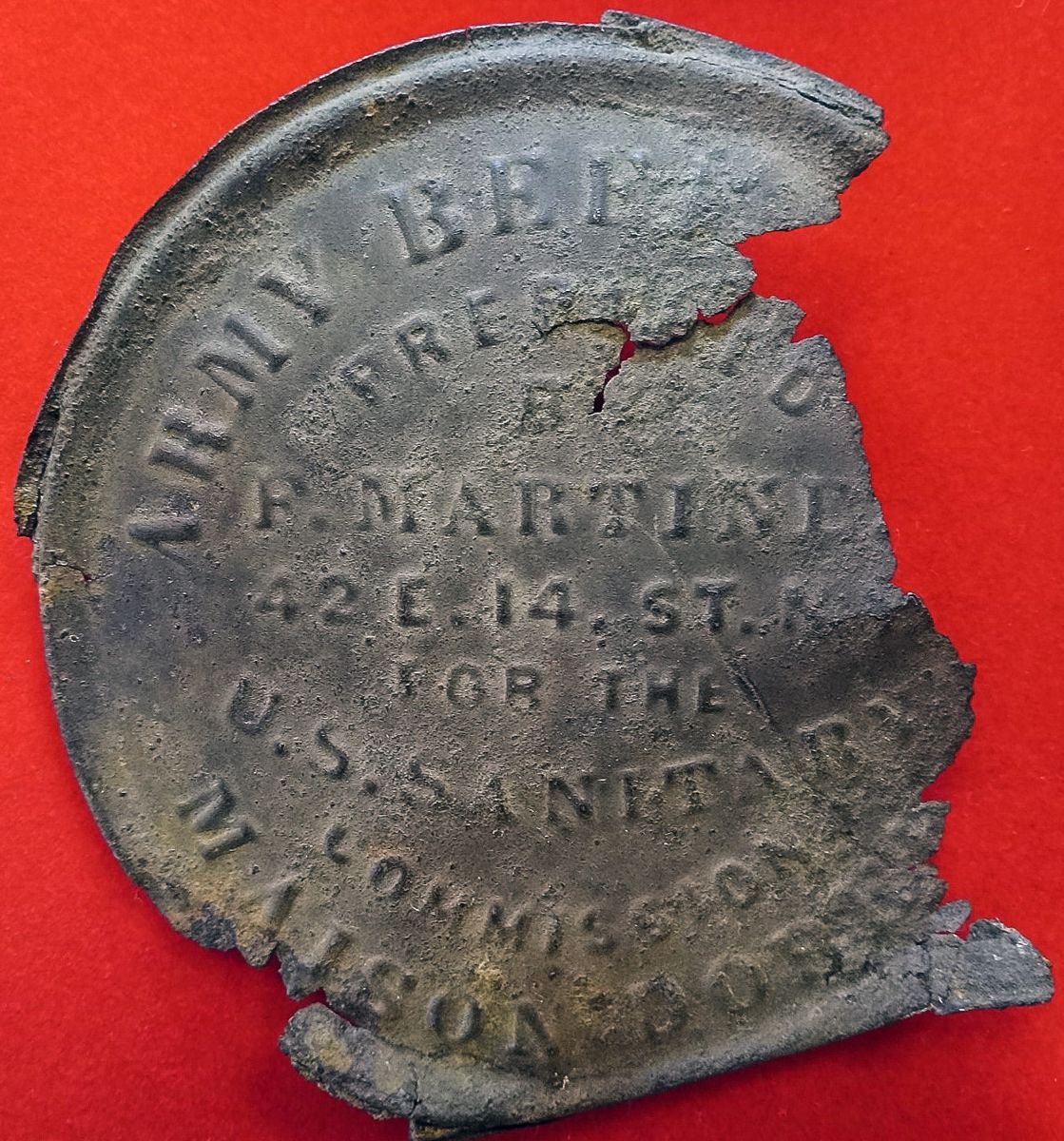
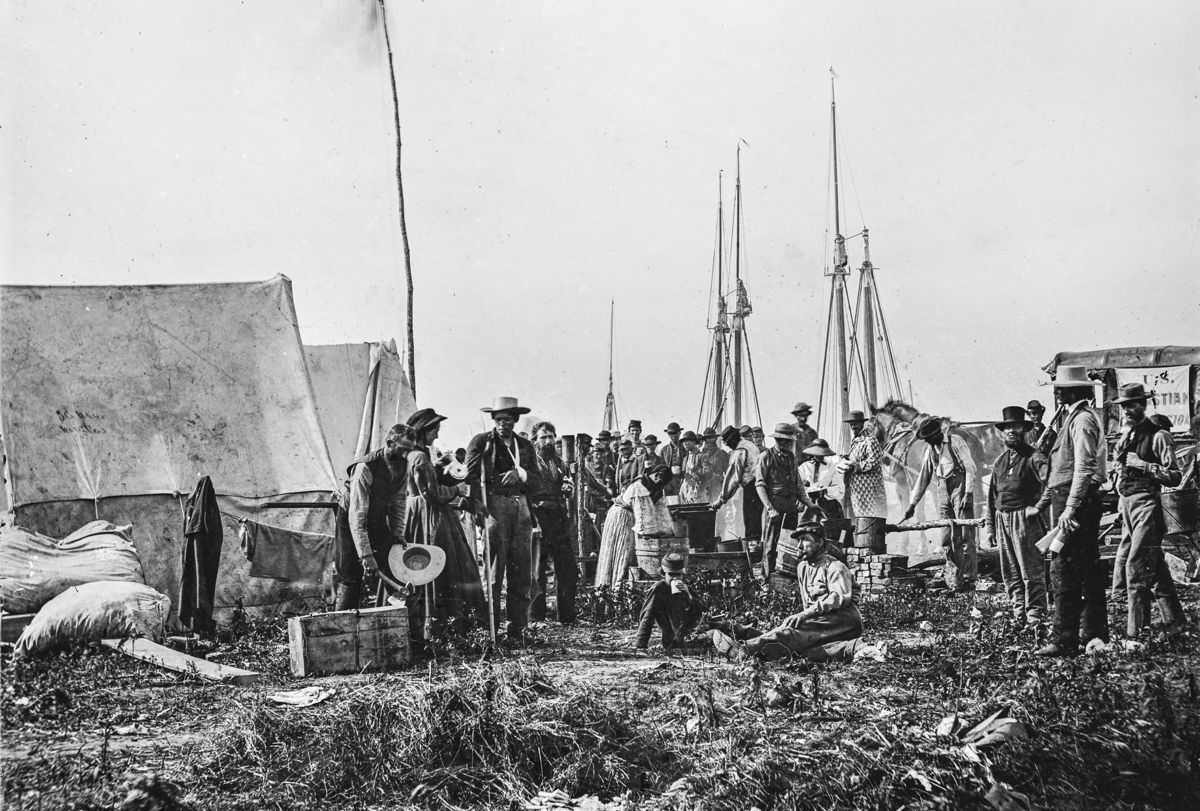
Commission and distributed by its Agents, the following articles : … three thousand one hundred and eighty-eight pounds farina; two thousand six hundred and twenty pounds condensed milk; five thousand pounds beef stock and canned meats; three thousand bottles wine and cordials, and several tons of lemons and other fruit, crackers, tea, sugar, rubber cloth, tin cups, and hospital conveniences. [emphasis added] Recounting her own experiences after the Battle of Gettysburg, Georgeanna Woolsey explained where and how the United States Sanitary Commission “filled the gaps” We stopped two miles from town, to find that, … just where the Government left off, the Commission had come in. There stood their temporary lodge and kitchen … surgeons told the men that if they could make their way to the cars, they would be taken to Baltimore … Once the men have the Surgeons’ permission to go, they are off; and there may be an interval of a day or two days, should any of them be too weak to reach the train in time, during which these poor fellows belong to no one, the hospital at one end, the railroad at the other, … The Sanitary Commission knew this would be so … and coming in, made a connecting link between these two ends… hundreds of fellows hobbled along as best they could, … for hours, slowly toiling, and many hired farmers’ wagons… and were jolted down to the railroad. Think of the disappointment of a soldier, sick, body and heart, to find, at the end of this miserable journey, that his effort to get away, into which he had put all his remaining stock of strength, was useless; that “the cars had gone” or “the cars were full;” … and that he must turn all the weary way back again or sleep on the roadside till the next train “tomorrow!” Think what this would have been, and you are ready to appreciate … relief and comfort … (Library of Congress)
Some women were given official positions working in military hospitals. Jane Wooley was appointed a Superintendent of Nurses at the Union Hospital in Alexandria, Va. Speaking of herself in the third person, she explained her duties: … the Superintendent [of Nurses] received a few words of instruction as to her position and its duties. … her serious business was to see that the women-nurses did their duty, and that the Special Diet was everything that it ought to be. She was required to know what quantity and quality of raw material was furnished by the commissary steward; to see that this was properly cooked, properly distributed from the diet kitchen, received in good order in the wards, carefully divided there; that each patient got, … the exact articles ordered for him by the ward medical officer; in short, she was expected to follow the food from the commissary storehouse down the sick man’s throat.
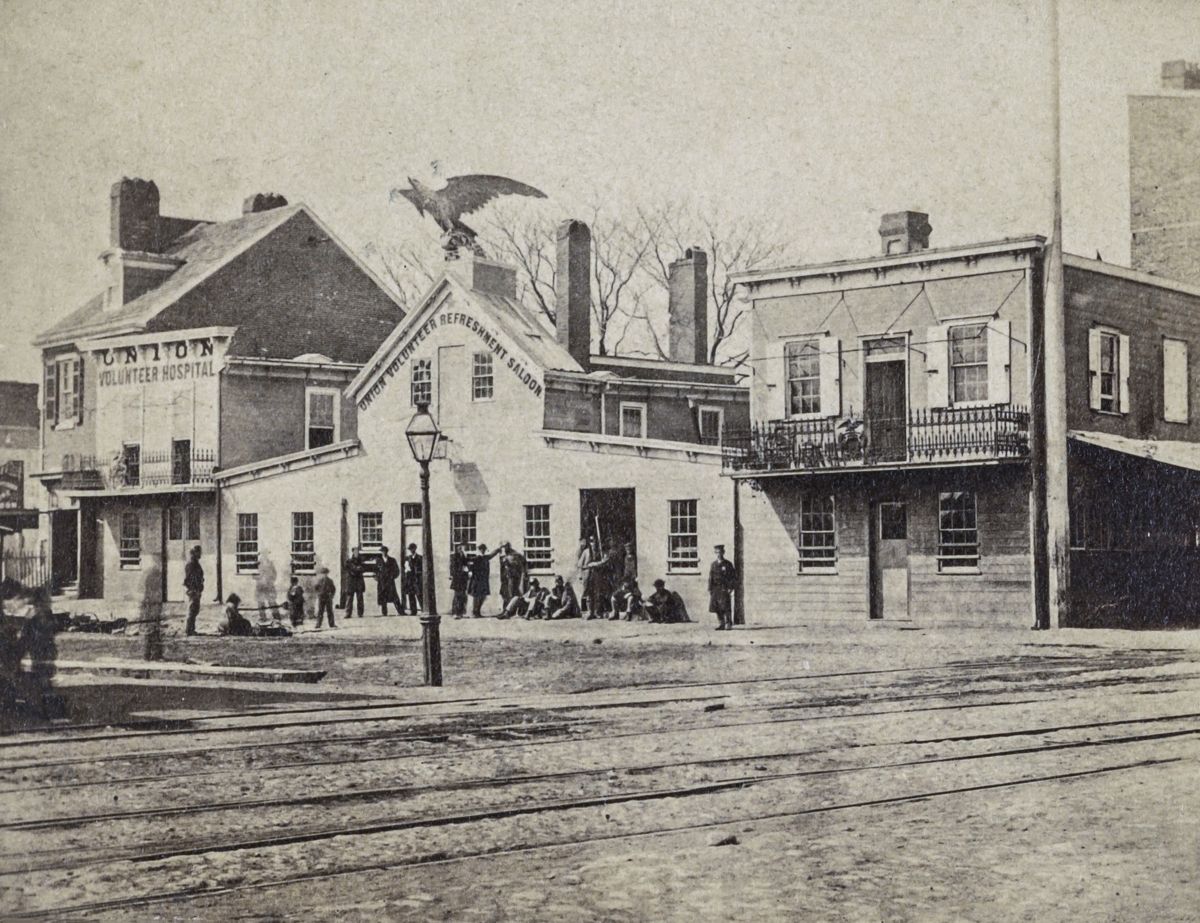
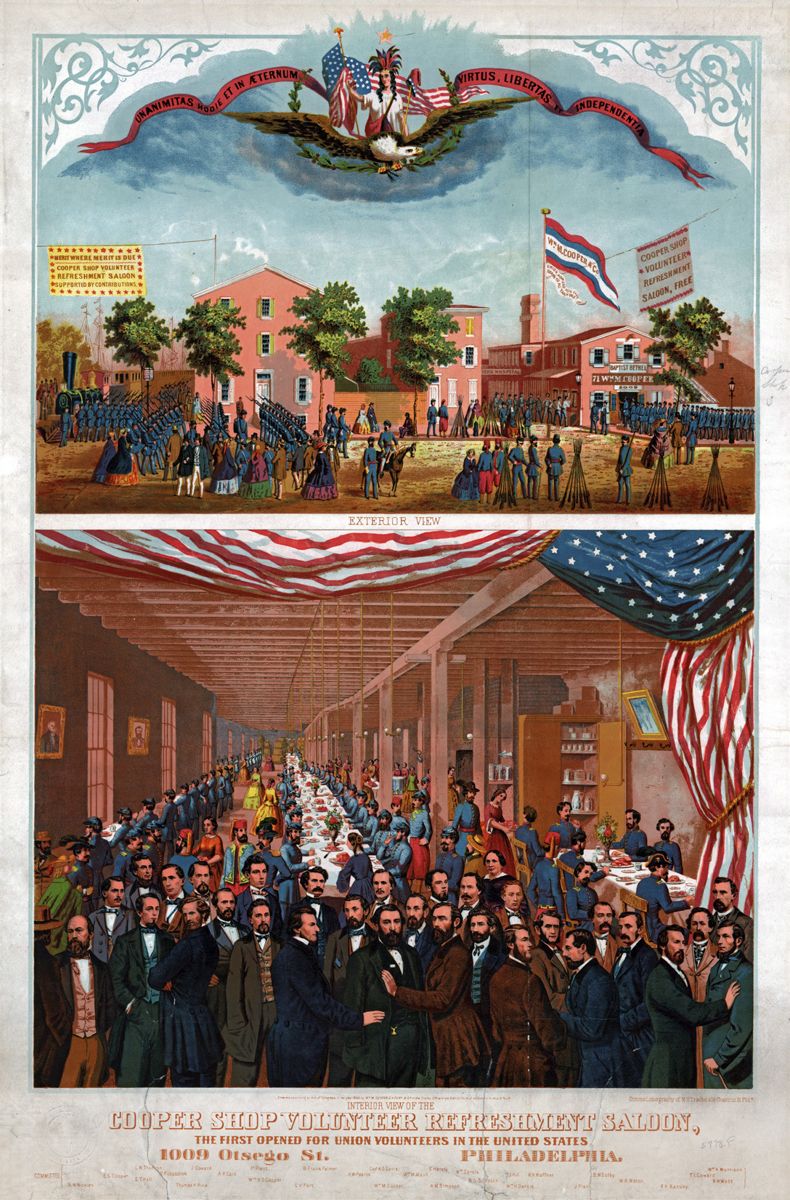
In addition to women who contributed as individuals, and those who contributed through organizations, there were those who worked with operations so thorough and so extensive, that we must consider them production workers, even though they were volunteers. In this category fall the women who organized and ran Refreshment Saloons; facilities which offered cooked meals to soldiers on a large scale. Many were near railroads and welcomed trainloads of soldiers. Two of the largest such operations were the Union Refreshment Saloon and the Cooper Shop, both in Philadelphia. Through the entire four years of the War, these saloons ensured that the soldiers on every train that arrived in Philadelphia had a hot meal offered to them, together feeding more than 1.3 million soldiers through the war years. Their facilities offered a wash-room, meals in facilities that could accommodate 1,000 men at a time, and both supplies and facilities to write letters home. Their scope later expanded to offering hospital beds, medical care, grave sites, and even care for the orphans of soldiers. The extraordinary impact of these facilities on soldiers was described in an annual report: “ We were speaking,” … of the demoralizing influences of camp life, and a friend remarked that … his regiment … had become sadly demoralized. … orders came for the regiment to march, and the men went on board the steamer much as if they were going to the gallows. We reached Philadelphia, and marched to the Union Volunteer Refreshment Saloon, and the warm welcome, the hearty shake of the hand, and the ample and delicious fare served up for us, put a new spirit into the men. They had landed in a mood fit for mutiny or desertion; they left Philadelphia, feeling that they were the cherished soldiers of the nation, loved for the cause in which they were to fight. This article has focused on women’s voluntary activities in providing sustenance for soldiers. There is as much, or even more, information on women coerced or forced to do the same. That topic must wait for another column. J uanita L eisch J ensen is a nationally known speaker , writer , researcher ( and avid collector ) of subjects related to civilians and the C ivil W ar . S he is currently serving as C hairman of the N-SSA 150 th
C ivilian E vents T ask F orce planning special events at the fall , 2024 national skirmish . S he is a member , fellow , and former G overnor of the C ompany of M ilitary H istorians . S he is also a member and former P resident of the S ociety for W omen and the C ivil W ar . S he authored two books : W ho W ore W hat : W omen ’ s C lothing , 1861-65, and an I ntroduction to C ivil W ar C ivilians . J uanita and her husband , military historian L es J ensen split their time between homes in O range C ounty , N.Y., and S henandoah C ounty , V a .
A Few Words About Words By Gould Hagler
Until recently books and articles on the Civil War referred to slaves as “slaves.” Nowadays the preferred term is something like “enslaved people” or “enslaved African Americans.” The extra syllables add no extra information about slaves or slavery but seem to be an effort by writers to say something about their attitude toward slavery. There is a newer trend of referring to slave owners as “enslavers.” Is this accurate? Three dictionaries I consulted all define the verb “enslave” the same way: to reduce a person to the condition of slavery, i.e., to subjugate a person who is not a slave and make him a slave. There is a distinction between a person who buys a slave and one who raids an African village to capture free people and make them slaves. Calling American slave-owners “enslavers” blurs this distinction. A fourth dictionary broadens the definition of “enslave” to encompass both acts, so that an enslaver is one who subjugates a free person or one who buys a slave. This one is an online publication, so it can easily keep up with trends. Is there a moral distinction between the two things? Perhaps not, but they are nevertheless two different things.
Dictionaries are descriptive works that define words as they are used by speakers of a language. Usage changes and meanings change. If writers continue to use “enslave” in the expansive sense then that is what the word will come to mean. The other dictionaries will catch up to the online dictionary in future editions. I read a book recently that mentioned the voyage of the Wanderer, a ship that in 1860 sailed to Africa and brought back a shipment of slaves. In this book the author states that the owner of the Wanderer “kidnapped” the 400 unfortunate men and women who endured the trans-Atlantic voyage and the 100 who did not survive the passage. According to a 2021 article in the Smithsonian Magazine, the 500 souls in question were purchased by the American ship owner. They (or their parents or grandparents or great grandparents) had already been enslaved, whether by kidnapping or by some other means, well before the Wanderer set sail. As dictionaries now define the word, the crew of the Wanderer did not “kidnap” the Africans. The author erred. However, if other writers repeat his error, and repeat it often enough, it will no longer be an error.
Fort Fisher items wanted nc ena Prov t!
us M a e
Rable Wins Austin Civil War Round Table Book Prize for study on conflict between Lincoln and McClellan Austin, Texas–—University of Alabama Professor Emeritus George Rable has won the 2023 Austin Civil War Round Table’s book prize for Conflict of Command: George McClellan, Abraham Lincoln, and the Politics of War published by the Louisiana State University Press. Rable will be presented with the prize at the June 20 meeting of the Round Table in Austin, Texas. The prize represents the Round Table’s twenty-ninth annual Daniel M. & Marilyn W. Laney Book Prize. Rable’s book tells the unusual story of an American president pushing a general to fight, when that general was wanting to use an easy hand on his enemy. Both men were men of capability and ambition with the same goal of saving the Union. But they each had very different approaches, both militarily and political. Rable covers the evolution of this relationship that resulted in a revolution of policy producing emancipation of slaves and hard war on the south during the final two and half years of war. Anyone who thinks America today is a country in chaos riddled with political division and partisanship, will learn from this book that we have gone through dysfunction and danger before but on a much larger scale. Zachery A. Fry, author of A Republic in the Ranks: Loyalty and Dissent in the Army of the Potomac says, “George C. Rable has tackled one of the most controversial stories of the Civil War as only a master historian can. Sifting through generations of partisan bickering, he offers a crisp, candid view of the Lincoln-McClellan saga that accomplishes something truly remarkable. It proves fair to both men.” Book reviewer Andrew Waggoner says of Rable that “one never gets the sense that he’s being distinctly unfair to either man when it comes to characterizing their actions in
ACE p yro
George Rable (left) accepting his award from Harley White.
a political context. That more open-minded approach to an area of study dominated by critically one-sided analysis is refreshing.” John Hennessy, retired chief historian at Fredericksburg and Spotsylvania National Military Park, in his review of the book said, “Good thinkers sometimes are not good writers, but good writing invariably requires good thinking, and George Rable delivers.” The Laney Prize includes a stipend and is awarded annually by the Austin Civil War Round Table, Inc. for distinguished scholarship and writing on the military or political history of the Civil War. Established by the membership of the Austin Civil War Round Table, the Prize honors the Laneys for their splendid efforts on behalf of the Austin Civil War Round Table, Inc., and especially, for their many efforts to protect the endangered battlefields of the Civil War. Among the previous winners of the Laney Prize are William C. Davis for The Cause Lost, Gary Gallagher for The Confederate War, Richard McMurry for Atlanta: 1864, Gordon C. Rhea for Cold Harbor, Craig L. Symonds for Lincoln and His Admirals, Edwin Bearss and J. Parker Hills for Receding Tide, S.C. Gwynne for Rebel Yell, Donald Miller for Vicksburg, H.W. Brands for The Zealot and the Emancipator, Robert Elder for Calhoun: American Heretic and Jeffrey Wert for The Heart of Hell.
llc