
The Unfinished Fight Vision and Valor:
By Lloyd W. Klein · Originally published November-December 2024 · pp. 42–46
Financing the Civil War:
Cotton Bonds & The
Erlanger Loan
For a nation composed of rebellious states to wage war, it must possess the financial resources to procure essential supplies such as weapons, armaments, horses, food, clothing, and soldiers’ salaries. In addition, it is crucial to establish and sustain a stable domestic commercial economy. Jefferson Davis was entrusted with the challenging task of establishing a national government and economic foundation while adhering to the doctrine of states’ rights, a conflicting objective that likely contributed significantly to the Confederacy’s downfall alongside its military setbacks.
Confederacy’s Financial Status The initial priorities were to establish a national monetary system and devise a means to generate revenue. Initially, no taxes were imposed due to the reluctance of state governments to support a robust central government. The Confederate government’s financial capacity was limited, a deliberate choice made by its founders in Montgomery. When the Confederate States of America (CSA) was formed, its treasury was empty, prompting the state of Alabama to provide a loan of $500,000. Initial funding sources also
included appropriation of approximately $200,000 from Federal customhouses in the Southern states. At the onset of the war, the Confederate government primarily relied on revenue generated from international trade, with an import tariff introduced in May 1861 at a rate of 12.5%, mirroring the Federal tariff from 1857. Between February and May 1861, 65% of the government’s income came from the tariff. However, the Union blockade led to the disappearance of tariff revenue, causing a drastic drop to a mere 0.5% of government revenue by November 1861. Despite Secretary of the Treasury Christopher Memminger’s optimistic projections of $25 million in revenue for the first year, the actual amount collected from tariffs throughout the war was a modest $3.4 million. The constitution of the Confederate States prohibited protective tariffs but allowed import taxes to fund state improvements.
The Necessity of Bonds Based on Cotton To raise cash to finance the war, the Confederate government issued various types of bonds, initially to its citizenry. But with only 6 million citizens, and even fewer with real wealth and flexible cash, public
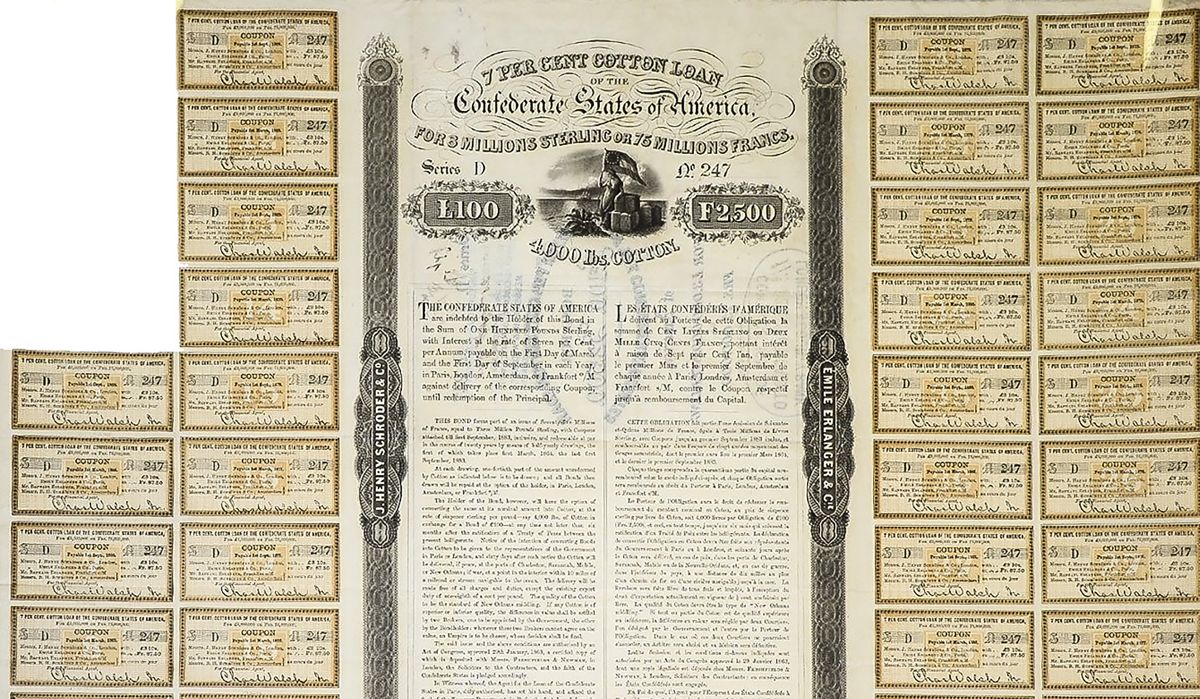
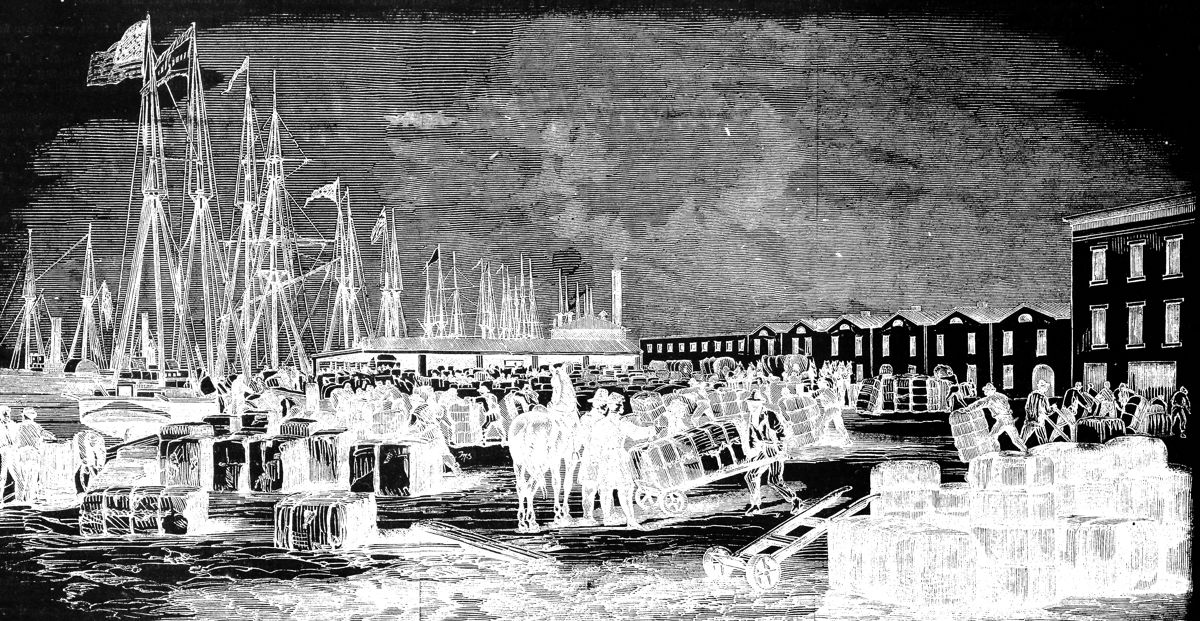
financing through bond sales proved a limited option. Recognizing the need for foreign trading and investment, the Confederate government sought to attract overseas investors. Unfortunately, conventional Confederate bonds were viewed as a poor investment and most were unwilling to speculate. Even the influential Rothschild family in France, who were prominent financiers of the time, refused to purchase the bonds. This was partly due to their genuine distaste for slavery, but also because the Confederacy was a poor credit risk. The Confederacy produced few manufacturing products to generate revenue. Even if the CSA were to survive the war, it lacked the gold reserves requisite to offer as collateral for the bonds. To spark interest in their bonds, the CSA developed an innovative solution involving exploitation of the South’s most important crop, cotton. Issuing Cotton Loan Bonds was a response to the risk of default faced by those who purchased Confederate bonds in the event of the Confederacy’s defeat. These bonds and certificates, backed by cotton, played a pivotal role in the Confederacy’s financial strategy during the war, given that cotton was its primary export and a valuable asset in global markets. Cotton was a crucial commodity for mills in England and Europe. This inventive approach enabled the South to convert its stranded cotton into an asset that could be used as collateral for a loan, as exporting it in significant quantities was hindered by the Union blockade. The Cotton Loan Bonds were secured by bales of Confederate “white gold” at a rate
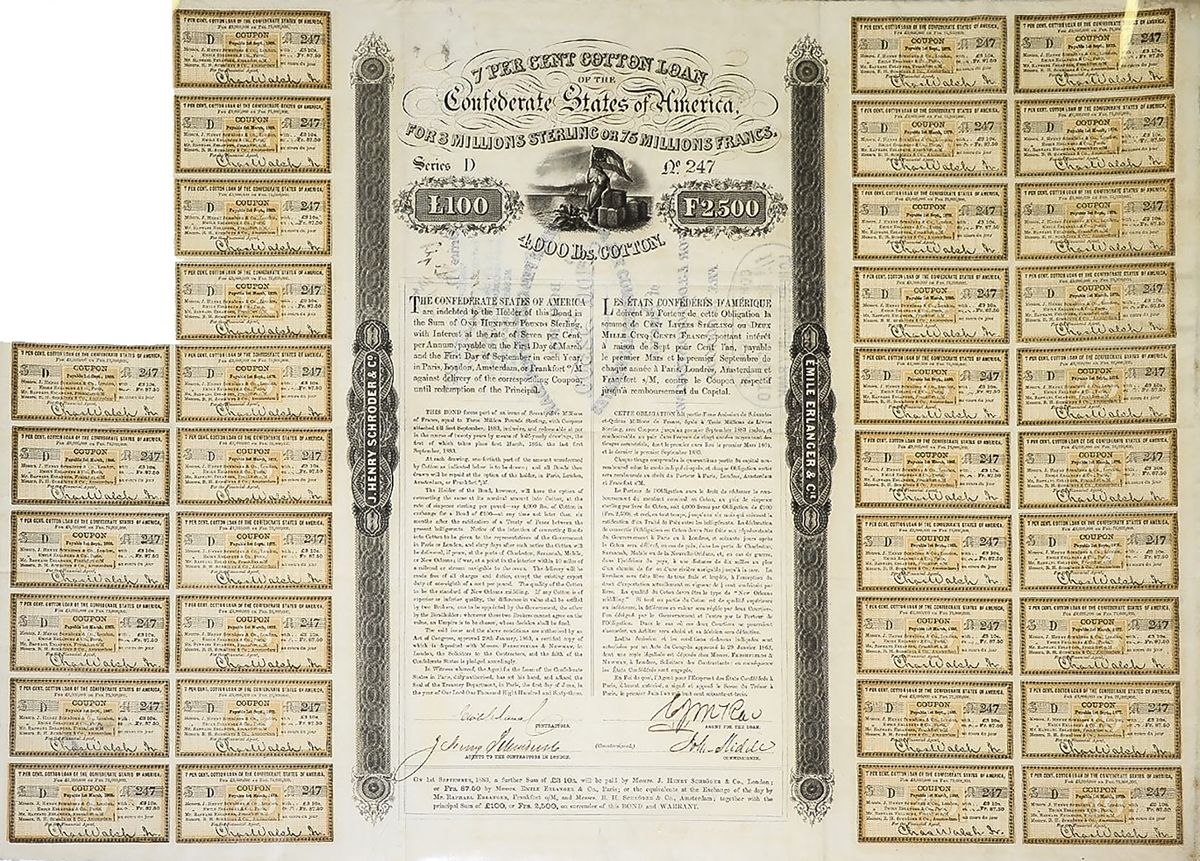
that would yield a profit for potential buyers if the bonds were redeemed with cotton instead of cash. The issuance of 20-year bonds was accompanied by a provision that allowed bondholders to convert them into cotton at a fixed price, if the 7% coupon payments were not made at the prewar price of 6 pence/pound. To run the price of their bonds up even more and pressure Great Britain into recognizing the Confederacy and potentially forming an alliance, the CSA imposed an embargo on cotton shipments to Britain. At the time, Britain imported 80% of its cotton from the South. Consequently, British imports of Southern cotton fell from 2.6 million bales in 1860 to 72,000 in 1862. The impact of the embargo was felt by late 1862 when Britain faced what was referred to as “The Cotton Famine.” This crisis devastated the British industry, particularly in the textile regions of northern England, resulting in widespread unemployment and civil unrest. The scarcity of cotton in Europe led to a surge in prices, making the convertible feature attractive to investors. The price of cotton rose significantly, from 6.25 pence/pound to 27 pence, increasing the value of the cotton-backed bonds. This economic development attracted investors from London and Amsterdam, providing some much-needed cash to support the war effort. The CSA initiated its bond program on February 28, 1861, by issuing a $15 million bond at 8% interest. Subsequently, as the war progressed, the CSA issued over $700 million in bonds, with $100 million issued in May and June 1861 alone. The timing of bond issuances was determined by the financial requirements of the Confederacy and the status of the war. The effectiveness of the Cotton Loan Bonds was hindered by factors such as the Union blockade, which impeded the Confederacy’s cotton exports, general economic instability resulting from the war, and severe ongoing currency devaluation. Despite issuing a significant amount of bonds, their success was limited. The bonds’ value was supported by the provision that holders could acquire physical cotton at a reduced price if the South failed to meet interest payments. However, the effectiveness of this collateral depended on the ability of creditors to take possession of the cotton. For this reason, the Union Navy’s capture of New Orleans in April 1862 held great significance due to its impact on the South’s cotton export gateway. By taking control of the main Mississippi Colorized photo of African Americans preparing cotton for the gin on River port, the Union effectively Smith’s plantation, Port Royal Island, S.C., 1862. (Library of Congress) cut off the South’s ability to
Seven Percent Cotton Bond, with bi-annual coupons. (HorseSoldier.com)
freely export cotton. This forced anyone looking to acquire Southern cotton as collateral for debt instruments to navigate through the Union Navy’s blockade, both entering and exiting the port. If the South had retained New Orleans and continued exporting its cotton to Europe, it is believed that they could have potentially sold over £3 million worth of cotton bonds in London alone. However, with Union control over the port and the uncertainty surrounding the availability of Southern cotton, any purchase of these bonds post-New Orleans was considered risky speculation.
Erlanger Loan In 1863, the CSA entered into a financial agreement known as the Erlanger Cotton Loan with French banking syndicate Emile Erlanger & Company, a banking house led by Baron Frédéric Émile d’Erlanger. This French finance and investment company, established by the German-born Parisian banker, was influential in securing European investors for the Confederacy. Emile Erlanger, a prominent French banker and a competitor of the Rothschild family, had expertise in directing French capital towards Southern railroads and land development, including the renowned Queen and Crescent Route. Erlanger’s name continues to be remembered through the city of Erlanger, Kentucky.
Through their efforts, the Erlanger Cotton Loan became a notable success in foreign financing, raising approximately £3.5 million or around $15 million in Confederate currency equivalent. Despite the uncertainties surrounding the Confederacy, this loan was a significant effort to secure foreign financing. The loan negotiated by Erlanger was strategically structured to attract European investors interested in maintaining the cotton supply for their textile industries. The loan essentially offered bonds backed by future sales of cotton. The Confederacy believed the demand for Southern cotton, particularly from Great Britain and France, would remain strong despite the ongoing war. The loan was negotiated by John Slidell (a name that also lives on as Slidell, La.). He was appointed commissioner to France in September 1861, then was captured in the Trent Affair. Despite being ignored by Napoleon and his government upon his arrival in Paris in February 1862, Slidell developed a fondness for France and established numerous business connections there. His main contribution was negotiating the loan from Emile Erlanger & Co. with absolutely no collateralization, largely because d’Erlanger was married to Matilde Slidell, the commissioner’s daughter. The Confederacy utilized the projected income from cotton sales to secure the loan from Erlanger and his banking establishment.
industry, where prices reached as high as twenty-four pence or twelve cents per pound. This stark contrast is evident when considering that cotton prices soared to well over $1 per pound during the peak of the Civil War. Meanwhile, Emile Erlanger & Company stood to make a fortune from the cotton bonds’ issuance. They received the bonds at $77 per $100 and sold them at $90 per $100, plus a 5% commission on each note. Erlanger had sold all the bonds by the time the CSA collapsed. Moreover, the bank charged a further 1% for handling the highly speculative instrument, which required that 2.5% of the loan amount be set aside twice a year to gradually retire the debt. In all, Erlanger earned profits exceeding £500,000 from a £3 million initial transaction. While the Erlanger Loan and other foreign financing initiatives did provide some additional funds for the Confederate war effort, their overall impact was limited. The Confederacy’s financial and military situation continued to worsen. The actual amount received by the Confederacy was lower than the loan’s face value, generating around $7.7 million, due to exchange rates, transaction costs, and other expenses. Ultimately, investors who held the Southern bonds after April 1865 faced a complete loss, because the Union refused to honor Southern debts, rendering the bonds worthless and highlighting the risks associated with such
John Slidell. (Library of Congress)
The Erlanger Loan bonds offered a 7% interest rate and could be redeemed after 20 years. Investors received a 7% coupon in pounds sterling, payable twice a year; the Confederacy would gradually repay the bond over twenty years through forty equal semi-annual payments. The coupon could be redeemed in pounds sterling upon request as each one matured. The CSA would not receive the total proceeds from the bond issuance all at once, but rather over a year, as investors’ subscriptions were payable in installments spread across seven months. The terms were considered standard for speculative bond issues in the 19th century, but what set this one apart was the innovative convertible feature. Investors were drawn to the idea that they could exchange the bonds for cotton after the war at a significantly discounted price compared to the market value. The redeemable nature in post-war cotton allowed holders to convert £100 bonds into eight bales (4,000 pounds) of cotton. Additional bonds were available in denominations of £250, £500, and £1,000, with trading taking place on both the London and Amsterdam Stock Exchanges. The conversion rate of six pence per pound of cotton represented a substantial discount compared to prevailing prices in Liverpool, the hub of Britain’s cotton
Baron Frédéric Émile d’Erlanger. (Public Domain)
investments. However, European markets continued to buy and sell the bonds, despite near worthlessness, until the 14th Amendment was passed, making clear that the U.S. Government would not redeem them.
Conclusion Although the funds acquired through the Erlanger loan aided the Confederacy in funding military operations, its effectiveness was limited. Factors such as the Union’s naval blockade, which hindered the Confederacy’s trade and revenue generation, as well as the Union’s superior industrial and manpower capabilities, were pivotal in shaping the war’s conclusion. Furthermore, the Confederacy’s challenges in obtaining additional loans and its economic instability, worsened by inflation, further weakened its capacity to sustain a prolonged conflict. The Confederate government struggled to manage its debt obligations amidst the economic strains of the war, territorial losses, resource depletion, and currency devaluation. As the Civil War progressed and the Confederacy confronted mounting difficulties, including military setbacks resulting in loss of territory and its natural resources, foreign cotton-backed bonds like the Erlanger Loan provided temporary relief in their financial predicament but fell short of altering the war’s outcome.
Sources N “Cornerstone Contributions: Investing in the Confederacy: The Role of Bonds in Funding the Confederacy.” https://www.dhr. virginia.gov/blog-posts/cornerstone-contributions-investing-inthe-confederacy-the-role-of-bonds-in-funding-the-confederacy.
N Dematos, Daniel. “The Confederacy’s Cotton Bonds.” https:// tontinecoffeehouse.com/2020/05/12/the-confederacys-cottonbonds. N Gentry, Judith Fenner. “A Confederate Success in Europe: The Erlanger Loan.” The Journal of Southern History, vol. 36, no. 2, May 1970, pp. 157–188. N Goff, Richard D. Confederate Supply. Pranava Books. 1969. N Klein, Lloyd W. “The financing and construction of the Confederate war supply network.” North and South Magazine 2024; Series II, vol. 4, issue 2): 9 – 26. N Leigh, Phil. “The Cotton Bond Bubble.” The New York Times, January 30, 2013.https://archive.nytimes.com/opinionator.blogs. nytimes.com/2013/01/30/the-cotton-bond-bubble. N Lester, Richard I. “An Aspect of Confederate Finance During the American Civil War: The Erlanger Loan and the Plan of 1864.” Business History, vol. 16, no. 2, 1974, pp. 130–144. N Taylor, Bryan. “The Confederate Cotton Zombie Bonds.” https:// globalfinancialdata.com/the-confederate-cotton-zombie-bonds. N Weidenmeier, Marc D. “The Market for Confederate Cotton Bonds.” Explorations in Economic History, vol. 37, issue 1, January 2000, pp. 76-97.
Dr. Lloyd W. Klein is a Clinical Professor of Medicine in the Cardiology Division of the University of California, San Francisco. He is a nationally recognized cardiologist, clinical investigator, and lecturer with over forty years of experience and expertise in managing myocardial infarction and individual tailoring of coronary revascularization strategies. He is also an amateur historian who has published extensively on the
Civil War. His particular interests
include political and military leadership and their economic
ramifications. His book Civil War Q & A was published by
McFarland in 2023.
Photographs from the Original Article




Captions and credits appear in the article text as originally printed.