
Critic’s Corner
By Stephen Davis · Originally published November-December 2024 · pp. 50–52
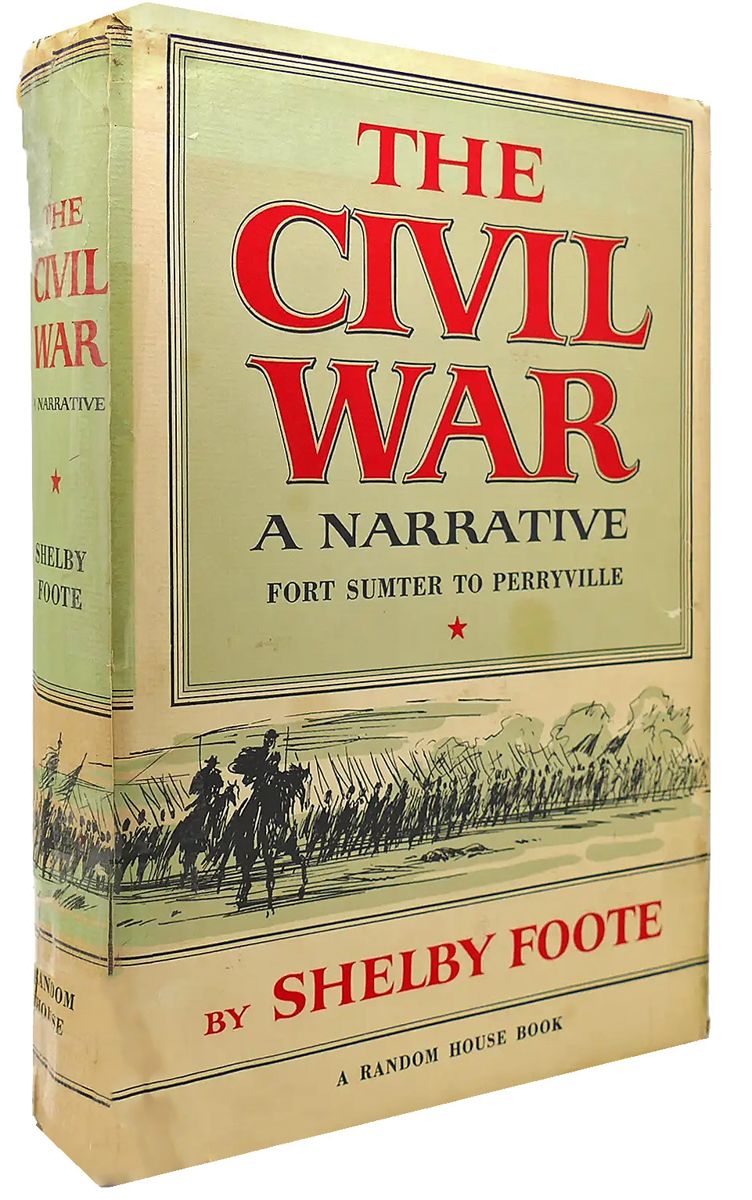
Shelby Foote’s The Civil War Volume One: Fort Sumter to Perryville (1958)
ne of the pleasures of senescence is the availability of time to re-read literary classics. In that anticipation of joyfulness—or maybe just satisfaction—I pulled out Shelby Foote’s trilogy.1 Born in Greenville, Mississippi, in 1916, Foote attended UNC, where he began writing short stories for the campus literary magazine. After army service in World War Two, he worked as reporter for The Delta Democrat Times, and sold his first short story to The Saturday Evening Post in 1946. Then quickly came three novels, 1949-51, all set in the South.2 Shiloh, his fourth, appeared in 1952, and follows the great battle in the words of three Yankees and three Rebels, April 5-April 8.3 In 1954 he started working on a military narrative of the war that Random House contracted for as one
Shelby Foote.
volume.4 Foote thought that the work would take two years; it ended up taking twenty. “I believed very much that the American Civil War was an experience central to our lives, to all Americans, but especially to Southerners,” he declared, and so he gave almost a quarter of his life to its literary telling. Foote’s very style of composition reflected his commitment to the opus: at his Memphis home, with an old-style pen dipped in ink, the author wrote 500 to 600 words a day.5 (No wonder it took two decades!) With this labor in mind, I committed to a reading schedule similar to the one I used back in 1976, when I read Volume Three: ten to twenty pages a day, reading almost aloud to savor the Mississippian’s mellifluous monologue. (“I was probably greatly influenced by my fondness for dramatic monologue,” he once said.6) What began as something of a chore, though, became a diurnal delight. Foote admits that he was neither a military expert nor a professional historian (he doesn’t use footnotes). “I am a novelist,” he declares, adding that both the novelist and historian are seeking the same thing: “the truth.” “They both want to tell us how it was,” he continues, “to re-create it, by their separate methods, and make it live again in the world around them” (Volume One, 815). Foote’s strength as a writer means that in reading The Civil War we are living as much in the author’s world as in his subjects’. More than once are we reminded that this is the composition of a Southerner. (“I am a Mississippian,” he forthrightly affirms [816].) He occasionally dubs the struggle, for instance, the “Second American Revolution,” as did Confederates (65, 662). And while he hails the fighting prowess of “the American volunteer, whichever side he was on in this war” (350), Foote bestows a special respect to Confederate soldiers, the “famished tatterdemalions” (618) who wrested victory so many times from their overnumerous foes. His statement that “Southerners saw themselves as the guardians of the American tradition, which included the right to revolt, and therefore they launched a ‘Conservative revolution’” (65) is straight from the Confederate apologia. Critics, of course, picked up on Foote’s partisanship, and found in it further evidence of the artist’s sensibilities. “Imbued with the sense of place, the sense of history, the sense of literary tradition,” declared one assessment, “The Civil War is most profoundly Southern in projecting the sense of tragedy”7—that tragic undercurrent that Woodward and other historians have commented upon. Volume One begins with Jefferson Davis’ resignation from the U.S. Senate and closes with Lincoln’s “State of the Union” in December 1862. In between are covered every major battle, east and west, and some on the water. He notes that Shiloh’s casualties exceeded those of America’s three previous wars, providing numbers as proof. Jackson’s battle at Groveton was “one of the hardest close-quarters fights of the whole war” (626). Astutely, he deems Bragg’s and Lee’s advances in 1862 raids, not invasions; the Confederates intended no permanent occupation. As for the former, Foote ventures the judgment that it was “the most successful offensive so far launched by a Confederate commander outside the strict national limit” (742). (I guess it takes a novelist to give the much-maligned Bragg his due.) Key figures are limned: “Old Blue Light” Jackson, the inchworm-crawling Halleck. In Foote’s text, the former has a “shrill, womanish voice” (433), but whose brilliance in the Valley Campaign, especially against Commissary Banks, allows Foote to dub him the “wagon hunter” (504). Meanwhile Johnston, commanding the army before Richmond, is seen as “not being exactly a forward, cutand-dash sort of commander” (122). His felicitous wounding at Seven Pines brought forth Robert E. Lee to high command, although the army of which he took charge possessed “perhaps the greatest number of high-strung troop commanders, per square yard, of any army ever assembled” (451). Lee’s ability to forge this into the South’s legendary fighting force alone elicits Foote’s praise, as does Lee’s ability to get along with President Davis. A “westerner” himself, Foote displays keen interest in the doings of that theater. Logan’s Crossroads was the South’s “first drubbing in the field” (179); Shiloh was “the first great modern battle” (338). Without calling its failure a turningpoint, Foote gives the three-pronged Confederate offensive in late summer of 1862 (Lee, Bragg, Van Dorn) a narration that I found as penetrating as one might read in the pages of John Keegan or S.L.A. Marshall. Kirby Smith’s lopsided victory at Richmond, Kentucky, was “the nearest thing to a Cannae ever scored by any general, North or South, in the course of the whole war” (650), leaving the reader to ferret the facts of Hannibal’s legendary triumph. From time to time, one is impressed that this is a new kind of military history, shedding details that might disrupt the writer’s rhythm. (The presidential candidates of 1860 are mentioned without first names, for instance.) Gracing this eight hundred-page military history is also a sense of proportionality; Manassas is given nine pages, Shiloh fourteen, the Seven Days thirty-eight. Permeating Foote’s pages is a confident omniscience that in turn solidifies his text. When he refers to “Mars Robert” (585, 586), one at first suspects a typo. But then we are inclined to grant the author an entitled wryness—one almost imagines his grin writing this. The author’s recounting of events is simple and cleareyed. “Lincoln had maneuvered them into the position of having either to back down on their threats or else to fire the first shot of the war,” he declares with an assertiveness that even an apologist for Old Abe would accept (46). The transformation in Lincoln’s war-thinking, from “soft war” (restoring the Union) to a hard one (eradicating Rebel slavery) is described as effortlessly as it is necessarily. His ability to see through war-fog and battle-smoke brings clarity to confusing contests. Sagely Foote accounts for the outcome of the Seven Days with three reasons: Confederates’ poor maps and intelligence, their inadequate staff work, and the Federal army itself, particularly its wellserved artillery. He might have added a fourth, wobbly battle captains (afterward, Lee shunted Magruder, Holmes and Huger out west.) A novelist must deal with the hubris of mortal man, so Shelby Foote, seated at his Memphis writing-desk, is plentifully poised to puncture the pomposity of Pope. Three times he quotes the ill-fated general’s boast that “we shall bag the whole crowd” (621). When, at Second Manassas, Pope believed that Jackson was actually trying to escape and so ordered a pursuit, the bemused Memphian observes that Pope’s pursuit “was probably the briefest of the war” (636). Longstreet came up, and as “the widespread jaws began to close” upon the hapless Yankees, “the weird halloo of the rebel yell rang out” (631)—a sonorous characterization the author seems to savor, and repeats (80). Similarly, when Confederates surround the Federal garrison at Munfordville, Kentucky, and demand surrender to avoid further bloodshed, Foote enjoys quoting the Union commander’s response: “Thank you for your compliments. If you wish to avoid further bloodshed keep out of the range of my guns” (658). Foote’s comfort with his subject is everywhere evident, even to his use of “contrabands,” not “Blacks.” (609) “Our folks ain’t got none them gumboats,” one declares. George Anand’s forty-four lucid maps are simple and effective, based as they are “from originals by the author” (812). More, they are judiciously placed throughout the text, not set together in some mid-book cluster. Foote’s erudition charmingly assumes the same for the reader’s, as when he terms Joe Johnston as “cunctative as Fabius Maximus” (124). Though he terms himself “Greekless” (Two, 970), Foote is very mindful of the classical tradition in the writing of history. He refers to Homer’s Iliad as his “model,” and even characterizes his work as “this iliad” (Three, 1064). Tacitus is “my favorite historian,” he avers (971); it shows, and in more ways than just his references to the Battle of Cannae. Volume One concludes in the wake of Sharpsburg, with Lincoln releasing his preliminary proclamation, Van Dorn licking his Corinth wounds, Bragg and Buell counting their Perryville losses, and Burnside awaiting his pontoons at Fredericksburg. The stage is set for Volume Two. In embarking upon this review, I told Jack that I proposed to treat all three books of Foote’s opus in our allotted 2,000 words. Fat chance. Volume One is so dreamily opulent, it offers more than enough wealth for this piece. I look forward to sharing my experience with its companion volumes in the future. In a Bibliographical Note, Foote indicates the range of his reference sources: the Official Records (which he borrowed from a Greenville library), Battles and Leaders, general war histories such as Catton’s, biographies, and specialized studies (Freeman’s Lee’s Lieutenants, Wiley’s Billy Yank and Johnny Reb). Yet he admits that he is neither a military expert nor a professional historian. Attesting to Shelby Foote’s The Civil War as a milestone in American literature is the praise bestowed upon it in 1975 by the great critic of Southern letters, Louis D. Rubin, Jr. A “magnificent history,” “a model of historical narration” filled with “genuine wisdom” and “written in the grand manner,” Dr. Rubin terms it, concluding, “Unless I miss my guess, it will be the classic full-length presentation of the American Civil War.”8 By my reckoning a half-century later, this judgement still stands.
Since 1978, we have collected or handled over 80 of the “Big Six” Confederate Notes to include nearly 10% of all known surviving Montgomery Notes.
Endnotes Shelby Foote, The Civil War: A Narrative, 3 vols. (New York: Random House). Volume One: Fort Sumter to Perryville (1958); Volume Two: Fredericksburg to Meridian (1963); Volume Three: Red River to Appomattox (1974). Douglas Martin, “Shelby Foote, Historian Who Made the Civil War Real for Millions, Dies at 88,” New York Times, June 29, 2005, A21. Shelby Foote, Shiloh: A Novel (New York: Dial Press, 1952). William C. Carter, “The Scribe of the Civil War,” Southern Living, June 1986, 147. Martin, “Shelby Foote.” Carter, “Scribe,” 147. Helen White and Redding S. Sugg, Jr., “Shelby Foote’s Iliad,” Virginia Quarterly Review, vol. 55 (1979), 239-40. Louis D. Rubin, Jr., “Shelby Foote’s Civil War,” Prospects: An Annual Journal of American Cultural Studies, vol. 1 (1975), 333.

Stephen Davis has been writing about the Civil War for a long time—“since Jesus was in third grade,” he contends.
He served as General Editor for The Reminiscences of General M. Jeff Thompson (Morningside, 1983), and from 1985 to 2005 worked as Book Review Editor for Blue & Gray Magazine. He is author of Texas Brigadier to the Fall of Atlanta: John Bell Hood (2019) and Into Tennessee & Failure: John Bell Hood (2020). With Bill Hendrick he wrote The Atlanta Intelligencer Covers the Civil War (2022). His next book, Confederate Triumph Volume One: 1861, begins his counterfactual narrative of how the South won the war. It will be out this summer. Steve and his lovely wife Billie reside in Cumming, Ga.
“I Thank the Lord I Am Not a Yankee…”
Eliza Frances Andrews (1840–1931) received a strong education and was a successful writer and educator. Her War-Time Journal of a Georgia Girl surely ranks among the most observant and intelligent wartime memoirs by a Southern woman. Edited with commentary by Stephen Davis, I Thank the Lord I Am Not a Yankee includes selections of her wartime and postwar journals which are most expressive of her Confederate patriotism and Southern pride. February 2023 • $35.00, hardback
Stephen Davis is author of ten books on the Civil War, most of which treat the Atlanta Campaign. His two recent volumes on Confederate General John Bell Hood have won several prizes, including the Fletcher Pratt Award of the New York CWRT.