A Fighting Parson’s Deadly Aim
By Joseph F. Wilson · Originally published November-December 2024 · pp. 54–55
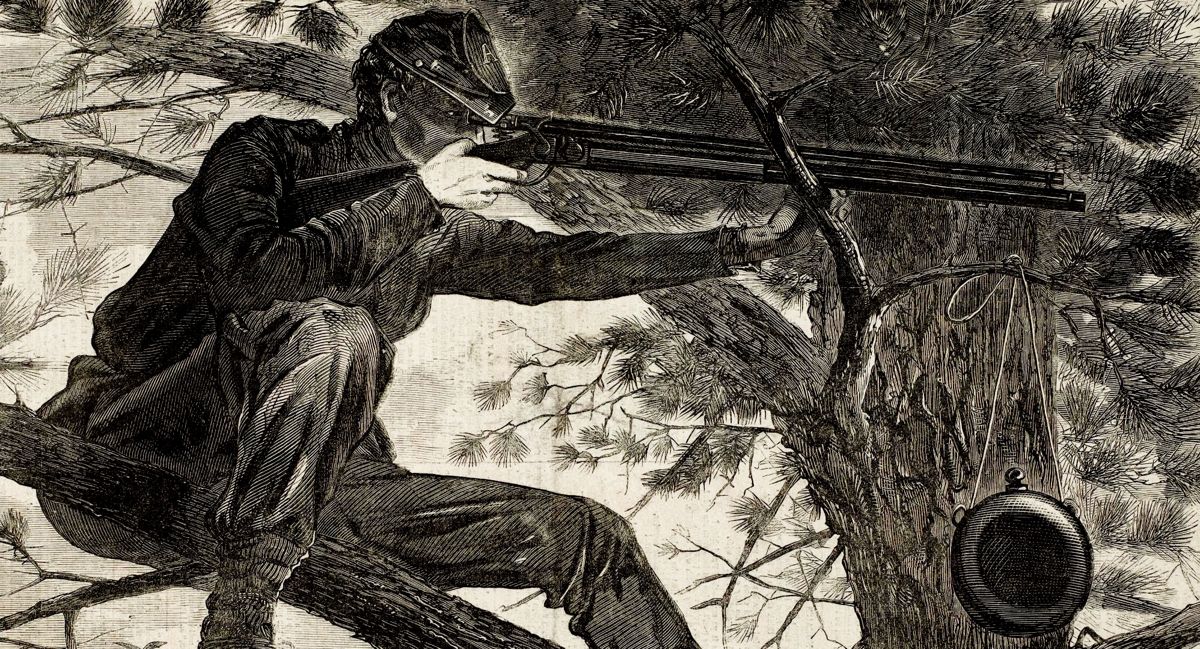
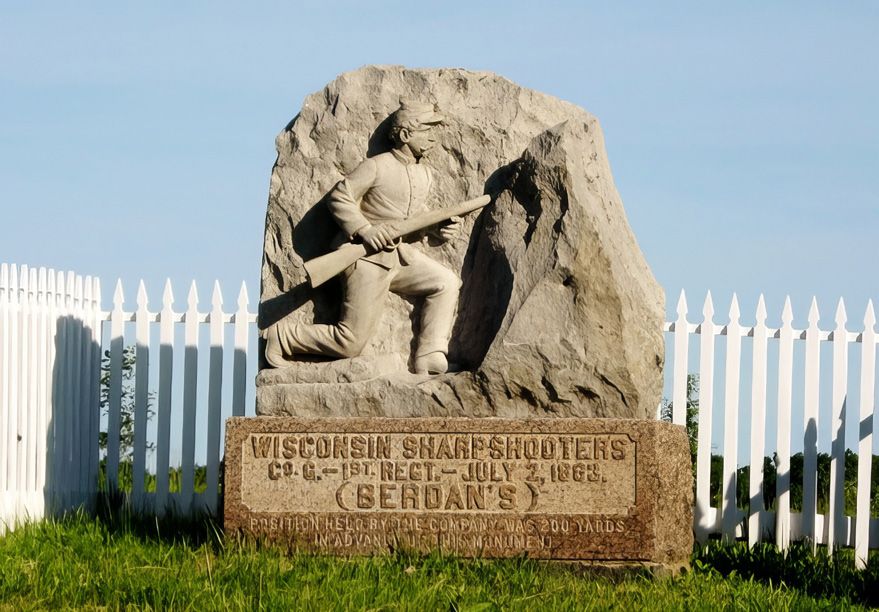
Deadly Aim By Joseph F. Wilson orgive me Lord, for I’m about to dispatch another Confederate soul straight into the afterlife. That thought or something similar may have passed through the head of Chaplain Lorenzo Barber while peering through his telescopic site as he took aim with his deadly long range sniper rifle. Gently squeezing the trigger, the explosion sent the lead projectile down the barrel on its fatal mission. The lethal aim of the reverend left General Robert E. Lee with one less soldier in his army. Known as “The Fighting Parson,” the sharpshooting preacher with the keen eye and steady hand, sent countless Confederate soldiers to an early rendezvous with their maker. Few in the army could match Barber’s ability to send the enemy into the hereafter. While serving in the prestigious Berdan’s Sharpshooters, the devout holy warrior didn’t need any instructions in the ungodly art of warfare. “Thou shall not kill” fell by the wayside for the chaplain, at least for the duration of the Civil War. Lorenzo Barber hailed from Albany, New York, and lived a life dedicated to a peaceful calling until the Civil War emerged. Once the Civil War broke out, the bible toting Barber evolved into a pious fighter in the same vein as Gideon. Bullets went into his cartridge box along with the bible in his knapsack. The colorful New Yorker might be the best known man of God to go to war, and by far the best shot. The chaplain enlisted in the 2nd Regiment of Berdan’s Sharpshooters in the latter part of 1861. For the next three years, the Good Book gave way to the manual of arms. Already a crack shot, the righteous rifleman had no trouble qualifying for membership in Berdan’s elite rifleman unit. All prospective members had to place ten shots within a five-inch bull’s eye at 200 yards to join the regiment, an easy hurdle for Barber. Whether delivering a sermon from a podium or discharging a lead missile from his specialized rifle, the chaplain’s dual functions wavered from saving souls in blue to forsaking souls in gray. Crouching behind a downed tree taking aim at his prey seemed to be as natural as preaching from the pulpit for the parson. It’s hard to imagine Barber’s emotions weren’t conflicted in carrying out his duty. Berdan’s 2nd Regiment took part in nearly every battle in the eastern theater. Some historians believe the 1st and 2nd Sharpshooter Regiments killed more southerners than any other two regiments in the Union army. The fighting preacher likely added considerably to that death count with his Jacob’s double barreled rifle that had sights for 2,000 yards. A bullet for distance filled one barrel, while a load of buckshot filled the other barrel should an enemy combatant stumble upon the hidden chaplain’s location. The saintly soldier would have certainly subscribed to 17th century Oliver Cromwell’s tenet to “Trust in God and Keep Your Powder Dry,” but it seems the chaplain put more trust in his telescopic weapon, rather than leaving it to the Almighty to carry out the mission. Another notable chaplain, Lt. Howell M. Forgy, while serving at Pearl Harbor on December 7, 1941, uttered the famous phrase, “Praise the Lord and Pass the Ammunition.” Chaplain Barber insisted on praising the Lord at services in camp whenever possible, but on the skirmish line, praise Hiram Berdan, commander of for the Lord took a back seat to eliminating Confederates. sharpshooters. (Library of Congress)
Barber didn’t shy away from action. In an early encounter with the enemy at Rappahannock Station in July 1862, the chaplain answered Colonel Henry A.V. Post’s call for two volunteers to flush out a few Confederate cavalrymen scattered in a cornfield. Regimental historian Charles A. Stevens recounts, “Chaplain Barber stepped out and went into the cornfield, and when the rebels jumped off their horse into the field, the chaplain got all mixed up with the rebels. At one time two Rebs had the chaplain, at another time the chaplain had two reb prisoners.” Barber, as well as the Rebs, succeeded in escaping the confrontation. Being a sniper, Barber often maneuvered on the front line, leveling his rifle at unsuspecting Confederates. Stevens tells it this way, “he gets up in Johnny’s face and says, ‘may God have mercy on your poor soul,’ and lets her go, and down comes Mr. Johnny.” God may have had mercy on their souls, but Chaplain Barber did not. Among his sharpshooting peers he excelled. Stevens called the chaplain “one of the best shots in the army.” Always volunteering to advance forward with his telescopic rifle, the courageous Barber was often on the skirmish line to do his dangerous work. A comrade stated, “That chaplain practices what he preaches. He tells us what we should do, and goes with us to the very front to help us in battle.” When not battling the Rebs, Chaplain Barber drew huge audiences to his lectures. It’s likely many attended just to catch a glimpse of the man, who by now had achieved celebrity status. The 2nd US Sharpshooters took part in all the battles of 1862 including the Peninsula Campaign, Second Bull Run, Antietam, and Fredericksburg. With the spring of 1863 came a renewed effort to move on Richmond at the Battle of Chancellorsville. Even Hiram Berdan took notice of the preacher in his report after the Battle of Chancellorsville. While praising many officers who performed well, Berdan added, “Chaplain Barber of the Second Regiment, took a rifle, and went in with the skirmishers with his usual bravery.” In mentioning Barber’s “usual bravery,” it appears Berdan was well aware of the parson’s earlier feats in battle. Following Lee’s bold victory at Chancellorsville, the emboldened Confederate Army of Northern Virginia headed north into Pennsylvania and the iconic Battle of Gettysburg. The 2nd USSS performed well in holding off the Confederates near Little Round Top. But Chaplain Barber missed the battle entirely. He volunteered to stay behind to bring up the mail. Along the way, Confederate cavalry captured the reverend near Emmittsburg. Somehow, the shifty chaplain managed to escape and rejoined the regiment after the battle. For the rest of the year the Union Army of the Potomac and Lee’s Army of Northern Virginia jockeyed for position in the Mine Run Campaign. Little was accomplished by either army. As usual, Lorenzo Barber maneuvered in front on the skirmish line looking for enemy targets. Leaning his heavy weapon against a fallen tree or stump, the extraordinary sniper went to work. Until Mine Run, the good reverend seemed to be under a cloak of protection provided by his heavenly father. Berdan’s sharpshooters had incredible marksmen, but the Confederates had a few of their own. A capable southern sniper found the chaplain in his crosshairs during the Mine Run Campaign. With one pull of the trigger, the gray clad rifleman sent one of the most prolific snipers in the Union army back to being a full time preacher. The lead projectile hit the chaplain in the leg causing a serious wound that brought Barber’s military career to an end. It would be a year before he returned to the ranks in a reduced role. While recovering from the wound, Chaplain Barber drew even larger crowds to listen to his preaching. Many in attendance may have left disappointed after coming out wanting to hear exciting war stories, rather than the Word of God. Lorenzo Barber returned to the army on December 4, 1864. But his sniper days were over, he mustered out of service on February 5, 1865, leaving behind a storied career as a sharpshooter that few could match. With the Civil War concluded, Barber returned to his love of hunting that had sharpened his proficiency with firearms before the war. A love that finally brought an end to the heavenly veil that shielded the good reverend throughout the tumultuous war years. After three years of escaping bullets and exploding artillery shells in numerous battles, a reckless gunshot by Lorenzo Barber himself ended it all. While on a hunting trip, an accidental discharge of his weapon tore into Barber. The regiment’s historian, Charles Steven’s recounted the incident, “Barber accidentally shot himself, and in a rather careless way too. While returning from a hunting expedition, a charge of shot entered his body from which he died.” From Stevens’s account describing “a charge of shot,” it appears the chaplain was hunting with a shotgun. Chaplain Barber, the celebrated sharpshooter, lost his life in a freak accident after being a prime target of so many Confederate rifles trying to dispatch the Reverend to a meeting with the Almighty. “The Fighting Parson” did what no Confederate rifleman could accomplish throughout the war. Lorenzo Barber laid his immortal soul to eternal rest at the end of a smoking barrel! Joseph F. Wilson is a member of Old Baldy CWRT and The General Meade Society. The writer lectures on Civil War topics and is the writer and producer of the documentary “Civil War Prisons – An American Tragedy” available on Amazon. His YouTube channel is – “Joseph F. Wilson.” Contact - Joef21@aol.com.