
How Shall all These
By Jonathan A. Noyalas · Originally published May-June 2024 · pp. 18–47
Wounds be Healed? Exploring Battle’s Impact on Families By Jonathan A. Noyalas
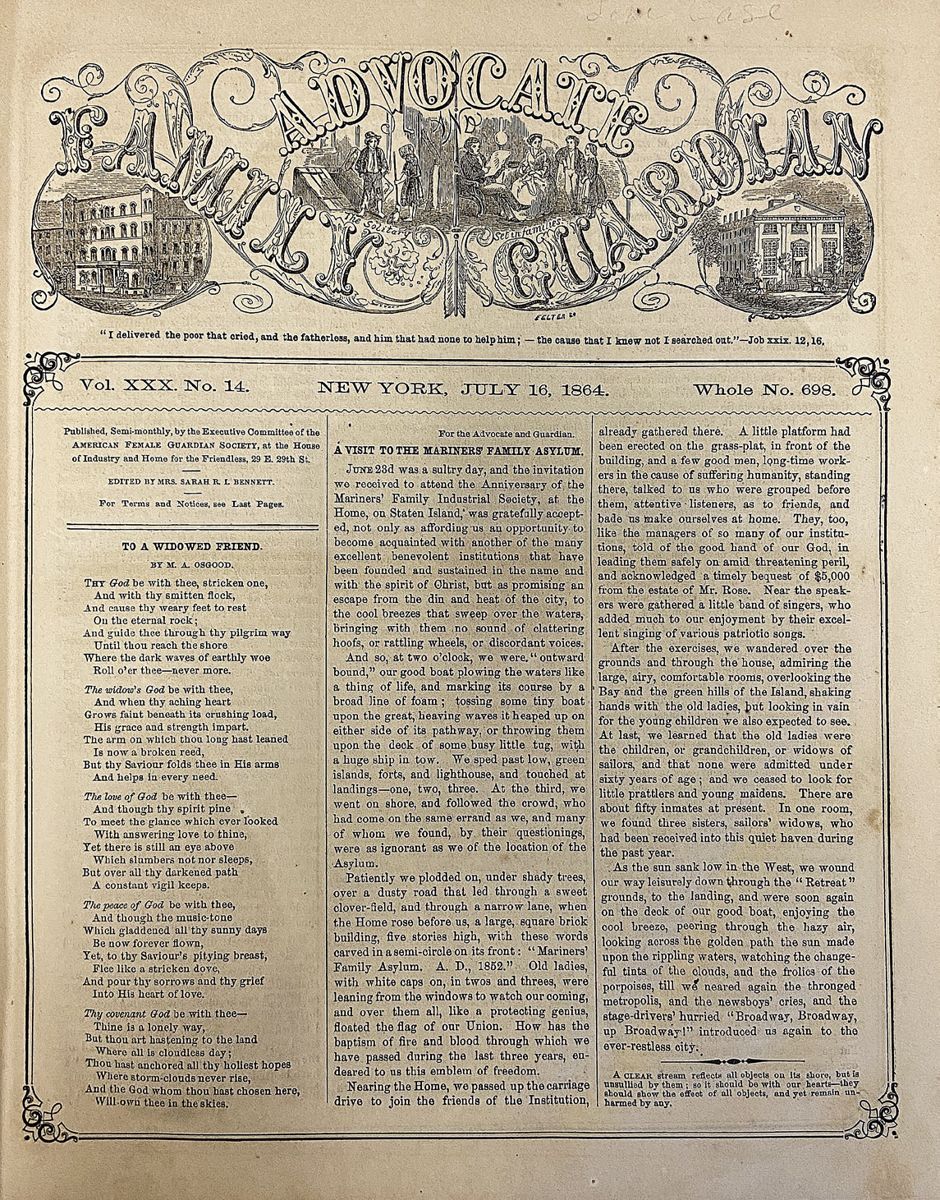
By spring 1864, Jane Boswell Moore, a nurse at a Union hospital near Bermuda Hundred, witnessed much suffering. During the previous two years, Moore, a native of Baltimore, Maryland, cared for wounded Union soldiers in Baltimore and at such notable battlefields as Antietam, Chancellorsville, and Gettysburg.1 As Moore went about her usual duties on May 21, 1864, she noticed a deceased Union soldier on a “bloodstained” stretcher “covered with a blanket.” Moore asked an “attendant” to remove the blanket and reveal the soldier’s face. It shocked Moore. “What a sight was that! I have seen death in almost every form, in the hospital and on the battlefield … I pray God I may never needlessly see such a sight again,” Moore wrote.2 She knelt beside the stretcher and searched the soldier’s pockets to “find some clue” as to his identity. From one of the pockets Moore pulled, as she explained, “a letter, perfectly saturated, dripping with the warm life-blood.” The letter was addressed to Private Patrick Dalton, 6th Connecticut Infantry, from the soldier’s wife, Honora.3 Moore took the letter, clipped a lock of Private Dalton’s hair, and wrote Honora that her husband succumbed to wounds received six days earlier near Drewry’s Bluff.4 After Honora received the crushing news of her husband’s death, she wrote Moore and expressed her gratitude “for the kindness” Moore “bestowed” toward her “beloved husband, and also in giving … the particulars of his death.” The “sad news” Honora received raised numerous questions in her mind, among them how she would care for her two children. “I am now a poor and lonely widow with two little children, one fourteen months and the youngest eight days old … so you see my circumstances,” Honora explained.5 Widow Dalton’s response struck a chord with Moore and forced her to contemplate the far-reaching impact of what happened on the battlefield. “This case is but one of thousands. Who shall make good the loss? How shall all these wounds be healed?”6 While nothing could ever replace her beloved husband or heal Honora Dalton’s broken heart, she could appeal to the United States government for financial assistance to aid her effort to care for herself and her two young children. In the summer of 1861, the United States Congress, once it authorized President Abraham Lincoln to accept the service of 500,000 volunteers, passed an act which guaranteed a pension to any volunteer wounded or disabled during service “and the widow, if there be one, and if not, the legal heirs.”7 Although well-intentioned, some believed the law confusing and inadequate. Attorney General Edward Bates was among those who criticized it. After reviewing the law, coupled with other pension statutes, Bates informed Speaker of the House Galusha Grow on March 11, 1862, that the new pension law created too much “uncertainty and obscurity” for the “suitable
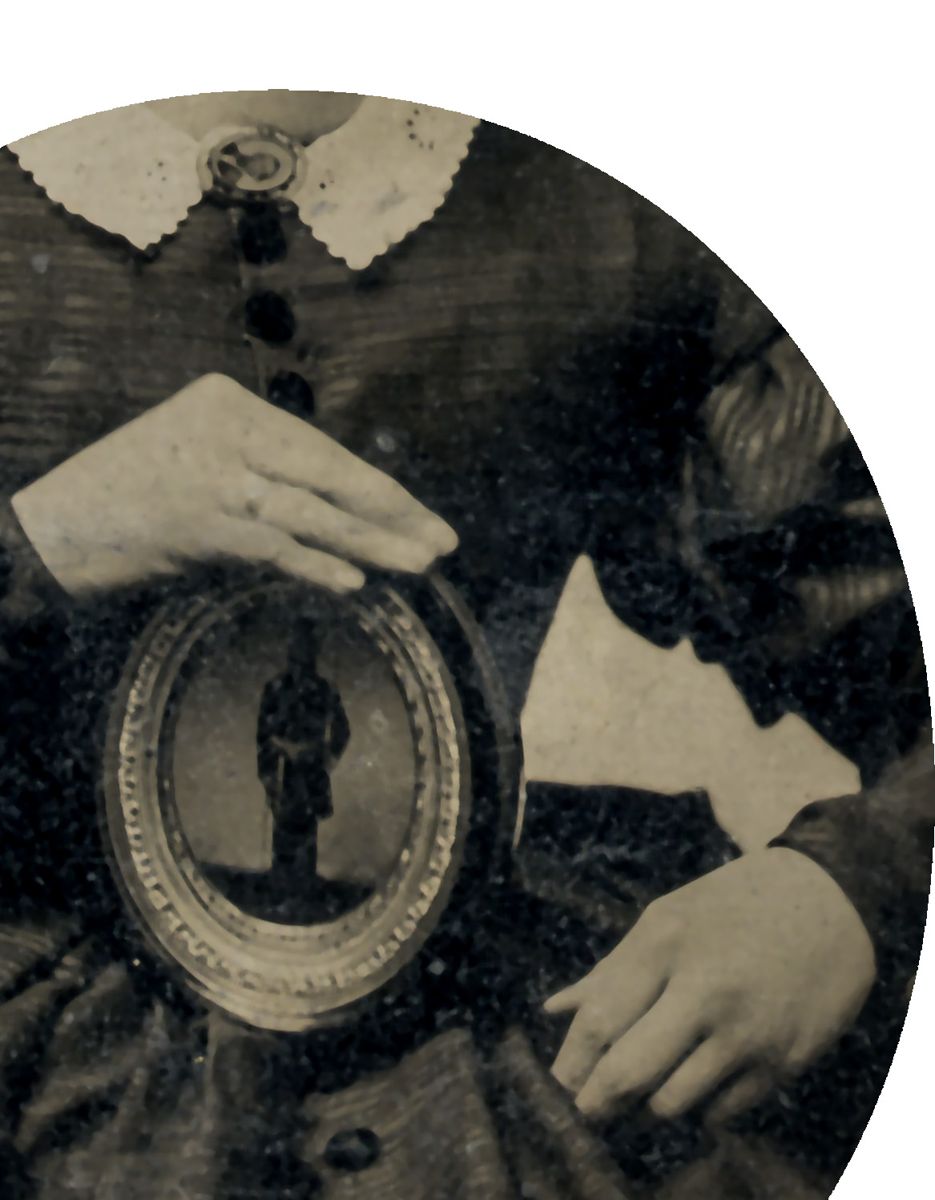
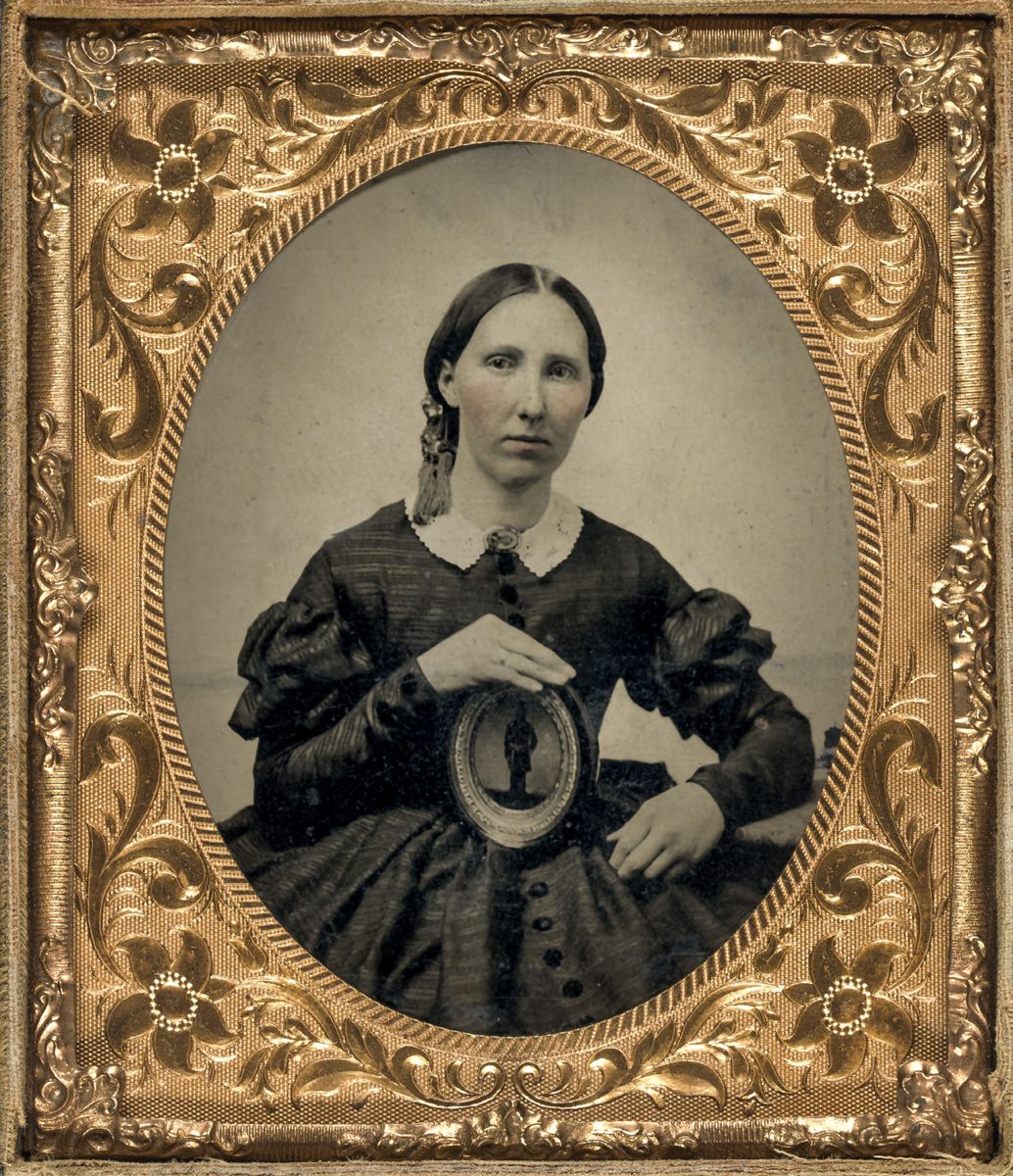
Left: While no known images of Honora Dalton exist this image of an unidentified woman in mourning, holding a photograph of her husband typifies the unquantifiable grief felt by wives transformed into widows. (Library of Congress)
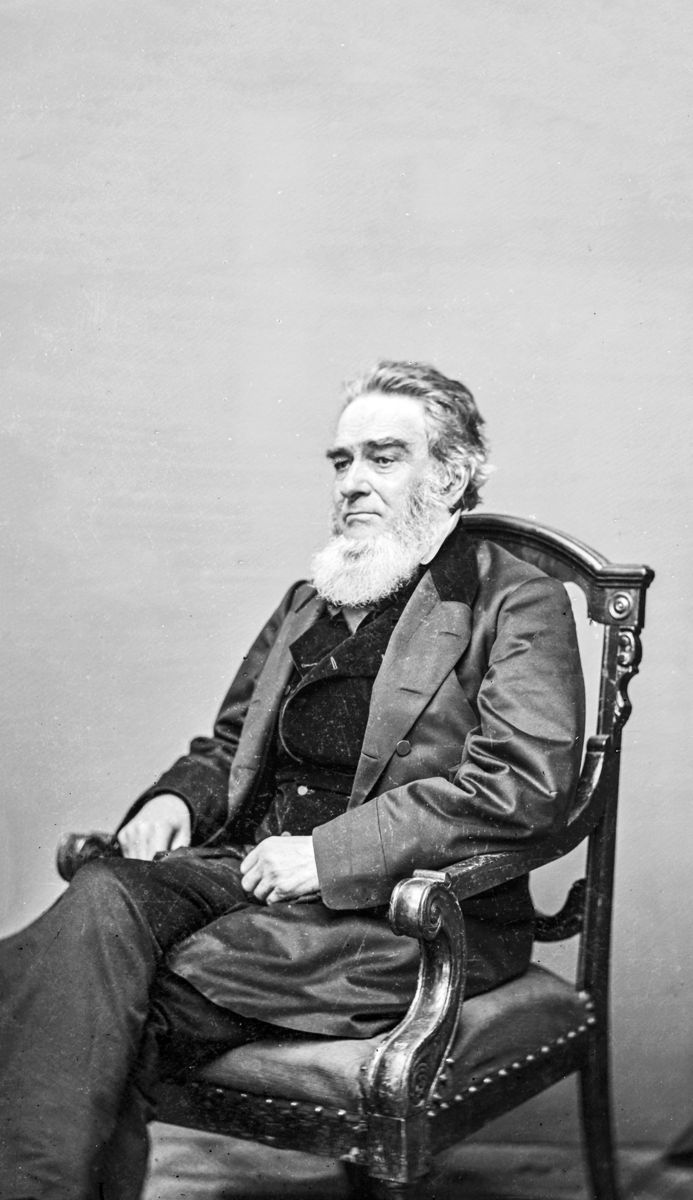
Attorney General Edward Bates believed the pension law passed by Congress in the summer of 1861 was inadequate and confusing. Bates’s assessment of that law helped pave the way for a new pension law, one that President Lincoln signed on July 14, 1862. (Library of Congress)
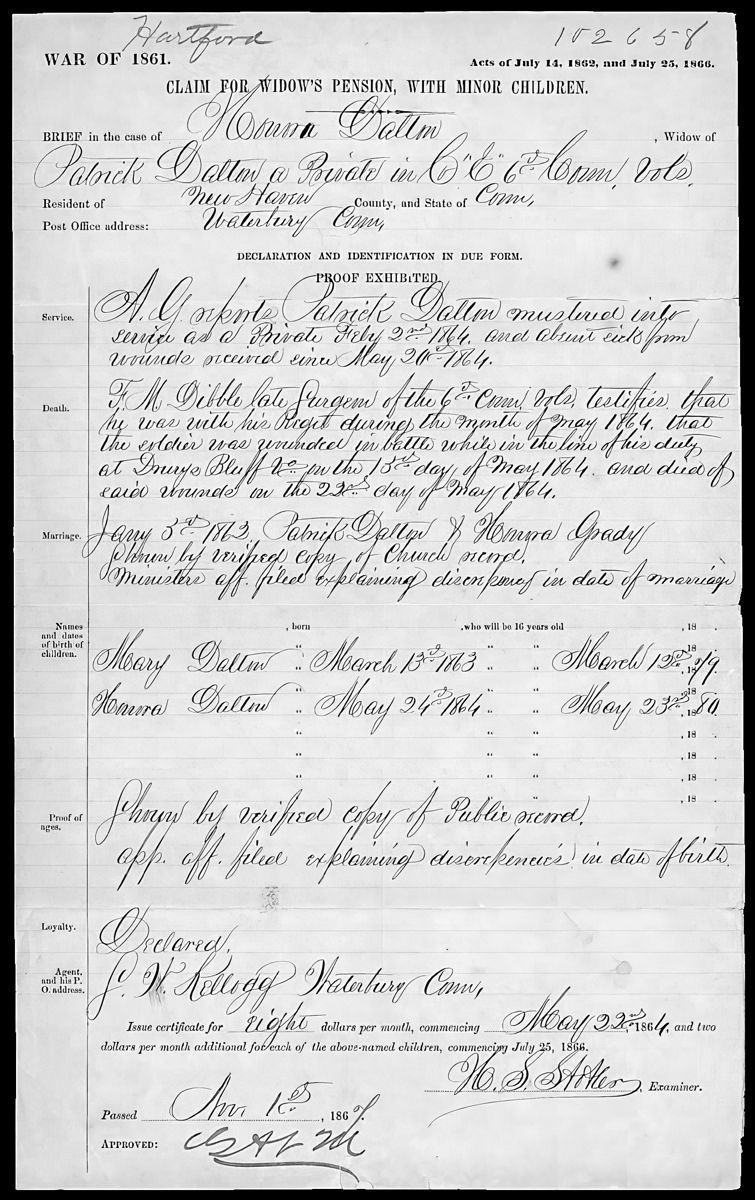
provision … for the families” of soldiers who “may be killed or die in the service.”8 Four months after Bates’s appraisal of the law’s deficiencies President Lincoln signed a new pension bill that provided much needed clarity on who was entitled and compensation amounts. The law, one which Assistant Secretary of the Interior John Usher regarded as the “most munificent enactment of the kind ever adopted,” granted widows pension based on their husband’s rank.9 Widow’s compensation ranged from $30 per month, for widows of officers who held the rank of lieutenant colonel or higher, to $8 per month, for non-commissioned officers, musicians, and privates.10 The law also granted an additional $2 each month per child until that child reached the age of sixteen.11 In the estimation of Commissioner of Pensions Joseph Barrett the 1862 law streamlined the claim submission process. “Nothing is required of the claimant which is not necessary and, in most instances, conveniently obtainable,” Barrett wrote on November 15, 1862.12 Filing a claim proved anything but easy for Honora Dalton. She submitted her application on October 10, 1864. On January 21, 1865, the Bureau of Pensions returned the application because of a discrepancy in the couple’s marriage date. On one form Honora stated that she married Patrick on January 5, 1852. Another document noted the two wed on January 5, 1862. While officials in Washington eventually resolved the discrepancy (the couple married on January 5, 1852) and awarded Honora Dalton a pension of $8 per month with an additional $4 for her two children the approval did not come until September 3, 1867. Although the Bureau of Pensions paid Dalton retroactively from the date of
Below: Page from Honora Dalton’s claim for a widow’s pension. (National Archives & Records Administration)
her husband’s death, she endured a stretch of forty months where she had to figure out a way to support her and her family.13 Aside from the $15 Honora initially received from sympathetic neighbors and friends little is known about how she supported herself during the period she awaited approval.14 Sadly, Dalton’s story is not unique. Whether widows waited months or years (most widows claims were approved within two to three months) they needed an immediate income and sought work. Finding employment proved particularly daunting for mothers. For example, in early 1865 the Female American Guardian Society in New York City reported that an unidentified widow of a Union soldier killed in 1863 on picket duty while serving in the Army of the Potomac confronted unnamed bureaucratic obstacles. The widow had no other alternative than to find employment. She easily found work as a house servant in New York City for $6 per month. The employer, however, prohibited her from bringing her three children with her. Confronted with financial destitution the widow had no other alternative than to accept the job and temporarily place her children in an orphanage. The widow entrusted her children to the care of the House of Industry and Home for the Friendless located on East 29th Street in New York City. “The claims of the bereaved wife to a pension were as yet unmet, she had therefore craved permission to entrust her… children for a while to the institution,” explained an official at the House of Industry and Home for the Friendless.15 Regrettably, this was a decision too many mothers had to make. Sometimes this decision, one intended to alleviate a mother’s burden, compounded a war widow’s grief. For example, several days after an unidentified widow of Union soldier entrusted her son to the care of an orphanage in New York City, she was notified that the son ran away and joined a gang. Fortunately, with assistance from New York’s American Female Guardian Society, they found the boy and temporarily placed him with a farmer in a more rural part of the state.16
Right: The Advocate and Guardian, published bi-weekly by the American Female Guardian Society in New York City, championed the cause of aid for widows and children during the conflict. (Jonathan A. Noyalas Collection)
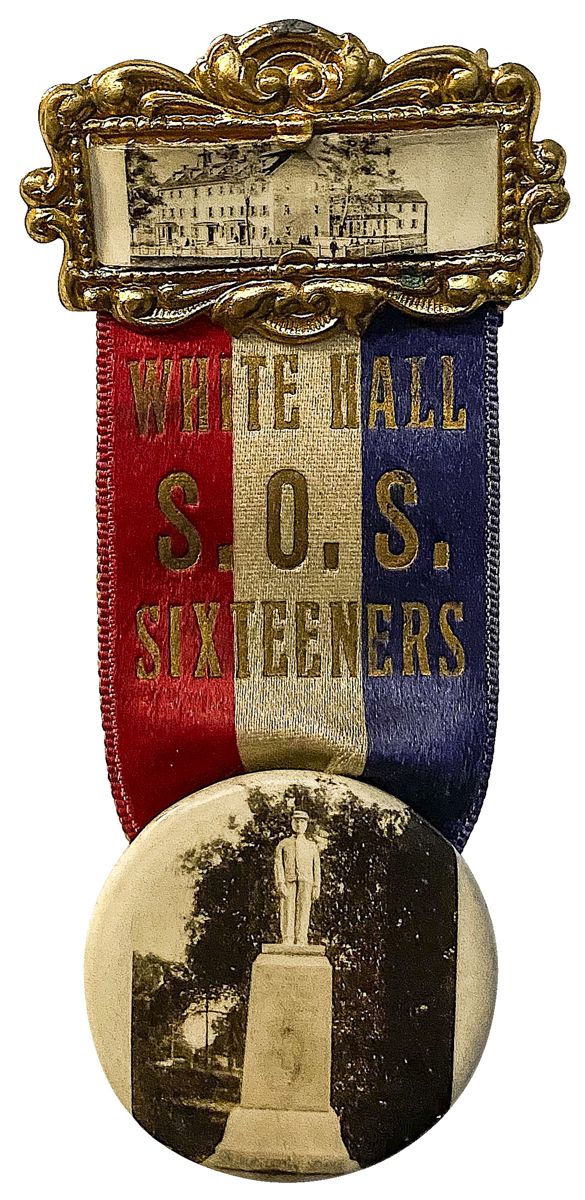
The precise number of children sent to institutions either because a mother sought employment or the child was a full orphan, meaning that the mother preceded the father in death, is unknown. Historians estimate that hundreds of thousands of children ended up in orphanages during the conflict. In Pennsylvania 1,226 children were enrolled in the Commonwealth’s Soldiers’ Orphan Schools by the war’s end.17 That number represents four percent of all Pennsylvanians who died in the Union’s service.18 Children who found themselves in institutions such as those established in Pennsylvania formed bonds with each other, a connection that lasted a lifetime. For example, in the decades after the conflict children sent to one of the nearly forty Soldiers’ Orphan Schools in the Keystone State formed the “Sixteeners.” The organization, which derived its name from the age when children left the school, oftentimes planned reunions with support from the Grand Army of the Republic. Reunions, such as the one that occurred for the Sixteeners who attended the Soldiers’ Orphan School in Mount Joy, Penn., in 1937, promised an opportunity for those “left bereft of one or both parents” during “those terrible years of the Civil War” to “come back with their memories” and view “relics of the old days.”19 As difficult as things were for widows and children of Union soldiers, the obstacles their Confederate counterparts faced seemed even more insurmountable. Despite entreaties, such as one issued by a newspaper in Harrisonburg, Virginia, in the late summer of 1863 for the Confederate government to pass legislation to “take care of the soldiers’ widows and orphans in these times of widows to a monthly allotment of one bushel of grain and eight severe trial,” Confederate authorities never created a system pounds of bacon. Children, up to age ten, received half a bushel of to support war widows wheat and three pounds of and their children.20 bacon.22 In Georgia, as one The only provision newspaper correspondent the Confederate noted, authorities offered government made salt “gratuitously to ‘all came in the autumn widows of soldiers” “ T H E M E M O R Y O F FON D PA R E N T S , of 1862 when the and “all other families AN D D E VO T E D H U S B AN D S , S ON S Confederate Congress AN D B R O T H E R S , W H O F E L L I N dependent upon the labor T H I S C R U E L WA R W I L L H AU N T T H E passed legislation that of a soldier.”23 V I S I ON S O F M I L L I ON S , M A R R I N G entitled the survivor of Regardless of the support E V E R Y P L E A S U R E AN D C A S T I N G a Confederate soldier a widow might receive, A G L O O M OV E R T H E PAT H WAY O F to receive back pay. some could not confront L I F E … W I D OW S AN D O R P H AN S , Claiming those funds the incalculable pain of WHOSE HUMBLE HOMES, THE involved submitting a losing a loved one. No ABODES IN M AN Y CASES OF claim in what historian P E N U R Y AN D S U F F E R I N G W I L L amount of money, food, or FO R M AN Y L ON G Y E A R S B E L I V I N G Robert Kenzer expressions of sympathy WITNESSES OF THIS FEARFUL characterized as a could remedy shattered AN D BLOODY CIVIL WA R .” “very complicated and hearts, whether Union or exhausting” process.21 Confederate. Newspapers, Some Confederate North and South, contained states, such as sad and grisly details of Virginia, attempted to how suicide seemed the alleviate the suffering only outlet for widows.24 of widows and children by establishing a system for local When Henrietta Commerford, whose husband Patrick, a private governments to provide foodstuffs. The provision entitled in 9th New Jersey Infantry, died on January 3, 1863, from wounds received near New Bern, N.C., Ribbon worn at a reunion of Sixteeners who five days earlier, attended the White Hall Soldiers’ Orphan she applied for a School in Camp Hill, Pennsylvania. (Jonathan A. Noyalas Collection) widow’s pension. A l t h o u g h awarded a monthly pension of $8 per month Henrietta struggled to make ends meet and so ventured to New York City to find work as a servant.25 A l t h o u g h she found a job Henrietta, overburdened by financial difficulties and her husband’s death, decided to commit suicide. On July 24, 1865, she overdosed on laudanum. The following day The Brooklyn Daily Eagle carried the sad story of the “RASH ACT OF A WAR WIDOW—Henrietta Commerford” who “committed suicide … by taking two drachms of laudanum. She had been in low spirit for some time in consequence of the death of her husband … becoming dejected she came to the determination to end her existence and thus avoid further earthly trouble.”26 The stories of the soldiers and family members explored in this article, ones that emulate the experiences of tens of thousands of people North and South, underscore two significant points worthy of consideration when thinking about the broader impact of Civil War battles. First, a battle’s significance can be measured in multiple ways. Traditionally a battle’s importance is judged by its strategic consequences or political outcomes. While noteworthy those usual measures fail to account for how what happened on the battlefield affected families. Whether the war’s largest battle or its smallest skirmish, for the wife transformed into a widow or the child made fatherless the war’s most significant moment came when their soldier at the front gasped his final breath. Second, for those left behind the impact of what occurred on the battlefield continued for years after the conflict. In some instances, the tribulations widows and children confronted after a loved one’s demise remained with them for the remainder of their lives. As the Civil War entered its second summer a resident of Marysville, Calif., far removed from the war’s major theaters, pondered how history, when the Civil War finally ended would remember the conflict. This unidentified Californian thought that future generations, those not alive during the war or directly impacted by the conflict, would exert all their attention on tales of heroism, bravery, and courage displayed on the battlefield. Although important, this Californian lamented that those celebratory stories would orient attention away from the war’s tragic consequences for families.27 This
IN THESE SEVERE
TIMES OF TRIAL.”
unknown Californian wrote in early August 1862: “The memory of fond parents, and devoted husbands, sons and brothers, who fell in this cruel war will haunt the visions of millions, marring every pleasure and casting a gloom over the pathway of life… Widows and orphans, whose humble homes, the abodes in many cases of penury and suffering will for many long years be living witnesses of this fearful and bloody civil war.”28 Jonathan A. Noyalas is a history professor at Shenandoah University and director of its McCormick Civil War Institute. He is the author or editor of sixteen books including
Slavery and Freedom in the Shenandoah Valley During the Civil War Era (University Press of Florida) and the forthcoming The BloodTinted Waters of the Shenandoah (Savas Beatie).
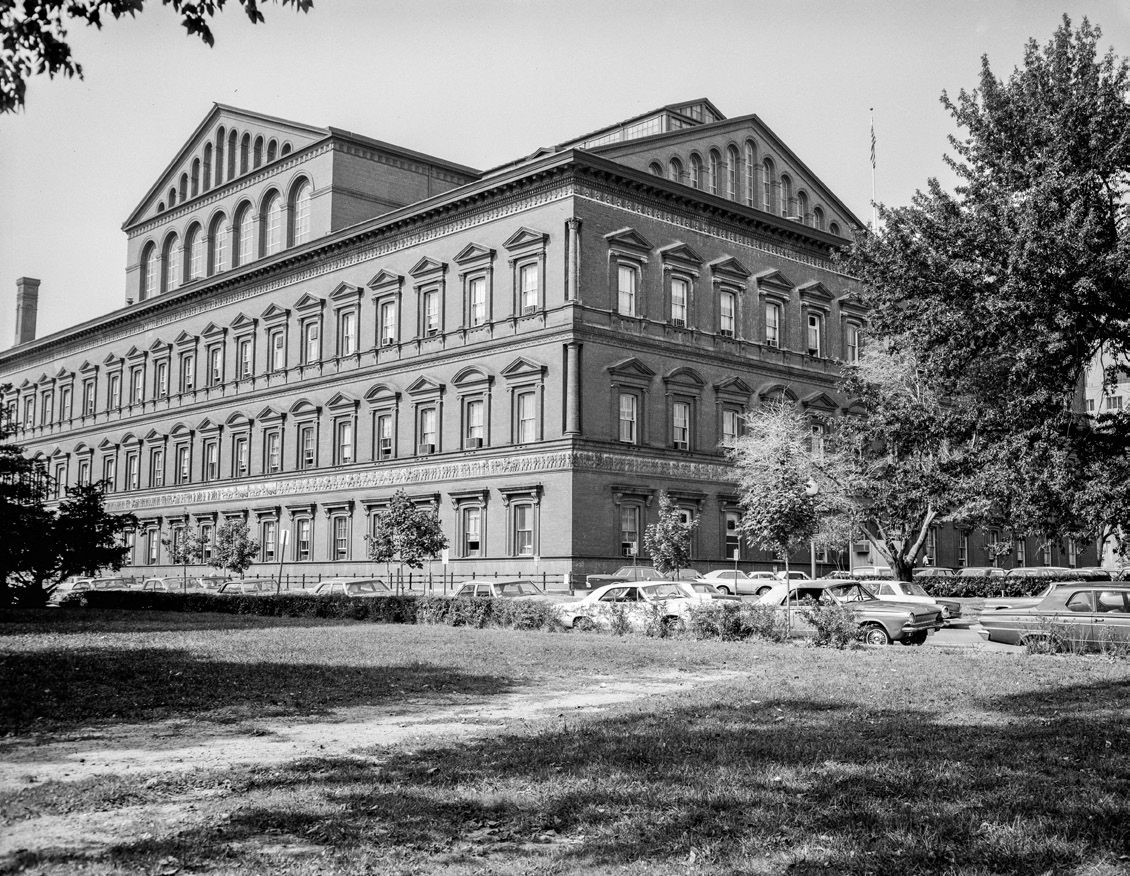
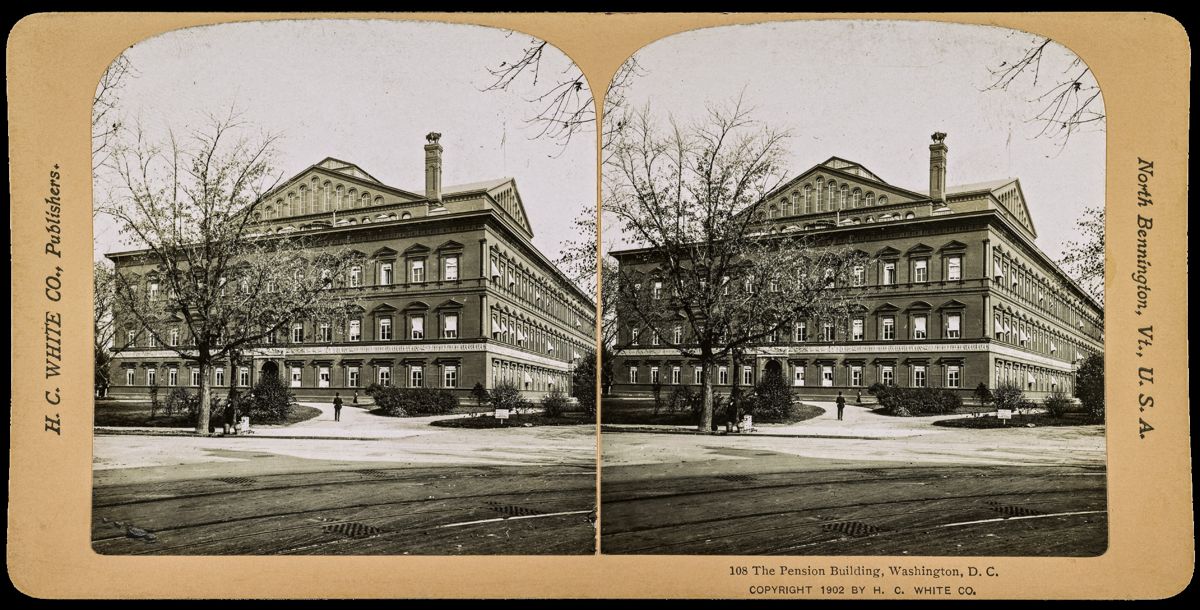
Above: Stereoview of Pension Building in Washington, D.C. By the end of 1865 the United States Bureau of Pensions approved claims for nearly 85,000 war widows. (Library of Congress) Below: South and West Facades of the Pension Building, Washington, D.C. (Library of Congress) The Reports of the Committees of the House of Representatives for the First Session of the Fifty-First Congress, 1889-’90 (Washington: Government Printing Office, 1891), 1; Frank Moore, Women of the War: Their Heroism and Self-Sacrifice (Hartford, CT: S.S. Scranton & Co., 1866), pp. 554-570. Jane Boswell Moore to friend, May 28, 1864, quoted in Advocate and Guardian (New York), July 16, 1864. Ibid. Patrick Dalton, 6th Connecticut Infantry, Compiled Service Record, National Archives and Records Administration, Washington, DC. Items from this collection hereafter cited as CSR. Items from this repository hereafter cited as NARA. Honora Dalton to Jane B. Moore, May 31, 1864, quoted in Advocate and Guardian (New York), July 16, 1864. Advocate and Guardian, July 16, 1864. Guide for Soldiers & Sailors’ Heirs (New York: Bragdon & Yerby, 1862), pp. 45-46. Edward Bates to Galusha Grow, March 11, 1862, in Executive Documents Printed by Order of the House of Representatives during the Second Session of the Thirty-Seventh Congress, 1861-’62 (Washington: Government Printing Office, 1862), 7: pp. 4-5. John P. Ushur quoted in John William Oliver, History of the Civil War Military Pensions, 1861–1865 (Madison: University of Wisconsin, 1917), p. 10. Ibid. Ibid. Report of the Commissioner of Pensions, November 15, 1862, quoted in Messages of the President of the United States to the Two Houses of Congress at the Commencement of the Third Session of the Thirty-Seventh Congress
(Washington: Government Printing Office, 1862), 2: p. 586. Patrick Dalton, 6th Connecticut Infantry, Widow’s Pension, NARA. Advocate and Guardian, July 16, 1864. Ibid., January 2, 1865. Ibid. Sarah D. Bair, “Making Good on a Promise: The Education of Civil War Orphans in Pennsylvania, 1863-1893,” History of Education Quarterly 51 (Nov. 2011): p. 469. Ibid., p. 460. Sunday News (Lancaster, PA), June 13, 1937. Rockingham Register (Harrisonburg, VA), September 4, 1863. Robert Kenzer, “The Uncertainty of Life: A Profile of Virginia’s Civil War Widows,” The War Was You and Me: Civilians in the American Civil War, ed. Joan E. Cashin (Princeton: Princeton University Press, 2002), p. 113. Ibid., pp. 122-123. Alexandria Gazette (Alexandria, VA), August 21, 1863. For further discussion of suicide among wartime widows see Diane Miller Sommerville, Aberration of Mind: Suicide and Suffering in the Civil War-Era South (Chapel Hill: University of North Carolina Press, 2018), pp. 67-75. Patrick Commerford, 9th New Jersey Infantry, Widow’s Pension, NARA; Patrick Commerford, 9th New Jersey Infantry, CSR, NARA; The Brooklyn Daily Eagle, July 25, 1865. The Brooklyn Daily Eagle, July 25, 1865. Angela Esco Elder, Love & Duty: Confederate Widows and the Emotional Politics of Loss (Chapel Hill: University of North Carolina Press, 2022), p. 2. Marysville Daily Appeal (Marysville, CA), August 2, 1862.
– MAKER –
&
&
This & That: Colonel Fremantle,
L Welcome to Texas By Gould Hagler
“In spite of their peculiar habits of hanging, shooting, &c., which seemed to be natural to people living in a wild and thinly-populated country, there was much to like in my fellow-travelers.” – Lt. Col. Arthur J.L. Fremantle t. Col. Arthur J.L. Fremantle’s Three Months in the Southern States is a well-known and highly regarded memoir. The British officer traveled to the Confederacy in 1863, via Cuba and Mexico, and spent three months traversing the new republic. His account, first published in 1864, tells of the land he crossed and the people he met. He offers commentary on the war being waged, on the issues related to that war and on the armies and people doing the fighting. I recently re-read the book’s first two chapters which take the reader across the Rio Grande from Matamoros and through the vast state of Texas. In this column, we will travel with the colonel to see what he saw and hear what he heard as he traveled through the Lone Star State. For much of the way his “pilot,” as Fremantle put it, was a helpful Irish-Texan merchant, Mr. M’Carthy. On April 2, Fremantle and M’Carthy “landed at the miserable little village of Bagdad, on the Mexican bank of the Rio Grande.” They made their way to Matamoros, a few miles upstream. Fremantle carried a letter of introduction addressed to Maj. Gen. John Bankhead Magruder, commander of the District of Texas, New Mexico, and Arizona, whom he hoped to meet while in Brownsville. While waiting, Fremantle crossed the river between Matamoros and Brownsville several times. On both sides of the border, he met various Confederate officers, local merchants, and the British viceconsul in Matamoros. Fremantle enjoyed the hospitality of his new acquaintances at dinners, dances, and the theater. There were “endless cocktails” to be imbibed, some “prepared in the most scientific manner.” On a less pleasant plane the British newcomer learned something of rough frontier justice. Some officers he met had recently hanged a man, a Unionist whom they had captured in a cross-border, retaliatory raid. A higher-ranking officer told Fremantle that this had been done “without his sanction,” but no action had been taken against the officers in question. Having waited 11 days for Magruder, and not knowing when or whether the general would appear in Brownsville, Fremantle and M’Carthy embarked on their journey. “Our vehicle,” Fremantle tells us, “was a roomy, but rather overloaded, four-wheel carriage with a canvas roof, and four mules.” The equine contingent was supposed to include two horses to help pull the vehicle through deep sand. In charge of this expedition was Mr. Sargent, “our portly driver,” who motivated his mules with loud and frequent cussing. Assisting Mr. Sargent was another mule driver, “a rough-faced, dirty-looking man, who rode up on a sorry nag.” Fremantle was surprised to hear M’Carthy address the assistant “with the title of ‘Judge.’” The Judge, we learn, was a minor magistrate of some sort, and also a member of the Texas state senate. The nag that carried the Judge was the only horse to arrive. The other had broken down, the Judge explained, so one would have to do. The trek would be an arduous one. There was much deep sand ahead, and only one nag to supplement the mules’ tractive power. Water and firewood were both scarce. The water at the first well reached “was very salt*, and made very indifferent coffee,” according to our informant, and the firewood at this stop could be reached only in the chaparral.” At a later point in the trip, the party resorted to using a ratranch for fuel. For the uninitiated, Fremantle helpfully added that rat-ranches “are big sort of mole-hills, composed of cowdung, sticks and earth, built by rats.” At one stop wild hogs devoured most of the company’s fresh meat. The men slept in the open and were tormented Antonio, where M’Carthy’s store was located and where by ticks and fleas. When they reached water (or struck water, Fremantle slept in a hotel. San Antonio was the secondas Fremantle adjusted his idiom to Texas mode), it was often largest city in Texas, with 10,000 people and “houses well salt. Not all the water, however: one time it came down from built of stone.” the heavens in a heavy two-hour thunderstorm. “No sooner Fremantle learned of more frontier justice while in San had we escaped from the sand than we fell into the mud, Antonio. “A woman was murdered at a ranch close by some which was still worse.” time ago, and five bad characters were put to death at San Two days out from Brownsville, Fremantle “espied the Antonio by the vigilance committee on suspicion.” cavalcade of General Magruder passing us by a parallel track, Fremantle remained in San Antonio for three days, meeting about half a mile distant.” He and M’Carthy rushed to catch with Confederate officers and touring about. He saw two up with the general’s command and were warmly greeted very pleasant springs and visited ruined missions. With when they succeeded. They letters of introduction to accepted a dinner invitation Gens. Braxton Bragg and and spent a long, festive Leonidas Polk, given to evening with the hospitable him by a colonel, Fremantle general and his staff. A set out for Houston. On this captain played the fiddle; leg he took a stage coach Magruder and other officers “into the interior of which sang; and “brewed punch” nine people were crammed brightened everyone’s on three transverse seats.” mood. One officer, an Others—“many others,” “aged and slightly elevated Fremantle says—clung to militia general,” was the roof of the conveyance. especially brightened and As the stage rocked along, made several “elegant” he admired the cultivated speeches. The general/host/ countryside and for the songster wore a red woolen first time saw cotton fields. cap, as he customarily did The other passengers were at such times. curious to learn “what Fremantle described was thought of their cause Magruder as a “fine in Europe; and none soldierlike man, of of them seemed aware about fifty-five, with of the great sympathy broad shoulders, a florid which their gallantry and complexion, and bright determination had gained eyes.” The general “spoke for them in England in of the Puritans with intense spite of slavery.” disgust, and of the first In Alleyton, 75 miles importation of them as west of Houston, Fremantle ‘that pestiferous crew of left the stage and boarded the Mayflower.’” a train. He noted that in On borrowed horses the democratic west “there Lt. Col. Arthur J.L. Fremantle. (and accompanied by men was only one class.” The tasked with returning them), Fremantle and M’Carthy caught comfortable seats “seemed luxurious after the stage.” The up with Mr. Sargent and the Judge. Thanks to his encounter engine and its two passenger cars crossed the Brazos River with Magruder, Fremantle was armed with “heaps of letters “in a peculiar matter.” It gained speed on a steep decline as of introduction.” it approached the river, raced across the bridge and, powered As he and his companions continued, they left the flat, by steam and momentum, managed to top the incline on the sandy (or muddy, depending) territory and entered a more opposite side. The crossing was successful, “But even in Texas pleasant landscape, “undulating or ‘rolling country,’ full this method of crossing a river is considered rather unsafe.” of live oaks of very respectable size.” Fremantle met some In Houston, Fremantle spent his first night in a crowded Texas rangers and noted they wore “the most enormous hotel room, then was invited to stay at the home of a General spurs I ever saw.” Also noteworthy was a practice of the Scurry, for whom he had a letter of introduction from General women he met: “Texas females are in the habit of dipping Magruder. Scurry arranged a dinner for the visitor, inviting snuff.” several officers and a judge, which gave his British guest Eleven days out of Brownsville, the travelers reached San another opportunity to meet people and learn about the
Confederacy, its people, and its cause. On this leg of the journey the hotel accommodations were The following day Fremantle boarded a train for Galveston. even worse than the ones Fremantle had endured earlier. He On the train he by chance met the man for whom Houston was and the judge shared a bed so dirty that they slept in their named. Fremantle found Sam Houston to be “a remarkable clothes, even with their boots on. The judge commented that and clever man…, extremely egotistical and vain.” Houston the boots “were a d____d sight cleaner than the bed.” was governor of the state in 1860 and “opposed the secession In Marshall, Fremantle got a respite from the ordeal of movement, and was deposed.” This Texas hero died less than riding in a packed stagecoach. From this town, 40 miles from three months after his encounter with Colonel Fremantle. Shreveport, Fremantle rolled toward the Louisiana border While en route Fremantle received a telegrammed invitation on a comfortable railroad train. However, this track ran only from the commander in Galveston. His host arranged for the 16 miles east of Marshall, at which point Fremantle and the colonel to view the port’s defensive works, some still under other passengers detrained and were “crammed into another construction. The fortifications were designed by a Confederate stage.” Soon the stage was in Louisiana, some 20 miles from officer who had formerly been in the Austrian army. The Shreveport. workers included 150 whites When Fremantle crossed and 600 slaves “lent by the state line on May 8, he had the neighboring planters.” been in Texas for one month Fremantle paid a call on the and eight days. Twenty-five British consul who, blockaded of those days were spent on with the Confederates, was the move, by carriage (with unable to communicate with Mr. Sargent and the Judge), the outside world. by stage and by rail. Google Fremantle returned to Maps tells me that, counting Houston and from there his side trip to Galveston took a train to Navasota, a and back, he covered nearly town 70 miles to the north, 800 miles. On the way, he where the rail line ended. His met numerous Confederate destination was Shreveport, officers, including several of La., 250 miles distant. He high rank. He traveled with left Navasota by stagecoach, and conversed with civilians one just as cramped as the of various sorts and stations previous one and dangerously in life. He saw much, heard top-heavy from the weight much, and learned much of topside passengers. His about Texans, more generally fellow-travelers were “mostly about Southerners, and elderly planters or legislators, about the war being fought and there was one judge from by these people to win their Louisiana.” As he conversed independence. The journey with these gentlemen, he so far had been in an area that heard some things that would had witnessed little fighting, not have been spoken had any but as he moved east that military men been present. would change. Fremantle writes that his *This is not a typo. I was “companions were united in surprised to learn that “salt” speaking with horror of the is an adjective as well as a depredations committed in noun and a verb. this part of the country by Maj. Gen. John Bankhead Magruder. their own troops on a line of march.”
&
Gould Hagler is a retired lobbyist living in Dunwoody, Ga. He is a past president of the Atlanta Civil War Round Table and the author of Georgia’s Confederate Monuments: In Honor of a Fallen Nation, published by Mercer University Press in 2014. He has been a regular contributor to CWN since 2016. He can be reached at gould.hagler@gmail.com.
Fort Fisher items wanted anc en Prov t!
us eaM
Civil War Soldiers and Weather on Central Virginia’s Battlefields By Tim Talbott esides commenting on food, perhaps the single thing most mentioned in Civil War soldiers’ letters, diaries, and memoirs is the weather. That is probably not surprising when one considers how much time soldiers spent out in the elements and how much a particular day’s weather conditions might affect their lives and brighten or dampen their morale. Other than Fredericksburg and Mine Run, the campaigns fought at Chancellorsville, the Wilderness, and Spotsylvania Court House occurred in what are typically mild weather months in central Virginia. However, the stresses of constant maneuvering, and enduring combat, often elevated the soldiers’ sense perceptions of climatological conditions like temperature. Similarly, in the hustle and bustle of campaigning, soldiers often jettisoned equipment that in normal times helped them endure the elements and keep comfortable. Additionally, as battlefield visitors to the Old Dominion probably know, the weather here can change drastically without warning. All these things helped leave strong impressions on the soldiers.
B Fredericksburg
In the days leading up to the Battle of Fredericksburg a significant cold snap came over the area. Cyrus Forwood, serving in the 2nd Delaware Infantry, mentioned in his diary that December 6-7, 1862, was “the coldest I have experienced since I joined the Army. Three men froze to death on Picket.”
But soon, temperatures started to climb. J.P. Coburn, 141st Pennsylvania wrote on December 10, “the weather is warm and pleasant today & the snow which has lain for several days is fast disappearing.” Melting snow and thawing earth created seas of mud. Although some histories depict the December 13 battle as cold and snowy, contemporary and many recollected accounts disagree. “The weather … was much above freezing point … there was no snow on the ground except on the northern exposures and in the woods,” remembered Oregon Foster, 9th Virginia Cavalry. One recording had the high temperature that day as 56 degrees. Exaggerated accounts of wounded soldiers literally freezing on the battlefield are legend, as the temperature that night did not drop below 40 degrees. However, if not properly equipped, conditions proved uncomfortable for soldiers. For example, Sgt. Charles T. Bowen, 12th U.S. Infantry, described December 13, 1862, as arriving “bright and beautiful,” but, he got cold after the sun went down. “When we were relieved we went back into the city nearly starved & frozen for our blankets were in our knapsack & we had no chance to eat while out,” Bowen wrote.
Chancellorsville
As Gen. Joseph Hooker maneuvered the Army of the Potomac to attack the Army of Northern Virginia, a thunderstorm hit on the night of April 28, 1863. It muddied the roads, which made marching While soldiers commented on extremely cold temperatures in and moving supplies much more the days before and following the Battle of Fredericksburg, most difficult. A lightning strike knocked period accounts note the rather mild weather conditions on out part of the telegraph line severing December 13, 1862. (Library of Congress) communications. The arrival of May 1 though, brought sunny skies and mid70s temperatures. John J. Shoemaker of Stuart’s Horse Artillery referred to it as a “genuine May day.” Capt. Alfred Lee, 82nd Ohio, wrote that on May 2 “the sun dawned clear and beautiful.” For those like Captain Lee in the XI Corps camps it was a comfortable day. However, for some of Gen. Thomas J. “Stonewall” Jackson’s hard marching Confederates, attempting to get into attack position, “the weather was fine but we suffered for water,” recalled South Carolinian Lt. J.F.J. Caldwell. Detached from the II
Corps and fighting with Sedgwick’s VI Corps, Maj. Henry Livermore Abbott, 20th Massachusetts Infantry, wrote about May 3rd, “All day there was skirmishing & the heat was terrible …” May 3 proved to be the hottest day of 1863 to that point, with the temperature rising to 80 degrees. A bright sun and cloudless day added to the miseries of the combatants. Following the fight at Chancellorsville, Taliaferro N. Simpson, 3rd South Carolina, wrote to his father, “My shoes are out, and my feet are so sore that I can scarcely walk. We have no tents, and the weather is as cold and rainy as any in winter time.” William White of the Richmond Howitzers concurred in his diary entry for May 5, when he wrote, “This afternoon the rain fell in torrents and soon our trenches were filled with water. Having no tents we were entirely unprotected, and the cold rain perfectly benumbed us.”
Moderate weather dominated the Battle of Chancellorsville fighting on May 1-3, 1863. However, on May 5, nature’s fury unleashed a storm that soaked both the victors and the vanquished. (Library of Congress)
Mine Run
Attempting to score a victory before going into winter quarters, Gen. George Meade attempted to turn the right flank of the Army of Northern Virginia positioned along the Rapidan River. Soldiers on both sides commented on the bad weather and bitter cold during the campaign. In a letter to his fiancé, Major Walter Taylor of General Lee’s staff noted when describing November 27, 1863, “It was intensely cold that morning; we left camp at 3 o’clock … the ground frozen as hard as ice.” Taylor thought it was funny how the cold frosted the men’s beards: “all around one’s mouth innumerable icicles hung appendant from the moustache and whiskers …” Holman
Both Union and Confederate soldiers commented on the bitter cold during the Mine Run Campaign. (Public domain)
Melcher, 20th Maine, wrote his brother that on the morning of November 27, “it was raining hard.” He continued that “It stopped raining about noon, but was muddy and unpleasant.” A soldier in the 122nd New York wrote to the Syracuse Daily Journal that “it was bitter cold, the men seated and lying round their fires …” in attempt to keep warm. Col. Robert McAllister, 11th New Jersey, informed his wife, “The night was bitter cold. The north wind and cold frost made us suffer. Those who had no blankets suffered terably [sic].” While the Confederates were disappointed that the Federals did not attack, and the Federals were happy that they did not have to, all were pleased to get out of the elements and into winter quarters.
The Wilderness
After spending the winter and first part of the spring of 1864 in winter quarters in Culpeper County and Orange County, Union and Confederate soldiers began preparations for a new campaign season. On May 2, cannoneer William White noted, “in the afternoon the skies were overspread with clouds and angry west winds came sweeping from the mountains with a hurricane-like sound … then came the rain and hail, driving full in our faces.” Lt. N.D. Peterson, 10th New York Cavalry, also commented on the May 2 wind and its results, “It was a cloud of dust—Virginia real estate on the rampage.” The day before going into the Battle of the Wilderness, Mississippian Lt. William C. Nelson, commented in a letter to his mother: “Day before yesterday we had quite a storm, and on the mountains snow was visible yesterday, but the weather today is quite warm and summer-like.” Sgt. Charles T. Bowen took note in his diary that, “The march on the 5th [May 1864] was very hot and we all had to throw away part of our kit. I left my overcoat on the roadside.” The temperature rose to the mid-70s on the first day of the battle. However, few breezes made it into the thick underbrush of the Wilderness causing soldiers to believe it was much warmer. Joseph Graves, Bedford (Virginia) Light Artillery, wrote that day, “It was very warm and dusty.” Thick smoke from thousands of rifles and wildfires in the dense underbrush only added to the uncomfortable conditions. On May 6, temperatures rose to the low 90s. Fierce fighting created more ground fires. So much movement by the contending forces also created clouds of dust. A soldier in the 37th Massachusetts remembered, “the many wheels and feet of horses and men pounded the dry soil into impalpable dust, which rose hundreds of feet in the air.” But there was no time to recover physically or mentally as Gen. U.S. Grant moved toward Spotsylvania Court House.
Fighting in dense woods during the Battle of the Wilderness made it feel warmer to the soldiers than it actually was. (Library of Congress)
Spotsylvania Court House
Since the ongoing fighting at Spotsylvania spanned almost two weeks, there was greater opportunity for variety in the weather. Sergeant Bowen wrote about May 8, 1863, noting, “We made a forced march & the day was terrible warm & dusty.” Nearby recordings put the high temperature at 95 degrees. On May 10 fighting continued, as did the hot weather with the mercury reaching 93 degrees. On May 11, a light drizzle turned heavier late in the day as temperatures rose. Federal soldiers found it difficult to find their way while positioning for an attack early on May 12. John Haley, 17th Maine, commented “rain fell steadily, and the night so dark men has to almost feel their way.” Once in line and ready, the assault unfolded in the unrelenting rain. The prevailing opinion among soldiers was that the rain on May 12 made one of the war’s worst days of combat even worse. A Union soldier wrote poetically, “it seems as if Heaven has to weep over the scene.” Sergeant Bowen described the conditions, “On the 12th we were ordered out in a tremendious rain & advanced through a ploughed field under a heavy fire within a short distance of the rebel works. Here we were ordered to lay down in the mud & the rain poured on us in torrents.” David Holt, 16th Mississippi, remembered, “All the time a drizzling rain was falling. The blood shed by the dead and wounded in the trench mixed with the mud and water.” Rain continued at Spotsylvania through May 17, turning fields and roads into oceans of mud. The fighting continued into May 18 and 19, both remarkably beautiful days, but tempered by additional bloodshed. On May 20-21, General Grant left Spotsylvania moving south around General Lee’s right flank to continue more punishing marches and combat through all types of weather on other fields of fury.
Fought during a downpour, the May 12, 1864, battle at Spotsylvania created horrific ground conditions for the soldiers enduring it. (Library of Congress)
Tim Talbott is the Chief Administrative Officer with the Central Virginia Battlefields Trust. The mission of CVBT is to preserve land associated with the four major campaigns of: Fredericksburg, Chancellorsville, Mine Run, and the Overland Campaign, including the Wilderness, and Spotsylvania Court House. To learn more about this grassroots preservation non-profit, which has saved over 1,700 acres of hallowed ground, please visit our website www.cvbt.org.
Aloha! I’m writing from vacation in Hawaii, where there’s not much American Civil War history baked into the landscape, as you can probably imagine. Yet, the war is not totally absent. On the way to Oahu’s north shore, I drove past Schofield Barracks, named for former Civil War General John M. Schofield. Schofield served as general in chief of the U.S. Army from 1888–1895, a highly consequential tenure during which he proved to be an influential reformer. He also served a stint as secretary of war under controversial Andrew Johnson. People might best know the barracks as the setting of From Here to Eternity. Schofield came to Hawaii in 1872 and first recommended the establishment of a military base at Pearl Harbor. I of course visited the NPS site at Pearl so I could pay my respects at the USS Arizona memorial. That has been a bucket-list destination for me my entire adult life. The experience was profound. I appreciated a remark one ranger made before the ferry departed for the memorial: “This is not an ‘attraction.’ It’s a cemetery. Treat it the same way you would the hallowed ground at a place like Gettysburg or even Arlington.” The most unexpected Civil War connection came when we landed on the west side of the Big Island. Hawaii is the youngest of the islands, and so Mother Nature has had less time to work her magic on the land. A ridge of dormant volcanoes bisects the island, and they capture all the moisture on the
The view from the western side of Big Island in Hawaii. island’s east side, which is lush and tropical. The drier west side consists of mountainous grasslands and vast lava beds in various stages of erosion. The less-eroded stretches looked like dried black cow patties, hundreds of yards wide. In places where wind and rain have worked on the landscape, the lava had begun to break apart and more resembled huge tumbles of dark, rich humus deposited willy-nilly by a Titan’s dump trunk. Think moonscapes. This brought to mind the experience of Robert E. Lee during the Mexican War. In August 1847, Lee had to scout a path through a lava-bed region known as the Pedregal, “a field of volcanic rock like boiling scoria suddenly solidified, pathless, precipitous …” It was reportedly a land where no horses could go and “men only with difficulty.” Lee, a captain of engineers, had to scout out a crossing and then lead Winfield Scott’s army across. Jeff Shaara actually wrote a good account of this in his novel Gone for Soldiers, which is where I first heard of it, but I could never quite understand what Lee faced in that dangerous mission, until I saw the lava beds on Hawaii’s west side. It was one more reminder of the many ways landscapes help us understand history, and why preserving the ground remains so vital.
Chris Mackowski, Ph.D.
Editor-in-Chief
Tenth Annual Emerging Civil War Symposium at Stevenson Ridge
Join Emerging Civil War’s Tenth Annual Symposium in August!
The theme of this year’s Emerging Civil Symposium is 1864: The War in the Balance. Our speakers’ lineup includes Jonathan Noyalas and Brian Steel Wills, and on Sunday Chris Mackowski will lead a battlefield tour of the Bloody Angle. Join us from August 2-4 at Stevenson Ridge on the Spotsylvania battlefield in Virginia. You can find out more details or order tickets at our Symposium page https://emergingcivilwar.com/ecw_event/2024symposium.
News & Notes
Bert Dunkerly is attending National Park Service Historic Weapons training, to stay certified to supervise demonstrations. He will be training on matchlock, flintlock, and percussion small arms, as well as eighteenth and nineteenth-century artillery. On March 23, he spoke at Historic St John’s Church in Richmond, part of the annual Liberty or Death commemoration Phill Greenwalt and Rob Orrison attended the 11th Annual Conference of the American Revolution March 15-17, in Richmond, Va., on behalf of Emerging Revolutionary War. Chris Kolakowski’s Tenth Army Commander received some glowing feedback from Military Review: “An outstanding volume, which is extremely beneficial for two key reasons. First, it adds significantly to one’s understanding of the Battle of Okinawa and to the operations of the Alaska Defense Command. Second, it provides readers with an opportunity to become acquainted or to greatly improve their understanding of Buckner.” Dave Powell spoke at the Shenandoah Valley Battlefields 2024 National Conference in Harrisonburg, Va. Evan Portman crossed a few items off his Civil War bucket list. He stopped at Maj. Gen. John Fulton Reynolds’ grave on a recent trip to Lancaster, Penn., and journeyed to Harpers Ferry to hike Maryland Heights. He also spoke to the Western Pennsylvania Civil War Roundtable on the “Chaos and Confusion in the Wheatfield at Gettysburg.” Brian Swartz was interviewed by WABI Channel 5 to discuss his book Passing Through the Fire: Joshua Lawrence Chamberlain in the Civil War.
ECW Bookshelf
Across North America’s periphery, Civil War campaigns waged over whether the United States of Confederacy would dominate lands, mines, and seaborne transportation networks of North
America’s mineral wealth. The United States needed this wealth to stabilize their wartime economy while the Confederacy sought to expand their own treasury. Confederate armies advanced to directly seize the West and its gold and silver reserves while warships steamed to intercept Panamá route ships transporting bullion from California to New York via Panamá. United States forces responded by expelling Confederate incursions and solidified territorial control by combating Indigenous populations and enacting laws encouraging frontier settlement. At sea, the U.S. Navy patrolled key ports, convoyed treasure ships, blocked Confederate naval attacks, and integrated continent-wide intelligence networks in the ultimate game of cat and mouse. Explore the hemispheric Treasure and Empire in the land and sea adventures to Civil War by Neil Chatelain. control North America’s Chatelain’s newest book mineral wealth, linking the explores efforts by the Union Civil War’s military, naval, and Confederacy to secure political, diplomatic, and North America’s mineral economic elements like never wealth for the war effort. before.
ECW Multimedia
In March, guests on the Emerging Civil War podcast included… Award-winning author John Waugh discusses his new book, Unforgettables: Winners, Losers, Strong Women, and Eccentric Men of the Civil War Era. Emerging Civil War’s own Dan Welch and Kevin Pawlak discuss their recently released book Never Such a Campaign: The Battle of Second Manassas. Emerging Civil War’s chief historian, Cecily Nelson Zander, discusses her new book The Army Under Fire: Antimilitarism in the Civil War Era. Dr. Angela Zombek of the University of North Carolina discusses incarceration, occupation, and insurrection in the Civil War. You can listen for free on Spotify or Apple Podcasts, or at https://emergingcivilwar.com/the-emerging-civil-warpodcast/. You can also find video versions of these podcasts on our YouTube page, along with a panel discussion about the end of Civil War Times magazine.
Shrouded Veterans
On January 12, 1884, Edward Heaton, a distinguished artillery lieutenant during the war, shot himself in the dining room of his New Jersey home. He was 41 years old. Was Heaton’s decision to take his life linked to war trauma, or could there have been other factors involved? Whatever the cause, he took the answer to the grave. Read more about Heaton and the effort to mark his grave at: https://emergingcivilwar.com/2024/03/03/shroudedveterans-distinguished-artillery-lieutenant-commitssuicide-after-the-war.
Skull and Bones members from the class of 1869. Heaton is standing to the far left.
“My intention is to fight the Kearsarge as soon as I can make the necessary arrangements… I beg she will not depart before I am ready to go out.” – C.S. Capt. Raphel Semmes, CSS Alabama
Officers of the USS Kearsarge. Capt. John A. Winslow is third from left. Colorization © 2024 civilwarincolor.com, courtesy civilwarincolor.com/cwn. (Naval History and Heritage Command)
On Sunday, June 12, 1864, U.S. Capt. John A. Winslow, USS Kearsarge, signaled his crew to return to the ship and was underway within two hours. Winslow had received a telegram that the commerce raider CSS Alabama was anchored 300 miles away in Cherbourg, France. After a year of hunting, his prey was within Winslow’s grasp. The Confederacy’s strategy to counter the Federal blockade was to employ its navy to attack Northern merchant shipping. The United States had previously used guerre de course, literally meaning war on commerce, against Britain’s maritime trade. By far, the most famous commerce raider was Capt. Raphel Semmes and his ship, the CSS Alabama. She was built by British shipbuilders John Laird Sons and Company. To circumvent British neutrality laws, she could not be armed until after reaching international waters. At Terceira Island in the Azores, the Alabama was armed with British made ordinance consisting of six 32-pdr. naval smoothbores (three each on the port and starboard side), the fore pivot cannon was a 110-pdr., 7-inch Blakely rifled muzzle-loader, and the aft pivot cannon was an 8-inch smoothbore. The Alabama was christened August 24, 1862. On January 11, 1863, she sank the USS Hatteras off the coast of Galveston, Texas.
CSS Alabama. Capt. Raphael Semmes standing by 110-pounder rifled gun. First Lt. John M. Kell is by the ship’s wheel. Colorization © 2024 civilwarincolor.com, courtesy civilwarincolor.com/cwn. (Naval History and Heritage Command)
The success of the Confederate navy capturing prizes drove marine insurance rates from 1.25% of cargo value to 6%. Merchants clamored for convoy escorts. President Lincoln refused to weaken the blockade by reassigning warships. Eventually, 18 warships were ordered to hunt down the commerce raiders. The Boston Post considered it, “like ten cats looking for a weasel in a hundred acre lot.” On April 6, 1863, Winslow took command of the Kearsarge, a Mohican-class sloop of war. She was launched September 11, 1861, and tasked with hunting Confederate commerce raiders. The Kearsarge was powered by steam and sail and had a retractable screw propeller with an extended hull with a narrow beam. She was armed with two 11-inch Dahlgren smoothbore guns, a 30-pdr. Parrott rifle in the forecastle, and four 32-pdrs. (two each on the port and starboard side). For about six months, Winslow followed his predecessor’s strategy of using days or weeks-old sightings of the Alabama to guess where she might be heading next. Then, Winslow had an epiphany. The raiders needed coal, supplies, and ship repairs. Instead of wearing out his crew on ship-chasing hunches, he focused on where his game would likely be found. Winslow decided to take the Kearsarge around the English Channel and focus on the French ports of Brest, Calais, and Cherbourg.
View in the Civil War exhibit area, showing the sternpost of USS Kearsarge with an unexploded Britten shell from the CSS Alabama embedded in it, a relic of the June 19, 1864, battle between the two ships. (Navy Memorial Museum, Building 76, Washington Navy Yard, Washington, D.C.)
In the spring of 1864, Semmes was contemplating his next moves. His ship had traveled 75,000 miles around the world on seven raids. The Alabama’s crew boarded nearly 450 vessels, captured or burned 65 Northern merchant ships, costing the North over $6 million in lost cargo, and took more than 2,000 prisoners without any loss of life among either prisoners or her own crew. According to Semmes, the Alabama was “like the wearied foxhound, limping back after a long chase, foot-sore and longing for quiet and repose.” Furthermore, “the last batch of newspapers captured were full of disasters. Might it not be that, after all our trials and sacrifice, the cause for which we were struggling would be lost?” The Alabama needed a retrofit. Leaks had dampened some powder rendering it unusable. Fuses in some shells had gone bad. Where could she safely be repaired? England was out as the British government was adhering to neutrality. Southern ports may have fallen into Federal hands. Semmes turned to France. The Alabama arrived in Cherbourg on June 11, 1863. On June 14, the USS Kearsarge arrived. Semmes had to decide quickly. He could pay off the crew and lay the Alabama in Cherbourg; or in the dark of night, build up steam and dash out of the harbor. However, Semmes was “tired of running.” He chose to fight. On June 19, the Alabama steamed out of the harbor. The thousands of spectators that had gathered to watch the Americans battle off their shores cheered. The Kearsarge led the way six or seven miles from the coast, well into international waters. About 10:50 a.m., the Kearsarge turned and sped towards her opponent. The Alabama fired first and missed. The Kearsarge held fire until the combatants were within one half mile. Winslow noticed that Semmes had shifted one of his guns to the starboard side. He had an additional gun moved to the Kearsarge’s starboard. Winslow ordered, “All guns! Open fire!” The Alabama’s flag fell. Semmes replaced it with a larger flag. The two ships traveled in a clockwise circle with their starboard sides towards their foe. A shell wounded three of a Kearsarge gun crew. As Semmes watched, the Blakely fore pivot cannon fired a 110pdr. shell into the Kearsarge’s stern post. It failed to explode. The two ships drew closer in a tightening circle. The Alabama’s crew cheered as her fire hit the hull at the Kearsarge’s boiler. They were stunned to see the shell bounce off. The Kearsarge’s sides
The U.S. Navy warship Kearsarge crew engages the CSS Alabama off the French port of Cherbourg on June 19, 1864. (Library of Congress)
had been draped with 120 fathoms of sheet chain, bolted down and covered with 1-inch planking over her most vulnerable areas. “It was the same thing as if two men were to go out and fight a duel, and one of them, unknowing to the other were to put on a suit of mail under his outer garment,” wrote Semmes. The Alabama was rapidly firing more rounds but the Kearsarge’s were more accurate. Overloading additional coal to surround the Alabama’s bulkheads and lower her waterline wasn’t protecting her. The Alabama’s aft pivot gun crew were hit by a shell. A shovel was used to toss the unidentified remains over the side. A piece of shrapnel hit Semmes’ right hand during the seventh circle. Semmes could feel his ship was lower in the water. He ordered Lt. John McIntosh Kell to go below “and see how long the ship can float.” As Kell passed the wardroom he saw the surgeon standing by his operating table as a shell swept the table, patient, and instruments through the other side of the ship. The surgeon paused before turning to his next patient. Kell continued to the engine room then returned to Semmes. He reported the ship had ten minutes afloat. Semmes ordered the white flag raised, the wounded ferried to the Kearsarge, and all who could, to abandon ship. Semmes and Kell were among the last to leave. Semmes threw his sword into the water before he jumped into the sea.
The water was filled with bobbing heads. Winslow yelled to the English yacht Deerhound, “For God’s sake, do what you can to save them!” The Deerhound rescued 42 men, then rushed back to England, taking Semmes with them. The Battle of Cherbourg lasted about 90 minutes. It earned Winslow a promotion. The Medal of Honor was awarded to 17 crew members. The Kearsarge’s sternpost with the unexploded shell was boxed up and shipped to Washington, D.C. Lincoln wanted to see the narrow escape the ship and crew had experienced. The sternpost can be seen today at the National Museum of the U.S. Navy.
Sources: Keith, Phil and Tom Clavin. To the Uttermost Ends of the Earth: The Epic Hunt for the South’s Most Feared Ship—and the Greatest Sea Battle of the Civil War: Hanover Square Press, 2022. Symonds, Craig L. The Civil War at Sea: Oxford University Press, 2012. Foote, Shelby. The Civil War: A Narrative: Volume 3: Red River to Appomattox: Vintage Books, 1974.
Stephanie Hagiwara is the editor for Civil War in Color.com and Civil War in 3D.com. She also writes a column for History in Full Color. com that covers stories of photographs of historical interest from the 1850’s to the present. Her articles can be found on Facebook,
Tumblr and Pinterest.
Author with 32-pdr. smoothbore, “Big Bill.” “Big Bill” served on the USS Kearsarge during the Battle of Cherbourg. (David Richardson)
Critic’s H o William r Andrew Fletcher, n Rebel Private e Front and Rear (1908) r
By Stephen Davis ood’s Texas Brigade was arguably the most famous fighting unit in the Army of Northern Virginia. Its men took pride, as Susannah J. Ural writes, as “the best soldiers in Robert E. Lee’s army and all the Confederacy.”1 One of them was William Andrew Fletcher. Born in St. Landry Parish, Louisiana (west of Baton Rouge) on April 23, 1839, his family moved to Texas in 1856. In 1859, Fletcher relocated to Beaumont, where he worked as a millwright. After Fort Sumter, at the age of 22, he enlisted in Company F, 5th Texas Infantry. Ordered to Richmond, Fletcher survived the measles and mumps, deadly ailments among encamped soldiers early in the war. He saw the elephant during the Seven Days, was wounded at Second Manassas, and fought at Fredericksburg. Afterward he declined to offer himself for a lieutenant’s vacancy. “I enjoyed getting in front,” he affirmed, “and would not lay down my gun.”2 As Dr. Bell Wiley wrote of Fletcher’s memoir, “He was in the war to kill Yankees, and he killed them
8th Texas Cavalry. (Panhandle Plains Historical Museum)
at every opportunity.”3 During the winter of 1862-63, despite Indeed. his expressed reluctance, Fletcher was appointed corporal, The Texan who wanted to kill Yankees appreciated the sight and held that rank to the end of the war. of dead ones. Approaching Malvern Hill, Fletcher came upon After fighting at Gettysburg, he was transported with Longstreet’s “evidence of a masterly piece of marksmanship”: rows of dead two divisions to Georgia in time for Chickamauga. There he received Yankees, laid out in tight rows, “so close that it put one in mind of a his second wound, an injury to his foot so serious that he was railroad grade with ties laid for ironing.” “The sight may have been transferred out of the infantry. In early 1864, he joined the 8th Texas awful to some,” he remarked, “but the fellows in this case who did Cavalry, in which he served throughout the Atlanta Campaign. He the viewing wanted to see others.” (I’m reminded of General Lee’s ended the war with Johnston’s surrender at Bentonville. remark on how war can become a thing of fondness.) Fletcher returned to his home in Beaumont, got married, Bill Fletcher was a diehard Rebel, one to whom the sight of entered the lumber business, and became rich as a landowner. slain Yankees gave a sense of satisfaction. Perambulating the field In 1907, well into his sixties, Fletcher composed his memoir, of one of the Seven Days’ fights, “I saw more dead bodies of the Rebel Private Front and Rear, which was published by a right kind, covering broad acres, than it was ever my pleasure to Beaumont press in a small edition. see before or since.” He noticed that most of the enemy dead had Bell Wiley rescued Fletcher’s reminiscence from oblivion been stripped of their uniforms. The soldiers who did this were when he edited it for republication in 1954 by the University not, in all cases, seeking replacement of their own garb so much of Texas Press. “The volume derives its value as a historical as scouring for merchandise to vend in the city, “as the clothing, source,” Dr. Wiley wrote when washed, was in his Preface, “mainly good stock in secondfrom Fletcher’s honesty, hand stores.” Besides, his close observation, he reasoned somewhat the richness and variety vengefully, “there was of his experience, and no harm in stripping the “Knowing the great disadvantage the sharpness of his dead, when the party memory.” stripped was a party to that was to our front caused the These qualities are on blockading our ports.” thought: Where is our boasted Lee? happy display throughout Then came Gettysburg, Fletcher’s narrative. and Hood’s assault on the Let’s begin with lice. Round Tops July 2. Why were we fighting an impregnable Encamped at Richmond, the 5th Texas, part of “We were soon position—was it ignorance? Hood’s Brigade, whiled forward and near away the time in various the opposite side ways. Writing forty years of the valley. We after the war, Fletcher still routed pickets and remembered the “itch,” scaled rock fences, the long welt caused by and worked our way a louse. After snatching to the front rapidly, one, “I could see its legs with pickets giving working.” Then he stripped off his clothing and held it and his bedding way before us, firing but little. We soon struck the foot of to a fire to kill the little beasts. The fabric became well scorched, but the hill, and found it rough and rocky, with large boulders he triumphantly “cooked the life out of most of them.” now and then, so our lines were not at all times well closed. To supplement his drab rations while at Richmond, Fletcher We soon were near enough the enemy’s line for them to and a buddy, Bill “Pard” Pemberton, went out into the streets. open fire. We had but poor chance to retaliate with much Wending through the sidewalk merchants, he and Bill worked effect. Our men near me commenced falling rapidly and out a system. One would engage the merchant in conversation especially color bearers. We did not attempt to scale the while the other would sneak food into his pockets. “Pard said hill for it would have been a good job on some parts for he could not see any harm in getting stuff this way, for the one used to mountain-climbing stripped for business.” fellow never missed it,” as Fletcher justified. Besides, this was wartime; “‘foraging’ was the word applied to such outings “The Yanks had a good thing and knew it,” he sorrowfully during the war—in civil life it is called ‘shoplifting.’” recalled. Having reached Devil’s Den in the assault, Fletcher He recalled the time during the Seven Days when his regiment spent the night of July 2-3 among the rocks; “the rock pile gave was in back, in reserve. That meant he saw the pitiable wounded me protection, either lying down or sitting in a stooping position.” coursing to the rear. Then, when ordered to advance, he saw the It’s noticeable what a soldier remembers years after the war. dead and dying strewn over the field. This caused him, pen in hand, Of Hood’s bloody charge against the enemy left, Fletcher to meditate on the meaning of it all—that is, of the senselessness of observed laconically that “the butchery of the second day, was, war itself. He concluded by simply reckoning, “as a man becomes as far as I was concerned, discouraging.” “It looked as though more aged and has bettered his reasoning, the clearer insight he has our officers were blind,” he grumbled, as “it looked to me to the great danger of unreasoned public agitation.” that a flank move would have dislodged the enemy.” Second-
Why this ignorance?
I guess so.”
guessing generals in such situations is a soldier’s prerogative. “Knowing the great disadvantage that was to our front caused the thought: Where is our boasted Lee? Why this ignorance?” he asked himself. “Why were we fighting an impregnable position—was it ignorance?” Then came the answer: “I guess so.” Fletcher was part of the grand troop movement that sent Hood’s and Lafayette McLaws’ divisions to Bragg’s army, arriving just in time for Chickamauga. On the second day, September 20, it was Longstreet’s assault that broke the center of the Federal line, sending the Yankees packing. “A great number of them were in a pushing motion and jammed at close range. I got two shots and thought—Oh, for a shotgun loaded with buckshot!” As the enemy fled the field, Fletcher looked for booty; “I had an eye for a dead Yankee to prowl.” He found one, but “he was a poor corpse and it was a poor haul”—the Yank’s knapsack did not hold much of value. Nevertheless, Fletcher threw it onto his back over his own. “At an opportune time I examined my knapsack, found several well-written sweet letters and from the wording, that fellow sure had some sweet girl stuck on him for she was anticipating a happy meeting and fulfillment of vows, when the Rebs were whipped and the cruel war was over. Letters did not arouse any sympathy in me, nor have I one pang of regret for being a party to breaking up that match. She wanted me whipped—she got that; I wanted dead Yankees—I got that. So both at least got part of their wants satisfied.” Old veterans remember their war wounds, and Fletcher recalled his most serious one from Chickamauga: “Something struck my left foot. I landed on my back, stretched at full length. I quickly removed my shoe and found I had a bad foot wound made by a bullet. Fear of capture put me at once hopping.” He made his way to a field hospital, where he was laid upon an operating table. But the surgeons did not come to operate. “I lay there all night, bleeding slowly, as my wound was not of a nature that required immediate attention.” On a cot nearby he noticed a severely wounded comrade, shot in the head; “from the sides the brain could be seen oozing out.” The soldier, though suffering greatly, would at times rise from his bed, “make a step or two and fall.” This caused Fletcher to wonder why someone did not at least put the poor soul out of his misery, “even if it done with the best method at hand and that was only a rock or club.” He concluded that it was due to the attendants’ cowardice. When a surgeon came to examine his wound, Fletcher began to worry that amputation was in store for him. So, raising his right leg, he kicked the doctor backwards. “I will leave you alone, without treatment,” said the surgeon.
William Andrew Fletcher. “Doc, that is what I want.” That evening Fletcher was taken from the field hospital and put on a train that eventually carried him to Augusta, Georgia. There he was admitted to a makeshift hospital in a church, where a pew became his bunk. A benevolent group, Sisters of Charity, saw to his wound, changing its dressing every twenty-four hours. Fletcher soon felt strong enough to get up and start walking around—rather, hopping. “I sure did display the act of expert hopper in town,” he reminisced, as he looked about for a set of crutches. He finally got a pair. But then gangrene was developing in the hospital wards, so Fletcher was dispatched to a private home. Even there gangrene began to infect his foot, so he was sent back to the infirmary. The surgeons could only pour acid on Fletcher’s wound to get rid of the gangrene; “I suppose the disease was new to them.” The corporal was correct. At the time of the Civil War, microscopic bacteria were indiscernible to physicians, and practices of hygiene were in their infancy. Thus in hospital wards, both North and South, almost every wound became infected. In Georgia, an enterprising physician, Dr Joseph Jones, even printed and sent out an eight-page questionnaire, “Inquiries Upon Hospital Gangrene,” asking colleagues for advice on what caused the mysterious inflammation.4 Unlike many of his fellow sufferers, Fletcher recuperated and after several months rejoined his regiment, which was quartered with Longstreet’s command in east Tennessee. Still, “I could not walk ten miles,” so he applied for transfer to a cavalry unit. “I think I know my condition best as I can,” he told one officer, “yet do honorable and good service as a cavalryman.” From a fellow soldier he bought a horse and saddle, and signed up with Company E of the 8th Texas Cavalry (Terry’s Texas Rangers) in March 1864, then in east Tennessee. Assigned to a foraging squad, Fletcher witnessed the looting of corn and fodder from a barn loft. The women and children at the place came running out and screaming, appealing to the Lord almighty that they might be spared, but to no avail. “I had been taught that God would answer prayer that came from the heart,” he averred. But in this case he acknowledged that “one loaded gun in hand would have been more effective.” The regiment was soon transferred to Gen. Joseph E. Johnston’s Army of Tennessee, quartered at Dalton in northwest Georgia. “We were soon at the front again and found the enemy slowly but surely moving forward.” To be sure: Sherman got his army group going in the first week of May 1864. To Johnston’s Confederates, who knew the odds against them, the looming campaign was ominous. Fletcher likened the Yankee host to “some great serpent with its prey ahead, at times sending forth its fiery red tongue.” “Our army was contesting every inch of the ground, both night and day,” Fletcher attested, though in his memoir he skips the details of the campaign. Instead, he recounts the Confederate cavalry’s activity, especially Joe Wheeler’s raid into the enemy rear, which started out from Atlanta (on August 10, we know; our author skimps on factual details). Wheeler’s aim was to strike the Western & Atlantic Railroad, Sherman’s supply line to Chattanooga. The Southerners hoped to burn railroad bridges, but were stymied by the manned blockhouses Sherman had ordered built at river crossings. They tore up track and burned trestles all the way into Tennessee before heading south back to Confederate lines in north Alabama. But Fletcher had to acknowledge that the raid had hindered Sherman’s progress not one whit. “We thought Sherman’s army would be put to their wits’ end and possibly fall back to their base of supplies, but such was not the case,” he writes, for when they finally reached safety, they learned that Sherman had already taken Atlanta. In the manner of many old soldiers’ reminiscences, our author avoids the telling of big campaigns. Instead, Fletcher spends a page and a half on how a hive of bumble bees bedeviled him and his comrades. Then came his capture. In a scrap with Yankee cavalry near Rome, in northwest Georgia, he was unhorsed and taken prisoner by the enemy, “The Yankees were on three sides and rear, with guns pointing and holloaing to drop the gun or they would kill Endnotes Susannah J. Ural, Hood’s Texas Brigade: The Soldiers and Families of the Confederacy’s Most Celebrated Unit (Baton Rouge: Louisiana State University Press, 2017), 15. William Andrew Fletcher, Rebel Private Front and Rear, ed. by Bell Irvin Wiley (Austin: University of Texas Press, 1954 [1908]), xii, 53.
me.” Fletcher wisely dropped his carbine. Escorted to the rear, he sought opportunities to escape, but saw none. “I cannot to this day say whether it was fear of committing an uncalled for brutal act, or was it pure cowardice that I did not attempt to escape,” he wrote. Marched to Kingston, he was soon on a train for Chattanooga, imprisoned for a few days, then put onboard a train again headed into Tennessee. Near Murfreesboro, the door of his jail car creaked open and Fletcher jumped out. By then, late November, Hood was leading his army north toward Franklin and Fletcher managed to hook up with the Confederate forces. After the disaster at Nashville, he was among the Army of Tennessee veterans who made their way into the Carolinas and joined Joe Johnston’s ragtag forces facing Sherman’s advance. He was among the paroled troops allowed to return home after Johnston’s surrender at Bentonville. Back in Beaumont, Fletcher got married, worked in a lumbermill, and managed to buy a farm. He died on Jan. 5, 1915, and is buried in Beaumont’s Magnolia Cemetery beneath a stone that reads simply,
“I am an honorable old line soldier, served in Hood’s Texas Brigade in Virginia…”
WILLIAM ANDREW FLETCHER 1839–1915 Toward the end of his memoir, Fletcher summed up his war service: “I am an honorable old line soldier, served in Hood’s Texas Brigade in Virginia; was wounded twice; disabled from infantry duty; was transferred to Terry’s Texas Rangers.” As he laid down his pen at the ripe old age of 68, he consoled himself: “our conscience was clear—we knew we had committed no wrong, for self-preservation born in man is one of his strongest traits, and if killing an invader in one’s country is not selfpreservation, please define.” Stephen Davis writes from Cumming, Georgia. He has written extensively on Confederate General John B. Hood—so extensively that when he submitted his manuscript on Hood’s generalship to Mercer University Press, Editor Marc Jolley decided to split it into two volumes. Texas Brigadier to the Fall of Atlanta: John Bell Hood was published in 2019 (503 pages). The next year there came out Steve’s Into Tennessee & Failure: John Bell Hood (340 pp.) Dr. Davis is old-fashioned, and writes out his manuscripts in pencil. As such, he is fond of Elliott Gould’s line in Contagion (2011): “Blogging is not writing. It’s graffiti with punctuation.” His next books are The Campaign for Atlanta & Sherman’s March to the Sea, Vol. 3 (with Theodore Savas, eds.) this summer, and The National Tribune Remembers the Atlanta Campaign (2025), both from Savas Beatie. Bell Irvin Wiley, “Preface” in Fletcher, Rebel Private Front and Rear, xii. Stephen Davis, “A Confederate Hospital: Surgeon John Patterson and the Clayton During the Atlanta Campaign, 1864,” Journal of the Medical Association of Georgia, vol. 75, no.1 (January 1986), 15-24.
58th Annual
MAY 18 & 19, 2024 Island Grove Event Center
Historical Fun GUN SHOW for Everyone! COLORADO GUN COLLECTORS ASSOCIATION
421 N. 15th Ave. Greeley, CO 80631
OVER
Early-In Passes Can Be Purchased at the Front Door Friday Morning at 9am May 17TH for $75. Valid for All Three Days
2024 Civil War Dealers Directory To view or download a free copy visit: civilwardealers.com/dealers.htm Your trusted source…
NC Relics Allen Gaskins
PO Box 2122 • Morehead City, NC 28557 Phone: 252-671-7770 • Email: sales@nccivilwarrelics.com
The Largest Selection of GAR & UCV
English Mortuary Basket Hilt £3,800
Scottish Highlanders Flintlock Pistol £8,500
Also Buying Unusual & Rare Single Items or Whole Collections
British Military Flintlock Blunderbuss Dated 1714 £9,500
Spanish Miquelet Pistol £1,750
WE BUY ANTIQUE WEAPONS
Hundreds of Memorabilia Items from Rev War through Vietnam Secure & Easy Guaranteed Authenticity of Every Item
CIVIL WAR RELICS AND ARTIFACTS • INDIAN WAR SPANISH AMERICAN WAR • WORLD WARS I AND II • VIETNAM WE HAVE BEEN IN BUSINESS SINCE 2000 AND GUARANTEE ALL ARTIFACTS TO BE 100% AUTHENTIC. WE STRIVE TO ENSURE OUR CUSTOMERS HAVE A POSITIVE BUYING EXPERIENCE
Calling the UK from overseas: +44 1484 685 234 Calling our UK cellphone from outside the UK: +44 7770 398 270 email: sales@andrewbottomley.com The Coach House, Holmfirth, England HD9 3JJ
WE HANDLE THE BEST Antique Bowie Knifes Civil War Swords Confederate D-guards Antique Firearms Dug Relics Buckles & Belts Identified Relics Letters & Documents Uniforms & Head Gear Images & Currency Flags
Dealing in the Finest Authentic Militaria Since 1995 with an Emphasis on the American Civil War
Presents The Finest Collectible & l Military Gun & Knife Shows l
Pistols, Muskets, Carbines, Rifles, Bayonets, Swords, Uniforms, Headgear, Belt Buckles, Cannon, Buttons, Bullets, Artillery Implements Etc.
Federal Firearms Licensed Dealer Life Member, Company of Military Historians Life Member, National Rifle Association (NRA) Life Member, Sons of ConfederateVeterans
Chickamauga (Dalton) Civil War Show
Northwest Georgia Trade Center 2211 Tony Ingle Parkway Dalton, GA 30720
February 4 & 5, 2023
Welcoming Consignments We invite you to sell at our 2023 Arms, Armor & Militaria and American Historical Ephemera & Photography auctions. Contact us to receive a complimentary estimate on a single item or entire collection.
INQUIRIES Tim Carey Director, Specialist, Arms & Armor 513.666.4984 timcarey@hindmanauctions.com
Tim Prince Senior Consulting Specialist, Arms & Armor 615.972.2418 timprince@hindmanauctions.com Katie Horstman Senior Specialist, American Historical Ephemera & Photography 513.666.4958 katiehorstman@hindmanauctions.com COWANS.COM HINDMANAUCTIONS.COM
Get in touch! (252) 636-3039
owner
History@shilohrelics.com 731-438-3541 ShilohRelics.com
3910 Highway 70 East, New Bern, NC 28560
Open your phone app and hover over the image to go directly to the website for current show schedule.
We have been a family business since 1965, buying and selling fine antiques. Our collection of antiques ranges from Civil War military to antique military and toys. Our collection of Colt firearms and accessories, revolvers, pistols, carbines, accoutrements, photography, edged weapons and swords are of the highest quality. As taught by my father before me, we sell original quality items that are backed by our family guarantee.
Is your collection appraised and inventoried for your heirs and family?
• Afraid of buying a “nice” piece just to find out you were stuck with a fake? • Tired of continuously checking a website and not finding anything new? • Irritated when you can’t reach anyone on the phone or get an email answered? • Frustrated by great “write-ups” but when you get your item, you feel cheated?
Call the “Rebel,”and let me show you how we put an end to these issues, and many more!
OVER 40 YEARS EXPERIENCE • AUTHENTICATION SERVICES FOR COLLECTORS & MUSEUMS
Brian “Rebel” Akins
• APPRAISALS FOR ANY INTENDED USE • I attend most major trade shows and auctions nationwide. • Available as a Buyers Agent when purchasing rare & expensive items.
• Consultations as to best monetize valuable objects or collections in current markets.
TE
D SE NIO R AP
PR
Certified Member of: International Society of Appraisers Appraisers Association of America Senior Accredited Appraiser (ASA)
D Yes! We offer both! You can have America’s premier relic magazine delivered six times a year straight to your door, or straight to your electronic device, it’s your choice! Every issue features 80 fullcolor pages devoted to artifact collecting, metal detecting, and discovering the history that is below our feet!
The N-SSA is America’s oldest and largest Civil War shooting sports organization. Competitors shoot original or approved reproduction muskets, carbines and revolvers at breakable targets in a timed match. Some units even compete with cannons and mortars. Each team represents a specific Civil War regiment or unit and wears the uniform they wore over 160 years ago. Dedicated to preserving our history, period firearms competition and the camaraderie of team sports with friends and family, the N-SSA may be just right for you.
For more information visit us online at www.n-ssa.org.
CIVIL WAR
Book Reviews Civil War News book reviews provide our readers with timely analysis of the latest and most significant Civil War research and scholarship. Contact email: BookReviews@CivilWarNews.com.
Two Pennsylvania Brothers Writing Home Their All For Freedom: The Civil War Letters of the Mulkin Brothers, 105th Pennsylvania Volunteers. By Ross J. Kelbaugh. Forty-three photos & illustrations, 76 pp., self-published (via Historic Graphics, LLC), $19.95. Reviewed by Paul Taylor The 105th Pennsylvania Volunteer Infantry was organized at Pittsburgh, Penn., on September 9, 1861. It was there that James and William Mulkin were mustered into the regiment’s Company H on September 12 to fight for flag and Union. Soon thereafter, the Mulkin brothers began writing home about their experiences with most letters being sent to their younger brother, Thomas P. Mulkin. Their story may have been lost to history had author Ross J. Kelbaugh not discovered and then purchased their few remaining letters in the early 1970s for $35 at a local antique show. According to Kelbaugh, that small purchase began a decades-long tale of collecting, research, and discovery that resulted in this book. After careful transcription along with research at the National Archives’ Civil War pension files, the brothers’ story emerged. The first letter is written from Washington, DC, dated September 17, 1861, and relays a new soldier’s typical excitement. Two from June and July 1862 describe action at the battles of Fair Oaks and then Malvern Hill. We learn how both brothers were captured at Bristol Station on August 26, 1862, but were paroled the next day, then sent by Union authorities to Camp Parole in Annapolis, Md. William’s service record indicates he deserted from August 1862 through October 1863. He eventually returned to his regiment; however, he forfeited nine months’ pay and allowances as punishment for his deed. His lone lengthy letter to home following his return did not mention his desertion. William Mulkin died on May 7, 1864, from wounds received at the battle of the Wilderness. James, meanwhile, was medically discharged on February 18, 1863, due to tubercular consumption. He passed away soon thereafter. Their All For Freedom contains a mere eighteen letters, thereby offering the reader only a glimpse into the lives of these two men and the 105th Pennsylvania Infantry. Due to the paucity of letters, this book most likely will offer little to serious students of the war other than those with an interest in the 105th Pennsylvania. On the other hand, it is obvious that producing this slender, self-published 8 ½ x 11 inch hardcover book was a labor of love for the author and for that he should be applauded. Kelbaugh added full-page color reproductions of the actual letters with full transcriptions, some contextual remarks about the regiment’s campaigns and parole camps, along with other numerous Civil War photos and color illustrations pertinent to the brothers’ story. The author rounds out the book by providing info on their father’s successful attempt to access William’s pension and lastly, the final search for each brother’s grave. Note that at the time of writing this review, it appears that Historic Graphics, LLC may no longer exist online. Those wishing to purchase a copy can do so from Amazon. Paul Taylor is an award-winning author of eight books pertaining to the Civil War era. His newest book is titled ’Tis Not Our War: Avoiding Military Service in the Civil War North and will be published by Stackpole Books in spring 2024.
Lincoln’s Political Army Wide Awake: The Forgotten Force That Elected Lincoln And Spurred The Civil War. By Jon Grinspan. Advance copy with only notes. Bloomsbury Publishing, bloomsbury.com, 2024, 322 pp., softcover, $32.
creates the sensation that the reader is actually caught up in the marching Wide Awake rallies. It is extensive in its documentation and well infused with primary source material. The only missing elements are the lack of photographs and newspaper accounts, all easily obtained, which would add immensely to the visual enhancement of the book. It is highly recommended for anyone desiring a thorough history of Wide Awakes and their impact on the 1860 election. Dr. Wayne L. Wolf is Professor Emeritus at South Suburban College and Past President of the Lincoln-Davis Civil War Roundtable. He has written several books and articles on the Civil War including Heroes and Rogues of the Civil War, The Last Confederate Scout, and Two Years Before the Paddlewheel. He frequently lectures at Civil War roundtables and events and extensively researches the life of the common soldier.
Reviewed by Wayne Wolf Little did Hartford, Connecticut, 19-year-old clerk Eddie Yergason, and his five fellow clerks, realize that they had started a movement that would help propel Abraham Lincoln to the White House. When they sewed their first black capes and caps, stole a few parade torches, and led a peaceful parade for the protection of anti-slavery speaker Cassius Clay, they set in motion the phenomena known as the Wide Awakes. This militaristic-looking movement was composed primarily of white, working-class youths but also included Northern antislavery adherents, radical European immigrants, xenophobic Know Nothings, and later women, freed slaves, and even antislavery Southerners. They became Lincoln’s political army and worked for Republican victories against a Democratic Party they felt was dominated by slave-owning Southern extremists. This new “army” reflected the rough and tumble politics of anti-bellum America. It was an outgrowth of the political behavior characterizing the first half of the 19th Century and, in many aspects, reflected the political turmoil still evident in today’s political arena. Wide Awakes were known for the acute imagery they portrayed and their oblique ideals, anti-slavery, pro-democracy, and pro-labor versus old aristocracy and exploiters of class hostilities. To achieve their aims, they dressed alike to promote their equality, organized companies to maintain order, elected officers in a democratic manner, drilled in military style, and cheered in unison. Some estimates placed their membership, which grew rapidly before the 1860 election, at 500,000. After achieving electoral victories at the state level, and then the presidency, they continued by making up the first Union volunteers at the outbreak of the Civil War, volunteered their clubhouses for recruiting stations, and encouraged enlistments to crush the Southern slaveholders. The Wide Awakes had become a symbol of everything Southerners feared about the North. Coincidentally, Northerners were ready to disregard Southern visions of Northern aggression. At the same time, Southerners were willing to follow through on their threats of secession. Thus, the greatest political movement in U.S. history brought about a Republican victory and simultaneously a terrible Civil War. Jon Grinspan’s book is exceptionally well written and
American History through a Child’s Eyes Josette and Friends Cook a Gumbo, by Elista Istre, illustrated by J oy Dabby. University of Louisiana at Lafayette Press, ulpress.org. 2023. 36 pp., illustrations, hardcover, $20. Reviewed by Richard H. Holloway One of the least favorite school subjects for many young students is history because dates and personages don’t always engage them. Fortunately, I ran across a children’s book that effectively bridges the gap from ambivalence to interest. The subject of this volume is one of Louisiana’s most popular culinary specialties, gumbo and the various cultures that contributed their ingredients to the dish over the years. To enhance the specialty of this volume, author Dr. Elista Istre actively engages the youth attending her book signings. The kids are encouraged to follow the characters along in the story by adding handmade felt ingredients to the gumbo pot she suspends from a tripod over a faux campfire. This book is an excellent primer for gumbo and its varied history throughout the state. After the story of Josette and her friends concludes, the author added a wonderful history of the meal and even the first documented mention of filé, a major ingredient in gumbo, by slaves in 1764. Let’s hope we see more history books like this one that cover the Civil War era. I highly recommend this book for both children and those young at heart. It is a great history lesson kids can relate to and learn from. The best part is when the author mentions, “Just like people, no two gumbos are alike.” What an impactful statement demonstrating to kids that no matter where you’re from, like gumbo, it’s okay to be different!
However, after a year, Mills reentered the service, even though his wounds left him partially lame. From the fall of 1863 through March 1865, he served as a staff officer, first under a regimental commander, then at the division level, and ultimately at the headquarters of the IX and then the II Corps. Charley’s letters home, most to his mother, some to his father and a few to others, offer good descriptions of the movements of the army and the fighting; they comment on the qualities of the generals in charge and other officers nearer to his own rank; they express opinions on the larger issues military and political; and convey news about his college friends and others who served in various capacities. From time to time, Charley showed his opinionated side as well as his superior attitude toward people not of his class and education. He preferred the company of gentlemen to that of roughs and had a rather odd prejudice against Pennsylvanians. He also had a low opinion of black soldiers and often, in a very casual way, used an impolite word in lieu of “black.” The reader also learns about his literary and sartorial preferences from the list of items he requests from home. The last letter written by Mills was penned on March 31, 1865, addressed to his mother, hours before he was struck by a solid shot and killed instantly. How this book came to be is an interesting story. In 1977, Gregory A. Coco bought a collection of artifacts that once belonged to Major Mills. Among the collection was a leather case of letters. Coco transcribed and edited the letters, which he self-published in 1982. The originals have been lost, both the 118 Coco published and the 80 or so others. Coco’s edition (only 300 copies) has been used by historians: I quickly found the 1982 edition listed in the bibliographies of four books on my own shelves. Aken’s edition builds on Coco’s original by providing useful footnotes and detailed editorial comments which add context to Mills’s account and supply information on the many characters who appear in the letters. With the publication of this book, the letters of Maj. Charles J. Mills can be read by a much wider range of Civil Warriors.
Richard H. Holloway is an author and former senior editor of both Civil War Times and America’s Civil War magazines.
Editor of Update Calls Letters “Clear-eyed, Candid, Informative” Through Blood and Fire: The Civil War Letters of Major Charles J. Mills, 1862-1865, Revised and Expanded Edition. Edited by J. Gregory Acken. Maps, photographs, bibliography, footnotes, index. 312 pp., 2023. The Kent State University Press. KentStateUniversityPress.com. Hardback, $55. Reviewed by Gould Hagler
Gregory Acken is an independent historian specializing in the writings of Civil War soldiers. In addition to the book under review, he has edited three collections of letters and diaries of other Federal officers. In this work, Acken presents 118 letters written by a Boston blueblood who served in the Army of the Potomac. Charles J. Mills was a member of a well-to-do Boston family and a Harvard graduate, class of 1860. Failing in his effort to secure an army Gould Hagler is a retired lobbyist living in Dunwoody, Ga. He is a past commission, Charley enlisted as a private in a president of the Atlanta Civil War Round Table and the author of Massachusetts militia unit which, unfortunately, Georgia’s Confederate Monuments: In Honor of a Fallen Nation, published was disbanded almost as soon as he signed up. by Mercer University Press in 2014. He has been a regular contributor to He tried again to earn a commission by recruiting CWN since 2016. He can be reached at gould.hagler@gmail.com. men for a regiment of volunt eers, but failing to bring in enough recruits, he was again disappointed. His efforts finally paid off when, in August 1862, he was commissioned as a second lieutenant in p y r ollc the 2nd Massachusetts Infantry. Located in Munson • PA Located in Saline • MI Lt. Mills’s first letters home describe Phone: (814) 765-5918 Toll-free: (877) 223-3552 the difficult marches he and his new Shop: FireArtCorp.com Shop: AcePyro.com comrades endured as they moved toward the battles in Northern Virginia and Maryland. The regiment was not engaged at Bull Run, but was in the thick of things at Antietam, where, after serving only one month, Mills was severely wounded by a shot which passed through both thighs. For most men, such a wound would mean a one-way ticket home and a permanent goodbye to the military.
ACE
Masterful New Overview of Second Manassas Never Such a Campaign: The Battle of Second Manassas, August 28-30, 1862. By Dan Welch and Kevin R. Pawlak. Maps, images, appendices, 192 pp., Savas Beatie LLC, savasbeat 2024. Softcover, $16.95. Reviewed by C. Michael Harrington This short, easy-to-read book is one of the newest additions to the popular Emerging Civil War Series. What makes this book particularly appealing is that Second Manassas (or Bull Run) is arguably the most overlooked and least documented major campaign of the entire Civil War. According to campaign scholar John Hennessy in his foreword to the text, this book is only the seventh study that “focus[es] in any significant way on the Second Manassas campaign.” No sooner had General Robert E. Lee’s Army of Northern Virginia blunted the spring 1862 attempt of Maj. Gen. George McClellan’s Army of the Potomac to capture Richmond, than a new threat to Lee’s army and Virginia materialized. Unhappy with McClellan’s generalship, President Lincoln had summoned Maj. Gen. John Pope from the Western Theater to take command of the new Army of Virginia, which consolidated all Union troops in the East except those under McClellan. Just as a football team with two quarterbacks has no quarterback, Lincoln’s decision to divide command of Union forces in Virginia between two generals, especially two generals who both disliked and distrusted each other, would prove to be self-defeating. Puffed up by his successes against lackluster Confederate commanders in the Western Theater, Pope brought to the East a harsher philosophy of war, one that targeted the Confederacy’s civil population as well as its military. In Lee’s eyes, Pope was not only a threat to Confederate communications and supply points in Central Virginia, he was also a “miscreant” who had to be suppressed. The authors’ account of the campaign proceeds in chronological order, beginning with Lee’s July 27 decision to send the wing of his army commanded by Maj. Gen. Thomas “Stonewall” Jackson northward from Richmond to seek out Pope’s army, and ending with the Battle of Chantilly (or Ox Hill) fought in a thunderstorm on September 1. Between these two dates Jackson’s command waged several pitched battles with Pope’s troops, including Cedar Mountain on August 9 and the Brawner farm on August 28. Jackson’s famous flanking march around Pope’s right in late August resulted in the destruction of the Federal supply depot at Manassas Junction and the temporary interruption of the Federal railroad network. Outnumbered and threatened with imminent attack, Jackson then formed a defensive line in an unfinished railroad cut near the First Manassas battlefield, just as Longstreet’s wing of Lee’s army was threading its way through lightly guarded Thoroughfare Gap, en route to linking up with Jackson’s wing. On the morning of Aug. 29, Pope unleased the first of a series of disjointed attacks on Jackson’s entrenched line, employing troops from the Army of the Potomac as well as from his own Army of Virginia. Jackson’s line bent but did not break. The next day, still obsessed with crushing Jackson and falsely believing Jackson was retreating, Pope ordered renewed assaults on Jackson’s hardpressed troops. Dismissing reliable intelligence that Longstreet’s men had arrived on the battlefield, Pope’s decision left his and McClellan’s attacking forces vulnerable to the powerful counterattack that Longstreet launched in late afternoon. As the afternoon waned, only a spirited stand by an Ohio brigade on Chinn Ridge saved the Federals from a total rout. As it was, when darkness ended the fighting on August 30, all Federal troops were in steady retreat towards Washington. Lee had won his most thorough tactical and strategic victory of the war, although at the cost of at least 8,300 Confederate dead and wounded, Co-authors Dan Welch and Kevin Pawlak are current or former Park Rangers in Virginia; and they are intimately familiar with the Manassas Campaign battlefields. They write well, too. Ten well-drawn maps and a profusion of photos and other illustrations complement and enliven the text. The several appendices include an incisive essay by Pawlak on how mistrust and miscommunication within the Federal high command contributed to the eventual Union defeat. The supplements also include a proposed driving tour of the campaign and an order of battle. There are no footnotes or endnotes, but the book ends with a “Suggested Reading” for those who want to dig deeper into the relatively thin historiography of Second Manassas. This book merits a wide readership, especially by those interested in learning more about the Second Manassas Campaign and the battle, but who lack the enthusiasm or time to undertake John Hennessy’s near 500-page definitive history that Welch and Pawlak laud in their “Suggested Reading.” C. Michael Harrington is a retired lawyer, residing in Houston and Galveston. He has authored several published articles on South Carolina soldiers, and lectured to Civil War organizations in Houston on multiple topics, including Yale’s Confederate alumni and South Carolinians in the war. He is a past president of the Houston CWRT.
“I Thank the Lord I Am Not a Yankee…”
Eliza Frances Andrews (1840–1931) received a strong education and was a successful writer and educator. Her War-Time Journal of a Georgia Girl surely ranks among the most observant and intelligent wartime memoirs by a Southern woman. Edited with commentary by Stephen Davis, I Thank the Lord I Am Not a Yankee includes selections of her wartime and postwar journals which are most expressive of her Confederate patriotism and Southern pride. February 2023 • $35.00, hardback
Stephen Davis is author of ten books on the Civil War, most of which treat the Atlanta Campaign. His two recent volumes on Confederate General John Bell Hood have won several prizes, including the Fletcher Pratt Award of the New York CWRT.