
“Gobbled Up” – Four Prisoners of War on Central Virginia’s Battlefields
By Tim Talbott · Originally published July-August 2024 · pp. 39–41

“Gobbled Up” – Four Prisoners of War on Central Virginia’s Battlefields By Tim Talbott hen attempting to create awareness for the importance of saving a particular piece of battlefield land, appeals rightly often include mention of the soldiers who were killed and wounded while fighting there. However, too often overlooked are those men who became prisoners during combat, because in many instances their capture led to life-altering situations, too.
W Gobbled Up
Combat in the American Civil War produced many situations that resulted in the capture of enemy combatants. Historians estimate that over 400,000 Union and Confederate soldiers experienced being a prisoner of war during the four-year conflict. The actual number may be much higher. Due to the amount of maneuvering, the style of fighting, environmental factors, and aggressive leaders, who
AID, WHO HAS
often responded to attacks with counterattacks, the battles of Fredericksburg, Chancellorsville, the Wilderness, and Spotsylvania Court House produced thousands of prisoners of war. The United States Articles of War, also known as the “Lieber Code,” defined that “a prisoner of war is a public enemy armed or attached to the hostile army for active aid, who has fallen into the hands of the captor, either fighting or wounded, on the field or in the hospital, by individual surrender or by capitulation.” Additionally, it states that, “all enemies who have thrown away their arms and ask for quarter, are prisoners of war, and as such exposed to the inconveniences as well as entitled to the privileges of a prisoner of war.” Early Confederate regulations stipulated that “prisoners of war will be disarmed and sent to the rear, and reported as practicable to the head-quarters,” and that “the private property of prisoners will be duly respected.” As the war wore on, some of these outlined protocols were ignored by both officers and enlisted men on both sides. A significant amount of scholarship is available about the experiences of Civil War soldiers detailing their incarcerated lives in prisoner of war camps. Less examined are the accounts of the situations that led to soldiers being captured on the battlefield, and their movements between their seizure and arrival at prisoner of war camps. In this article, we will look at four prisoner of war soldiers as examples from the battlefields that the Central Virginia Battlefields Trust works to preserve.
Fredericksburg
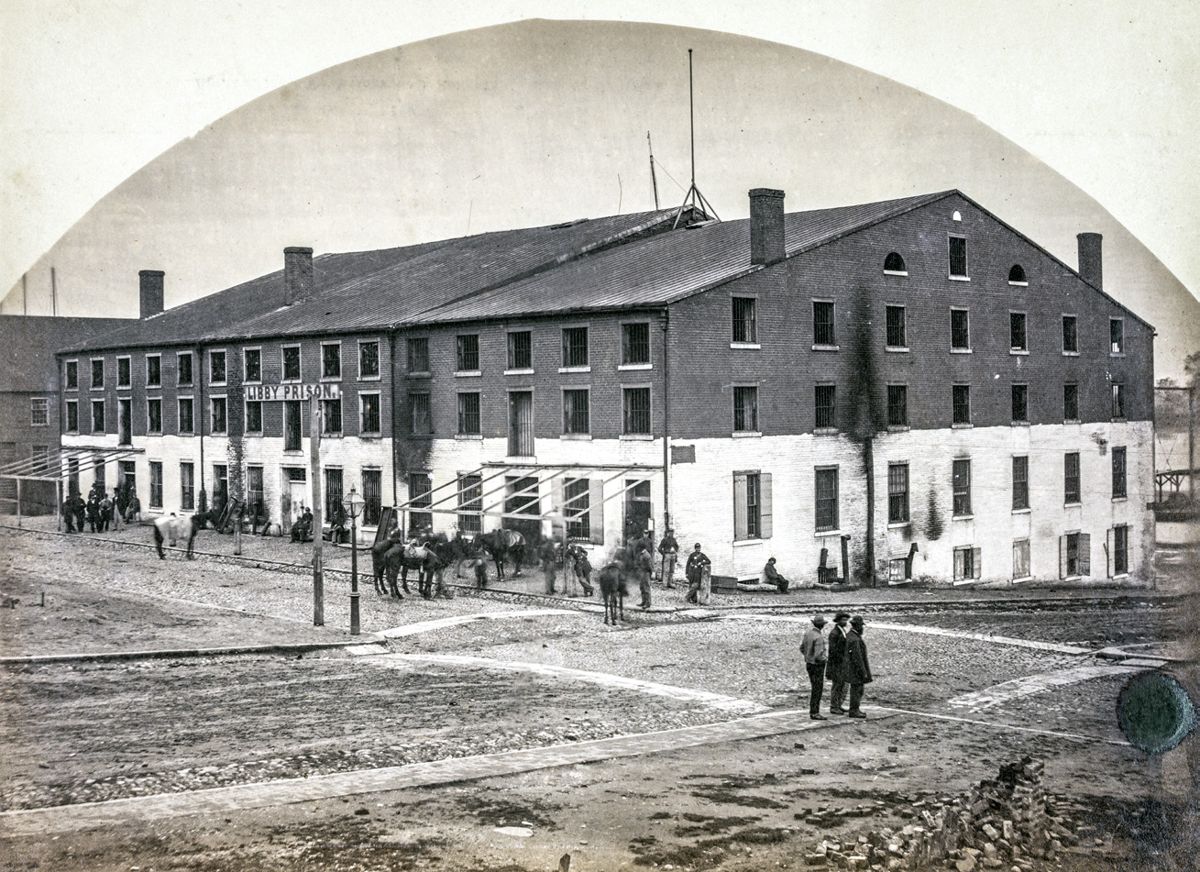
On December 13, 1862, while fighting on the south end of the Fredericksburg battlefield, Sgt. Alonzo M. Crapsey, 13th Pennsylvania Reserves, Meade’s Division, I Corps, became a prisoner during the see-saw fighting after being unable to get away. Crapsey, who enlisted in May 1861 at 18 or 19 years old, had experienced his fair share of combat by the time of the Battle of Fredericksburg. Some of the companies in the 13th, including Crapsey’s, served in the Shenandoah Valley, fighting at Harrisonburg and Cross Keys, before reuniting with their regiment in time for South Mountain and Antietam, where they endured heavy casualties. After becoming a prisoner at Fredericksburg, Sgt. Crapsey and other captured soldiers traveled by train to Richmond, under guard, where they spent about three weeks at Libby Prison. Crapsey’s stay, perhaps combined with previous combat experiences, appears to have deeply affected him. Eventually paroled, Crapsy also spent about five months of uncomfortable time at Camp Parole in Annapolis, Maryland, waiting to be formally exchanged. Crapsey returned to his regiment in late May 1863. Suffering noticeably from both physical and mental illness symptoms, Crapsey received a disability discharge three months after Gettysburg. Returning home, Crapsey’s depression continued to worsen, and he tried to commit suicide twice. Crapsey was finally successful in his third attempt to take his own life, in August 1864. He was only 21 years old. Pathway to Hell: A Tragedy of the American Civil War by Dennis W. Brandt, published in 2010 by Bison Books, covers Sgt. Alonzo Crapsey’s sad life story.
the direction of our abandoned line, which I could barely see as the smoke still hung low, was a scattered line of men coming toward us on the double-quick. They advanced to near where we wounded men were lying, as that in some Chancellorsville measure put them out of range of our artillery which then Corp. Rice C. Bull, fighting with the 123rd New York seemed to be again working with redoubled energy. Coming Infantry, XII Corps, received wounds in the face and neck, to a halt they dressed their line, which was much broken, and then on the hip/back on May 3, 1863. Unable to flee, and lay down. They were not dressed in Union Blue but in Corp. Bull fell into Confederate hands. “Looking back in Confederate Gray… . Most of them seemed and acted as though they had troubles of their own and had no desire to annoy us [the wounded], Bull wrote.” Moved by Confederates to the Fairview section of the Chancellorsville battlefield on May 4, Bull stayed there for several days suffering the horrors of a field hospital. He explained that “While the stench from nearby dead horses and men was sickening it was not worse than that from the living who lay in their own filth. Finally, not the least of our troubles were the millions of flies that filled the air and covered blood-saturated clothing … .” Bull was fortunate that he did not have to endure a long captivity in a formal prison of war camp. He and other Union wounded prisoners received rather quick paroles. Federal ambulances arrived on May 12 and took the wounded to Acquia Creek, then on to hospitals in and around Washington, D.C. Corp. Bull recovered and returned to his regiment in the fall of 1863, by that time serving in Tennessee. After his capture near Prospect Hill during the Battle of Bull’s harrowing account is found in Soldiering: Fredericksburg, Sgt. Alonzo Crapsey of the 13th Pennsylvania The Civil War Diary of Rice C. Bull, edited by K. Reserves was sent to Libby Prison in Richmond (pictured Jack Bauer, Presidio Press, 1977. here) and then to Camp Parole in Annapolis, Md., before being exchanged. (Library of Congress)
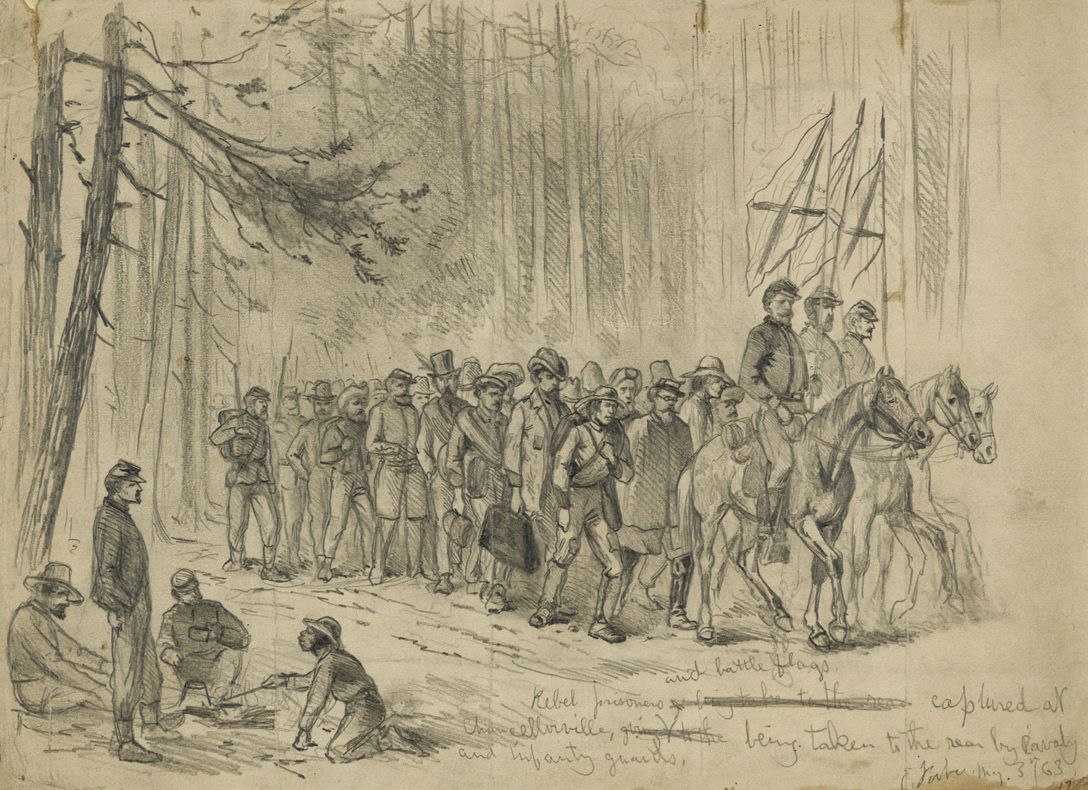
Captured during the fighting at the Battle of the Wilderness, Pvt. John W. Northup, 76th New York Infantry, eventually ended up at Camp Sumter, better known as Andersonville. (William Waud, artist. Library of Congress)
The Wilderness
Pvt. John Worrel Northup, 76th New York Infantry, V Corps, was in the service for about eight months when the spring 1864 Overland Campaign began. He kept a diary, published in 1904, of his experiences that also included postwar recollections. On May 5, 1864, in the tangled woods of the Wilderness, Northup and others ended up separated, mixed, and captured. Below is his telling of the event: “I heard Captain [Edwin J.] Swan say ‘It’s no use, better surrender;’ Some attempted to break their guns against trees, but Rebel bayonets were so near and so many, that we desisted. The wounded in our midst begged us not to fire. Plunging the bayonet which I had fixed to my Springfield, into the ground, I said ‘Boys you’ve got us.’ ‘Come heah,’ they said, and I did, cutting my straps at the same time. I tore the bugle from my hat, not caring to indulge the Rebel craze for Yankee trinkets. Just after an officer rode up to the next man and said, ‘Gimme that bugle on your hat suh (a brass ornament for hat or cap.) Johnnies mixed freely with us to trade canteens, knives, caps, rubber blankets, tobacco boxes, etc. Excitement chiefly over we marched about 30 rods to a strip in of clearing where we found a division of Hill’s corps in line of battle of receive us. One said to me they had been watching for us all the afternoon.” Northup and other Union prisoners marched to Orange Court House, then Gordonsville, and from there took trains to Amelia, Lynchburg, Danville, and ultimately Andersonville. Unlike so many others, Northup survived Andersonville. He received a discharge from the army in June 1865. His soldier experiences are available in his book, Chronicles from the Diary of a War Prisoner in Andersonville and Other Military Prisons in the South in 1864, published in 1904.
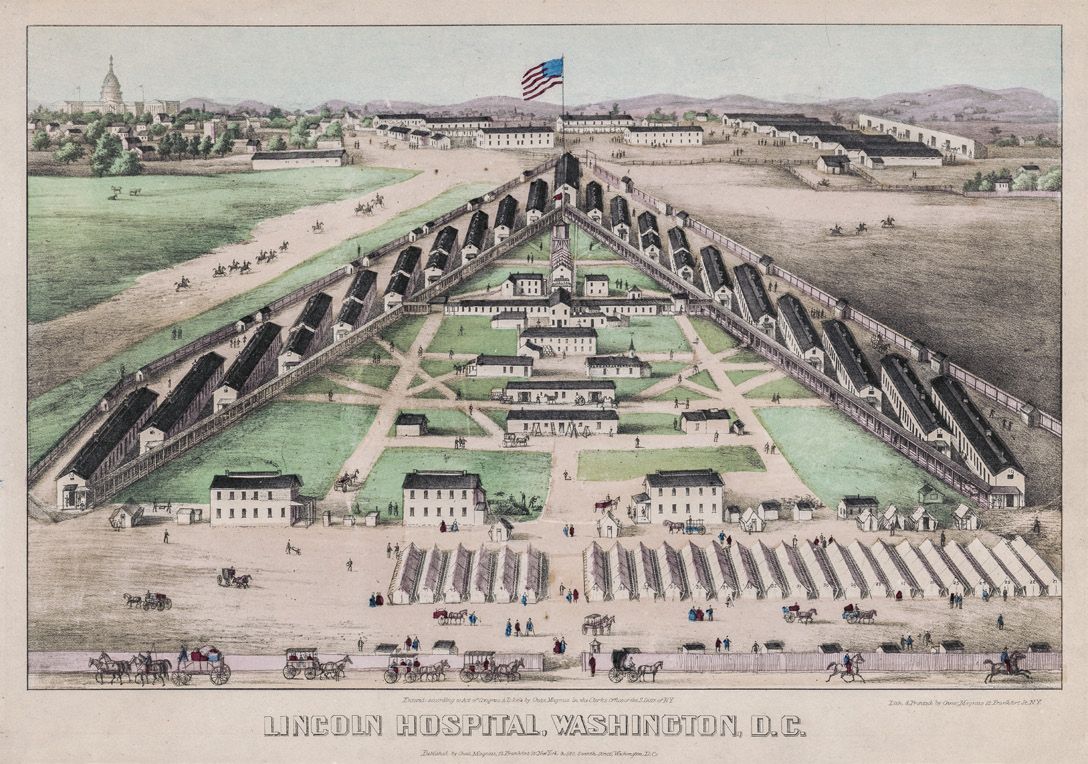
troops fell back, Sergeant Silas Smyre and Corporal E. G. Bost endeavored to carry me from the battlefield. They were so exhausted from marching and fighting that they could not hold me up so as to prevent the crushed leg from dragging on the ground. To protect them from being captured, I begged them to leave me to my fate.” Without water, due to a bullet hole through his canteen, Sherrill lay on the field until overpowering thirst and the fear of bleeding to death caused him to call to the enemy and surrender. Operated on the following day, enduring an amputation procedure under chloroform that took his left leg off at the thigh, Sherrill remained in a field hospital for “two or three days” until taken on an excruciating ambulance ride from the field hospital to a landing on the Potomac River. He then traveled by boat to Alexandria. Sherill spent about three months recovering at the Marshall House hospital, the site of Elmer Ellsworth’s death in 1861. Sherrill next spent time at Lincoln Hospital in Washington City before he received crutches and a transfer to Old Capital Prison. In November 1864, Sherrill received another transfer, this time to Elmira prison in New York state. Fortunately for Sherill, his stay at Elmira proved rather short as he was formally exchanged in February 1865, and returned home. Sherrill eventually became the North Carolina state librarian. He died in 1916. His account is available in his brief memoir, A Soldier’s Story: Prison Life and Other Incidents in the War of 1861– 1865, which was published in 1904. Tim Talbott is the Chief Administrative Officer with the Central Virginia Battlefields Trust. Spotsylvania Court House
The assaults by the Army of the Potomac at Spotsylvania Court House on May 10 and May 12 netted thousands of Confederate prisoners. Included among those taken on May 12 were Maj. Gen. Edward “Allegheny” Johnson and Brig. Gen. George “Maryland” Steuart. More commonly captured were the multitude of enlisted men and noncommissioned officers throughout the almost two-week fight at Spotsylvania. One such soldier was Sgt. Miles Sherrill, Company A, 12th North Carolina Infantry. Sherrill, from Catawba County, North Carolina, enlisted at age 19 in 1861. The 12th North Carolina fought in the Seven Days’ battles, South Mountain, Chancellorsville, Gettysburg, and the Wilderness. Other than a few hospital visits for illness, Sgt. Sherrill went unscathed. However, his previous good fortune ran out at Spotsylvania on May 9, 1864. During an assault with Gen. D.R. Johnston’s Brigade, Sherrill’s regiment ended up flanked by the Union IX Corps. In the fight, Sherrill received a grievous wound to the left knee. According to his service records, a shell fragment caused the damage. Sherrill remembered years later: “As our
After being captured in Spotsylvania and receiving treatment for a leg wound at the Marshall House Hospital in Alexandria, Va., Sgt. Miles Sherrill, 12th North Carolina Infantry, recovered at Lincoln Hospital (pictured here) in Washington D.C. before being sent to Elmira as a prisoner of war. (Library of Congress)