Evergreen Cemetery, Southgate, Ky. A Civil War Site Worth Visiting
By Charles H. Bogart · Originally published May 2023 · pp. 26–27

Evergreen Cemetery is located in Southgate, Ky., at the junction of Alexandria Pike (US27) and Highland Avenue. This 30-acre park-like cemetery was founded in 1848 by the city of Newport, Ky., and was at that time located three miles south of the U.S. Army’s Newport Barracks. The first burial in the cemetery was in 1848. The entrance to the cemetery is today located off Alexandria Pike. From 1893 to 1936, the cemetery was served by the Cincinnati, Newport & Covington Street Railway’s Route 15 Southgate streetcar. The streetcar had a return loop at the end of Electric Avenue, and the cemetery installed its main entrance gate here. This entrance gate is now normally closed.
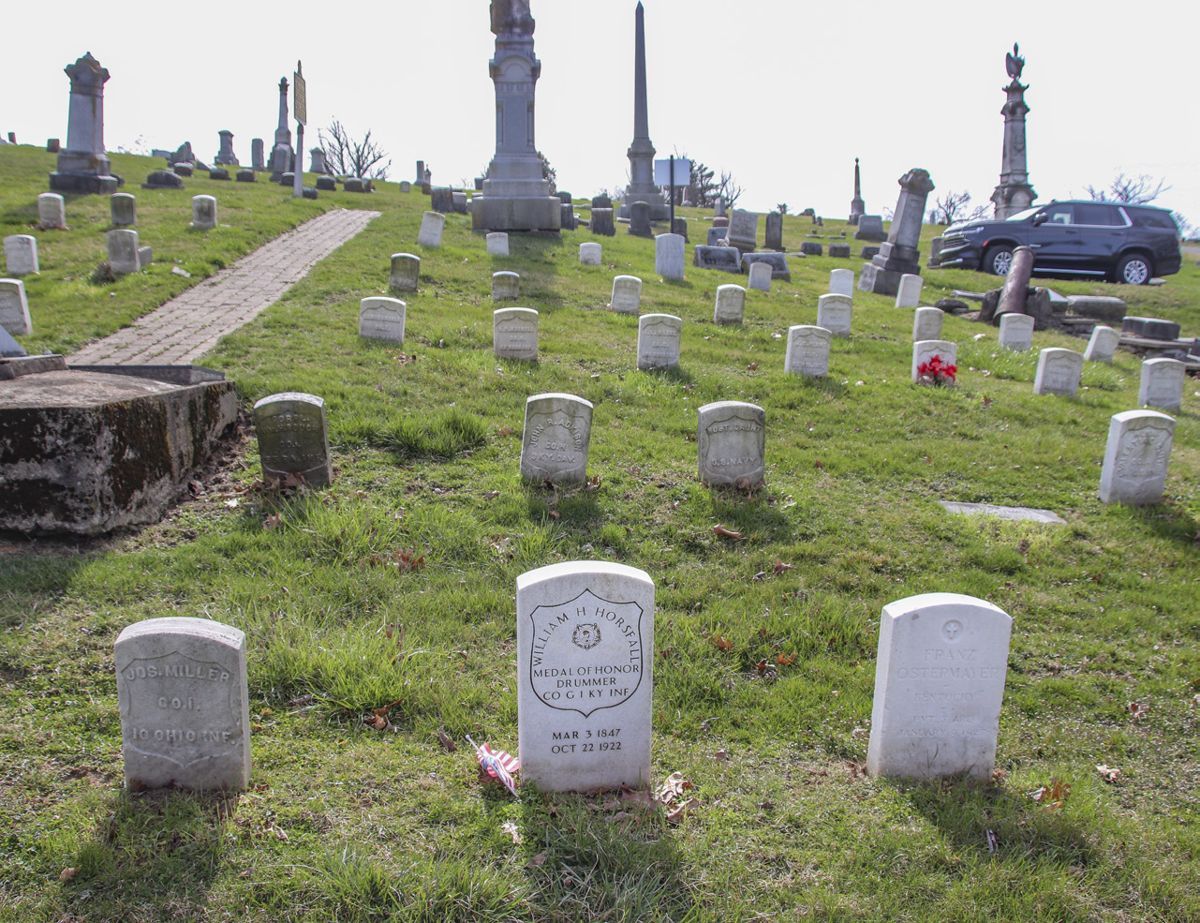
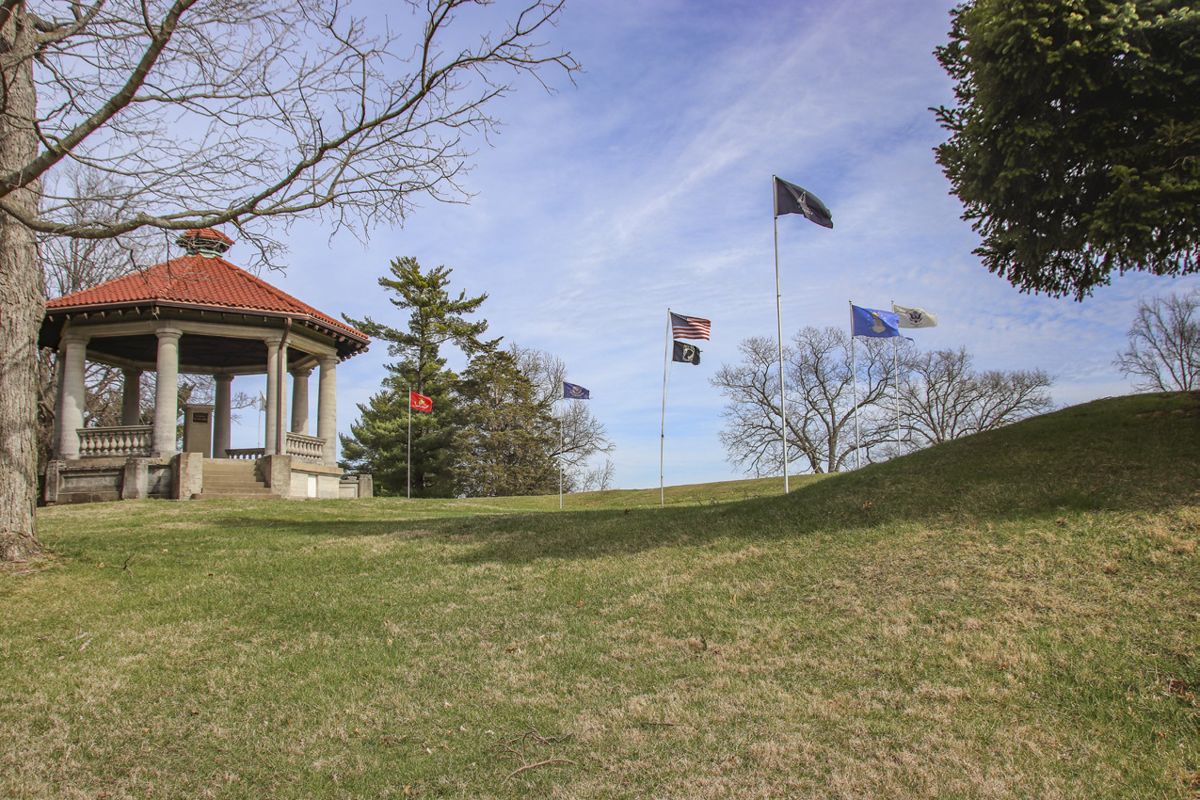
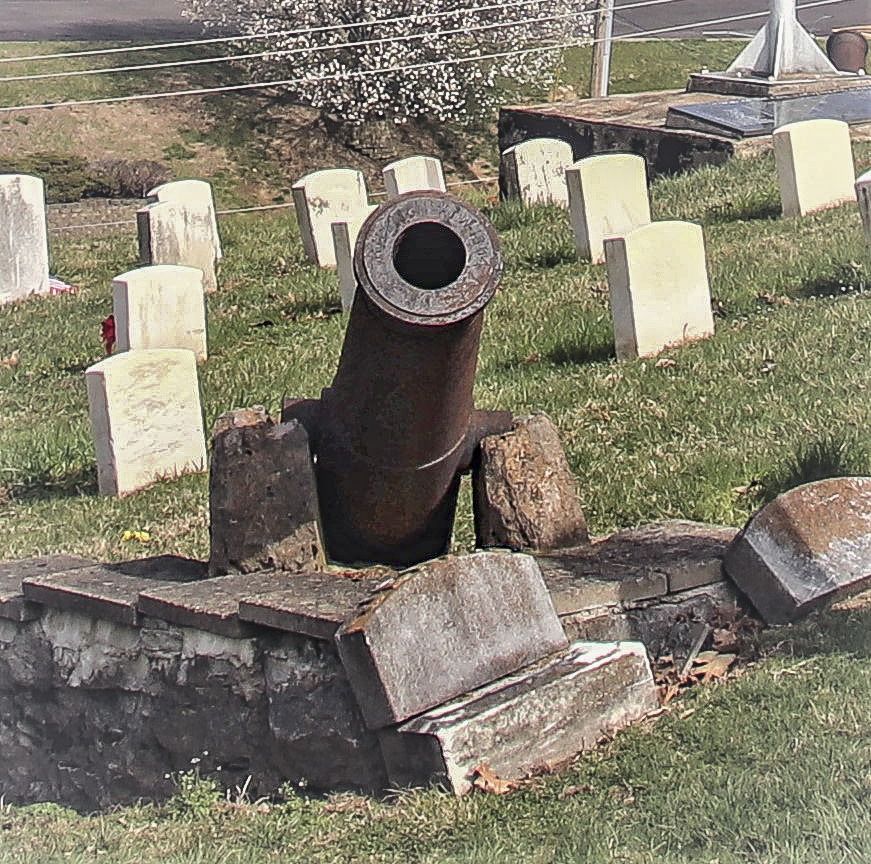
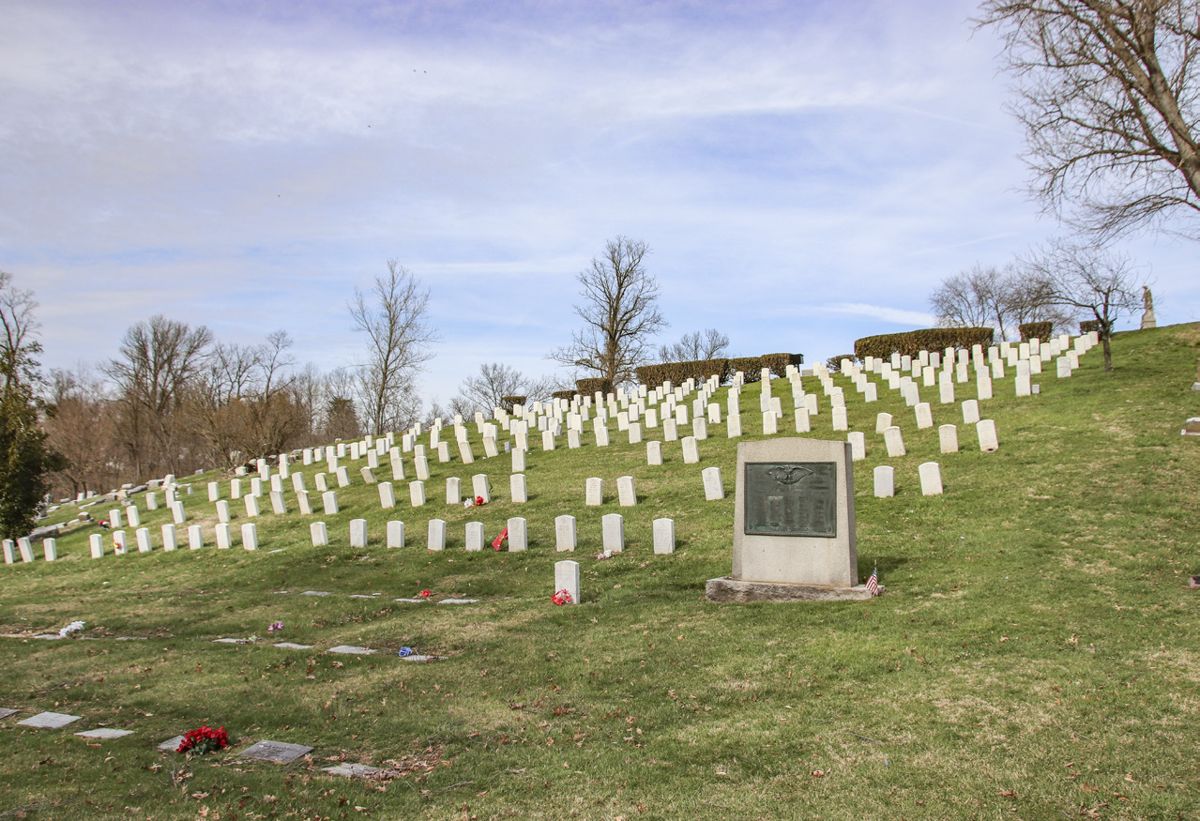
Upon entering Evergreen Cemetery from Alexandria Pike, if one turns left, the road leads to the Civil War-era military cemetery. This 150 feet by 150 feet plot of ground is surrounded by a low stone wall. At each corner of the wall a Model 1844 24-pounder Siege and Garrison howitzer is mounted. Buried within the plot are 68 soldiers and sailors who died during the Civil War while at the Newport Barracks, or were post war members of Newport’s Grand Army of the Republic Post. Among those buried here is William H. Horsfall who was awarded the Medal of Honor on May 21,1862, at the age of 15 for saving the life of “a wounded officer lying between the lines during combat at Corinth, Mississippi.” In 1861 at the age of 14, Horsfall had run away from his home in Newport, and enlisted as a drummer in Company C, 1st Kentucky Volunteer Infantry. He remained in the Federal Army until March 1866. Thereafter, he lived in Newport and was very active in GAR affairs until he died in 1922. Upon leaving the Civil War cemetery, a short drive brings you to the grave of Confederate General George Baird Hodge (1828–1892). Hodge was a member of the Kentucky House of Representatives from 1859 to 1861 and Chairman of the Committee on Federal Relations when Kentucky declared itself neutral on May 16, 1861. Hodge, in September1861, entered the Confederate Army as a private. During 1861, he was also a member of Kentucky’s Confederate Provisional Government. In 1862, Hodge was made a captain in the Confederate Army and served as Assistant Adjutant General in General Breckinridge’s Division. In April Horsfall. 1862, he was promoted to major for distinguished gallantry at the Battle of Shiloh. In 1864, Hodge was promoted to colonel and then to brigadier general. During 1865, he was in command of the Confederate Military District of Mississippi and Louisiana. Post war he returned to Newport where he practiced law and served in the Kentucky Legislature. After leaving General Hodge’s grave, drive to the highest point in the cemetery. This is Battery Shaler. Erected in 1862 by the Black Brigade of Cincinnati, Ohio, the battery was part of the northern Kentucky defensive works guarding Cincinnati during Confederate General Edmund Kirby Smith’s 1862 invasion of Kentucky. The Black Brigade was made up of African American volunteers from Cincinnati who performed pioneer work helping build the Northern Kentucky defensive line. The interior of the battery is crowned by a bandstand.
Within the bandstand, a bronze plaque reads “In Memoriam, The Nations Heroes.” Evergreen Cemetery was developed not only for burial of loved ones but also as a place for people to walk about and enjoy a day in the country. Throughout the streetcar era, the bandstand was used on Memorial Day and the 4th of July by the GAR to eulogize its dead comrades. Battery Shaler was named for Dr. Nathaniel B. Shaler, Chief Surgeon at Newport Barracks. It was armed with three 32-pounders, two 30-pounders, four 24-pounders, and three 12-pounders. Its guns were never fired in anger, and it is one of the few intact northern Kentucky 1862 defensive gun battery sites one can visit. Near the former streetcar entrance to Evergreen Cemetery are the damaged remains of a sundial erected circa 1895 by the Woman’s Relief Corps. The sundial was damaged when hit by an automobile some 30 years ago.
While the sundial was repaired and is once again standing at its site, it has lost its gnomon. The brass plate at the foot of the sundial reads “Joe Hooker Womans Relief Corps, GAR of Dayton Kentucky, in Memory of the Unknown.” On the sundial is the following wording, “Grow old along with me the best is yet to come.” Also located in the cemetery is the Fort Thomas Military Post Cemetery. Fort Thomas was a regimental infantry post from 1888 to 1946. Buried in the cemetery are soldiers and their dependents who died while living on the post. Among those buried within this military plot is Drum Major Thomas M. Doherty (1869–1906) of Company H, 4th United States Infantry, who was awarded the Medal of Honor for heroism during the SpanishAmerican War on July 1, 1898, at Santiago, Cuba, where he “Gallantly assisted in the rescue of the wounded from in front of the lines under heavy fire from the enemy.” Also buried here is Nicholas Peblo of 30th Company, Philippine Scouts, who died at the post in 1905. Charles H. Bogart has a BA from Thomas More University and an MCP from Ohio State University. He is employed as a tour guide at the Fort Boone Civil War Battle Site in Frankfort, Ky., serves as President of the Frankfort Civil War Roundtable, and is a board member of the Kentucky Civil War Roundtable. He has written several books and articles on military and naval history.