
Civil War Impressionists Association Claims Rocking Horse a Winner
By Bob Ruegsegger · Originally published May 2023 · p. 8
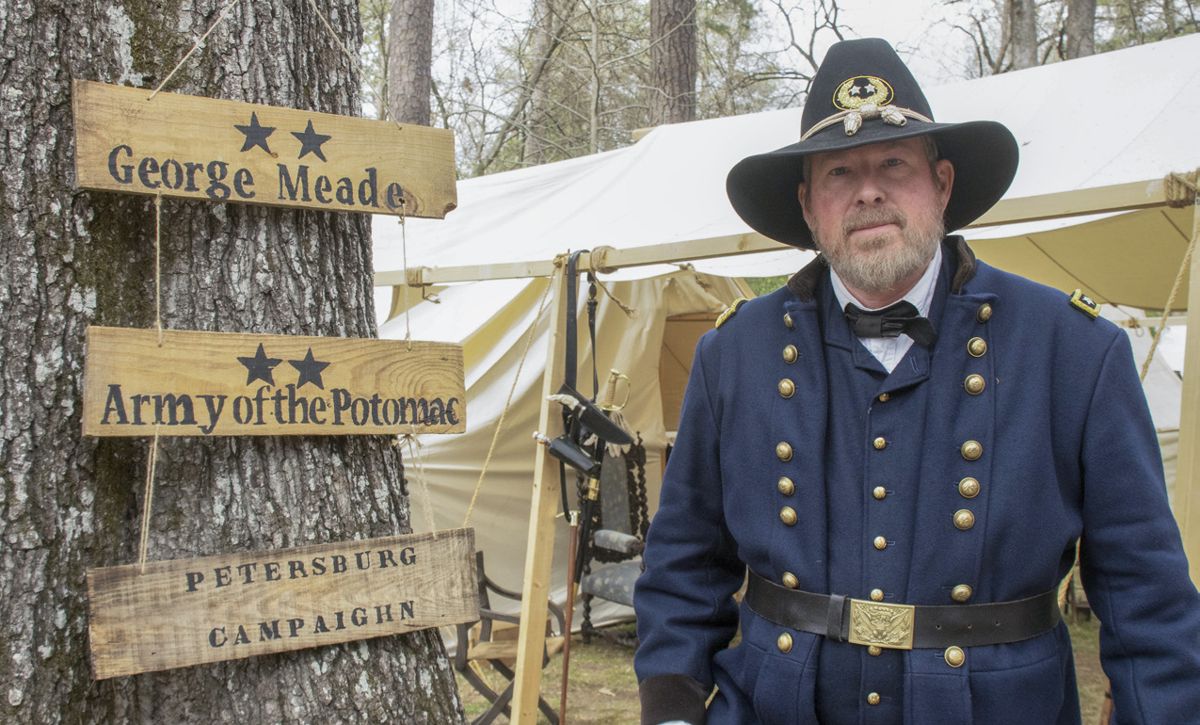
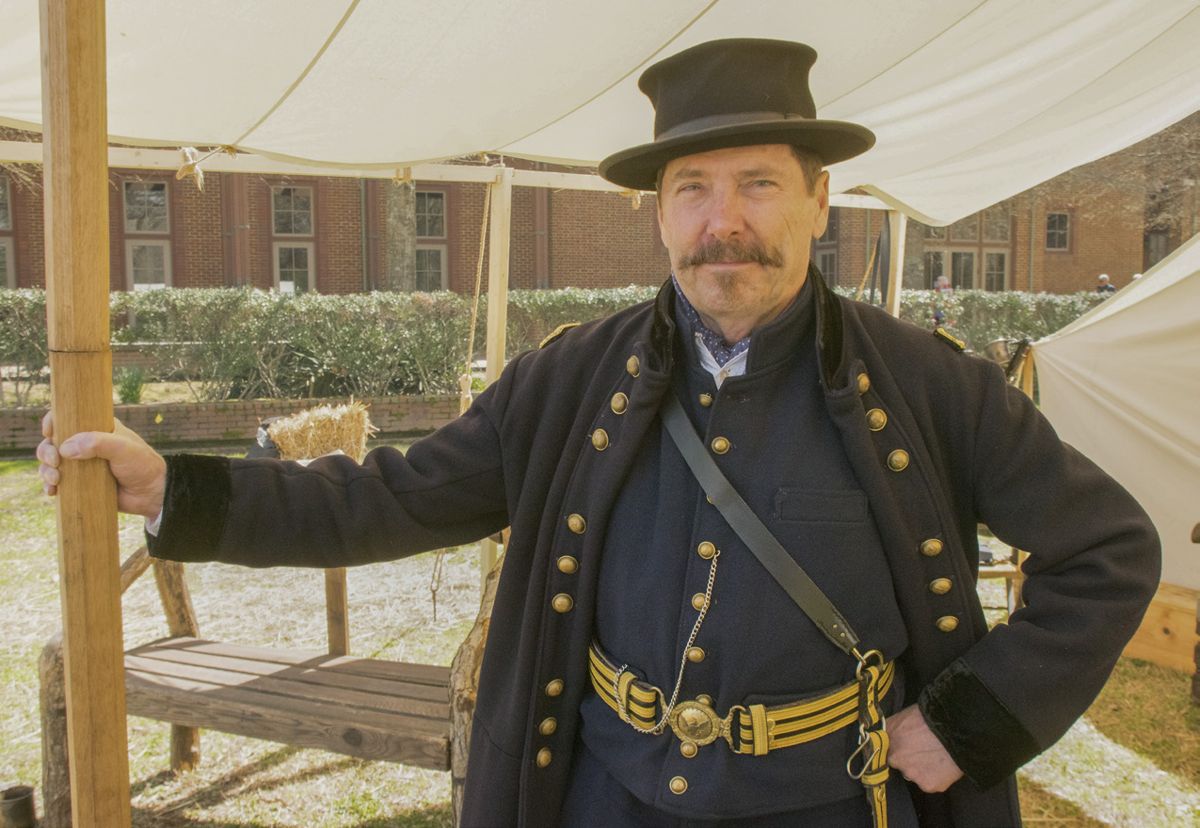
In 2022, the Civil War Impressionists Association made a highly favorable impression at Jamestown Settlement’s annual Military Through the Ages event with their replication of Grant’s Headquarters at City Point in 1864. They were awarded an honorable mention in the Visitors Choice competition for their meticulous recreation of the City Point scenario and their fastidious portrayals of Civil War notables. This year, the CWIA returned to MTA with their detailed reproduction of the exterior of Grant’s “tent city” headquarters complex. Their impression was based upon a Matthew Brady photograph taken in the summer of 1864 prior to construction of wooden cabins for winter quarters. Brian Withrow of the CWIA portrays General Grant. He decided to introduce something new, a little giddy-up to pique the curiosity of youngsters who visited the organization’s already superb City Point Headquarters 1864 exhibit. “This is a Victorian rocking horse. Rocking horses have been around for hundreds of years. There are still companies in England making them,” said Withrow. In the 1800’s, a well-to-do
CWIA’s Brian Withrow refurbished the rocking horse. Victorian family, according to Withrow, would probably have owned a large rocking horse and perhaps smaller-sized versions for younger children. Farm folks who couldn’t afford a fancy professionally made model would often make their own equine effigies if they had the carpentry skills. Examples of rustic-looking, vintage equine folk art turn up for sale occasionally. Withrow opted for a professionally made paradigm. Although Withrow was unable to document the use of rocking horses for training cavalrymen during the Civil War, he was able to confirm their use as cavalry training aids during World War I. “There are actually some photos that you can find on line that show World War I cavalry soldiers getting their first training on one of these rocking horses,” said Withrow. When Withrow began preparing for a return to the Military Through the Ages event, he wanted to add something to his unit’s presentation that would add to their interaction with youngsters. “I started researching rocking horses,” said Withrow. “With General Sheridan here, we equipped the rocking horse with a McClellan saddle and outfitted it as a training horse for the cavalry and kids to enjoy.” Dozens and dozens of youngsters throughout MTA weekend took advantage of the
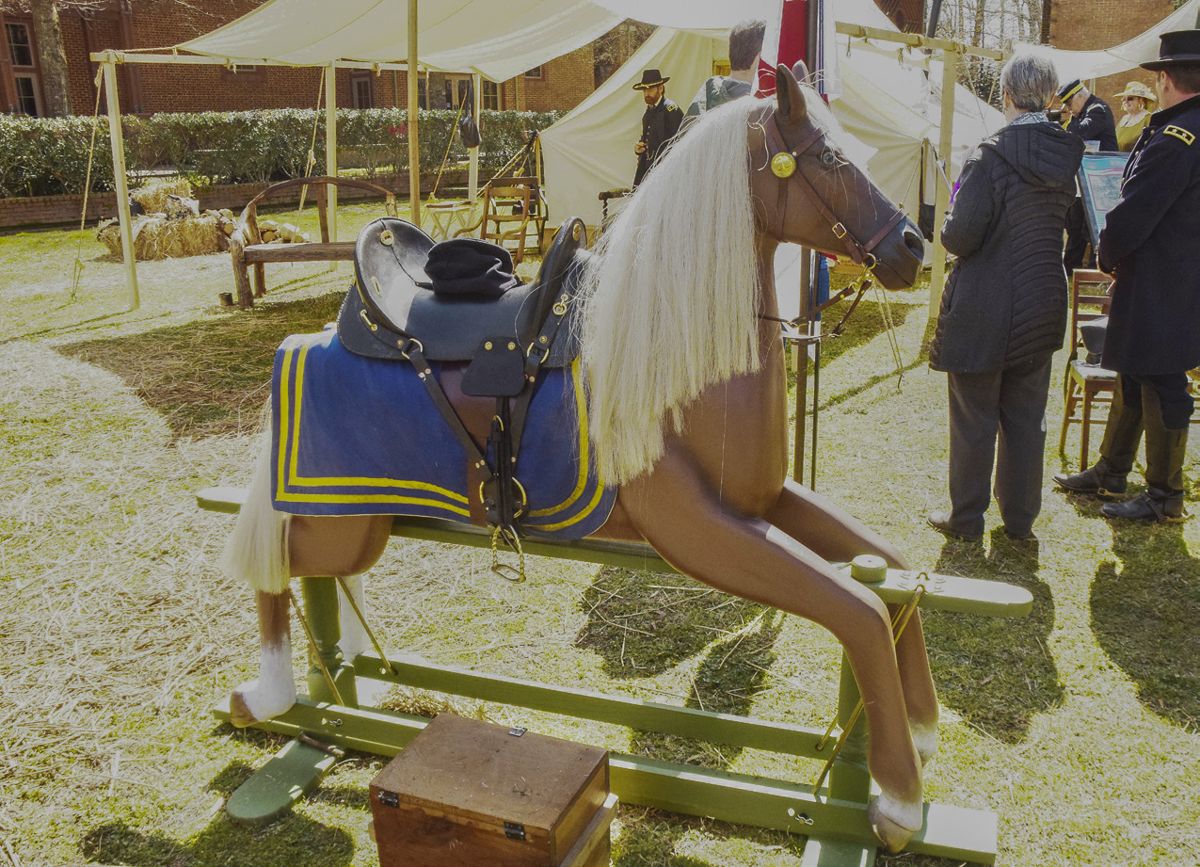
Once in a while, smaller versions of a rocking horse are available for sale to parents whose youngsters may be aspiring to portray Civil War cavalrymen.
opportunity to ride the CWIA’s “giddy-up” exhibit. “Some kids didn’t want to get off,” said Withrow. “It’s been very popular.” Withrow ordered plans from England to create his own fullsized rocking horse but time constraints compelled him to purchase an existing horse from a British couple living in Philadelphia who bought it for their children decades ago. “I had to build a brand-new stand for it. I totally stripped the horse down to the wood, repainted it, left the hair,” said Withrow. “I basically designed it as a chestnut flaxen horse—a darker body mare with a lighter mane and tail.” James Standard was on site portraying Major General Philip Sheridan, Grant’s leading cavalry officer. Sheridan, Little Phil, became infamous for his brutally successful Shenandoah Valley Campaign. His victory at Five Forks and capture of the Southside Railroad forced General Lee to withdraw from Petersburg and Richmond. “Sheridan was quite a capable individual. He was recognized for his ability,” Standard observed. “He looked after his men well. He looked after the horses. That was number one.” Standard and other CW impressionists kept an attentive eye on the chestnut flaxen mare to ensure the wooden horse was well tended and treated with all the respect due a training aid. “It wasn’t just for play. It was a training device back in the day,” said Standard. “The hardest thing about riding is the ground. Mr. Newton figured that out a few centuries ago. It’s a gravity thing. It’s hard,” observed Standard. “Initially, they did some training especially with saddlery, mounting the horse, and putting the tack on.” When cavalry trainees were comfortable with the basics, mounting the horse and handling the equipment, they were more easily introduced to actually riding the live four-legged animal. “During the Civil War, in the North, the biggest problem we had with cavalry was we did not have a lot of people who rode horses anymore. They were behind the horses as a farmer with a plow. That’s a big difference,” noted Standard. “If you have a green horse and a green rider, your next two colors could be black and blue, and all the colors of the rainbow.” Being in the cavalry was a hard life. Spinal injuries, piles, hemorrhoids, and brain fever were common ailments suffered by Civil War era cavalrymen, both Union and Confederate. Families flock to Military Through the Ages to learn about history. Youngsters are an integral part of the audience and need to be addressed with experiences that will be memorable—and safe but exciting. “If you’re on a huge hobby horse that goes back and forth, it’s a lot of fun,” said Gary Carlsberg who portrays General George Meade with the CWIA. “It’s been quite the conversation piece.” Carlsberg’s brothers-in-arms kid him now about his falling off a horse during a Battle of the Crater reenactment. As General George Meade, Carlsberg rode his horse out on the battlefield before the action started. He was certified to ride horses on the re-enactment battlefield, but the horse bucked Carlsberg off, and his fall looked incredibly realistic. Unfortunately, Carlsberg suffered severe injuries in the fall. “I was seriously busted up,” recalled Carlsberg. “I broke six ribs in eight places and punctured a lung. I just about got killed. I’ve obviously recovered.” At the time when the ambulance hauled him away, no one fully appreciated the seriousness of his injuries. His colleagues long after his complete recuperation have never let him forget his “incredibly realistic” display of horsemanship during that battle reenactment. “They tease me by saying that the only horse I can safely ride is the hobby horse,” said Carlsberg. “We’re just having fun with it.” Bob Ruegsegger is an American by birth and a Virginian. His assignments frequently take him to historic sites throughout Virginia, the Mid-Atlantic, and the Southeast. His favorite haunts include sites within Virginia’s Historic Triangle— Jamestown, Yorktown, and Williamsburg. Bob served briefly in the U.S. Navy. He is a retired educator and has been an active newspaper journalist for the last twenty years.