
The Unfinished Fight
Soap
By Craig L. Barry · Originally published March 2023 · pp. 12–13

Soap One subject that has been neglected in the study of mid19th Century material culture is soap. Traditionally, as far back as the Colonial-era, soap was produced in America primarily on the farm. It was easily made from by-products that resulted from the two most common activities of agrarian life, clearing of land for fields and slaughtering animals for meat. From the ashes of burnt wood mixed with water, alkali lye was produced. To this tallow or animal fat is added and the resulting mixture boiled to produce soap. There was not much more to it than that, though the process would be refined with time. The major uses for soap were household applications, either washing clothes or the body. In textile manufacturing, particularly for pre-shrinking and compacting wool cloth, a process called “fulling,” or thickening and scouring woolens. Because Colonial-era America was largely rural and agrarian, soap making remained widely scattered until near the time of the American Revolution. By that time any excess local soap production had turned into a minor commercial export item, but the trade was interrupted by the first war of American Independence in 1776. Soap remained a largely non-commercial item locally produced for home use for another fifty years. By the late 1830s, due to increasing industrialization in the North, more of the population was now located in cities. The increased demand for soap could no longer be easily met on a local or individual household basis. The first commercial soap makers were founded near centers for the meat packing industry. One of the necessary ingredients of soap being tallow, this encouraged the first commercial soap makers to locate where animals were processed. For example, Cincinnati, Ohio, was one such meatpacking center, and in 1837 it attracted Messrs.’ Proctor and
Gamble. These two men who married sisters began the candle and soap making enterprise that still bears their name today. They were not alone as there were seventeen different soap making companies in Cincinnati alone. A major change in the production of commercial soap occurred in the 1840s when manufacturers began to replace lye made from ashes with another alkali, sodium carbonate. Sodium carbonate, or “soda ash,” is a form of lye made through a chemical process which results in a purer compound than wood ash. The firms usually made soap in one pound bars, but some soap was produced in slabs sold to grocers, who wire-sliced the product for individual consumers, like a wheel of cheese. There were few major brands and little advertising was directed at consumers. Soap factories remained mostly regional, centered in or nearby cities with
Servants at quarters of Prince de Joinville in front of Yorktown, May 3, 1862. (Library of Congress)
a meat packing industry before the Civil War. As a result of being located in Ohio, Proctor & Gamble became a major Federal supplier of soap and candles during the Civil War. New York and New England were also commercial hubs for candle and soap manufacturing. The following is an early advertisement for soap that appeared in Harpers Weekly:
“August 6, 1861. MY DEAR SIRS: Your Soap is as good as ever. It seems that one box lasts almost a life-time. I am sure it will become a universal thing. Some of the farmers have given up making soft soap since using your Soap. They say it pays to sell their soap-grease and buy your Soap. Some say they save the price of the Soap in wood… Yours, &c., E. PERRY The above soap is packed in boxes of sixty bars, one pound each, with directions for making each bar into “three gallons of handsome Soft Soap.” Price $5 per box, with a selection from a list of books, or a subscription to a newspaper gratis. Send for circular containing list of books and papers. B. T. BABBITT As the U .S. Civil War dragged on, soap and tallow candles became increasingly scarce for both soldiers and civilians. Letters from soldiers in the field often asked for these items which were sometimes omitted from their rations. Soap was considered a “camp ration” (four pounds per 100 men) and not issued to soldiers on the march. It was noted by J. Billings in Hardtack and Coffee that: “The soap, candles, etc., were not issued to the soldier when on the march, as he could not carry them; but, singularly enough, as it seems to me, unless the troops went into camp before the end of the month, where a regular depot of supplies might be established from which the other parts of the rations could be issued, they were forfeited, and reverted to the government— an injustice to the rank and file, who, through no fault of their own, were thus cut off from a part of their allowance at the time when they were giving most liberally of their strength and perhaps of their very hearts blood…” In the Confederacy, a city of Richmond swelled in size during the war years and the lack of basic necessities made it a very expensive place to live. Candles and soap commercially made in New England before the war, were obviously no longer available. The Union blockade of Confederate ports prevented items like soap from being easily imported from Europe because priority was given to military arms and medicines for imported items run through the blockade. While there were many documented instances of smuggling personal necessities like soap and other items into the Southern states by Confederate sympathizers in the North, supply never came close to reaching the civilian demand for such essentials. Soldiers received soap as part of their issues while in permanent camp, but it was not part of the marching rations. One officer, Nelson Miles, wrote in a letter to the Army & Navy Journal in 1863:
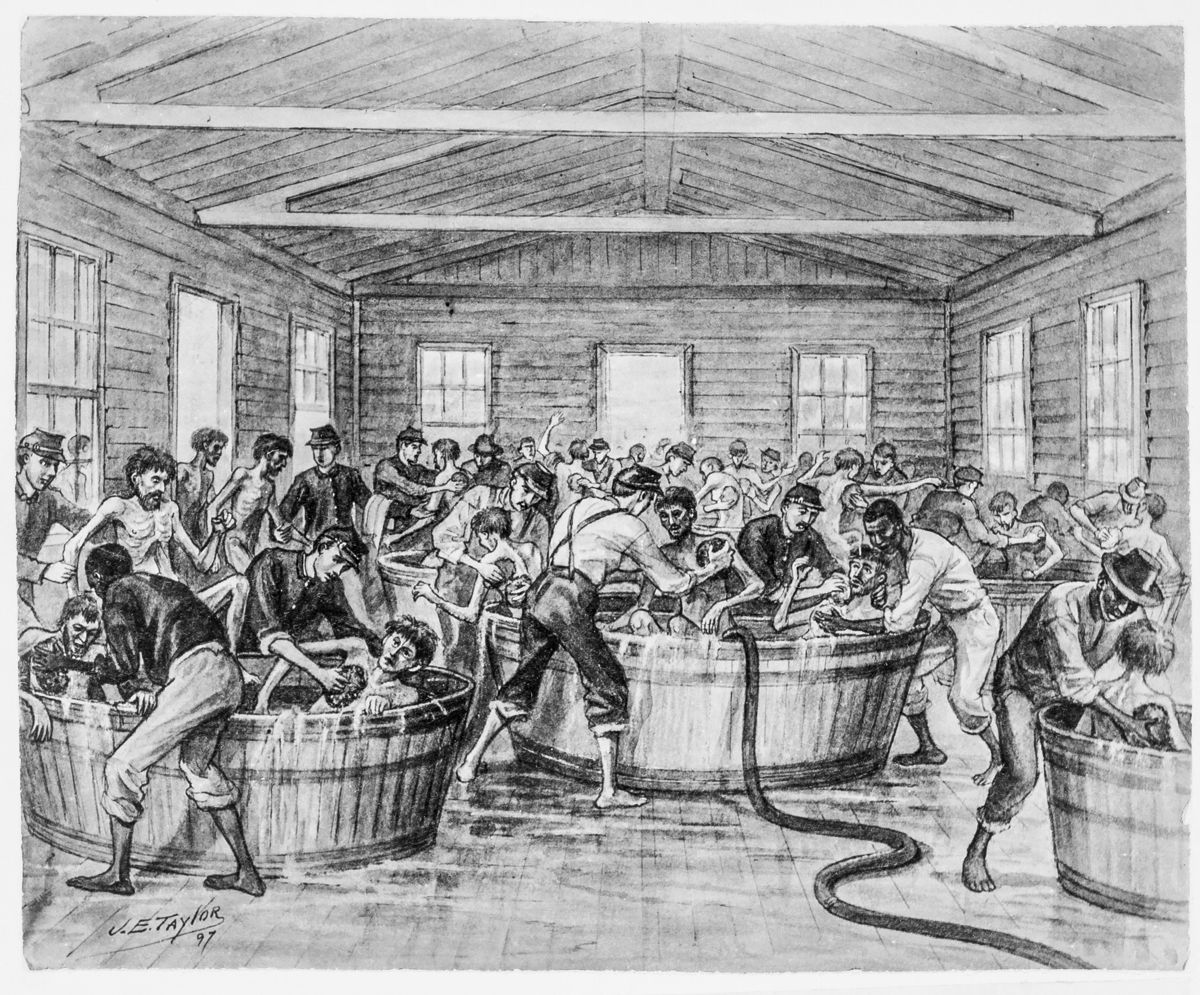
CivilWarNews.com “Will you please call the attention of Headquarters to the necessity of a general order on the matter of personal cleanliness in the Army? Every correspondent of London journals has sneered at our Army in this respect… Bathing should be encouraged in warm weather. Prof. ______ has determined by experiment that a beleaguered garrison can hold out and subsist longer by half whenever the men bathe daily.”
Even if soldiers felt they could go without soap for extended periods, as so often proves the case, “necessity was the mother of invention,” and Southern civilians were resourceful people. Cottonseed was ground in a mortar to extract the oil and cooked with lye to produce a crude soap. Author Victoria Rumble wrote in Shortages and Substitutions of the War-time South: “As farm animals were taken by the army, both C.S.
and U.S., meat became scarce and with that came a shortage of fats to make soap and candles. Wax for candles was obtained by boiling the wax off myrtle berries and straining it, and homespun wicks several yards long were passed through a shallow pan of pine rosin and beeswax until approximately the size of a pencil then the long wick wrapped around a bottle, corncob or other item of similar size to produce a Confederate candle. Corn shucks and cottonseed were among the items resorted to for replacing fats in soap making.” Here are some period receipts (recipes) for making several different Civil War-era soaps, from The Confederate Receipt Book published in 1863.
HARD SOAP
Pour twelve quarts of boiling water upon five pounds of unslacked lime. Then dissolve five pounds of washing soda in twelve quarts of boiling water, mix the above together, and let the mixture remain from twelve to twentyfour hours, for the purpose of chemical action. Now pour off all the clear liquid, being careful not to disturb the sediment. Add to the above three and a half pounds of clarified grease, and from three to four ounces of rosin. Boil this compound together for one hour, and pour off to cool. Cut it up in bars for use, and you are in the possession of a superior chemical soap, costing about three and a half cents per pound in ordinary times.
SOFT SOAP Bore some holes in a lye barrel, put some straw in the bottom, lay some un-slacked lime on it, and fill your barrel with good hard wood ashes, wet it, and pound it down as you put it in. When full, make a basin in the ashes and pour in water, keep filling it as it sinks in the ashes. In the course of a few hours the lye will begin to run. When you have a sufficient quantity to begin with, put your grease in a large iron pot, pour in the lye, let it boil, &c. Three pounds of clean grease are allowed for two gallons of soap.
COLD PROCESS SOAP Cut chunks of glycerin into slices and heat on stove top at low heat. Add your favorite natural oils and botanicals such as rose petals, honey and oatmeal, spices such as cinnamon, and lemon or orange peel and pour the liquid mixture in molds. Chill for a half hour or so and then remove from the mold. Greasing the mold with cooking oil before filling will allow the bars of soap to release easily. Bars of soap should cure or rest for a week or so before using. Craig L. Barry was born in Charlottesville, Va. He holds his BA and Masters degrees from UNC (Charlotte). Craig served The Watchdog Civil War Quarterly as Associate Editor and Editor from 2003–2017. The Watchdog published books and columns on 19th-century material and donated all funds from publications to battlefield preservation. He is the author of several books including The Civil War Musket: A Handbook for Historical Accuracy (2006, 2011), The Unfinished Fight: Essays on Confederate Material Culture Vol. I and II (2012, 2013). He has also published four books in the Suppliers to the Confederacy series on English Arms & Accoutrements, Quartermaster stores and other European imports.