
This And That
Rest on Arms Reversed
By Gould Hagler · Originally published March 2023 · pp. 24–25
Rest on Arms Reversed Confederate monuments, like war memorials generally, take numerous architectural forms, some common and some rare. Among the less frequently used forms are memorial stones, walls, benches, arches, gates and fountains; preserved industrial facilities; and (to my knowledge) one stained glass window. Obelisks and statues have been used much more often, with statues outnumbering the obelisks. With varying degrees of emphasis, these memorials serve several purposes: mourning the dead, praising the soldiers, defending their cause, conveying a message to the Confederates’ descendants, and expressing gratitude for peace and reconciliation. The architectural form chosen for a monument, its location, the inscriptions, and the decorative elements are all parts of the message. An inscription quoting Isaiah 2:4 (“They shall beat their swords into plowshares…”) speaks of a nation weary of war and thankful for peace. Other inscriptions stress the soldiers’ bravery, perseverance
Athens.
and honor.* The rightness of the cause is announced with such phrases as “They fought to maintain a just union” and “These men died in defence of the principles of the Declaration of Independence.” A draped obelisk topped with an urn, sited among soldiers’ graves in a cemetery, is obviously an expression of grief. More common than any other form of memorial is the soldier statue. The bronze and marble soldiers stand in a variety of positions. Most are standing at parade rest, or some semblance of it; (Remember, these were citizen-soldiers, not professionals.) Some are marching with shouldered rifles, but not many. A few stand facing north, in the guard against infantry position, or to repeat, some semblance of it.** The rest on arms reversed position, commonly seen in the United Kingdom and the Commonwealth, is rare in the United States. Here a soldier stands, head bowed, holding his rifle muzzle down, resting on the left foot. There are three such statues in Alabama and another in a similar pose. These Confederates are mourning their dead comrades. Georgia has one, kind of.
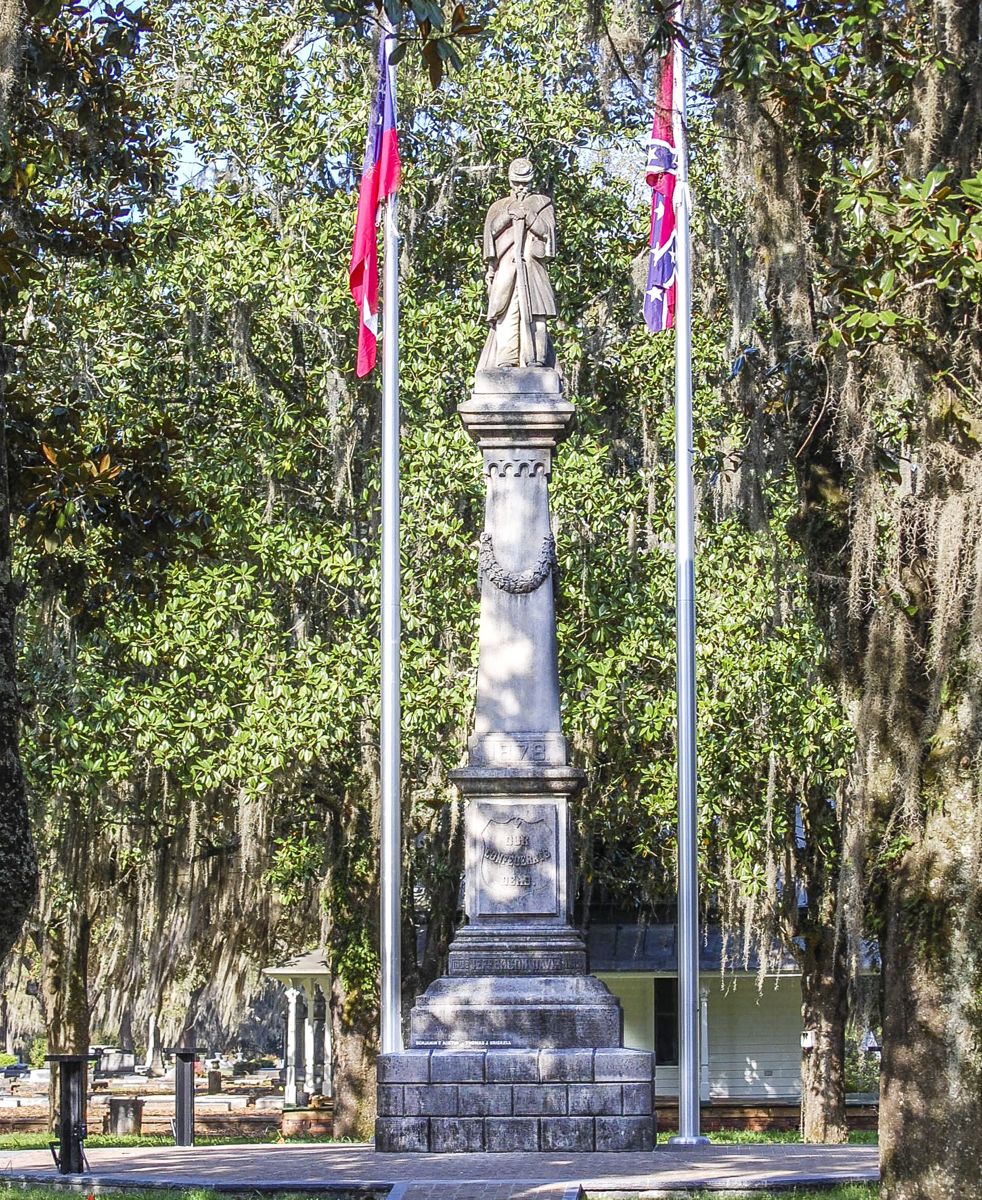
It depends on when you saw it. Selma’s monument stands in Confederate Circle, on a piece of land owned by the local chapter of the United Daughters of the Confederacy, in the middle of city-owned Live Oak Cemetery. Built by the local Ladies Memorial Association, Selma’s statue is an old one, dedicated in 1878. It is noteworthy that the president of the LMA at the time was Elodie Breck Todd Dawson, the half-sister of Mary Todd Lincoln. The words inscribed on the monument’s base are wholly mournful in tone. OUR CONFEDERATE DEAD. HALLOWED THE DUST, WHERE SLEEP THE BRAVE. DULCE ET DECORUM EST PRO PATRIA MORI. THERE IS GRANDEUR IN GRAVES, THERE IS GLORY IN GLOOM. (The last inscription quoted is from the poem “A Land Without Ruins” by Father Abram J. Ryan)
Camden.
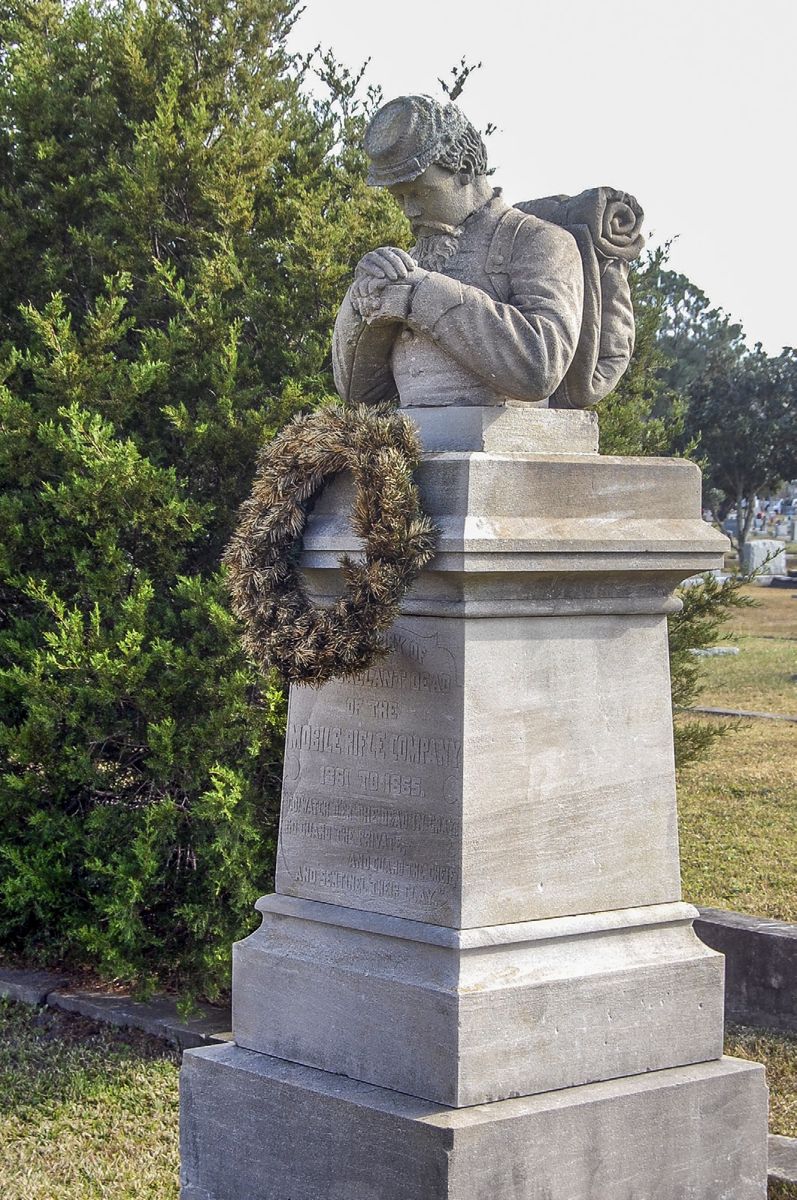
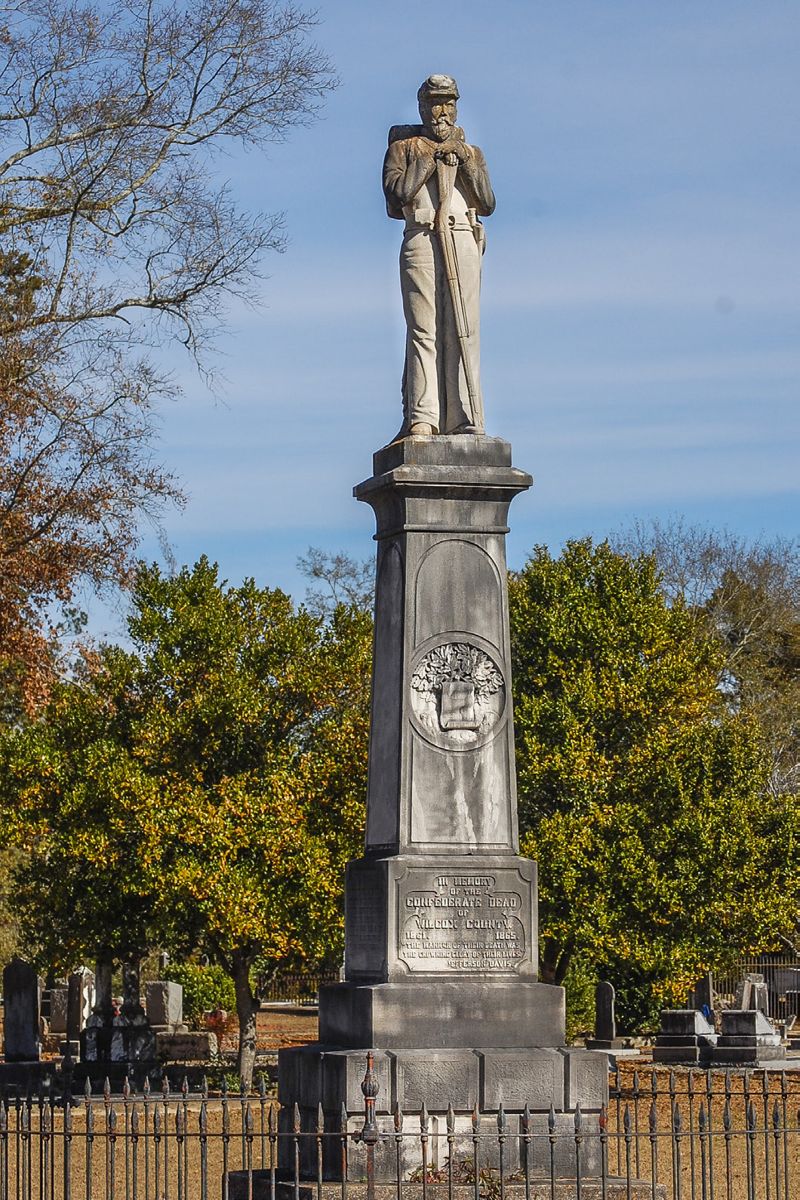
The superb condition of this monument shows that it has been well-maintained over the decades. The cost was $2,500. In 1880 a very similar statue was erected in the town of Camden, Alabama. One of the inscriptions below the grieving soldier articulates the builders’ continued belief in the justice of their peoples’ cause. THEY GAVE THEIR LIVES FOR US; FOR THE HONOR OF ALABAMA; FOR THE RIGHTS OF THE STATES; AND FOR THE PRINCIPLES OF THE UNION AS THESE WERE HANDED DOWN TO US BY THE FATHERS OF OUR COMMON COUNTRY. The builders, the Ladies Memorial Association and the Wilcox Monumental Association, quoted Father Ryan, as did the ladies in Selma and numerous other places. WHEN MARBLE WEARS AWAY AND MONUMENTS ARE DUST, THE SONGS THAT GUARD OUR SOLDIERS’ CLAY WILL STILL FULFIL THEIR TRUST. The quote is from the poem “Sentinel Songs.” The inscription identifies Father Ryan as the poet, which is unusual. His poems were so well known at the time that most people didn’t have to be told where the quote came from. In Mobile, a statue that once topped a column in Magnolia Cemetery was shattered by lightning in 1931. The fiftyseven-year-old monument was rebuilt, minus the statue. You can still see the young Confederate, however; a remnant was saved and reused in a memorial erected in 1961. The soldier is (or was) standing at rest on arms reversed. His bowed head is
Mobile.
obvious. A close examination reveals that his hands are resting on the missing rifle’s butt. The repurposing was done by the local camp of the Sons of Confederate Veterans. Father Ryan’s “Sentinel Songs” is quoted again: GO! WATCH O’ER THE DEAD IN GRAY! GO GUARD THE PRIVATE, AND GUARD THE CHIEF, AND SENTINEL THEIR CLAY.
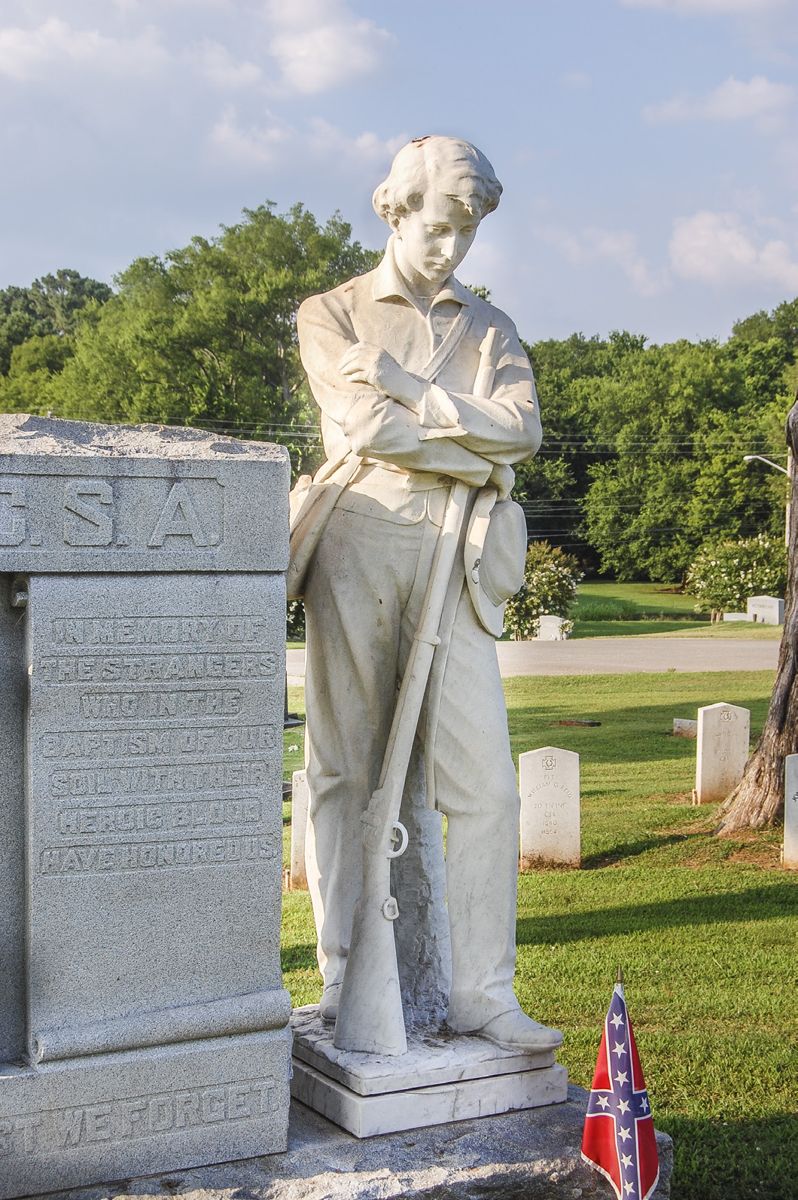
CivilWarNews.com The northern Alabama town of Athens has two Confederate soldiers. The one pictured was originally standing on a column at the Limestone County Courthouse, erected in 1909. Soon, however, the mournful soldier was removed and replaced with a more typical soldier standing at rest. The original statue was moved to the Athens City Cemetery in 1912 by the local chapter of the United Daughters of the Confederacy. The soldier’s rifle is not reversed, but the message is nevertheless clear. The sad soldier looks down upon the graves of 29 known and eight unknown Confederate dead. In 2005 the local SCV camp erected the modern granite marker which lists the names and units of the known dead. The inscription reads: IN MEMORY OF THE STRANGERS WHO IN THE BAPTISM OF OUR SOIL WITH THEIR HEROIC BLOOD HAVE HONORED US Our last statue is in Savannah, Georgia, in Catholic Cemetery. Erected in 1910, it honors the men of the Irish Jasper Greens. The inscription reads: IN MEMORY OF THE IRISH JASPER GREENS COS. A AND B FIRST VOL. REG. OF GEORGIA WHO DIED IN THE SERVICE OF THE CONFEDERATE STATES 1861-1865. REQUIESCANT IN PACE. The soldier is clearly standing at rest on arms reversed. I am told that in 1910 the rifle was placed muzzle down. Years ago, when I first photographed the statue, the rifle was MIA. Later, when the monument was restored, the brave Irish American volunteer was rearmed, but the rifle was installed muzzle up. Several months ago I showed a photograph of the restored statue to an audience which included a lady from Savannah. She told me there was a possibility that the rifle would be placed in its original, correct position. I have not visited Savannah since and do not know if this has been done.
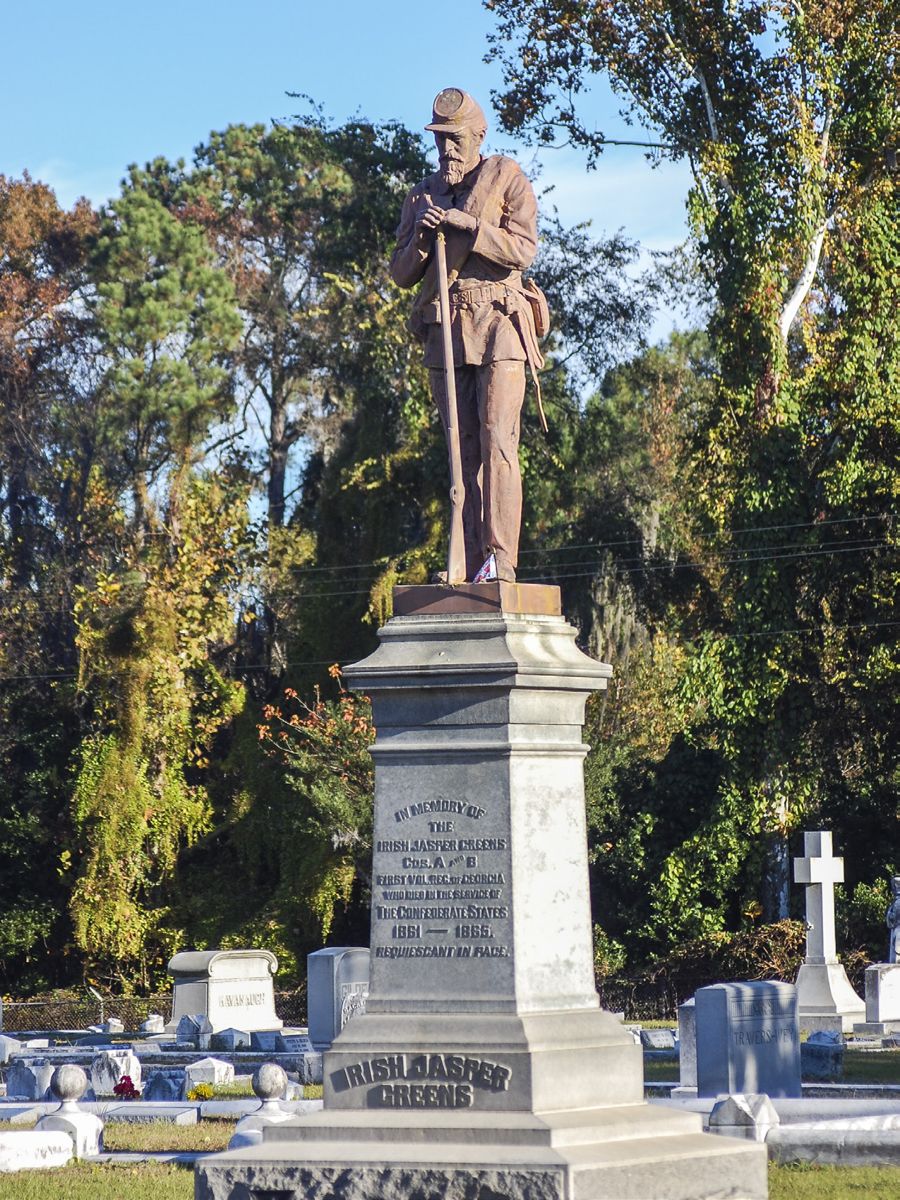
Everyone who reads this column and views the accompanying images will be familiar with the Civil War’s terrible cost in terms of human life. More than a quarter of a million Confederate soldiers did not survive the conflict. When the memorials were built in Selma and Camden the wounds of war were still fresh, as evidenced by the physical forms chosen by the builders and the tone of the inscriptions graven on the stone. A generation later the loss was still deeply felt, as the statues in Athens and Savannah tell us. The replacement statue in Athens, however, is more typical of the memorials erected in the early years of the 20th century. As time passed and as wounds healed, the mournful aspect of Confederate monuments, though still present, was less emphasized. *There are numerous examples, one of the oft-used quotes being “These were men whom power could not corrupt, death could not terrify, defeat could not dishonor.” **It is a common misconception that all, or most, Confederate monuments of the soldier variety face north. They face every which-a-way. Gould Hagler is a retired lobbyist living in Dunwoody, Ga. He is a past president of the Atlanta Civil War Round Table and the author of Georgia’s Confederate Monuments: In Honor of a Fallen Nation, published by Mercer University Press in 2014. Hagler speaks frequently on this topic and others related to different aspects of the Civil War and has been a regular contributor to CWN since 2016. His email is: gould.hagler@gmail.com.
Waud Drawing, Funeral March
There is some confusion between the rest on arms reversed position and the reverse arms position. The former, as we have seen, relates to a soldier’s (or a statue’s) position while standing. The latter relates to the position of the rifle borne by a marching soldier. Both, obviously, connote mourning and respect for the fallen. Images of troops marching with arms reversed are not easy to find, but I did locate one from the Civil War by Alfred Waud. And here is an excellent video on the subject: https://www.youtube.com/watch?v=-hq0V25pcyw. Selma.