
One Soldier’s Ups and Downs with the Stonewall Brigade
By Carl L. Sell Jr. · Originally published March 2023 · pp. 8–9
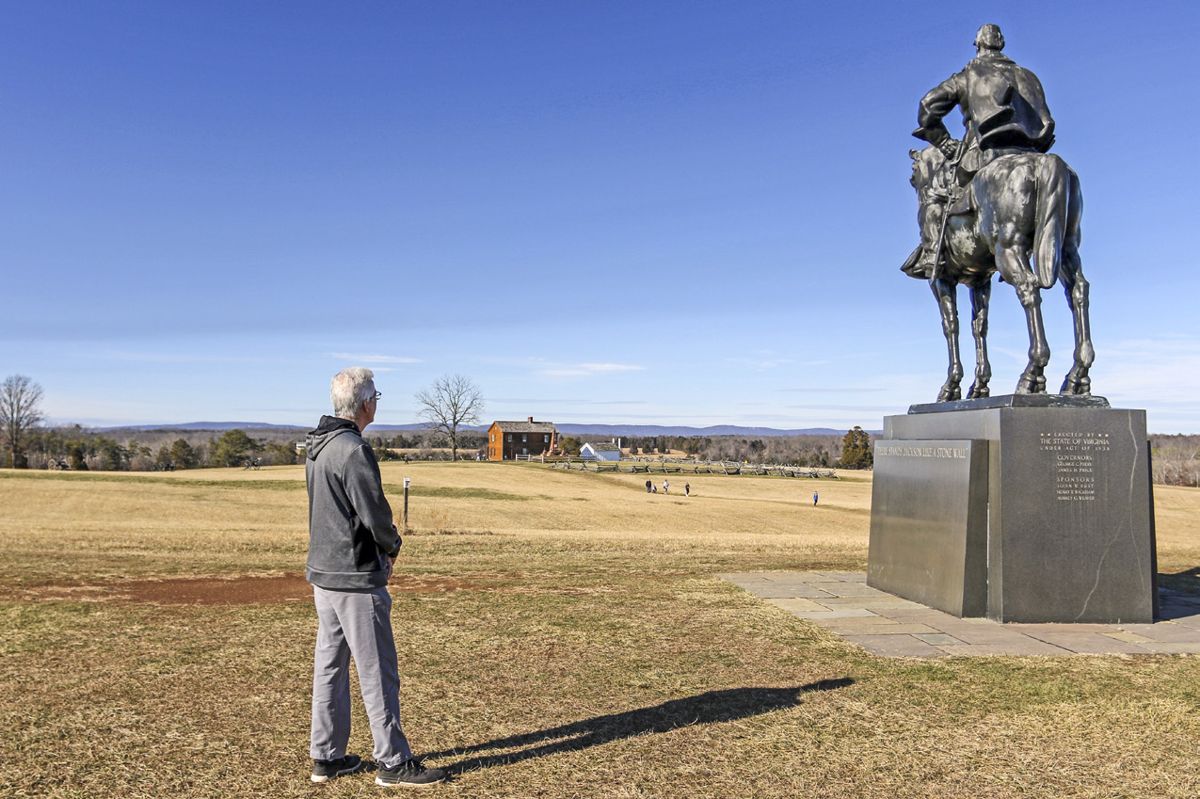
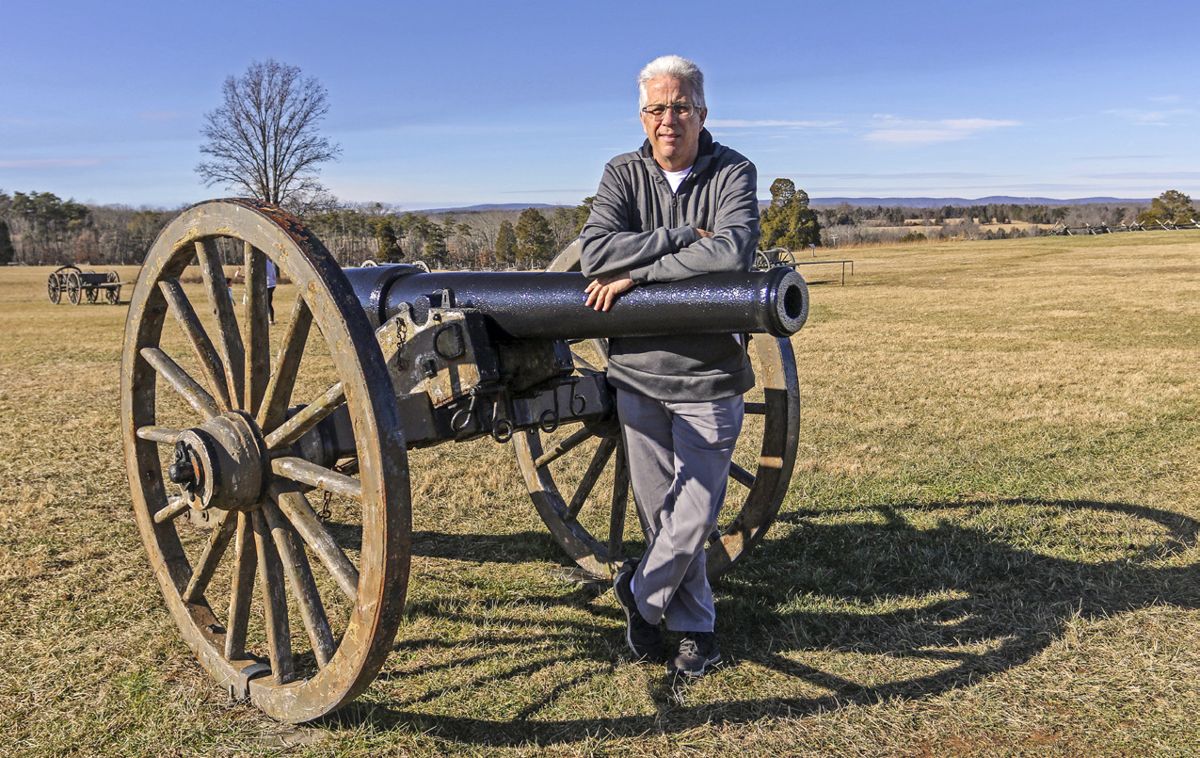
This is the story of one member of the Stonewall Brigade. He survived the Civil War despite fighting in major battles, being wounded and captured at Gettysburg, captured again at Spotsylvania Courthouse, marching, marching, and marching until he decided to desert. This story also picks up after he was reinstated in 1864 as the Confederates await a Union attack as the Overland Campaign began. Henry Brown and Albert Bolton, two members of the Greenbriar Rifles, enlisted in the Confederate Army at Meadows Bluff, Virginia (now West Virginia), on May 11, 1861. The Twenty-Seventh became part of the famous Stonewall Brigade, an outgrowth of their gritty performance at Manassas. The Brigade’s first march was north, “down the valley” through Staunton, New Market, Strasburg, and Winchester to Harpers Ferry. The men rode in wagons for most of the trip, a luxury they would not experience during the rest of the war. In July, Confederate forces in the Shenandoah Valley were placed under General Joseph E. Johnston. In mid-July, Johnston’s army began moving toward Winchester as Union threats to Harpers Ferry lessened and there were rumors of a battle coming on the other side of the Blue Ridge Mountains, the eastern heights that bordered the Shenandoah Valley. About July 18, their pace quickened as the soldiers reached Winchester and word spread that Confederate forces under Brigadier General Pierre G.T. Beauregard had been attacked along Bull Run. The troops hurried toward the Blue Ridge, being cheered by citizens along the Winchester-Berryville
Turnpike. They bivouacked on the Blue Ridge’s eastern slope at 2 a.m. On July 19 they piled onto a train at Piedmont on the Manassas Gap Railroad for the 32-mile trip to Manassas Junction, four miles from the future battle site. The next morning, Jackson’s brigade marched past damage from musketry and cannon fire and freshly dug graves from a battle that occurred two days earlier. Jackson was instructed to guard the Stone Bridge over the Warrenton Turnpike. His brigade wound up on the far left of the Confederate line, facing slightly northwest toward a line of Federal cannon on Henry House Hill. Two assaults on the Union lines had already failed when Jackson ordered his men to charge and “drive them to Washington.” The men recalled they faced gun muzzles that looked as big as flour barrels and backed by infantry “as thick as wheat in the field.” The Union cannon fired canister that brought down a third of Jackson’s charging men, but the rest pressed on and put the defenders to flight. No enlisted man among the attackers was killed, but 122 were wounded. They would be known from then on as the “Bloody 27th,” Jackson would earn the nickname of “Stonewall,” the brigade would henceforth be known as the Stonewall Brigade. The Twenty-Seventh and the Stonewall Brigade moved as far north as Fairfax Courthouse that fall. Jackson, by now a major general, was ordered back to the Valley. In December, the Brigade was part of the Valley District under Jackson’s command, and moved to confront Union activity on the Chesapeake and Ohio Canal. During that time, Jackson also shut down the Baltimore & Ohio Railroad between Martinsburg and Point of Rocks and diverted scores of locomotives and rolling stock to the Confederate cause by taking them by rail and wagons to the Manassas Gap Railroad western terminus at Strasburg, and later to Staunton, where they joined the Virginia Central Railroad. In early 1862, the Brigade marched through a blizzard toward Romney in western Virginia, crossed into Maryland, bombarded Hancock, and camped at Romney in heavy snow. The Stonewall Brigade returned to Winchester and then to Strasburg in the face of advancing Federal forces. In early March, Jackson learned a Union army led by Major General Nathaniel Banks had crossed the Potomac and was headed toward Winchester. Jackson at first planned to attack the Federals at Winchester, but a misunderstanding among subordinates scuttled the attack plans and the Brigade instead headed back to Strasburg. When it was learned in midMarch that Banks was leaving the Valley to reinforce Federal forces that threatened Richmond.
Jackson reversed direction and headed north to intercept the Federals. He met a force larger than his own and suffered the only defeat of his career. At Kernstown, the Confederates held their own until the Stonewall Brigade ran out of ammunition and withdrew. Jackson was incensed and ordered the arrest of Brigadier General Richard Garnett, who had ordered the retreat in the face of overwhelming odds and no ammunition. Garnett was later reinstated by General Lee. Brown lost his rifle, and later his hearing, at Kernstown. After marching back to Strasburg, Jackson regrouped and began his celebrated Valley Campaign that chased the Federals north and ended any attempt to bolster forces in what would become the Peninsula Campaign. Jackson then marched his weary men to Gordonsville, boarded trains, then marched to help thwart a Federal thrust that had reached the gates of Richmond. No sooner had McClellan’s army started leaving the peninsula, Major General John Pope’s Army of Virginia was assigned the task of attacking Richmond from the north. The bombastic Pope had been brought in from the western front to end the war by conquering the Confederate capital. Lee, learning of the threat to his rear, turned the Army of Northern Virginia around and rebuffed Pope at Cedar Mountain and Second Manassas. Jackson and the Stonewall Brigade played major roles in both victories. After Second Manassas and an encounter at Chantilly, Lee decided to attack the Union by crossing the Potomac River into Maryland. Jackson set the stage by crossing the river at Leesburg, then recrossed at Williamsport, and captured Harper’s Ferry and 12,500 Union troops from behind. Although the bloody battle at Sharpsburg (we’re talking about Confederates here) produced massive casualties on both sides, the Twenty-Seventh suffered only three dead and five wounded. The troops, although barefoot and half-starved, were proud of themselves for holding their own against a well-trained, wellfed and well-equipped enemy. The Stonewall Brigade retreated across the Potomac and camped at Bunker Hill before moving farther back to five miles north of Berryville, and then farther down the Valley Turnpike. After being criticized for not following up after Antietam, McClellan was fired by President Abraham Lincoln and replaced by Major General Ambrose Burnside. While Burnside began to move the Union Army toward Fredericksburg, Lee followed and actually stole a march on his adversary, which had to wait for pontoon bridges to be to Fredericksburg. By that time the Stonewall Brigade had moved south, crossed the Blue Ridge at Fisher’s Gap, and was bivouacked in Madison County. They faced a 140-mile march to Guinea Station southeast of Fredericksburg and were angry because Jackson had bypassed a Brigade favorite, Colonel Andrew Jackson Grigsby, and appointed Colonel Elisha Franklin Paxton as its leader. Paxton had been a member of Jackson’s staff. He had been defeated by Grigsby in an election to lead the Twenty-Seventh. Henry left the Army in November 1862 after 18 months of marching, fighting, and then marching some more. He fought in First and Second Manassas, the
Valley Campaign, the Peninsula Campaign, and Sharpsburg. The upheaval in leadership and the fact the unit was marching 10 miles per day toward Fredericksburg, no doubt led to Brown’s decision to go home. After six months of hiding from both Yankees and fellow Confederates, Henry decided to return to duty in late April 1863. By the time Brown returned in May, the Confederate Army was understrength from casualties and sickness and
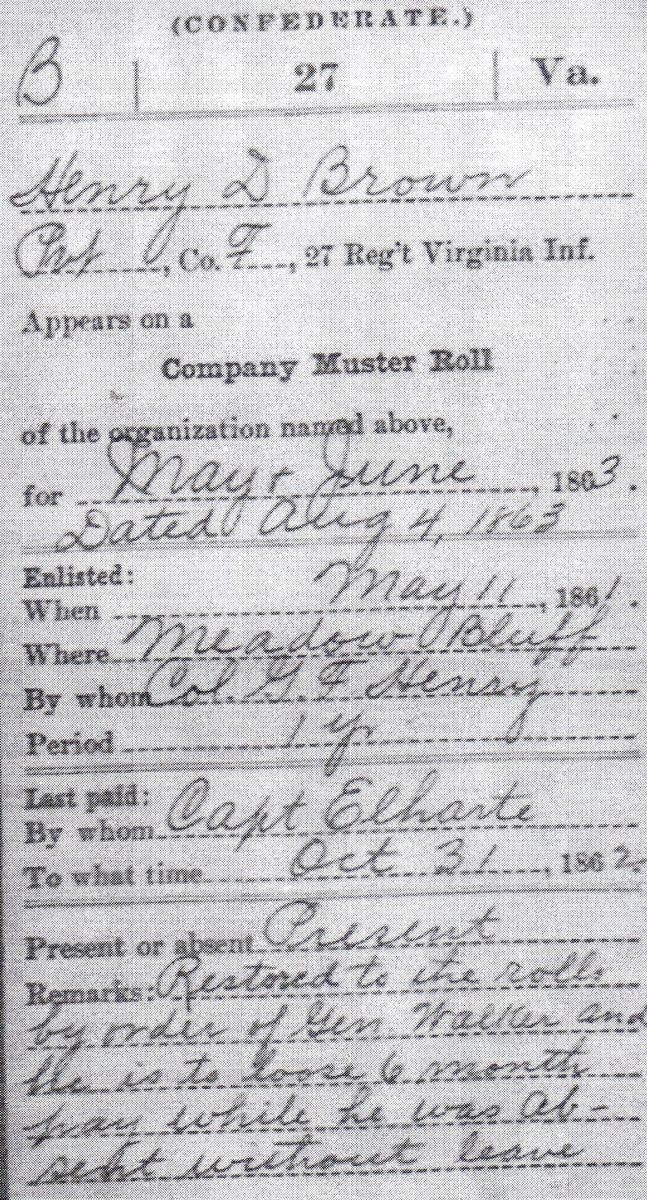
CivilWarNews.com desperate for replacements, especially one who qualified as a sharpshooter. Despite previous harsh punishments for desertion, including facing a firing squad, he was welcomed back and ordered reinstated by Brigadier General James A. Walker, the new leader of the Stonewall Brigade. General Walker was happy to sign his reinstatement, although he did fine Brown six month’s pay for his absence. Brown arrived at
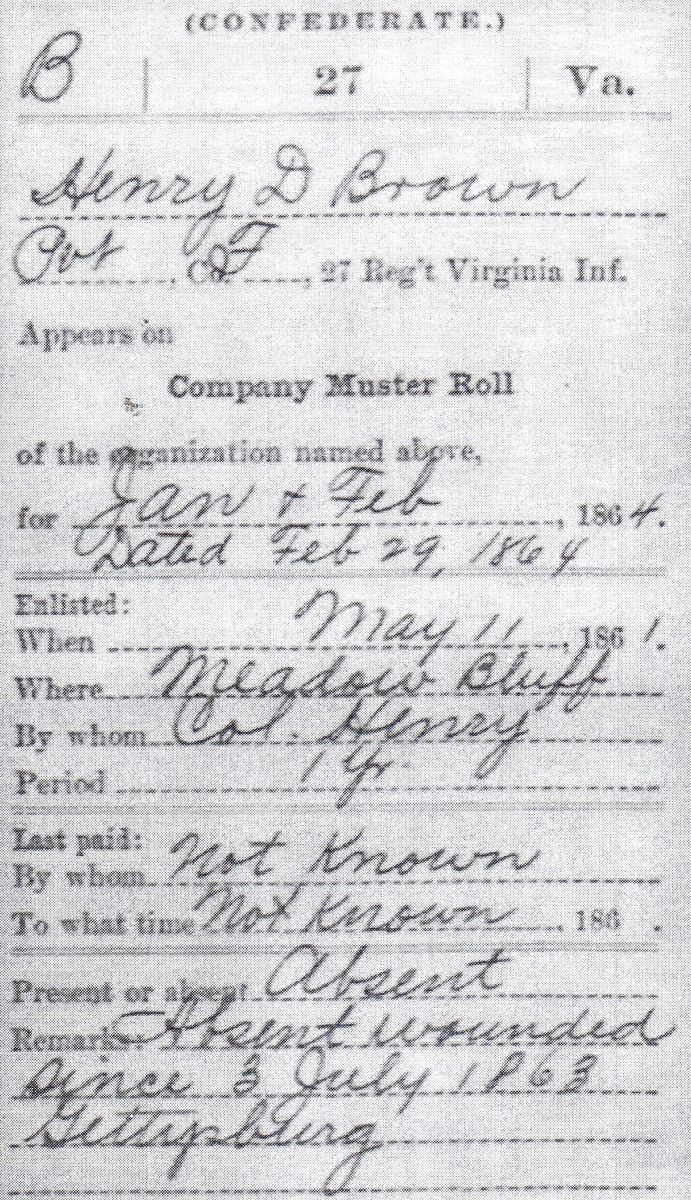
Chancellorsville on the eve of the loss of Lieutenant General Thomas J. (Stonewall) Jackson, who was mortally wounded by friendly fire on the evening of May 2, 1863. Confederate Cavalry leader Major General James Ewell Brown Stuart took over as head of Jackson’s Second Corps and completed the victory at Chancellorsville so brilliantly planned by General Robert E. Lee and Jackson. A flank march by Jackson’s troops on May 2 caught the Union by surprise and set the stage for the Confederates’ victory in a row. After the victory at Chancellorsville, the men looted the knapsacks of fleeing Federals. They had little time to enjoy the spoils as General Lee began preparations to invade the North. The Army of Northern Virginia’s reorganization caused by Jackson’s mortal wounding at Chancellorsville resulted in there being three infantry corps. The Stonewall Brigade was placed in the Second Corps under Major General Richard (Baldy) Ewell. as part of a reorganization. They were now part of a division led by Major General Edward (Allegany) Johnson, who endeared himself to his troops by confiscating shoes of captured Yankees and distributing them among his men. The Twenty-Seventh reached Carlisle, Penn., on Saturday, June 27. They camped for two days before an order came to march to Gettysburg. They arrived at dark on July 1 and stayed in camp the next day. At dawn on July 3, the Twenty-Seventh participated in seven unsuccessful assaults on Culps Hill. Brown was wounded and captured during one of them. He was sent to DeCamp General Hospital on David’s Island, New York. The hospital and prison camp were located on Long Island Sound near New Rochelle. He was exchanged on September 9 but did not rejoin the 27th until the following February. On March 7, 1864, Private Henry Brown of Company F, Twenty-Seventh Virginia Infantry, resumed an exchange of letters with Annie Bolton, sister of Albert Bolton, one of Brown’s 27th Virginia comrades, after an almost two-year hiatus. Henry and Annie had never met but Annie had recently written Henry inquiring about her brother, Albert. Annie responded and Henry wrote back on April 24, apologizing for the delay, citing picket duty on the Rapidan River. He said the Yankees were in plain view but were very quiet. He said there was no sign of a fight at present but one could not be far off. The letter also told of his wounding and capture at Gettysburg, subsequent release, and return to duty. Annie said she received a letter from Company F saying her brother had gone off to get married. Henry responded that “if such is the case he has kept it a secret from me. I would not be at all surprised if he was only playing you an April trick. He is now with the company and has been since I returned though he speaks of going to Greenbrier to get married as soon as he can get a furlough.” On May 1, 1864, Henry wrote Annie to tell her that both he and her brother were well but were “looking for a fight very soon.” That was an understatement as the Union Army began the Overland Campaign three days later by crossing the Rapidan River and attacking in the Wilderness. Less than two weeks later, the 27th was positioned on the left of the famous “Muleshoe” at Spotsylvania. On May 12, a Union assault at Spotsylvania Courthouse ended the TwentySeventh’s effectiveness as a fighting force. Brown and almost 900 comrades were captured when their rifles failed to fire because of wet powder. Brown was taken to Belle Plains, the Union supply depot on the Potomac River in Stafford County, and arrived at Fort Delaware on the Delaware River, just south of Philadelphia, on May 21. Brown and many other captives were imprisoned there for the remainder of the war. Bolton escaped capture that day. He almost survived the siege of Petersburg unhurt but was wounded in the left leg at Hatcher’s Run February 5, 1865. Furloughed on February 28, he went home, settled down, then married Sarah Further in 1868. They apparently had five children and moved to Illinois in the 1870s. After being captured at Spotsylvania, Brown was held at Fort Delaware until the end of the war. He was released on June 19, 1865, and returned to Virginia. Henry married Susan Brown from Rappahannock County on February 7, 1867, and they set up housekeeping on a hilly farm near Sperryville. Part of the farm remains in family ownership. A daughter, Mary Virginia (Mamie), was born on May 20, 1868. Henry Brown’s application for a pension included a letter from Dr. W.H. Amiss, dated January 27, 1896. The letter cited Brown’s loss of hearing caused by a concussion from a shell burst at Kernstown in 1862 that had caused him to become disabled later in life. Brown was awarded a pension of $15 per year. Henry died in 1907 and Susan in 1933, age 90. They apparently are buried in unmarked graves on what was once part of their farm in Sperryville. Their daughter Mamie is buried there along with other family members. Mamie married Charles Kuhn, who was born in Germany in 1870. They had a son, George, who married Margaret Conroy, born in Roscommon, Ireland. George died in 1934 in Washington, D.C., while Margaret lived until 1968. Their daughter, Mary Elizabeth Kuhn, married William Blair Kamenjar. William and Mary Elizabeth lived in Rockville, Maryland. He died in 2002 and she passed in 2016. Veteran Both Sides The exchange program ended after Major General Ulysses S. Grant took command of the Union forces just before the start of the Overland Campaign. Annie Bolton given name was Ann Mildred and she apparently never married. Bill Kamenjar’s great-great grandmother had a descendant who was a captain for the American forces in the Revolutionary War. Bill and sisters Christine, Mary Elizabeth, and Ann Margaret learned that their ancestor, Daniel Brown, was a captain in George Washington’s army. The credit for discovery and authentication of the personal information in this story came from Genealogist Karen Conair. The Civil War facts are scrutinized and provided by historians Don Hakenson and Ben Trittipoe. Contact the author at 703-971-4716 with comments or suggestions.