
Jon Meacham and Jonathan W. White Win Lincoln Prize
Originally published June 2023 · pp. 1–4
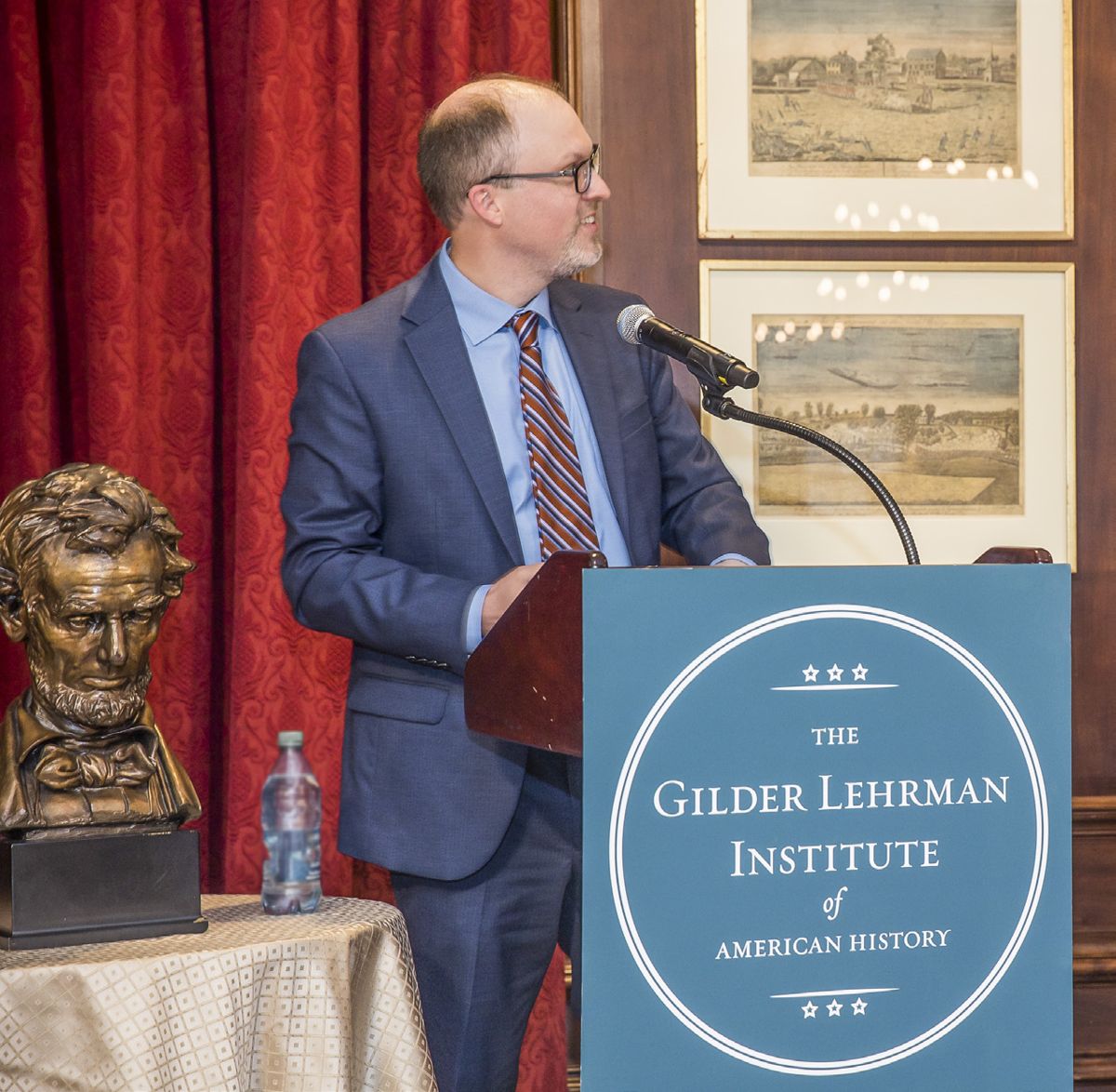
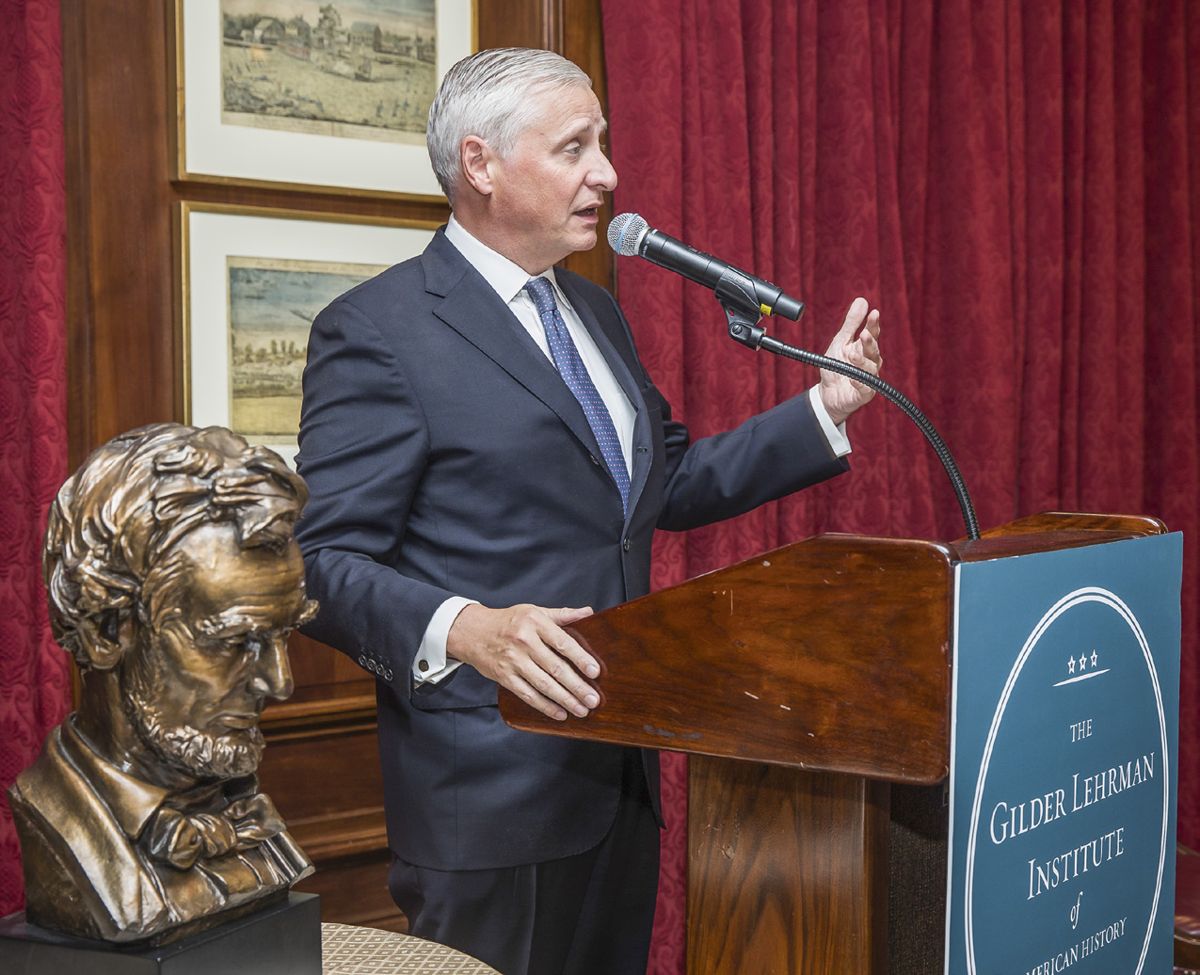
On April 11, the Gilder Lehrman Institute of American History awarded the prestigious Gilder Lehrman Lincoln Prize to historians Jon Meacham and Jonathan W. White. The ceremony took place at the Harvard Club in New York City. The two laureates each received half the $50,000 award, and each received a bronze replica of Augustus Saint-Gaudens’s lifesized bust, Lincoln the Man.
Lincoln Prize. The prize jury consisted of Elizabeth Varon, Harold Holzer, and John Stauffer; they wrote that Meacham’s And There Was Light: Abraham Lincoln and the American Struggle (Random House) is “a timely and original biography of Lincoln, well informed by modern scholarship and full of educational value for the broad reading public.” They concluded, “Meacham’s superbly readable biography … is one of the very finest that we have, and will stand the test of time.” The jury wrote that White’s A House Built by Slaves: African American Visitors to the Lincoln White House (Rowman and Littlefield) “captures the symbolic importance of social equality as an issue to be addressed during— and after—the restoration of the Union and eradication of slavery.” In a review that appeared in
Civil War News last year, Harold Holzer wrote, “A House Built by Slaves is a welcome and crucial contribution to the Civil War literature, and should be cited as long as Lincoln biography is written.” James G. Basker, president of the Gilder Lehrman Institute of American History, said, “And There Was Light and A House Built by Slaves powerfully humanize the story of the Civil War by re-examining the lives and legacies of those who lived it. Thousands of books have been written about Abraham Lincoln and his contemporaries, but these studies by Meacham and White stand out for their narrative skill and interpretive brilliance.” Larry D. Walker, a trustee at Gettysburg College, added, “We are pleased to be able to honor two outstanding books. Jonathan White’s work provides us with a deeper and important understanding of the view of Lincoln shared by African Americans in the Civil War era. Jon Meacham’s work is a major contribution to the long line of Lincoln biographies that will be read and re-read for decades.” Jonathan W. White, who regularly writes reviews for Civil War News, delivered the following remarks when he accepted the award. ~ It is an honor to be here tonight. I thank the jury and the board of trustees for selecting A House Built By Slaves as one of this year’s recipients. I am especially thrilled to be sharing this honor with Jon Meacham. My wife, Lauren, our daughters, Charlotte and Clara, and my parents, Bill and Eileen, have been steadfast support over the years. My poor kids—who are right over there—have been living with Lincoln for as long as they can remember. They’ve visited more Lincoln sites than most Americans ever see … although they don’t let me dress them up as Old Abe anymore. Before I make a few remarks about the greatest American, I
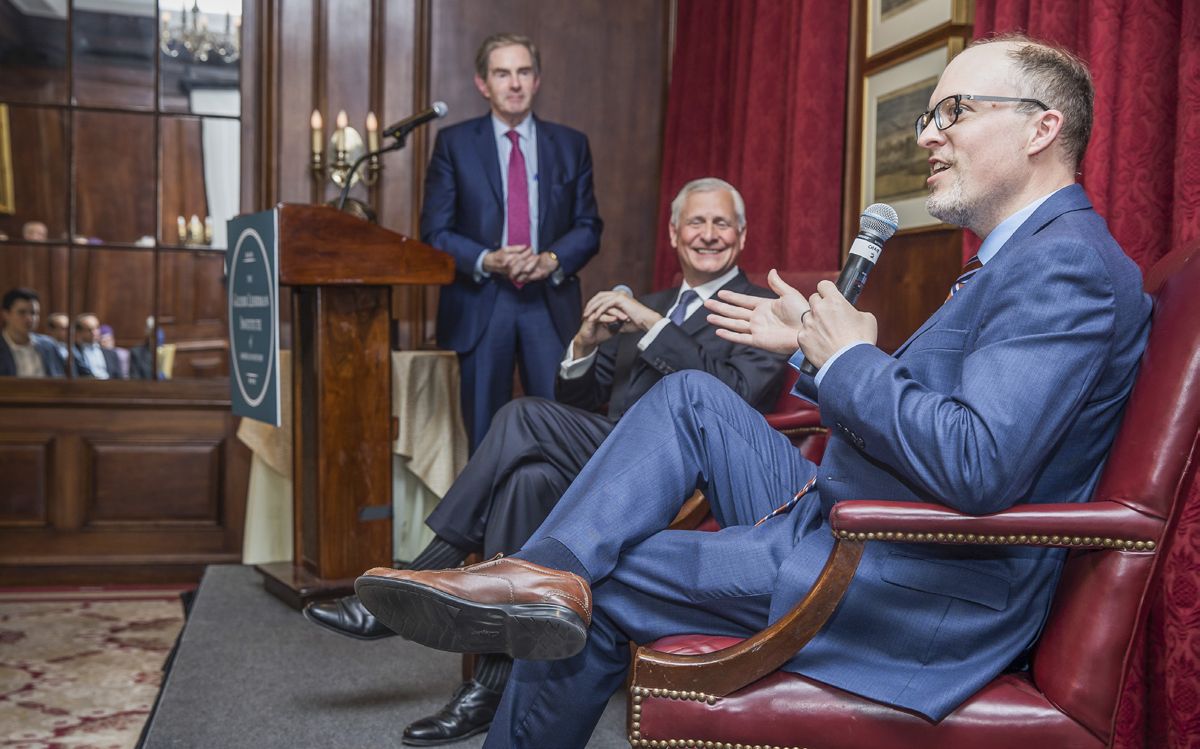
Jon Meacham and Jonathan W. White greet one another with Harold Holzer and Elizabeth D. Leonard. (Photos by Ilir Bajraktari) want to say something about a letters from African Americans Now, I don’t know what very great man, to whom we all to Lincoln, and I published Lincoln’s reaction was when he owe a debt of gratitude—but to them in 2021 in a book called held this letter in his hands, but I whom I am particularly thankful. To Address You As My Friend: highly doubt that he laughed. You Lewis Lehrman has transformed African Americans’ Letters to see, most letters Lincoln received the field of American history. His Abraham Lincoln (University of were sent throughout the federal founding of the Gilder Lehrman North Carolina Press). One of bureaucracy and are now housed Institute has been a boon for my favorites came from a man in various record groups at the scholars, and has brought named Hannibal Cox. National Archives. But Lincoln history to life for thousands of Cox had been born into held onto this one, and it remains schoolchildren. One of the first slavery in Virginia, but after in his personal papers at the grants I ever received was a Lincoln issued the Emancipation Library of Congress. Clearly this Gilder Lehrman Fellowship in Proclamation, he joined the Union letter meant something to the 2006 that enabled me to come to Army; as a soldier he learned president. New York for three weeks to do how to read and write. Cox was In the course of my research I research for my dissertation. so proud of what he was learning learned that African Americans In 2007, Lew sponsored a that he wanted his commander did not simply write to Lincoln. conference at Princeton for young in chief to know about it. So, in They also went to the White scholars interested in American March 1864 he sent a letter to House to meet with him. In doing history. At that conference I met Lincoln, briefly describing his life so, they were claiming the right two professors from Christopher story and praising the American of U.S. citizens to speak freely, Newport University, and I guess I flag. But the most touching part is and to petition the government made a good impression, because the postscript in which he wrote: for a redress of grievances. two years later, they hired me “I sends this for you to look at, A remarkable transformation as a postdoc, and I have been at you must not laugh at it.” took place during Lincoln’s Christopher Newport ever since. I Hannibal Cox knew that people presidency. Prior to the Civil War would not be the scholar I am today had a natural inclination to laugh African Americans were more were it not for Lewis Lehrman. at mistakes made by others. He likely to be bought and sold by His kindness and generosity set knew that his grammar, spelling, a sitting president, than to be me on a path toward becoming punctuation, and penmanship welcomed as his guests. But one of the luckiest people in the were not perfect. And he worried Lincoln broke down barriers that world, a tenured professor at an that Lincoln might hold this letter extraordinary university. in his hand and chuckle. But he Lincoln In 2014, I started collecting sent it to Lincoln anyway.
Alexander Crummell presented the gift to the Lincolns will be with you.” Lincoln was the same concern that we heard H Lincoln … from page 1 including and Joseph Jenkins Roberts. in the White House library, on visibly moved by these words. in Hannibal Cox’s letter. These had been in place for decades. He treated black visitors with kindness and cordiality, and he always shook their hands, something that few white Americans of his generation would ever do. In August 1862, he met with the heroic South Carolinian, Robert Smalls, a former slave who had freed himself by stealing a Confederate ship. He met with Frederick Douglass three times during the Civil War to discuss matters of public policy. Douglass later remarked that Lincoln treated him as an equal and “received me … just as you have seen one gentleman receive another!” He met with Paschal Randolph, a spiritualist and sex magician, who wanted to recruit black soldiers. Since my kids are in the audience, I’m not going to tell you what a sex magician was— you’ll have to pick up a copy of the book. He met with officials from black nations like Liberia and Haiti,
Despite opposition from his own family, he shook black hands at public receptions, including two army surgeons, Alexander T. Augusta and Anderson R. Abbott. When black delegations came to the White House asking for the right to vote, Lincoln showed sympathy for their cause and began working behind the scenes to push for black suffrage. In September 1864, black ministers from Baltimore gave Lincoln a beautiful Bible with this gold emblem on the front cover. The following month, Sojourner Truth marveled at the gift. I could tell many, many stories tonight, but I will focus on just two. In the spring of 1864, an artist from Philadelphia named Caroline Johnson decided to make a beautiful wax fruit display for Abraham and Mary Lincoln. The gift cost her about $150 to make, and it had a retail value of $350. Mrs. Johnson and her black Baptist minister, James Hamilton,
April 2nd. Now, the library was the large, oval-shaped room in the Lincolns’ private living quarters. It is the room where Lincoln would find quiet to read, think, nap, or play with his boys. It was not a public space. For Lincoln to invite a black woman into this room made a remarkable statement. In fact, this may be the first time a person of color, other than a servant or member of the White House staff, was invited into the private living spaces of the first family. Rev. Hamilton opened the conversation by offering the gift to Lincoln as a symbol of African Americans’ gratitude for emancipation. He then said, “Perhaps Mrs. Johnson would like to say a few words?” Caroline Johnson was understandably nervous. She gazed down at the floor, not knowing what to say. But after a few moments, she placed her hand on her chest, feeling as though a fire was burning inside of her. She later said: “It burned and burned till it went all over me. I think it was the [Holy] Spirit.” Her mind went to Isaiah chapter 51, in which God promises everlasting comfort and salvation to the suffering. “Listen to me, you who pursue righteousness,” wrote the Old Testament prophet, “look to the rock from which you were hewn… . Look to Abraham your father.” With these words in her mind, Mrs. Johnson looked at Lincoln and said, “Mr. President, I believe God has hewn you out of a rock, for this great and mighty purpose. Many have been led away … but you have stood firm, because God was with you, and if you are faithful to the end, he
He thanked her for “the beautiful present,” and, choking back tears, he added, “You must not give me the praise—it belongs to God.” Lincoln also met many black people around Washington, D.C. One Saturday morning, he went to the Contraband Camp on 7th Street, wanting to hear the exslaves sing. The commander of the camp asked a black refugee named Mary Dines to lead the singing. Mary’s knees trembled as she “stumbled” forward and began singing “Nobody Knows What Trouble I See, But Jesus.” She sang the first verse by herself, constantly glancing over at Lincoln. Then the rest of the contrabands joined in. They sang for an hour, as Lincoln wiped tears away from his eyes. The singers seemed to forget that he was there, and they “began to shout and yell” and dance. But Mary later said, “he didn’t laugh at them.” In Mary’s recollection, we hear young black men and women feared that Lincoln might laugh at them for being different. But he didn’t. He treated them with kindness and respect, as human beings who had dignity and value. Mary Dines later added that Lincoln “was no President when he came to camp. He just stood and sang and prayed just like all the rest of the people.” Lincoln’s empathy and humility helped transform the White House, at least for the final three years of his presidency. He strove to live up to the principles of the Declaration of Independence— that all people are created equal, and endowed by their Creator with certain unalienable rights. While Lincoln did not bring about perfect equality during the Civil War, something that would have been impossible to accomplish, he did set an example for future generations, and he serves as a model that we would be wise to never forget.
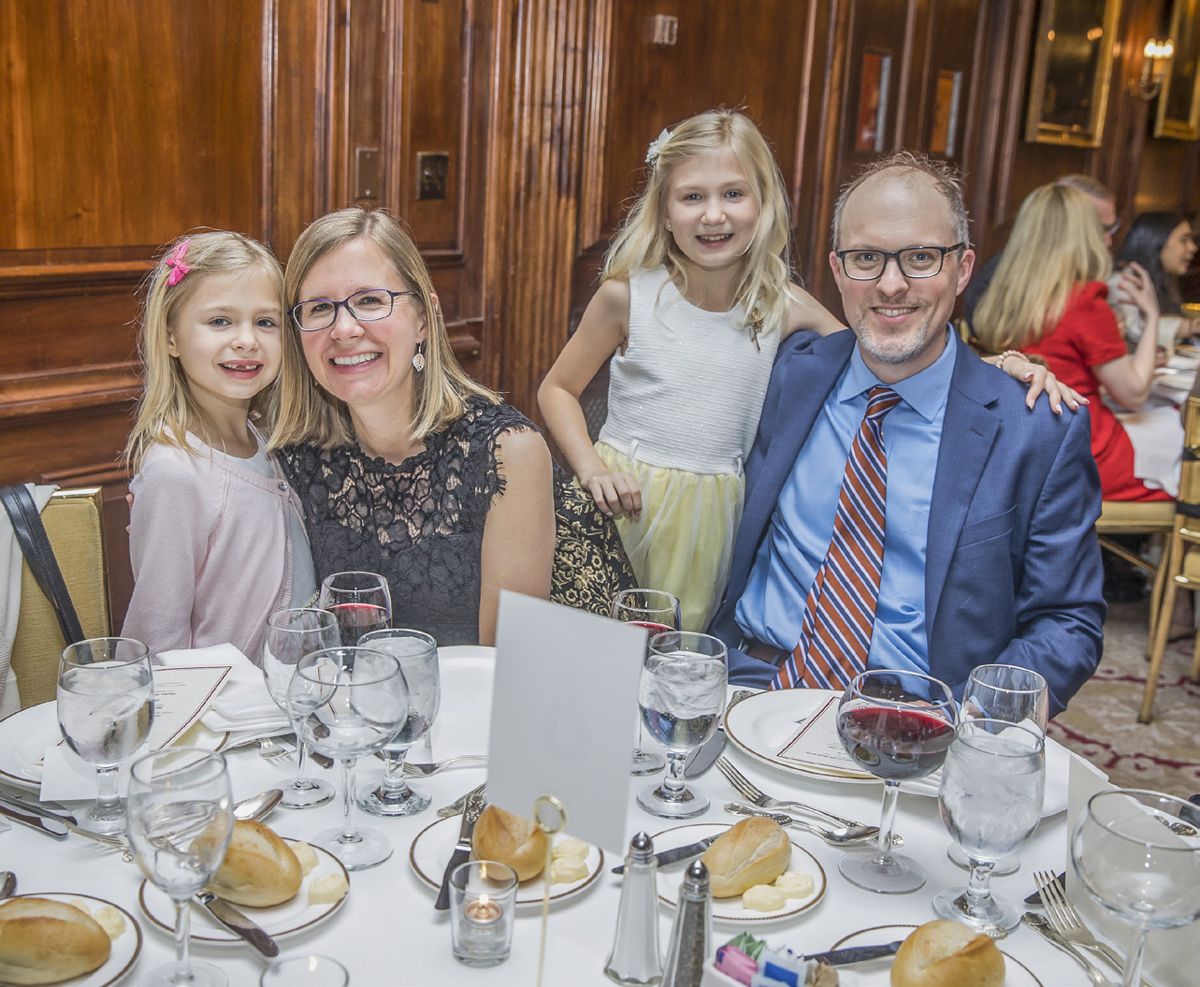
White with his wife, Lauren, and daughters Charlotte (right) and Clara (left)