Bennett Place State Historic Site – General Johnston’s Surrender
By Bob Ruegsegger · Originally published June 2023 · pp. 32–33
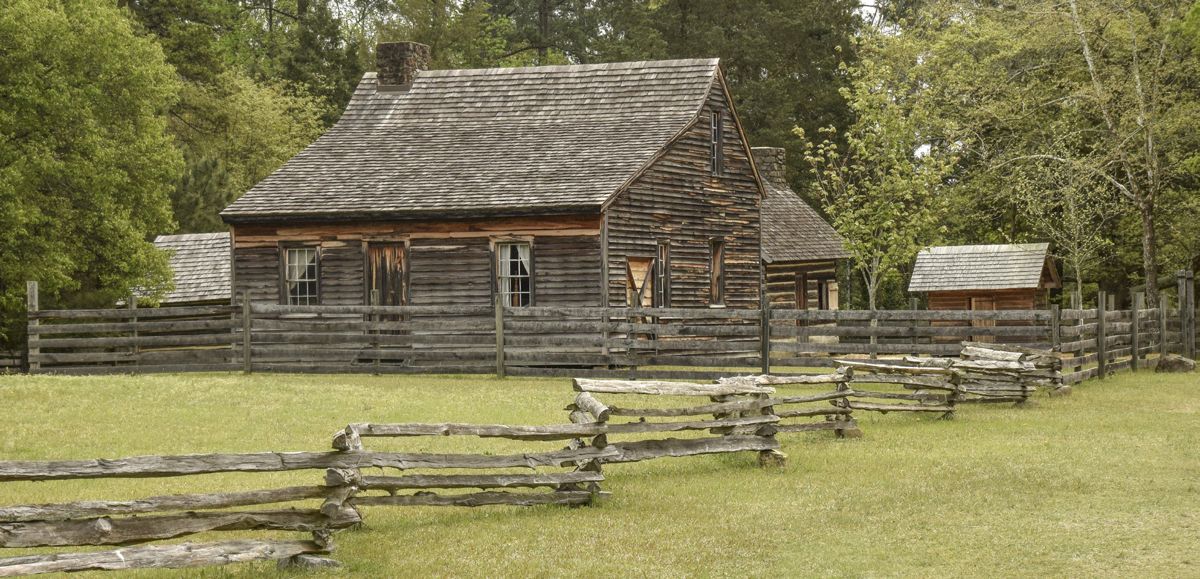
General Joseph E. Johnston and General William T. Sherman met in James Bennett’s farmhouse parlor to negotiate the surrender of Johnston’s Confederate forces. The parley would go down in history as the largest surrender of soldiers during the Civil War. Today, Bennett Place exists as a North Carolina State Historic Site. It appears, in essence, as it did on April 17, 1865, when the two opposing generals met privately in the parlor to discuss the terms of surrender. “Prior to Johnston and Sherman meeting here, Sherman had just received a telegram in Raleigh notifying him of Lincoln’s assassination,” said Matthew Gregg, site manager at Bennett Place. “That might have been one of the reasons that Sherman wanted to meet with Johnston in private.” Nobody in the area knew of President Lincoln’s assassination. Sherman and the telegraph operator in Raleigh were the only ones who knew of Lincoln’s death when Sherman and Johnson entered the Bennett house. “The first thing Sherman did was pull out the telegram and hand it to Johnston. Johnston read it,” said Gregg. “Johnston exclaimed that the worst possible calamity has happened. That was what was going on that first day.” The news of Lincoln’s assassination had arrived. Johnston and Sherman were trying to bring about the end of this war specifically between the two opposing armies of their respective commands. It was sheer coincidence that Bennett Place was chosen as the surrender site. It was simply in the right place at the right time. Johnston was in Greensboro, and Sherman left Raleigh by train and rode down to Durham Station. They planned to meet about midday along the Hillsborough Road on April 17th. General Sherman was escorted by the 9th Pennsylvania Cavalry led by Judson Kilpatrick. General Johnston was accompanied by the South Carolina Cavalry led by Wade Hampton. Sherman was headed west. Johnston was traveling east from Hillsborough to the Raleigh road. Sherman and Johnston met each other. Although they were both West Point graduates, this was the first time that they had personally met. Sherman asked Johnston if he knows of a place where they can sit down together privately. Johnston told Sherman about a farmhouse nearby that might prove suitable for negotiating an armistice. “They turned around and they stopped right here at the Bennett farm,” said Gregg. “James Bennett ended up coming out of the house. The generals politely asked James Bennett if they could use his house for a private meeting,” he said. “James agreed to it.” While the generals met in the farmhouse parlor, James Bennett took his wife Nancy and their daughter Eliza and their grandchild Alphonso Duke to another building. Bennett and his family stayed in the kitchen house while the generals occupied their residence for the parley. Inside the farmhouse the commanders were involved in delicate negotiations. Outside on the property, Kilpatrick and Hampton were engaged in a heated confrontation.
Matthew Gregg is the site manager at Bennett Place Historical Site. He has nine years of experience as an interpreter with North Carolina Historical Sites, Department of Cultural Resources. “I’ve also read where the altercation gets bad enough that Johnston and Sherman have to step out of the house,” said Gregg. “They had to come out here and actually separate the two cavalry officers.” Gregg imagines that the generals might have been “pretty irate” with their cavalry commanders. While the generals were in the farmhouse attempting to bring an end to the war, their cavalrymen were outside trying to start up hostilities again. The terms Sherman and Johnston agreed to on April 18th were drafted by Sherman. The terms were conditional, contingent upon approval from Washington. As drawn up, the terms exceeded Sherman’s authority. Sherman’s negotiations were partly involved in civil matters, the politics of reconstruction. Secretary of War Stanton was displeased. Sherman was only authorized to deal with military matters. Stanton ordered Grant down to Raleigh to relieve Sherman of command and end hostility with Johnston’s forces. “That didn’t happen,” noted Gregg. “Grant came down here (Raleigh area) and told Sherman to try and fix this issue since they were on the cusp of finally bringing this war to a complete close.”
Contact was reestablished between the two generals. They agreed to meet back at the Bennett Place on April 26th. Johnston surrendered his command. No civilian politics were involved whatsoever, just military matters. “Johnston’s surrender actually encompassed North Carolina troops, South Carolina, Georgia, and Florida,” said Gregg. “Technically, he surrendered Confederate troops in North Carolina, South Carolina, Georgia, and Florida. It ended up covering 89,270 troops,” he said. “In comparison, the troops surrendered here numbered three times those surrendered at Appomattox.”
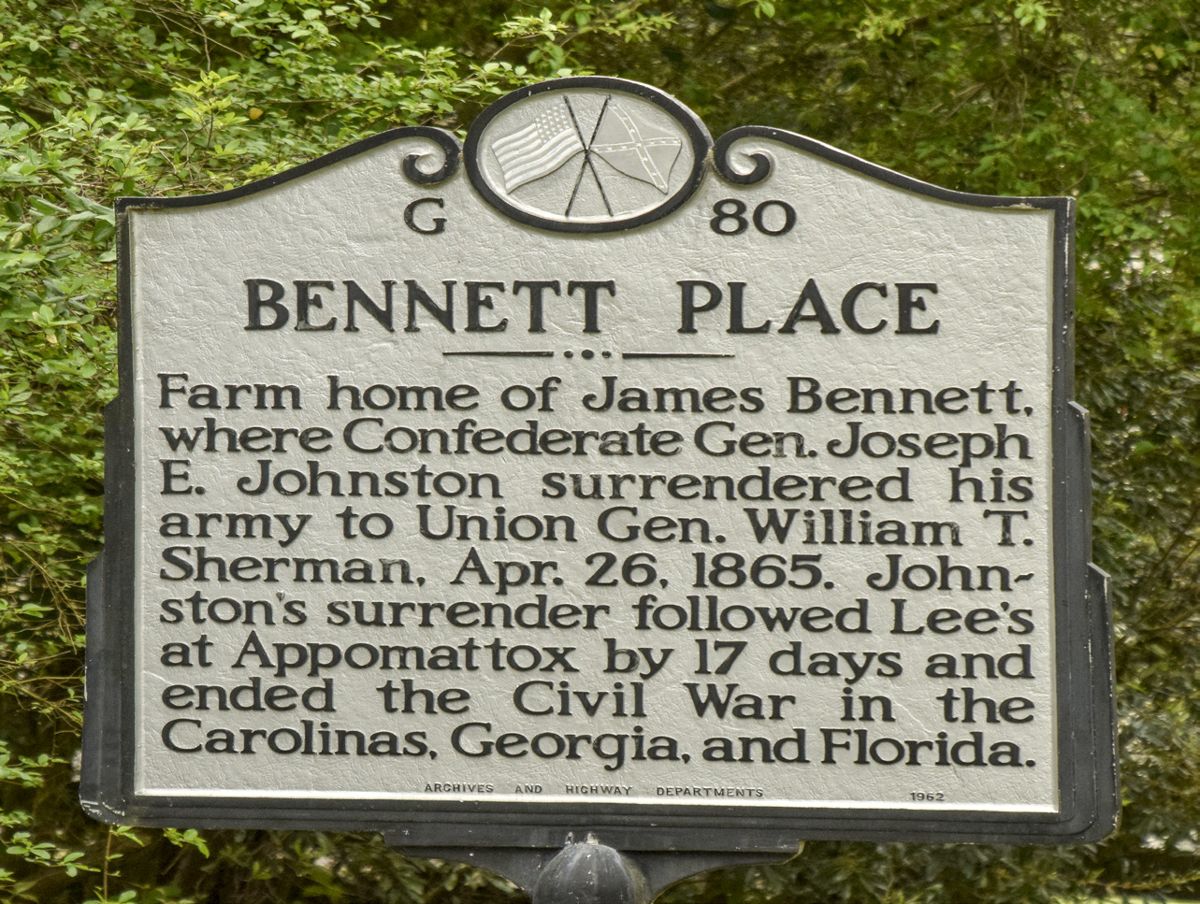
This site sign marks the entrance to Bennett Place Historic Site.
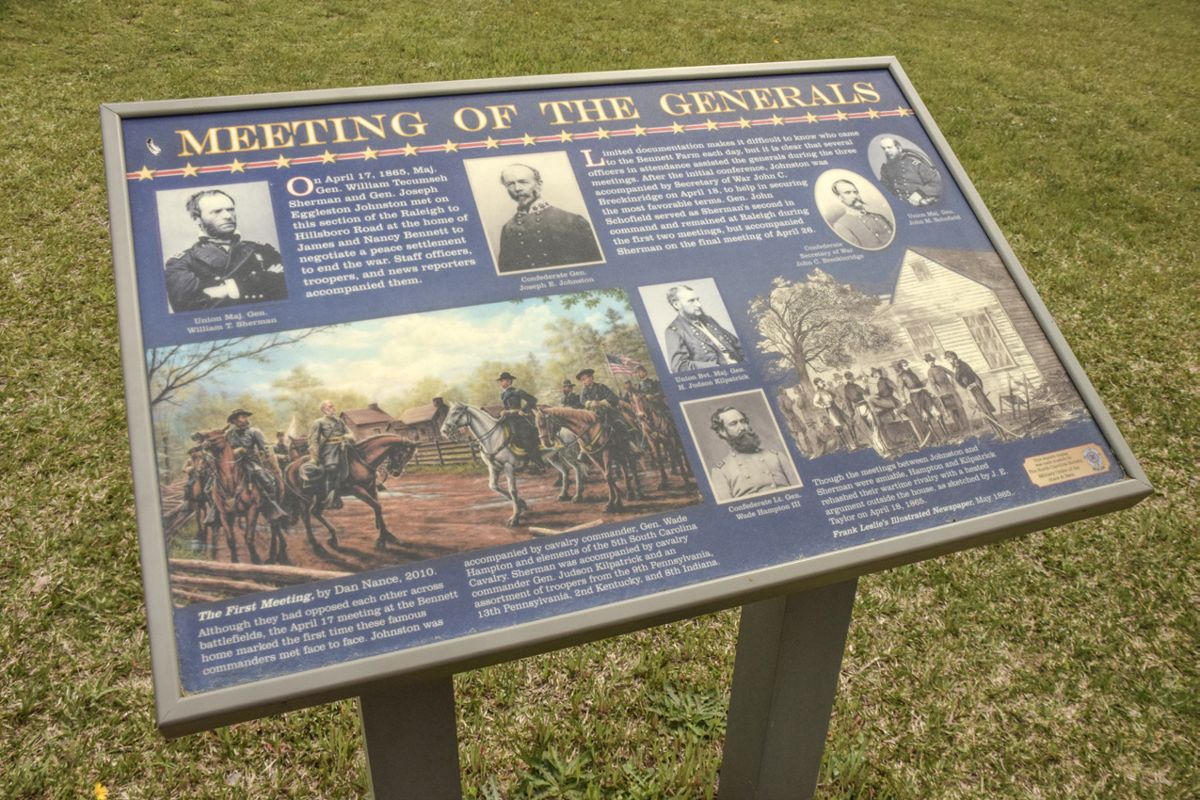
CivilWarNews.com Sherman and Johnston ended up forming a friendship. Gregg suspects that their friendship developed from the time they spent together on the Bennett property. For three days, the generals were engaged for hours in negotiation and additional hours walking the Bennett property together. The two generals corresponded regularly while writing their memoirs. Johnston served as an honorary pall bearer at Sherman’s funeral. Out of respect, Johnston removed his hat at Sherman’s funeral. When one of Johnston’s associates suggested that Johnston cover his head to avoid catching a cold, Johnston responded that, if Sherman was in his place, he’d be doing the same thing out of respect for him. Unfortunately, Johnston passed away from pneumonia about a month after Sherman’s funeral. Their friendship and respect for each other had endured until their deaths. In the early 20th century, local officials wanted to preserve Bennett Place as it was for its historical significance. The
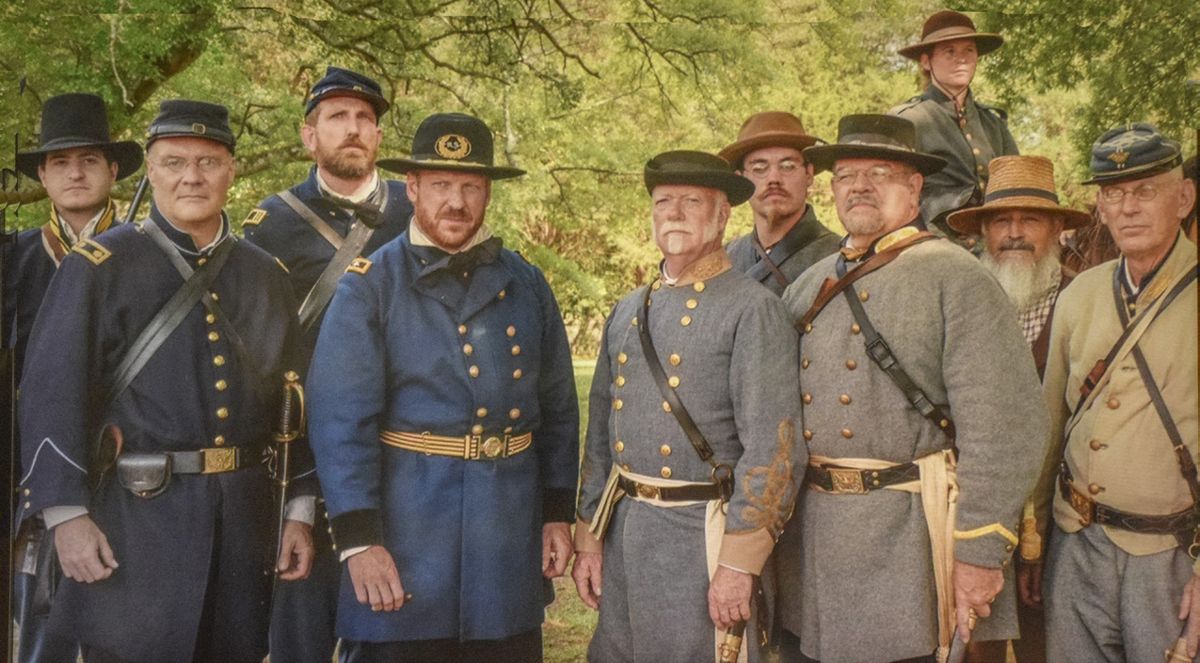
These colorful signs identify Civil War sites throughout North Carolina.
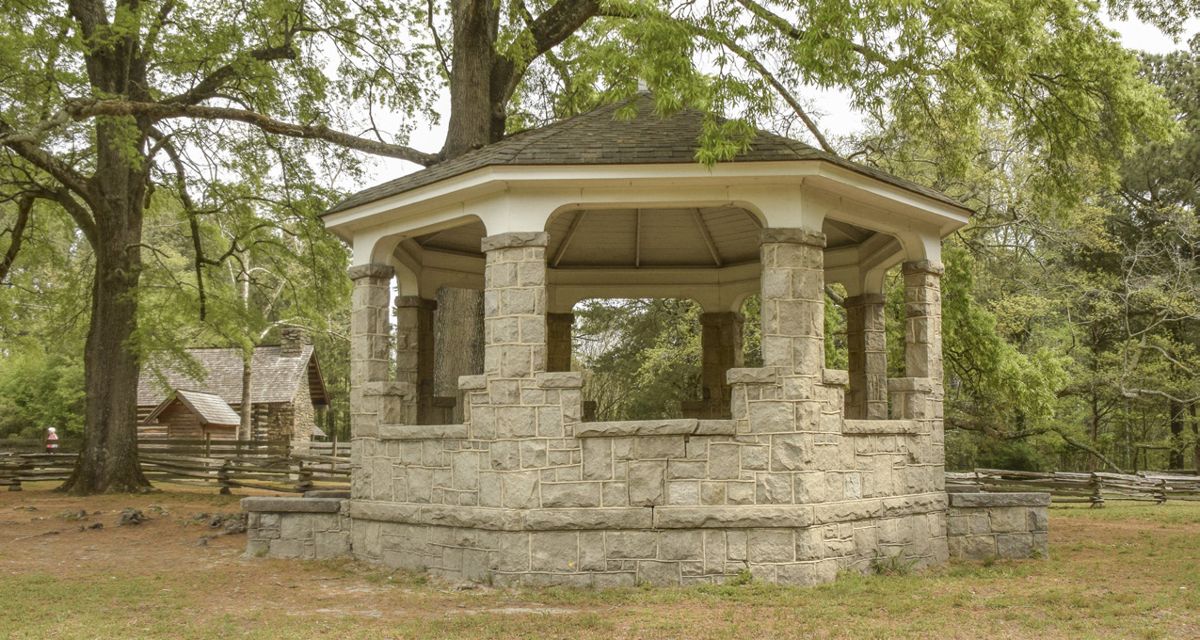
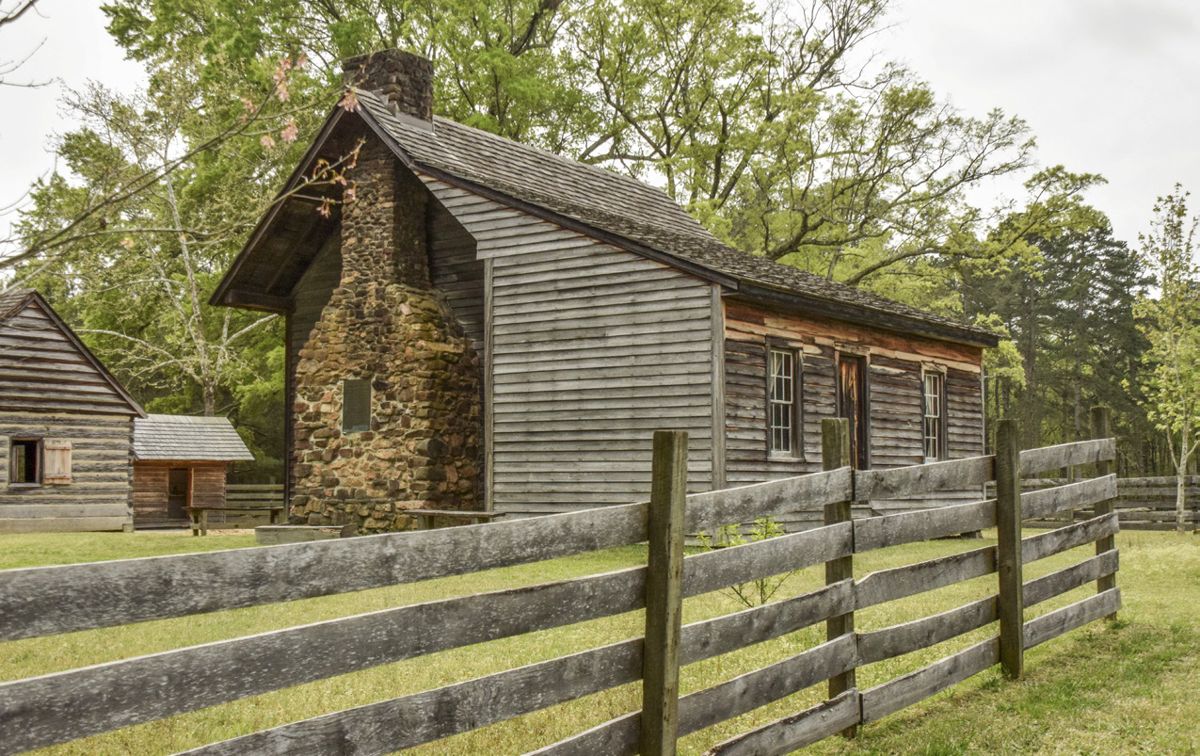
property had been abandoned for about 30 years. It was still owned by the family. After 30 years of neglect, the house was literally falling apart. Samuel Morgan acquired the property with the intention of restoring the site to what it once was, the site of the largest surrender of the Civil War, but Morgan passed away soon after he acquired the site. On October 12, 1921, the dilapidated Bennett house mysteriously burned to the ground. The fire was attributed by some to hobos traveling by rail who needed a temporary place to stay. There was no clear evidence of how the blaze started. The only part of the original house that remains was the fireplace and chimney. “Samuel Morgan’s family, especially Sarah Morgan, wanted to carry out the wishes of her late husband, and the Morgan family started moving to preserve the site,” said Gregg. “They contacted local and state officials to get this place memorialized,” he said. “That came about by erecting the Unity Monument on October 12, 1923. It was erected exactly two years from the day the house burnt down.” The Unity Monument symbolizes the reunification of the country after four years of bloody fighting. It was officially unveiled on November 8, 1923. An inscribed tablet summarizes the historically significant events that occurred on this revered ground in April 1865. A single crosspiece connects a pair of Corinthian columns signifying the reunification of the South and the North. “Whenever visitors come to Bennett Place, they’re going to be stepping into a period piece. The house we actually have out here is the Proctor House. The house was originally located in Durham,” said Gregg. The Bennett Place Historical Society wanted to restore the property to what it once was in time for the centennial celebration (1965). The Proctor House was disassembled and transported to the Bennett site.
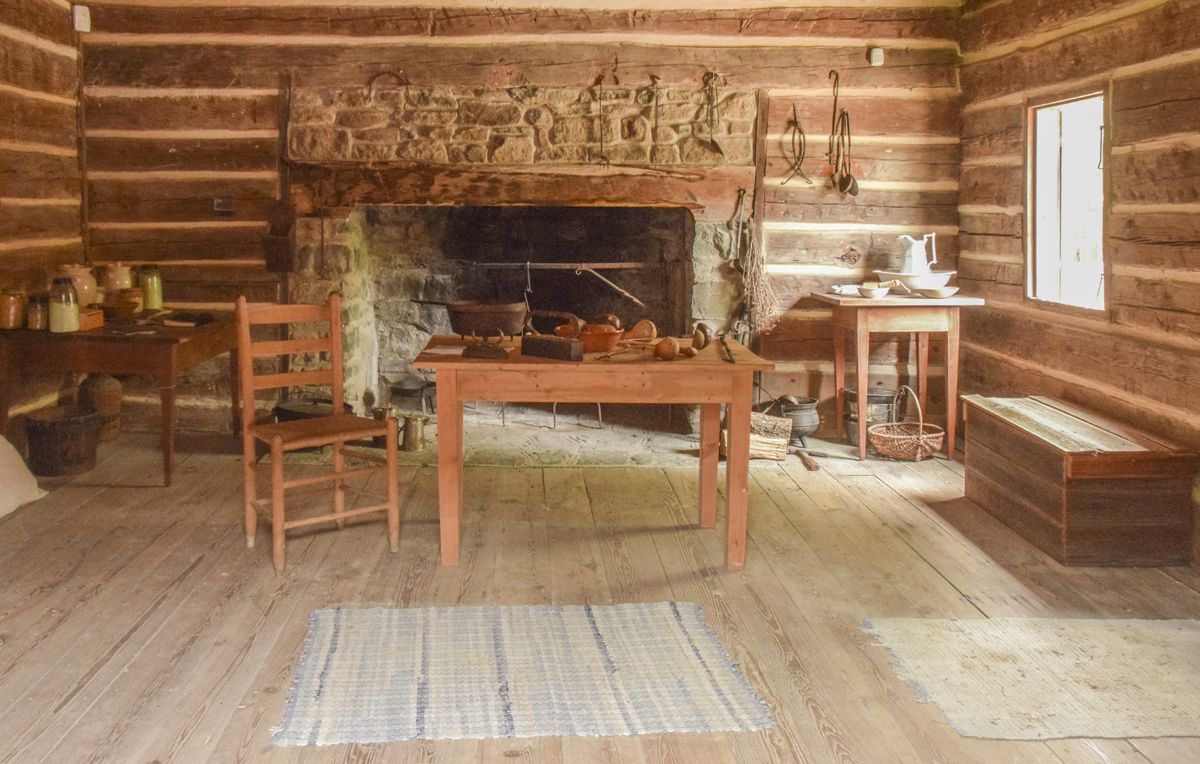
The reconstruction process began. “Even though they’re not stepping into the Bennett home, our guests are stepping into a period piece. It is a home from the same time period,” said Gregg. “The inside of the house is designed exactly as the original Bennett House was.” Sketches of the Bennett parlor made by Theodore Davis on April 18, 1865, formed the basis for interpreting the parlor as it was when Johnston and Sherman were negotiating the surrender. The terms of surrender at Bennett Place and Appomattox were almost identical,” said Gregg. “The soldiers were able to retain their sidearms. The horses were retained by the troops as well,” he said. “The Confederate arms and munitions were confiscated by the Federals.” While General Grant never actually stepped foot on the Bennett property, he received the amended documents of surrender. Grant reviewed the terms and officially approved them. He took the surrender documents with him to Washington. During a recent staff visit to Appomattox, Bennett Place Site Manager Matthew Gregg learned something very surprising from talking with Pat Schroeder, Appomattox park historian. “Bennett Place was designated as an historic park on November 8, 1923. At the dedication of the Unity Monument, the Morgan family transferred the park to the state. From what Schroeder was telling me, Appomattox wasn’t actually a part of the National Park Service until 1940.” Bob Ruegsegger is an American by birth and a Virginian. His assignments frequently take him to historic sites throughout Virginia, the Mid-Atlantic, and the Southeast. His favorite haunts include sites within Virginia’s Historic Triangle— Jamestown, Yorktown, and Williamsburg. Bob served briefly in the U.S. Navy. He is a retired educator and has been an active newspaper journalist for the last twenty years.