
The Graphic War
The Charge of the First Maryland Regiment
By Salvatore Cilella · Originally published July 2023 · pp. 24–25
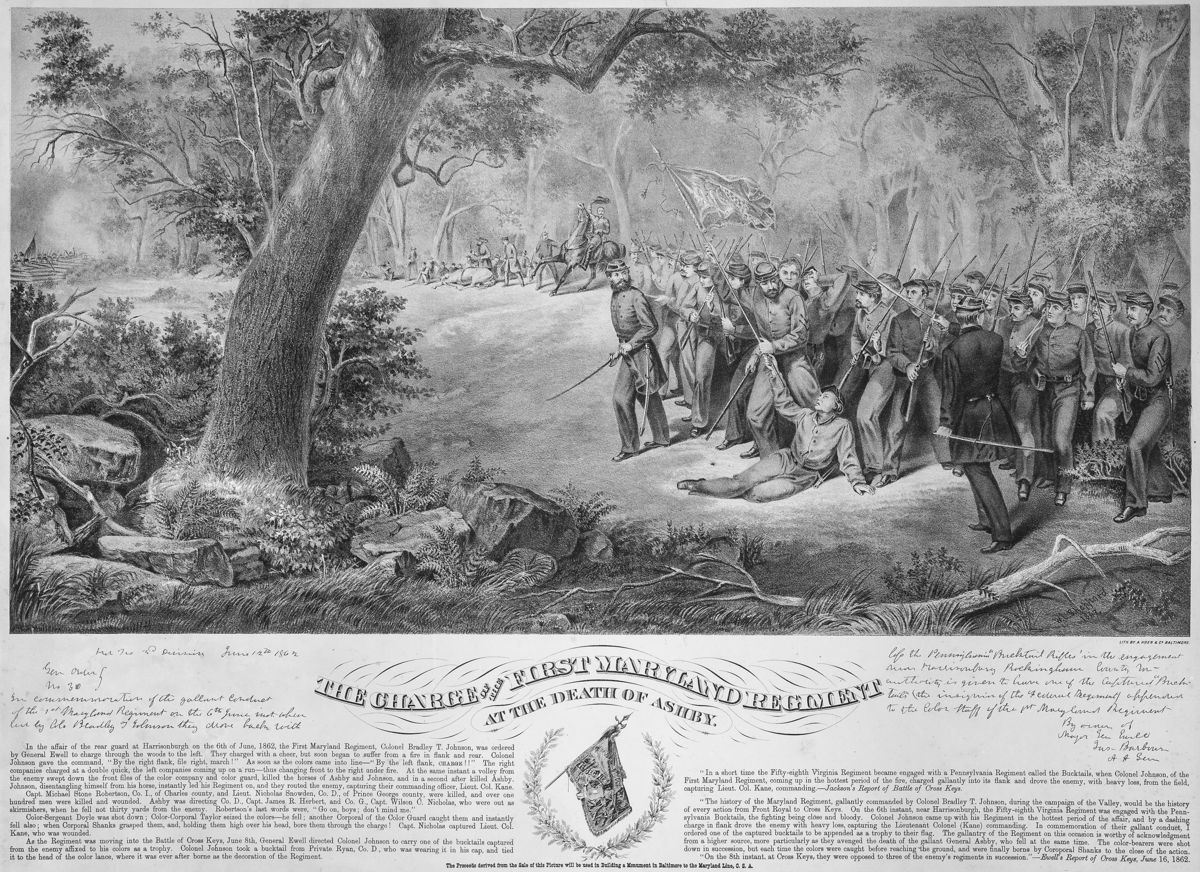
The Charge of the First Maryland Regiment The Graphic War highlights prints and printmakers from the Civil War discussing their meaning and the print maker or artist’s goals. Turner Ashby; Virginia cavalier, firebrand, fierce horseman, and loyal Confederate, was Stonewall Jackson’s right-hand man until he wasn’t. He was “a darkcomplected, myth encumbered figure who, at the age of thirtythree was known as the ‘Black Knight of the Confederacy’.”1 The irony of his death in the war’s early years is notable. He was with Jackson in the 1862 Valley Campaign and contributed to the early rebel successes. However, at the First Battle of Kernstown,
Ashby underestimated the forces facing Jackson. Instead of four regiments, Jackson faced a division of 9,000 Federals. Again “at the First Battle of Winchester, as Union forces under Maj. Gen. Nathaniel P. Banks were retreating, Ashby failed to cut off their retreat because his troopers were plundering captured wagons.”2 Ashby met his fate near Harrisonburg June 6, 1862, when the First New Jersey Cavalry attacked his position near Good’s Farm. He survived the initial cavalry attack, but the ensuing infantry attack killed his horse. On foot, Ashby charged ahead and was stopped with a bullet through the heart. Supposedly the 13th Pennsylvania Reserve; the “Bucktails” were responsible but it may have been friendly fire. Ashby, one of the Confederacy’s leading cavalrymen, horseless, had been shot down while on foot supposedly waving his sword uttering his last words: “Charge, men! For God’s sake. Charge!”3 Answering Ashby’s call, the 1st Maryland engaged the Bucktails. After the war ended, artist William Ludwell Sheppard, depicted the charge of the 1st Maryland Infantry after Ashby fell. Lithographer G. A. Muller reproduced the image in 1867. He has since slipped from the historical record. His print was published by the Baltimore lithographic house A. Hoen and Company, an ideal publisher because of its locale. The firm had been around since before
1848 when it specialized in scientific illustrations and maps, as well as publishing local views of Baltimore and portraits. After the war, it established a printing plant in Richmond. Muller’s lithograph depicts Corporal Shanks taking the colors from a dramatically fallen color bearer; the second having been just shot down. As authors Holzer, et al., wrote, although the casualty rate of color bearers was high, “they did not always fall so artistically…. These lithographed Maryland color bearers owe more to picturesque imagination than to battlefield reports.”4 The print’s title margin is a wealth of information including excerpts of official reports, which is remarkable since the OR were not published until 1880–1901; it includes an excerpt from Richard Ewell’s after-action report. Where he got a copy of the report to letter press onto the 1867 print remains unknown. It means the print probably does date to 1867 while the Ewell report was added toward the end of the century. It reads:
“The history of the Maryland regiment, gallantly commanded by Col. Bradley T. Johnson, during the campaign of the valley, would be the history of every action from Front Royal to Cross Keys. On the 6th instant, near Harrisonburg, the Fifty-eighth Virginia Regiment was engaged
Lithograph of Turner Ashby (Library of Congress)
with the Pennsylvania Bucktails, the fighting being close and bloody. Colonel [Bradley Tyler] Johnson came up with his regiment in the hottest period of the affair, and by a dashing charge in flank drove the enemy off with heavy loss, capturing the lieutenant-colonel (Kane) commanding. In commemoration of their gallant conduct, I ordered one of the captured bucktails to be appended as a trophy to their flag. The gallantry of the regiment on this occasion is worthy of acknowledgment from a higher source, more particularly as they avenged the death of the gallant General Ashby, who fell at the same time. Two color-bearers were shot down in succession, but each time the colors were caught before reaching the ground, and were finally borne by Corporal Shanks to the close of the action.”5 Sheppard, and two other others, Allen C. Redwood, and Conrad Chapman were staunch post war southern artists who embraced the Lost Cause. Viewing the three through the lens of “intellectual and artistic context,” it was obvious that they embraced the Lost Cause’s principles of “Southern rights, honor, white supremacy…and the “assertion that the confederacy was overpowered by a flood of Yankee men and materiel.”6
The print owed its origins and eventual publication to the 1st Maryland’s commanding officer, General Bradley T. Johnson. He paid Hoen and company in 1867 “when money was plenty,” to have Sheppard’s painting reproduced and published. It is not known how much it cost Johnson, but he “gave a copy to every man who was there.” The painting ended up in the Confederate Soldiers’ Home in Pikesville, Maryland, while the lithograph was supposed to be used as a fund raiser to build a monument in Baltimore to the Maryland Line, C. S A.”7 The monument was never built. Endnotes: 1. Virginia Encyclopedia. https://en.wikipedia.org/wiki/Turner_Ashby. 2. Ibid. 3. Ibid. 4. Holzer, et, al., The Confederate Image, Prints of the Lost Cause, Chapel Hill, University of North Carolina Press, 1987, 216-217. 5. Ewell’s report, June 16, 1862. Official Records Of The War Of The Rebellion. Operations In N. Va., W. Va., And Md. Serial 1, v. 12, part 1, page 782. [Chap. XXIV]. 6. Ibid. 208. 7. Ibid. 215-217. The Soldiers’ Home was originally a federal arsenal dating to 1818. In 1888, the State of Maryland appropriated $5,000 to convert into a soldier’s home. It remained in operation until 1932. The ultimate fate and location of the original Sheppard painting is unknown. After 43 years in the museum field, Cilella devotes his time collecting American prints and maps and writing. His most recent books are Upton’s Regulars: A History of the 121st New York Volunteers in the Civil War (U. Press Kansas, 2009). His two-volume Correspondence of Major General Emory Upton, (U. of Tennessee Press, 2017), received the 2017–2018 American Civil War Museum’s Founders Award for outstanding editing of primary source materials. Upton’s love letters 1868-70, (Till Death Do Us Part) was published in 2020 by the Oklahoma University Press. His current book, the Memoirs of Dewitt Clinton Beckwith of Upton’s Regulars (McFarland Press) was released this spring.