
The Unfinished Fight
V. R Lock Plate
By Craig L. Barry · Originally published January 2023 · p. 18
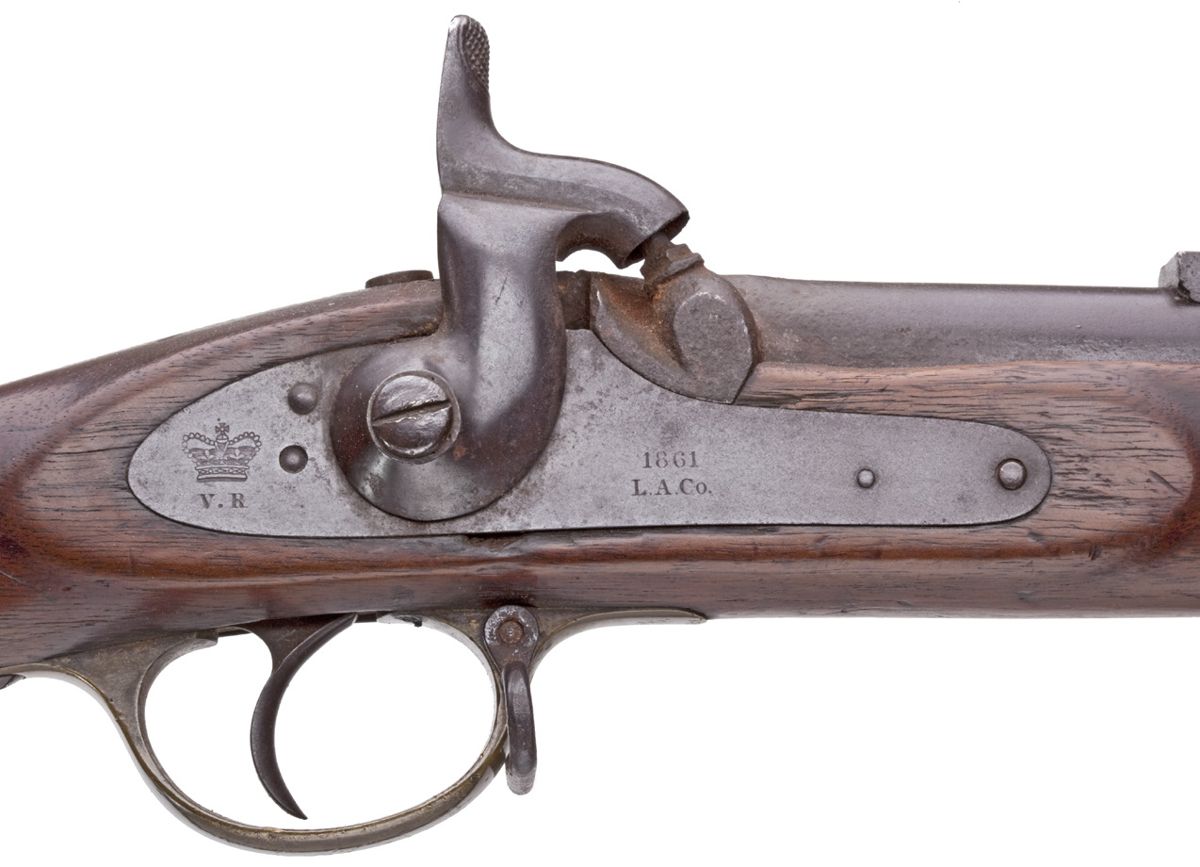
V. R Lock Plate A debate on a well-known Civil War internet forum centered around the American Civil War provenance of any 1853 British Enfield long rifles with a marking of “V. R” under the crown on the lock plate. It was flatly stated that, if so marked, the Enfield was the property of the British War Department and would not have seen use in the American Civil War. It is difficult to deal in absolutes. It is especially difficult to deal in absolutes about every Pattern 1853 Enfield because there were
Crown over V. R marking on a Pattern 1853 lock.
so many different commercial gunmakers producing them during the early 1860s. Also, as I like to say, “you are entitled to your own opinions, but not your own facts.” Let’s take a look at a few of the known facts. First, to say that no P-53 Enfield long rifles marked “V. R” were used in the Civil War is incorrect. The royal cypher “V. R” stands for Victoria Regina (Queen Victoria). It suggests government ownership similar to the eagle stamped on U.S. Armory produced military weapons. However, virtually every single London Armoury (L.A.Co.) marked lock plate produced during the American Civil War-era had the royal cypher whether made for commercial export or a British Government contract. Due to scant surviving London Armoury Company (LAC) records, historians have depended on US, CS, and English documents as the main source for information on the firm. That, and the weapons themselves, are all we have to study.
London Armoury was started in February 1856 in Bermondsey, across the river from the city of London. It was an arms manufacturer producing both Adams designed revolvers and P-53 Enfield long rifles for the British War Department. The board of directors was offered a large contract by the War Department in 1859 if they would purchase a duplicate set of machinery identical to what was used at Royal Small Arms Manufactory, which they did. Adams disagreed with the new direction and left the firm. LAC produced their P-53 Enfield long rifles on contract in identical fashion and used the exact same machinery regardless of the customer. The British, US, and CS governments all had contracts filled by LAC marked with “V. R” under the crown on the lock plate. Were those P-53s made for US/CS contracts exactly identical to the British Government contracts? Without getting too deep into the woods, there is some evidence that those made for export to the US/CS largely had Palmer type barrel bands vs Baddeley bands as specified for British Government contracts. Even that distinction is not absolute. Some P-53s with Baddeley type bands may have been imported late in the Civil War. Anecdotally, Baddeley type bands were claimed to have been dug by relic hunters in Georgia. So, who knows? This much is known, they were all first class, parts interchangeable weapons. What makes all this interesting within the context of the careful study of the material culture of the mid-19th century is that it discourages dealing in absolutes. These matters weren’t concluded with an eye toward what collectors and Civil War buffs would think important 160 years later. The British War Department used the “V. R” mark as a way of identifying government ownership of those military arms which passed their inspection and could be issued to their own troops much as the US Government marked the lock plate with a spread eagle and “US.” The British government did not knowingly sell government arms to either side in the US Civil War, unlike the Austrian government who did sell their obsolete arms from the Royal Armory. The TOWER lock plate marking was also intended to suggest that a weapon passed government inspection with gauges at the “Tower” government arms inspection facility. There was one in Birmingham on Bagot Street and of course, the Tower facility in London. We know none of the hundreds of thousands of Birmingham Small Arms Trade commercially produced P-53s marked TOWER ever got anywhere near a British Government arms inspection facility. Of course, these are also acknowledged as widely used by both sides in the Civil War. London Armoury had the same machinery as the Royal Small Arms Manufactory. LAC did this with an eye toward selling parts interchangeable P-53 Enfield long rifles to the War Department; then the US Civil broke out. In fact, LAC had to finish up a War Department contract before beginning to first fill orders for the Commonwealth of Massachusetts, and then the Caleb Huse contracts for the CS Government. How many were made? If LAC had a set of the same machinery as Royal Small Arms Manufactory, and the output there was 6,000 arms per month, it seems reasonable that LAC could produce about half the same amount, or 3,000 per month. Whatever the exact figures may have been, the LAC P-53s were imported to America in fairly large numbers, and they were all marked “V. R” under the crown behind the hammer. We can put the notion to rest that no Enfield long rifles with the royal cypher “V. R” were used in the Civil War. There were a sizeable number exported to America and used by both sides. London Armoury sold their products to anyone who had the money, and with whomever it was legal to transact business with, including both American governments during the Civil War. It was a large gun manufacturing operation and at one point their minimum order was 10,000 arms per contract. LAC did not for a moment concern itself that the “V. R” appearing under the crown on the lock plate might run contrary to what other commercial gunmakers in London and Birmingham were doing and might be confusing to collectors 160 years later. Craig L. Barry was born in Charlottesville, Va. He holds his BA and Masters degrees from UNC (Charlotte). Craig served The Watchdog Civil War Quarterly as Associate Editor and Editor from 2003–2017. The Watchdog published books and columns on 19th-century material and donated all funds from publications to battlefield preservation. He is the author of several books including The Civil War Musket: A Handbook for Historical Accuracy (2006, 2011), The Unfinished Fight: Essays on Confederate Material Culture Vol. I and II (2012, 2013). He has also published four books in the Suppliers to the Confederacy series on English Arms & Accoutrements, Quartermaster stores and other European imports.
Typical plain LAC lock with V. R under crown behind hammer and date 1861 over L.A.Co. in front of the hammer. (Jack W. Melton Jr.)