
Through The Lens
No Confidence
By Stephanie Hagiwara · Originally published January 2023 · pp. 24–25
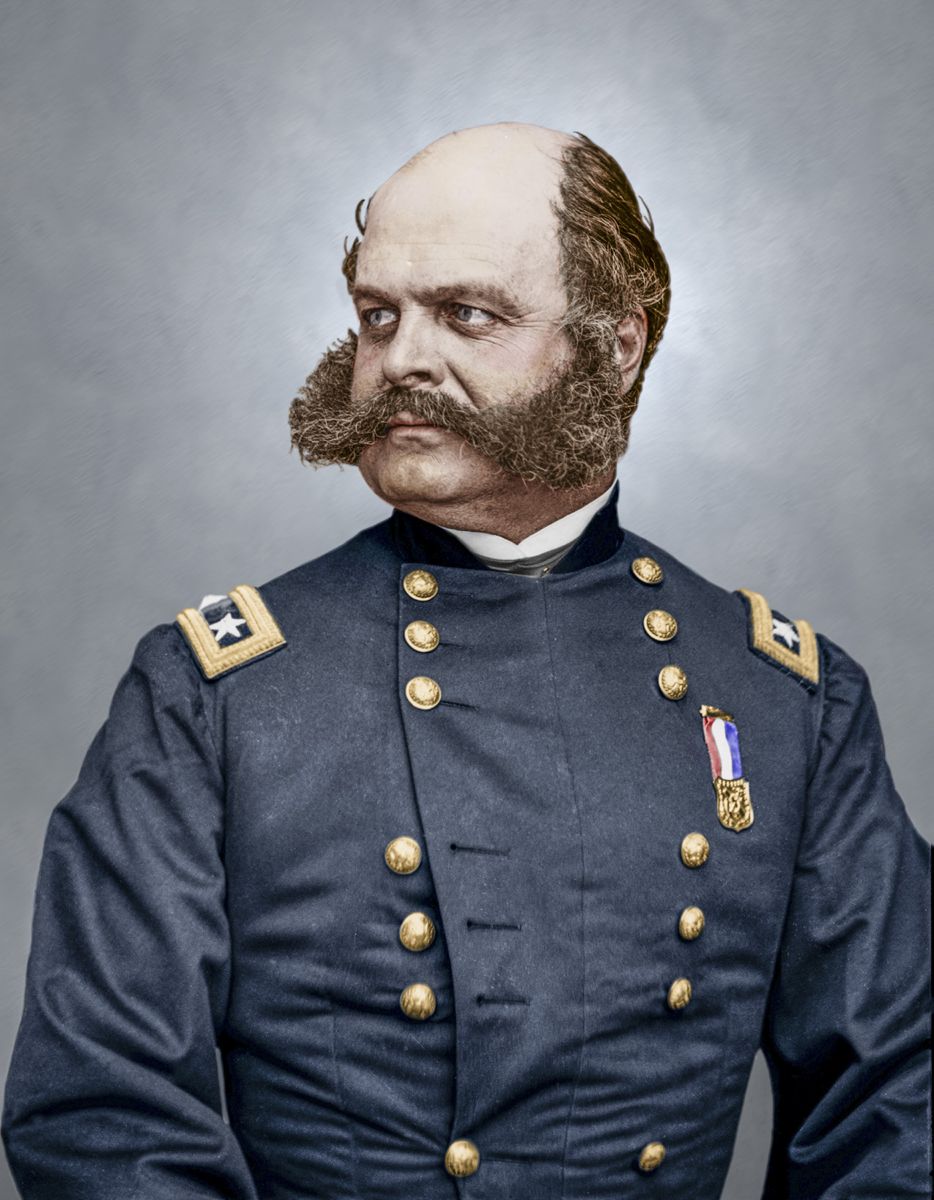
No Confidence “Nobody ever assumed a command under more unfavorable circumstances.” – C.S. Gen. Joseph E. Johnston In November 1862, both U.S. Gen. Ambrose Burnside and C.S. Gen. Joseph Johnston were assigned commands they did not want. On November 7, 1862, Burnside was promoted to be the commander of the Army of the Potomac despite pointing out his abilities were not up to the position. Burnside was told either he took the position, or second choice Gen. Joseph Hooker would. President Jefferson Davis’s solution to having limited resources was to shuttle men and supplies between armies as needed. Four small independent armies operated in the Western Theater; generals Braxton Bragg’s in Tennessee, John C. Pemberton’s was based in
Vicksburg, Miss., Edmund Kirby Smith’s, in East Tennessee, and Theophilus Holmes,’ in Arkansas. During the 1862 Federal incursions into Kentucky, the lack of cooperation and public squabbling between the armies convinced Davis he needed an overall commander to coordinate the resources. On November 12, Johnston reported for active duty after recuperating from wounds suffered during the May 31, 1862, Battle of Seven Pines, Va. Johnston knew it was unrealistic to be reinstated as commander of what was now the Army of Northern Virginia, as he had hoped; the position was held by Gen. Robert E. Lee. Instead, he was assigned command of the Department of the West. Johnston soon realized that due to the distances involved, it would be more practical to split the department’s force into two armies. Johnston was also uncomfortable with Davis’s expectation that he would be the commanding officer of any army he was visiting, without having knowledge of its day-to-day activities. Furthermore, Davis had the commanders’ reports sent directly to Richmond, Va., and would inform Johnston of any changes in plans after the fact. Johnston believed he was being set up to fail. Before the War, Johnston, Davis, and Lee had been friends and were classmates together at West Point. The split between them occurred in September 1861 because rank and status were important to Johnston. Johnston believed he out ranked Gen. P. T. Beauregard and was not within the Virginia chain of command headed by Lee. As far as Johnston was concerned, Davis did not sufficiently support him. On the other hand, Davis doubted Johnston’s loyalty due to his friendship with Senator
Louis T. Wigfall. The Johnston family stayed in Wigfall’s Richmond home during his convalescence. The Confederacy did not have any political parties to structure exchanges of ideas. Wigfall actively contributed to Richmond’s political turmoil and Davis resented any questioning of the effectiveness of his policies. On December 10, Davis departed Richmond by train on a morale boosting western tour.
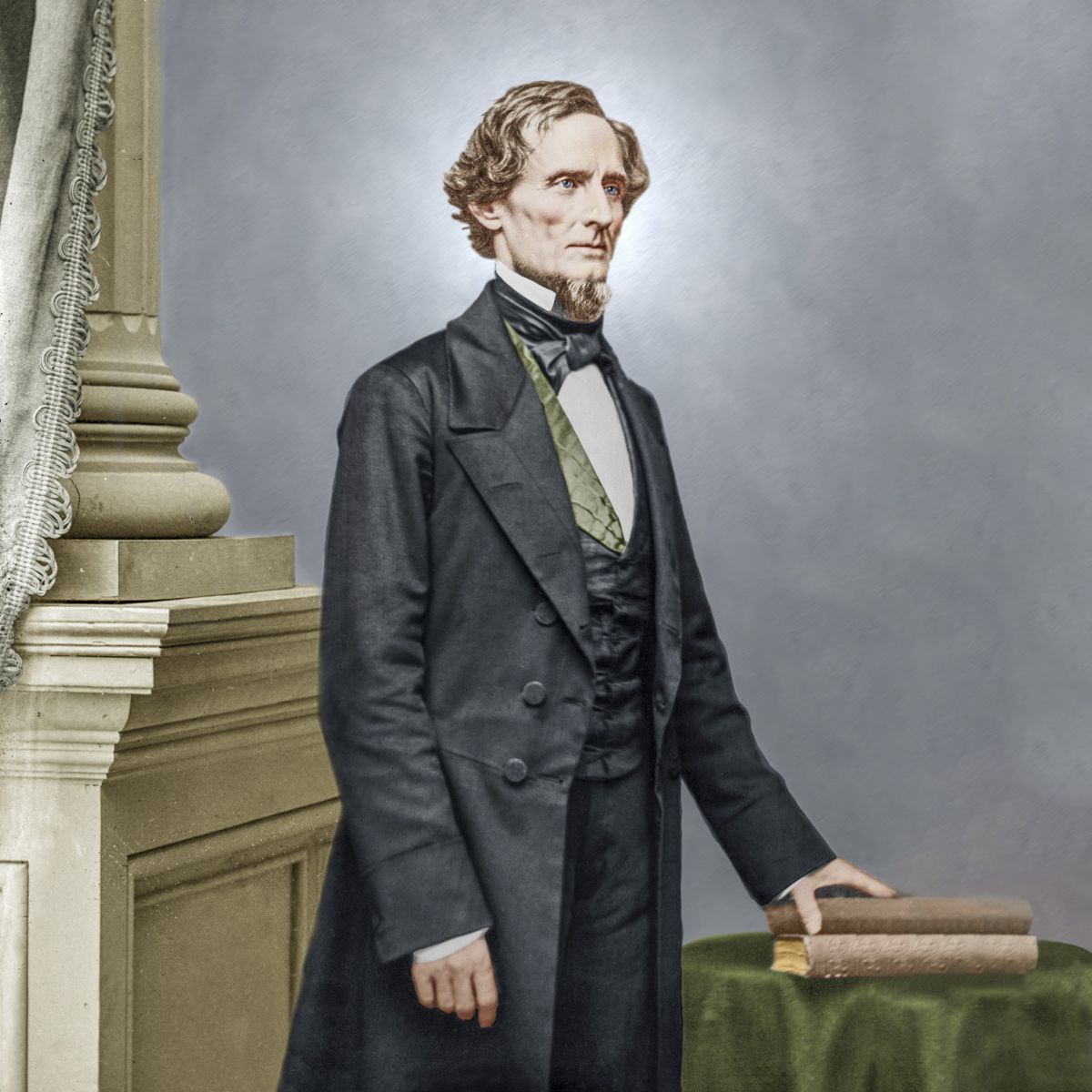
He brought one valise and was accompanied by his nephew and a servant. Crowds cheered Davis as the train passed by the stations. On December 11-13, Burnside fought the Battle of Fredericksburg, Va., as part of his plan to reach the Confederate capitol at Richmond. He had tried to get across the Rappahannock and beyond Fredericksburg before Lee could block his movement on the capitol, but the pontoon bridges needed to cross the Rappahannock were held up by bureaucratic delays. As Burnside waited, Lee blocked the crossing. Instead of altering his plan, Burnside made repeated frontal attacks on Lee’s elevated position, resulting in devasting Federal losses. “What luck some people have,” Johnston wrote to Wigfall when informed of the battle. “Nobody will ever come to attack me in such a place.” At Murfreesboro, Tenn., Davis ordered Johnston to send 9,000 men from Bragg to Pemberton. If the Federals attacked Bragg, “fight if you can,” said Davis, “and fall back beyond Tennessee.” To Wigfall, Johnston wrote: “This has blown away some tall castles-in-the-air. I have been dreaming of crushing [U.S. Gen. Ulysses] Grant with Holmes and Pemberton’s troops, sending the former into Missouri, and with the latter, Bragg, & Kirby Smith, marching to the Ohio.” On December 30, Burnside took advantage of unusually warm weather and ordered his cavalry to attack the Virginia Central and Fredericksburg railroads. The cavalry only traveled 30 miles before being stopped to await further orders. Burnside had received a telegram from
Washington. Two of Burnside’s division commanders had made it into a room with Lincoln. They couldn’t bring themselves to say, “that the whole trouble was that the privates had no confidence in General Burnside.” Instead, they suggested an investigation. Lincoln considered the pair as two self-promoting officers who simply wanted to get their commander’s job. Burnside wanted them cashiered and Henry Halleck, General in Chief of the Armies, supported Burnside. Lincoln didn’t see the point in firing Burnside or cashiering the officers. Burnside was advised that the government endorsed the idea of forward movement, but the government was not trying to drive him. On December 31–January 2, 1863, the Battle of Stone’s
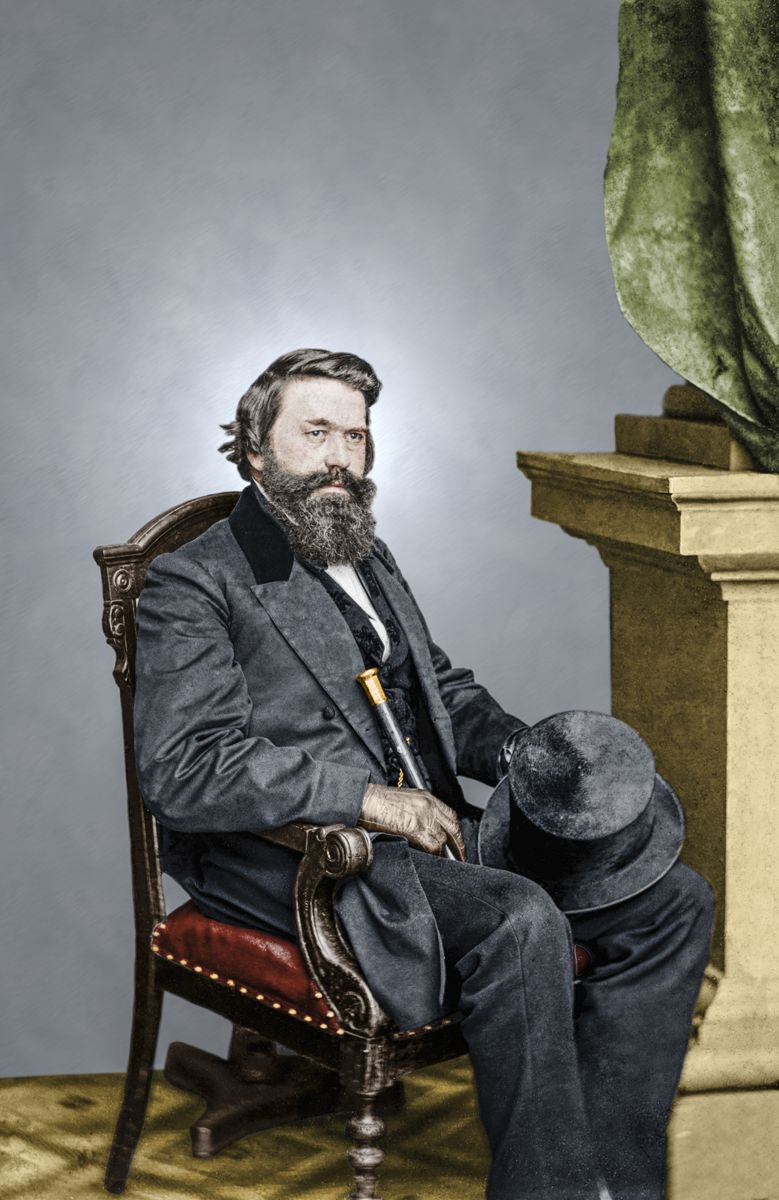
Stuck in the mud; A flank march across country during a thunder shower. Edwin Forbes, artist. (Library of Congress)
River, Tenn., was fought between Bragg and U.S. Gen. William Rosecrans. Rosecrans was ordered to find a fight and win it, to give teeth to the newly signed Emancipation Proclamation. The Federals had cut the telegraph lines, so Johnston was unaware of a major battle until it was over. On January 4, back in Richmond, Davis commented that a few Yankees who had cried “on to Richmond” actually got there—as prisoners.” On January 20, Burnside ordered his troops men to pack up their winter camp at Falmouth, Va., swiftly march to United States Ford, cross the Rappahannock and outflank Lee. By afternoon the clear sky had turned cloudy; in the evening incessant rains came, and the wind howled. The roads turned into mud over two feet deep in some places. The next morning the mud was so “… despairingly deep as to check the discordant, unmusical braying of the mules, as if they feared their mouths would fill, to have it so deep that their ears, wafted above the waste of mud, were the only symbol of animal life, were depths to which the army had now descended for the first time.” Cannon were dragged with tripled teams but would sink unless logs and fences were placed under it during a breather.
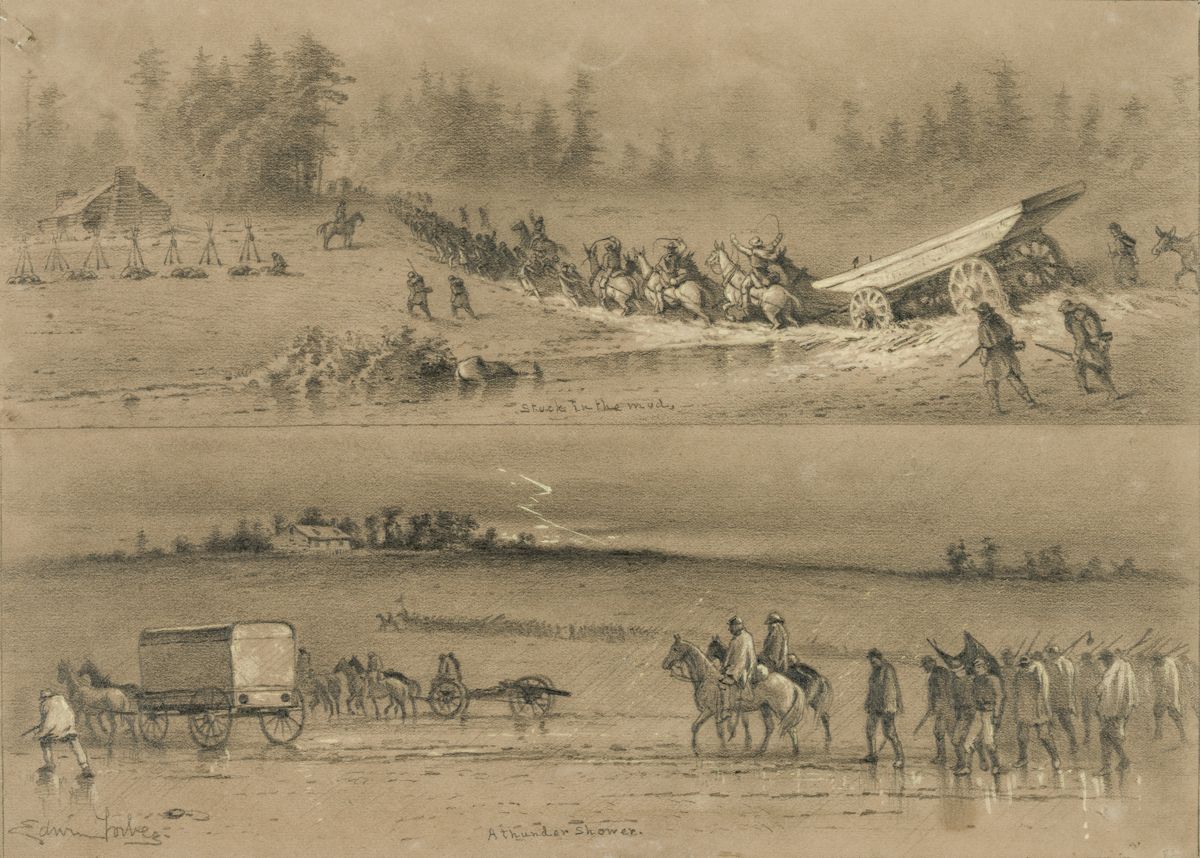
“Our position was like that of liliputions [in Gulliver’s Travels] in a great mud pile,” wrote a solider. Across the river the Confederates enjoyed themselves, offering advice and signs pointing the way to Richmond and “BURNSIDE STUCK IN THE MUD.” His officers finally convinced Burnside, who was not a quitter, to give up. According to a private, “it was no longer a question of how to go forward, but how to get back.” After what became known as the “mud march,” Burnside’s offer to resign was accepted. On January 26, 1863, Hooker was appointed commander of the Army of the Potomac. Burnside was appointed to command the Department of Ohio. Johnston was asked to investigate complaints regarding Bragg. Gen. Benjamin Franklin “Frank” Cheatham said, “he would never go into battle under General Bragg again.” Johnston’s forte was commanding in the field. Honor prevented him from submitting a negative report with the result of subsequently being rewarded with Bragg’s command. He wanted to be ordered to replace Bragg as the commander of the Army of the Tennessee. As the army itself was in relatively good condition, he submitted a positive report. Davis declined Johnston’s request to relieve him twice; Johnston wrote to Wigfall, “If you can help me out of my present place I shall love you more than ever.” Sources: Davis, William C. Jefferson Davis: The Man and His Hour: Lume Books, 2016 Catton, Bruce. Glory Road (Army of the Potomac Trilogy Book 2): Open Road Media, 2015 Symonds, Craig L. Joseph E. Johnston: A Civil War Biography: W. W. Norton & Company, 1994 Wert, Jeffrey, D. The Sword of Lincoln: The Army of the Potomac: Simon & Schuster, 2005 Stephanie Hagiwara is the editor for Civil War in Color.com and Civil War in 3D.com. She also writes a column for History in Full Color.com that covers stories of photographs of historical interest from the 1850’s to the present. Her articles can be found on Facebook, Tumblr and Pinterest.