
The Graphic War
Cyrus McCormick and the Battle of Shiloh
By Salvatore Cilella · Originally published January 2023 · pp. 36–37
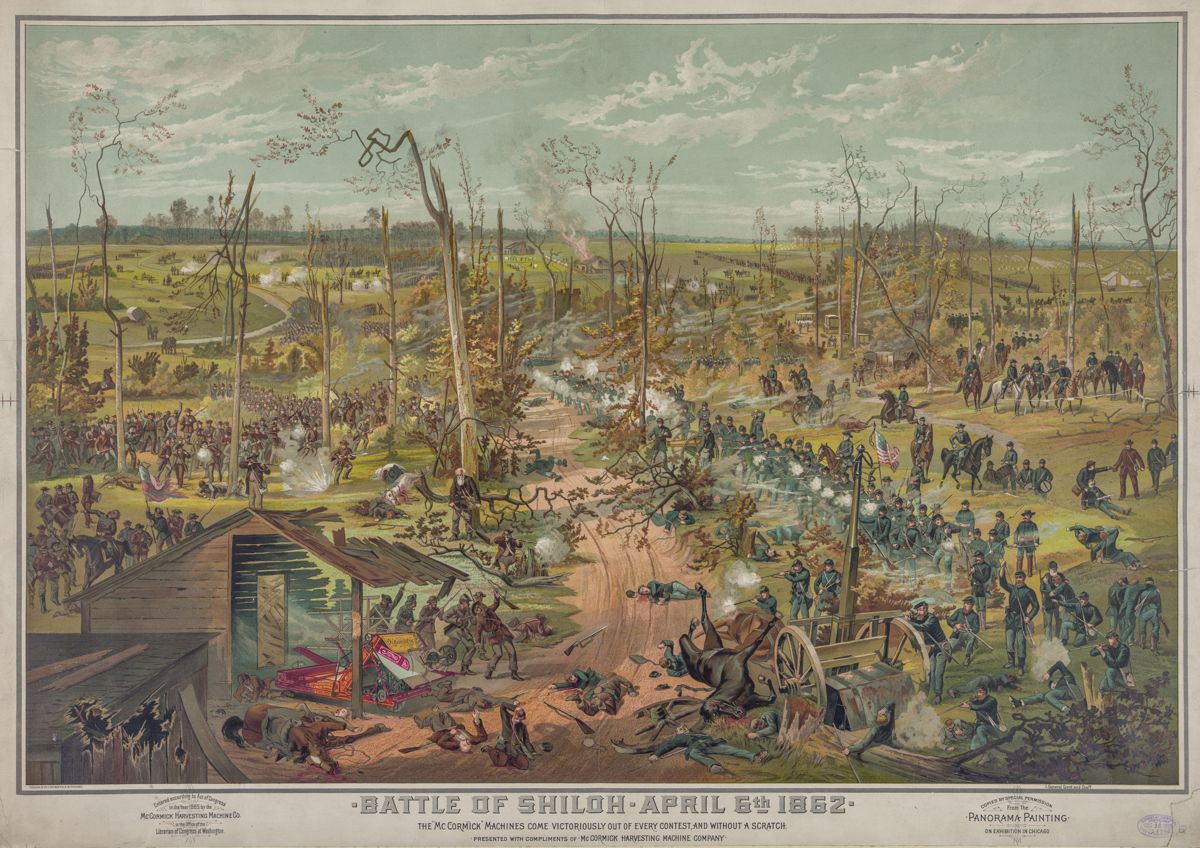
Cyrus McCormick and the Battle of Shiloh The Graphic War highlights prints and printmakers from the Civil War discussing their meaning and the print maker or artist’s goals.
We have written before about the intersection of commerce and the horrors of war through the marketplace of lithographs. In this month’s column we feature the more egregious usage of commercial marketing of a product using one of the bloodiest battles of the Civil War. The Battle of Shiloh, April 6 and 7, 1862, was the most horrific combat to that point. Nearly 25,000 combined casualties included 3,500 killed over the two-day period. More than 16,000 were wounded. The Confederates lost nearly 1,000 captured or missing, while Federal troops suffered close to 3,000 wounded or missing. The latter came when Union Brigadier General Benjamin Prentiss surrendered his surrounded command at the Hornet’s Nest. According to most sources, Prentiss’ delaying action allowed Grant to establish a new line of defense closer to Pittsburg Landing. It may be that action depicted in the lithograph featured this month. Simply titled “Battle of Shiloh – April 6th, 1862,” it was the work of the Cosack & Company publishing firm of Buffalo and Chicago. The Cosack firm, like many lithographic houses, morphed into several different iterations over the course of its long life from 1864 to well into the 20th century when it closed in 1920. Founded by immigrants Herman Cosack and Hugh Clay, it produced the usual items such as trade cards, plates for color books, broadsheets, and standalone lithographs. By 1885 when this print was published, “the firm had the largest press room in the United States at 70x200 feet with a ceiling 40 feet high… employing two hundred people.”1 The artist who executed the lithograph is unknown, but the original artist of the painting that was the source of the lithograph was French military painter Theophile Poilpot. Poilpot spent his entire life and career (1848–1915) in Paris turning out academic art, particularly of military subjects. As his obituary revealed, Poilpot “did not confine himself to French subjects, and his paintings are located in a number of countries. Several of his best-known works are part of collections in the U.S., including ‘Bull Run,’ in Washington, D.C., and the ‘Merrimac and Monitor.’ Other major works by Poilpot include the ‘Battle of Jena,’ now in Paris, the ‘Crowning of Emperor Alexander III,’ in Moscow, the panorama of the ‘Battle of Balaklava,’ now in London, the ‘Transatlantic Panorama,’ which was shown at the Universal Exposition in 1889, the ‘Algerian Panorama,’ shown at the Paris Exposition of 1900, and the famous ‘Panorama of who hired…Poilpot to produce ‘Battle of Shiloh’ for Chicago.”3 As historian Yoni Applebaum revealed, “Cycloramas of other Civil War battles followed in rapid succession, all of them depicting notable Union victories and intended primarily for Northern audiences. In August 1885, Chicago promoters hoping to reproduce the sensational success of the Gettysburg Cyclorama unveiled a new cyclorama of the Battle of Shiloh. It used the features of 2,000 actual participants in the battle, and when it opened just a week after the death of General Ulysses S. Grant, seemed poised for great success.”4 In order to provide the utmost accuracy in his 400 by 50-foot panorama of Shiloh, Poilpot “interviewed several survivors and represented more than 2,000 individual faces from their carte de visite photographs.” Unfortunately, only “cyclorama” or “panorama” paintings exist in the world, the two most vivid in Atlanta and Gettysburg, depict those battles. Shiloh “was later exhibited in Washington, D.C., but is now considered lost.”5 What remains is the Cosack print. Although the print is labeled “Battle of Shiloh-April 6th 1862,” its immediate subject is debatable. According to the Library of Congress, the scene Cosack depicted is action of April 6 on the Corinth Road. According to another opinion, the fighting shown may represent Benjamin Prentiss’ stand along the Sunken Road that same day.6 Prentiss was surrounded and according to early reports, largely promoted by Prentiss after the war, the action saved the Union to fight another day. The print certainly appears to support the latter interpretation. Over to the right, (or North) in mid foreground is U. S. Grant and his staff; behind him in the background are the Union camps. Unidentified and almost hidden in the far left of the print (South) is a wounded Confederate officer on his horse. Could this be Albert Sidney Johnston just after he received his mortal wound? If so, it would certainly make sense that this is the action around the
CivilWarNews.com sunken road, which was never sunken; the peach orchard, and Prentiss’ command. Perhaps the most jarring aspect of Cosack’s interpretation of Poilpot’s work is the obscene introduction in a shattered building, in the midst of the fighting, of a “McCormick Harvester & Twine Binder,” untouched by cannon and musket fire. In fact, the title margin reads “Battle of Shiloh-April 6th 1862/ The ‘McCormick’ Machines come Victoriously out of every contest, and without a Scratch/ Presented with Compliments of McCormick Harvesting Machine Company.” The right title margin reads “Entered according to Act of Congress/in the Year 1885 by the/ McCormick Harvesting Machine Co./in the office of the/Librarian of Congress at Washington.” The left margin reads: “Copied by Special Permission/from the/ Panorama Painting/on Exhibition in Chicago.” Above this legend is “General Grant and Staff.” The lithograph is nothing more than an advertisement for the McCormick Harvester Company which owned the land on which Poilpot’s original “panorama” of Shiloh appeared. Chicago city leaders decided in the early 1880s that the city needed to remember the great fire of 1871 and show the world its remarkable resurgence. A cyclorama was the answer. The “Chicago Fire Cyclorama building between Madison and Monroe Streets on Michigan Avenue” was built “on land owned by the family of mechanical reaper magnate Cyrus McCormick.” According to historian Carl Smith, “it was erected in 1885 to host The Battle of Shiloh.”7 What was originally a horrific and tragic battle early in the Civil War was turned into a crass commercial advertisement for farm equipment. It would not be the first nor the last. In 1896, the Budweiser brewing company acquired Otto Becker’s depiction of Custer’s last stand and eventually produced more than a million prints advertising a combination of beer and military disaster. What could be more American?
Endnotes: 1. Jay Last, The Color Explosion: Nineteenth Century American Lithography, 58. 2. “Theophile Poilpot Dead/ Famous Military Painter Succumbs in Paris in His 67th Year.” New York Times, February 2, 1915. 3. Rick Kogan, “Long before movies and screens, Chicago went nuts for something called cycloramas.” Chicago Tribune, October 19, 1921. https://www.chicagotribune.com/entertainment/ct-ent-firecyclorama-kogan-1019-202110195fyzf55nave4vkoif6vnd5bjdy-story. html. 4. Yoni Appelbaum, “Cycloramas,” Essential Civil War Curriculum https://www.essentialcivilwarcurriculum.com/cycloramas.html. 5. Picryl, https://picryl.com/media/battle-of-shiloh-april-6th1862-cosack-and-co-lith-buffaloand-chicago. 6. Historynet, Battle of Shiloh Pictures https://www.historynet.com/battle-of-shiloh-pictures. 7. Carl Smith, Franklyn Bliss Snyder Professor of English and American Studies and Professor of History, Emeritus, at Northwestern University. https://www.chicagohistory.org/cyclorama.
After 43 years in the museum field, Cilella devotes his time collecting American prints and maps and writing. His most recent books are Upton’s Regulars: A History of the 121st New York Volunteers in the Civil War (U. Press Kansas, 2009). His two-volume Correspondence of Major General Emory Upton, (U. of Tennessee Press, 2017), received the 2017–2018 American Civil War Museum’s Founders Award for outstanding editing of primary source materials. Upton’s love letters to his wife 1868-70, (Till Death Do Us Part) was published in 2020 by the Oklahoma University Press. His current book, the memoirs of Private Dewitt Clinton Beckwith of Upton’s Regulars for McFarland Press will be released this Spring.