
The Tragic Career of Union Brigadier General George Bayard
By Carl L. Sell Jr. · Originally published August 2023 · p. 38
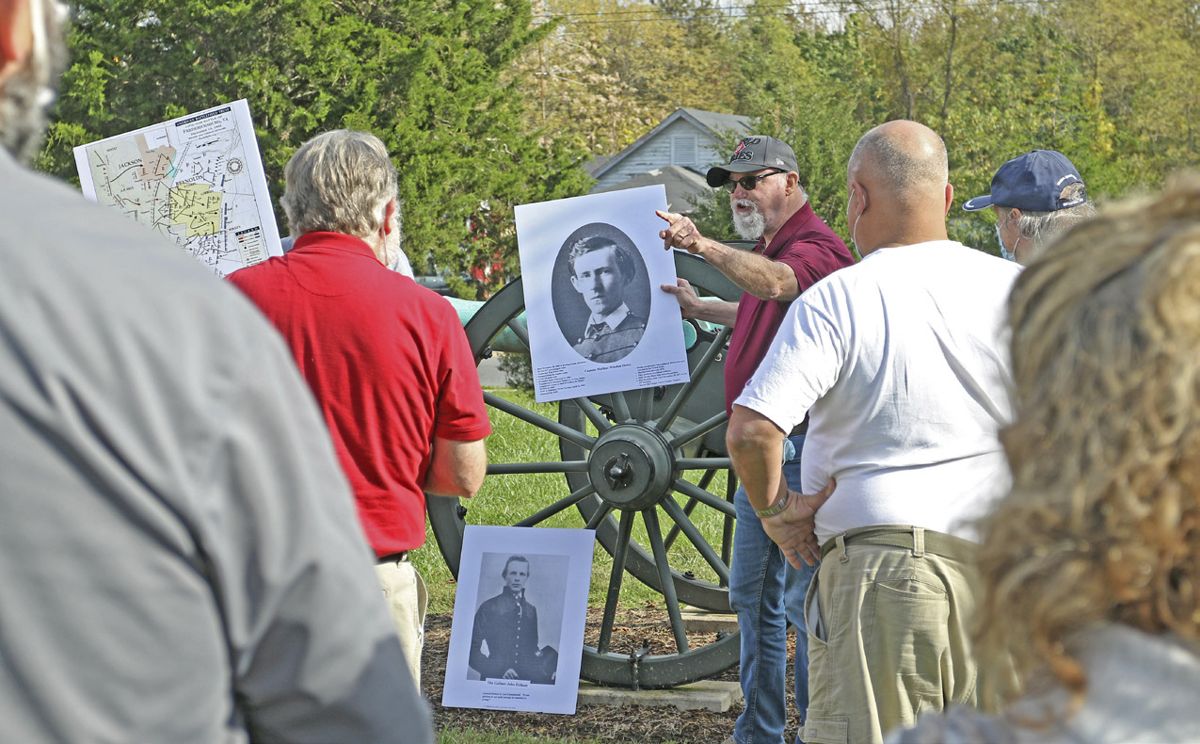
Before the Civil War, George Bayard escaped death twice as a member of the First United States Cavalry, fighting in the Indian Wars. First, he stared down an angry buffalo after his horse had fallen, unseated its rider, and ran off. The second event occurred in actual combat as Bayard was hit in the left cheek with an arrow.
General George D. Bayard. After a long recovery from the wound, Bayard returned to duty just as the Civil War began. He was struck by a Confederate shell at Fredericksburg December 13, 1862, and died the next day from the loss of blood, four days short of his twenty-seventh birthday. By then, he was a brigadier general leading his own brigade and was considered a rising star in the Union cavalry. Bayard’s ancestors reached back to the American Revolution and the family of President George Washington.
Some publications indicate that after Fredericksburg, Bayard was scheduled to marry Mary Ellen Bowman, daughter of Alexander Hamilton Bowman, the Superintendent at West Point during Bayard’s time there. Contradicting those accounts, other records show that Mary died in 1860, at age 18. The name of the general’s bride-to-be didn’t appear in his father’s book. Nor did the author or his team find a copy of the general’s death-bed letter to her. Research continues! In the buffalo incident, Bayard was part of a hunting party. A surviving buffalo seemed ready to charge the defenseless officer who had lost his weapons when his horse fell. For some reason, unknown to Bayard, the animal decided to retreat and allowed the young cavalry second lieutenant to rejoin his comrades. Bayard described the incident in a letter to his father, Samuel J. Bayard. On July 11, 1860, Bayard was hit by the arrow in a battle with Kiowa Indians at Black Water Creek in New Mexico’s Salt Desert. The action began after the Kiowa killed a local rancher. Bayard’s men then tracked down and killed Kiowa Chief Big Pawnee, provoking a KiowaComanche uprising. The First Cavalry was then charged with protecting settlers from Indian attack on the Santa Fe Trail. Surgeons were unable to remove the arrowhead and Bayard spent months in pain and constant bleeding that threatened his life. He returned to St. Louis for additional surgery and the arrowhead finally was extracted. More complicated surgery involving the carotid artery stopped the bleeding and saved his life. He was then assigned to West Point, where he had graduated in 1856, to recover. On March 16, 1861, he was promoted to first lieutenant of the Third Volunteer New York Infantry and on August 20, he was promoted to captain of the Fourth United States Cavalry. He then was granted a leave of absence to accept an appointment as colonel of the First Pennsylvania Volunteers, which led to his commission on August 27, 1861. After the regiment moved to Virginia on October 10, 1861, Bayard was slightly injured, and his horse killed in a skirmish with Confederate guerillas at Dranesville, Va., on November 27, 1861. Early in 1862, Bayard and his command were sent to the Shenandoah to assist in a campaign to drive Confederates from the Valley. Bayard was part of the force which killed Confederate cavalry chieftain Turner Ashby at Harrisonburg. He was with Union troops defeated at Cross Keys, the start of a Union retreat that allowed Major General Thomas (Stonewall) Jackson’s forces to join up with General Robert E. Lee just outside Richmond and foil capture of the Confederate capital. Union Major General George McClellan’s Army of the Potomac abandoned the Peninsula Campaign and withdrew to Fort Monroe, Va. At the same time, Major General John Pope’s new Army of Virginia began a march toward Richmond from the north. After leaving the Shenandoah Valley, Bayard was promoted to brigadier general and placed in command of cavalry in the Department of the Rappahannock. His brigade joined Pope in time for the Battle of Cedar Mountain. There, the Confederates began a string of Confederate victories that emboldened General Lee to expand the war north of the Potomac. After the battle at Cedar Mountain, Bayard was one of the Union officers who met with their Confederate adversaries under a flag of truce to collect the dead and wounded from each side. In doing so, Bayard ran into former West Point classmate, Confederate Major General James Ewell Brown Stuart. Both had served and had been wounded on the western frontier before the war. During their conversation, Bayard heard a Union soldier begging for water and asked Stuart to hold his horse’s bridle while he went to the man’s aid. Stuart quipped that it was the “first time he had played orderly to a Union Brigadier General.” The War moved on to Second Manassas and another Confederate victory before both armies crossed the Potomac into Maryland. Antietam was a bloody infantry fight, leaving the cavalry on both sides with responsibility to protect artillery and troop movements. Bayard’s Brigade was assigned to protect Washington City. After a lengthy delay in following Lee’s army into Virginia, President Lincoln replaced McClellan with Major General Ambrose Burnside in early November. The Union commander moved the army toward Fredericksburg, but delayed in crossing the Rappahannock River because pontoon bridges from a previous crossing of the Potomac River at Berlin, Maryland (today’s Brunswick), were late arriving in Fredericksburg.
Bayard’s Brigade was transferred to the command of Major General William. B. Franklin, part of the contingent charged with attacking Stonewall Jackson’s Corps south of town. Here. Major General George Meade’s forces at first broke the Confederate line on December 13 at what became known as the Slaughter Pen. A Confederate counterattack pushed the Union troops back toward Bowling Green Road to end the threat. Instrumental in the Confederate success was cannon fire from the lone remaining gun of a battery commanded by Major John Pelham. Pelham’s battery is generally credited with firing the shot that would end Bayard’s life. Bayard had gone to Franklin’s headquarters in the afternoon to discuss the battle situation when he was struck in the hip by shrapnel from a cannonball that hit a tree under which Bayard was standing. Surgeons warned Bayard that he likely would not survive amputation; the general died from a loss of blood about 24 hours later. Sustained by morphine to deaden the pain, he wrote his parents saying he was weakening and offered advice as to the distribution of his personal effects. Bayard’s father, Samuel Bayard, heard of the wounding and started toward Fredericksburg to bring his son home to Philadelphia. His son died before he arrived, but he accompanied the body to Princeton, New Jersey, for burial. Bayard had served with several other notable generals in the prewar campaigns who were killed in the Civil War, including Major General John Sedgwick and Brigadier General Nathaniel Lyon on the Union Side and Lieutenant General Jackson and Major General Stuart on the Confederate side
Much of the information for this article came from the 1878 book Life of George Dashiell Bayard, late Captain and Brigadier of Volunteers Killed in Battle of Fredericksburg, December 14, 1862, by Bayard’s father, Samuel Bayard. The book is out of print, but can be read on the Internet by searching for the general or the title. The story was augmented by Official Records.
Carl Sell is a frequent contributor to the Civil War News. His research team includes Genealogist Karen Connair and historians Ben Trittipoe and Don Hakenson. Carl can be reached at sellcarl@aol.com or 703-971-4716.