
The Unfinished Fight
Gen. George Thomas
By Craig L. Barry · Originally published August 2023 · pp. 10–11

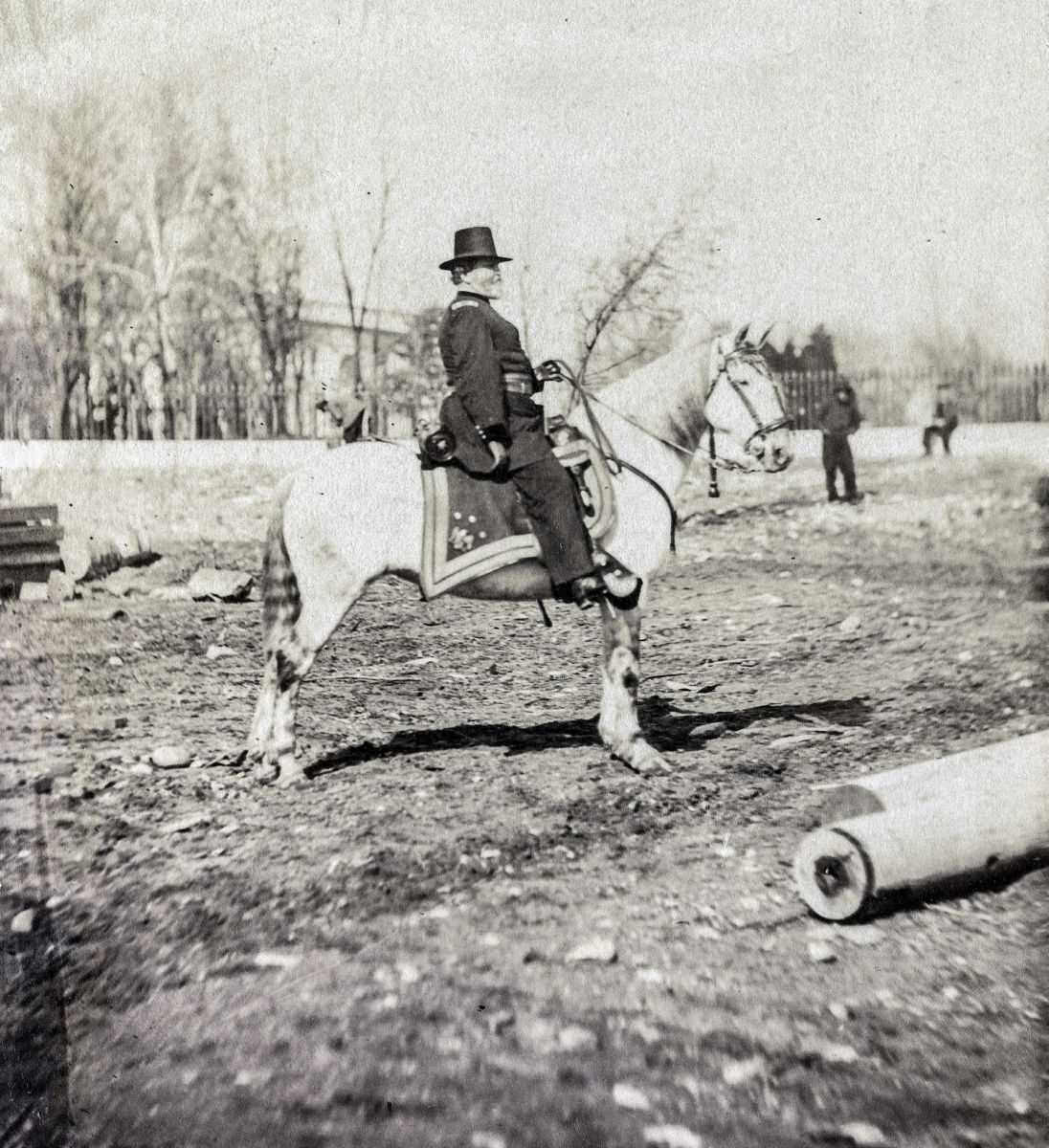
Gen. George Thomas In May 1865, after fighting in the Civil War had mostly ended, there was a parade in Washington, D.C., featuring all the Union heroes. Ulysses S Grant was there and so were George Meade and William T. Sherman. Missing however was George Thomas of the Army of the Cumberland. The so-called “Rock of Chickamauga,” who had also later demolished John Bell Hood’s forces near Nashville in 1864, Thomas as much as anyone, deserved to be there. George Thomas grew up in Tidewater Virginia on a plantation in Southampton County just above the North Carolina border. He went to West Point and graduated in 1840. His room mates were William T. Sherman and Stewart Van Vliet. His first assignment was with an artillery crew at Fort Lauderdale, during the 1840’s Seminole Wars. Just before the Mexican War in 1845, his troops were ordered to Texas. His artillery units served with distinction and Thomas received steady promotions during the Mexican War. In 1851, based partially on a recommendation from Braxton Bragg, he returned to West Point when Robert E. Lee was Superintendent at the Academy. Thomas was assigned as a cavalry and artillery instructor. The story goes that there was concern about the endurance capabilities of the Academy’s elderly horses. Thomas knew the tendency of cadets was to overwork the horses during cavalry drills. To prevent this he insisted on performing at a pace known as “the slow trot.” Hence, he became known by the unfortunate nickname ”Slow Trot Thomas.” Certainly not slow at everything, while at West Point, George Thomas met his future bride, Frances Kellogg from Troy, New York, and was married in 1852. In late 1860, Thomas requested a leave of absence from the from the Army. While traveling to Virginia, he fell off a train platform severely injuring his back. When the Civil War started, Thomas opted to remain with the United States Army. His wife being a New York native probably helped influence the decision. His wife Frances later noted that “whichever way he turned the matter over in his mind, his oath of allegiance to the Government always came uppermost.” In response, his family turned his picture against the wall, destroyed his letters, and never spoke to him again. While Thomas is often remained in the US military as well. Besides George Thomas the list includes Admiral David mentioned for being a Virginian who fought for the Union, there were other Southerners who
Farragut, Winfield Scott, John Gibbon, Edmund Davis, and William R Terrill. Nevertheless, when Thomas stayed in the Union Army his true loyalties were questioned and he was always regarded with some degree of suspicion. These concerns obviously proved baseless once the actual fighting got started. After the Battle of First Manassas, all of Thomas’s assignments were in the Western Theater. In January 1862 he defeated Crittenden and Zollicofer at Mill Springs in Eastern Kentucky. Though not a huge victory, it was an early Union success that turned Confederate forces back into Tennessee. Arriving after the fighting ended at Shiloh, Thomas successfully led forces at the Siege of Corinth. After Perryville, he was passed over for command in favor of Rosecrans. Although resentful, Thomas successfully held the center of Rosecrans forces at Stones River famously remarking “this army does not retreat.” Perhaps his greatest moment came at Chickamauga in September 1863. Thomas once again held a desperate position against General Bragg’s onslaught while the Union line on his right collapsed. Thomas rallied broken and scattered units together on Horseshoe Ridge to prevent a significant Union defeat from becoming a hopeless rout while Rosecrans retreated to Chattanooga. After the battle he became widely known by a new nickname: ”The Rock of Chickamauga,” for his determination to hold that vital position against continued attacks. After Chickamauga, Rosecrans was fired and Thomas appointed to command the Army of the Cumberland during the Battles for Chattanooga in November 1863. Missionary Ridge was a stunning Union victory highlighted by Thomas’s troops taking Lookout Mountain on the right and then storming the Confederate line on Missionary Ridge the next day. Assistant Secretary of War Charles A. Dana, an eyewitness, called the assault “one of the greatest miracles in military history…as awful as a visible interposition of God.” Grant for his part, perhaps relying on old grudges from many years past considered George Thomas a defensive general who was slow to attack. Author Bruce Catton noted that Thomas ”comes down in history…as the great defensive fighter, the man who could never be driven away but who was not much on the offensive. That may be a correct appraisal. Yet it may also be worth making note that just twice in all the war was a major Confederate army driven away from a prepared position in complete rout—at Chattanooga and at Nashville. Each time the blow that finally routed it was launched by (George) Thomas.” While strangely unappreciated in his time, George Thomas was always well prepared, and is now highly regarded among military historians for understanding the role of logistical support in achieving success on the battlefield.
Craig L. Barry was born in Charlottesville, Va. He holds his BA and Masters degrees from UNC (Charlotte). Craig served The Watchdog Civil War Quarterly as Associate Editor and Editor from 2003–2017. The Watchdog published books and columns on 19th-century material and donated all funds from publications to battlefield preservation. He is the author of several books including The Civil War Musket: A Handbook for Historical Accuracy (2006, 2011), The Unfinished Fight: Essays on Confederate Material Culture Vol. I and II (2012, 2013). He has also published four books in the Suppliers to the Confederacy series on English Arms & Accoutrements, Quartermaster stores and other European imports
![Battle of Mission [i.e., Missionary] Ridge, Nov. 25th, 1863, presented by McCormick Harvesting Machine Company. (Library of Congress)](/article-images/cwn-2023-august/cwn-2023-august-gen-george-thomas-05.jpg)